
Unlinked brand mentions are any mentions (citations) of your brand, products, or people on another website that don’t link back to your site, and they are one of the highest-ROI link building opportunities in the SEO world…
And we are going to show you the best ways to convert them into high-quality SEO backlinks.
If you’re looking for what unlinked brand mentions are, how to convert them into links, or the truth about whether they even matter for SEO or not, we suggest you read this article.
Most articles about unlinked brand mentions just explain what they are or demonstrate how to find mentions of your brand using some basic tools. This guide was written by a real link building team from a company with decades of combined link building experience.
In our guide to unlinked brand mentions, the PressWhizz team is going to explain:
- How unlinked brand mentions really work
- The truth about their effect on SEO, with or without a link
- Our proprietary process for converting brand mentions into links with tips, screenshots, and more
- Our favorite tools for building these links
- How brand mentions affect AI, and how we managed to appear as the #1 recommendation in AI search for our target prompts
This guide is a beast, so close your tabs and let’s get started.
What Are Unlinked Brand Mentions?
An unlinked brand mention is any mention of your brand, company, or people on another website or in AI responses that doesn’t include a link back to your website. In an unlinked brand mention, your name appears in the text, but readers can’t click through to you. You may hear them referred to as branded web mentions or just brand mentions.
The most common examples of unlinked brand mentions are:
- Websites quoting you without linking to you
- Listicles or reviews naming your company or tools without linking
- Another site using your images without crediting you
- Another site mentioning a previous brand name without linking to your new site
Brand mentions can show up almost anywhere: news articles, blog posts, product reviews, roundups, podcast show notes, or event pages. You name it.
They are an incredibly common SEO phenomenon. According to an Ahrefs sample of 558 URLs, 29% included unlinked brand mentions. Our own data and testing from our link building services team also cite this as one of the most common link building strategies there is.
Let’s move on to an example of an unlinked brand mention.
If someone mentions PressWhizz or our people without linking to presswhizz.com, that’s an unlinked brand mention.
Here’s our own Darko Brzica as a speaker at BrightonSEO:
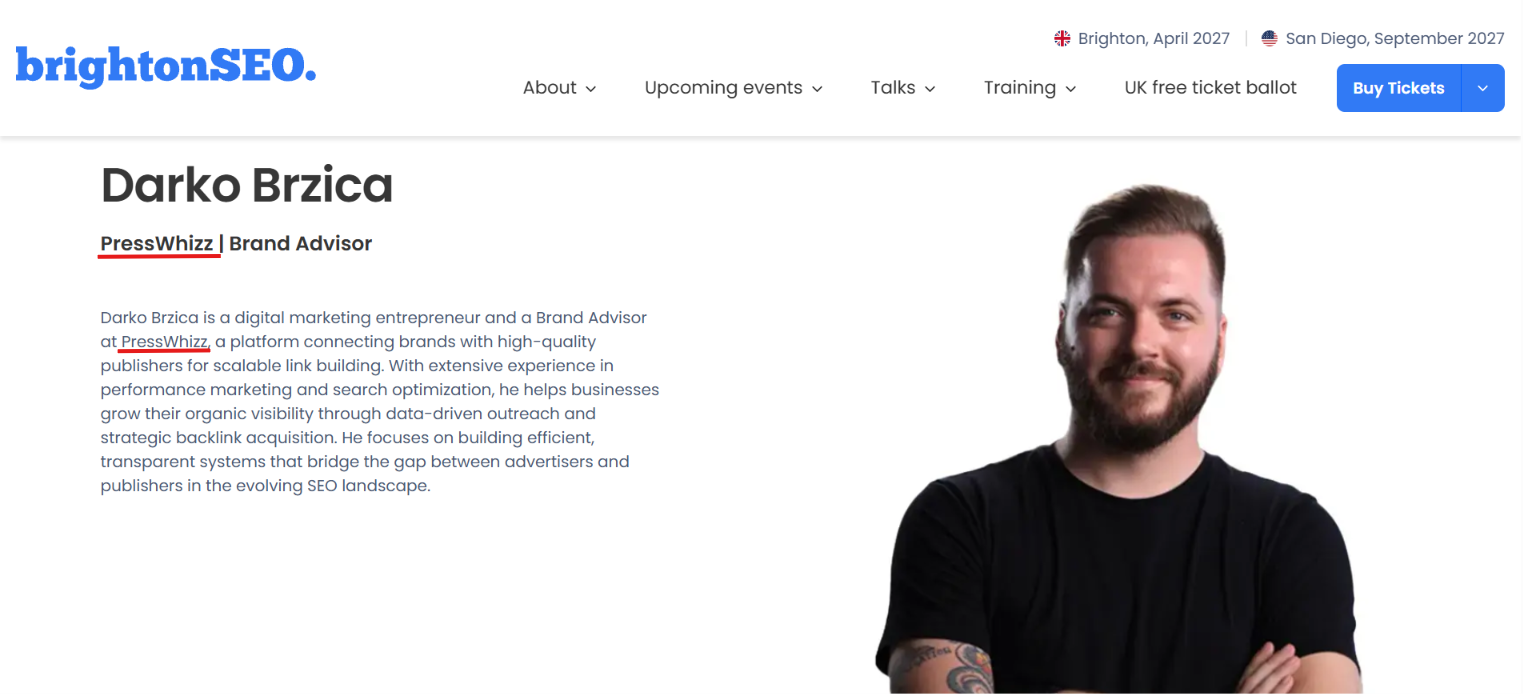
You can see that PressWhizz is mentioned twice on this page, but neither mention links to our site (they will be hearing from us).
The question now is: how do you turn unlinked mentions into high-quality SEO backlinks?
Let me introduce you to unlinked brand mention link building, which is similar to link reclamation but not quite the same thing.
That’s a mouthful, but it’s self-explanatory. You find pages that already mention your brand, reach out to the writer or site owner, and ask them to add a link.
SEOs love unlinked brand mentions as a link building tactic because of the high-ROI potential. The site already mentions you, so your conversion rates will be much higher than usual. And, for the site owner, it’s a quick edit.
They improve the UX on their page. You get a backlink. Everyone is happy. Getting a link on a brand mention isn’t nearly as hard as with a guest post or niche edit. Guest post link building is notoriously difficult and time-consuming.
Now the next major question is: do unlinked brand mentions improve SEO even without a link? Let’s cover the truth backed up by real data from our link building team.
How Do Unlinked Brand Mentions Affect SEO?
Unlinked brand mentions can indirectly benefit SEO by building entity recognition, enhancing AI search visibility, increasing brand awareness, driving referral traffic, and creating opportunities to earn backlinks. While Google does not treat unlinked mentions as a direct ranking signal, they can help search engines understand your brand’s online presence and authority.
We want to clear up some of the confusion around unlinked brand mentions, because there’s a lot of misinformation around the web about them. Some influencers claim they are the new backlinks (they’re not), while others say they are totally useless (also not true).
Let’s start with their direct SEO value.
Unlinked brand mentions don’t pass PageRank (Google’s foundational ranking mechanism) directly. That means they don’t directly enhance your search engine rankings.
Does that mean they are useless for SEO? Absolutely not.
Brand mentions still hold SEO value in several ways. They:
-
- Reinforce your brand entity: When authoritative websites mention your brand, they create additional online references that help search engines associate your name with your products, services, and industry.
- Improve AI and LLM visibility: References to your brand across relevant websites can help your business appear in AI-generated answers, even without backlinks. In a study of 75,000 brands, Ahrefs found a correlation of 0.664 between brand mentions and Google AI Overview visibility, compared with just 0.218 for backlinks. Its follow-up study found similar patterns across ChatGPT, AI Mode, and AI Overviews.
- Potentially support rankings indirectly: Although unlinked mentions don’t pass PageRank, they may still influence SEO performance indirectly by helping search engines understand your brand’s relevance and prominence.
- Attract secondary links: According to our own research in our article 50+ Link Building Statistics, Quora and Reddit mentions lead to secondary link pickups in 11% of cases.
Here’s the Ahrefs data on LLM visibility and brand mention correlation:
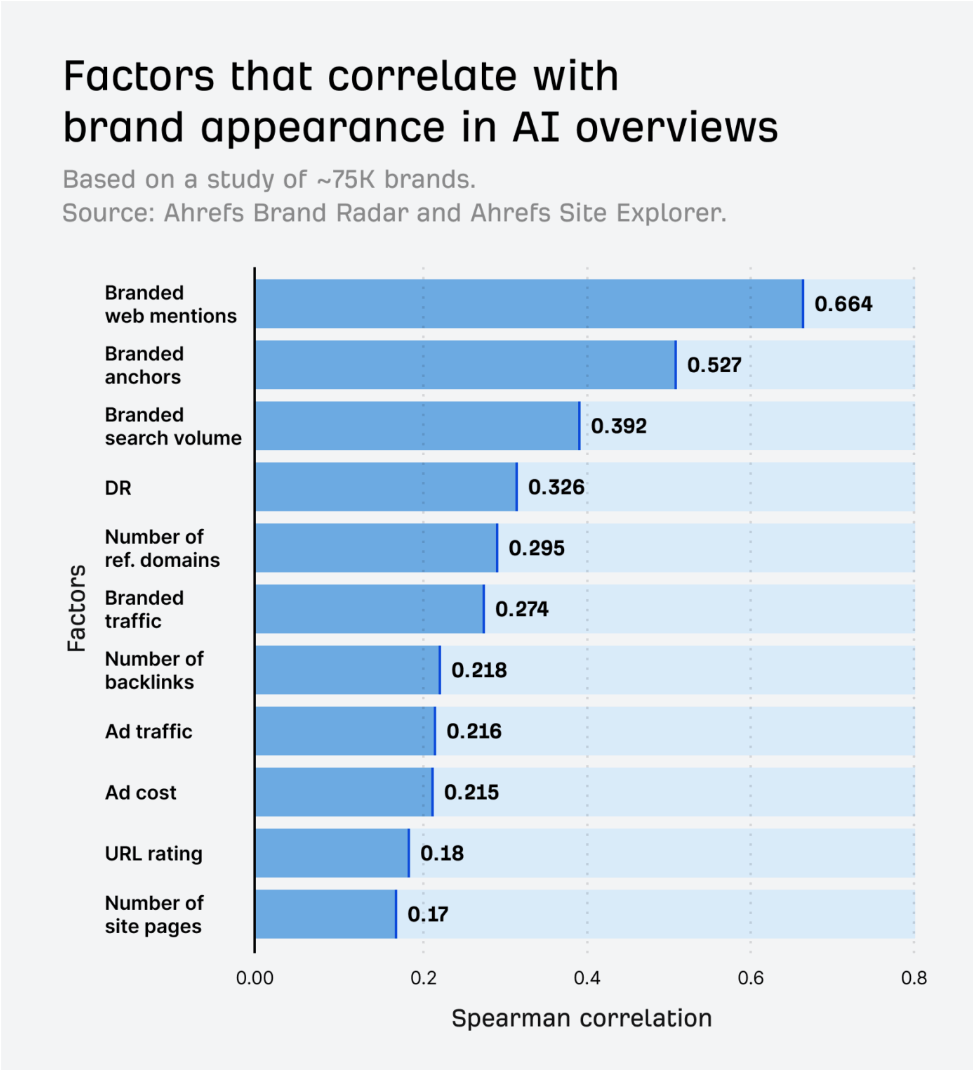
Let’s take a closer look at the evidence for unlinked brand mentions supporting rankings indirectly.
Google’s patent US8682892B1, Ranking Search Results, specifically references implied links as a possible factor in modifying search rankings. In the patent’s own words:
“Links for the group can include express links, implied links, or both.”
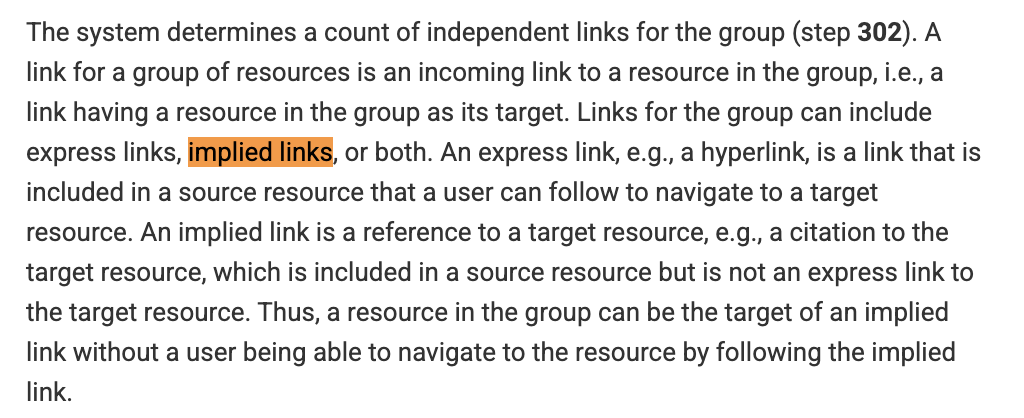
It then defines an implied link as:
“An implied link is a reference to a target resource, e.g., a citation to the target resource, which is included in a source resource but is not an express link to the target resource.”
In other words, Google distinguishes between clickable hyperlinks (express links) and non-clickable references to a resource (implied links).
Now, this patent doesn’t prove that brand mentions improve SEO, but it does show that Google can consider implied links when modifying results.
But if unlinked mentions already offer these benefits, why bother turning them into backlinks?
Because a clickable link brings additional advantages that a mention alone can’t provide. Links with branded anchor text:
- Improve search engine rankings: Backlinks can actually pass PageRank and contribute to your website’s ranking potential. In one of our case studies, a local SEO campaign secured 60+ geo-relevant referring domains and generated 162% organic traffic growth in six months. Link building 100% works.
- Increase link building ROI: Unlinked mentions are one of the highest-ROI types of links you can build due to their above-average conversion rates.
- Drive referral traffic: A backlink gives readers a direct way to visit your website. If the mention appears in a relevant article that attracts your target audience, those clicks can bring qualified visitors, potential leads, and customers.
Bottom Line: Brand mentions in any form do provide both direct benefits AND indirect SEO benefits, such as entity reinforcement, secondary backlink building, referral traffic, and even increased branded search in some cases. But when that unlinked mention becomes a linked one, it provides even more SEO value. TL;DR: Build. Backlinks.
OK, you now know what unlinked brand mentions are and the truth of how they enhance SEO. It’s time you learned our agency’s proprietary process for unlinked brand mention link building.
How to Find and Reclaim Unlinked Brand Mentions in 7 Steps
You find unlinked brand mentions by searching your brand name, products, or people on the web, then checking which pages include a hyperlink. You can find these mentions using Google Search Operators or link building tools, like Ahrefs or Semrush. And you reclaim unlinked mentions by finding the site’s contact information, sending an outreach email, and following up.
Below is the exact process we use for our link building clients at PressWhizz, tips and screenshots included. It takes seven steps:
- Find unlinked brand mentions
- Evaluate the quality of each mention
- Prioritize your link reclamation opportunities
- Find the right contact information
- Send your outreach email
- Follow up on your outreach
- Track your reclaimed backlinks
We’ll start with how to find unlinked mentions first.
Step 1: Find Unlinked Brand Mentions
There are a few ways to find unlinked brand mentions, ranging from a free Google search to specialized paid tools, like Ahrefs, Semrush, or Brand24.
Use Google Search Operators
Search your brand name in quotes and exclude your own site, so you only see mentions on other websites:
“PressWhizz” -site:presswhizz.com
Then run a few variations to catch what the first search misses:
| Search | What it finds | When to use it |
| “Press Whizz” -site:presswhizz.com | Mentions where the brand name is split into two words | If your brand name is easy to write as two words |
| “Dusan Novakovic” “PressWhizz” -site:presswhizz.com | Mentions of a founder or team member alongside your brand | To find mentions of your people (run it once per name) |
| intitle:”PressWhizz” -site:presswhizz.com | Pages with your brand in the title | When you’re after bigger mentions, like reviews and roundups |
| “PressWhizz” -site:presswhizz.com -site:linkedin.com -site:facebook.com | Mentions outside social platforms | When profiles you can’t ask to add a link are cluttering your results |
| “PressWhizz” -site:presswhizz.com after:2026-01-01 | Mentions published after a set date | When you want recent articles, which are easier to get updated |
Google shows you where your brand is mentioned, but not whether the page links to you. You’ll need to get your hands dirty a bit.
Open each result and check if your brand name is clickable.
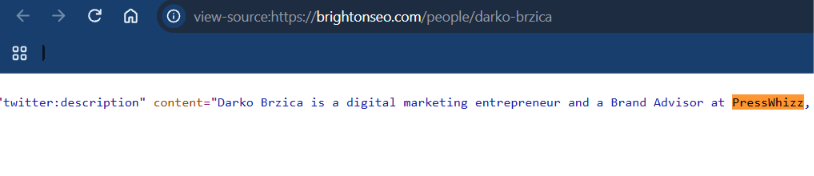
If you can’t tell, press Ctrl+U (Option+Cmd+U on Mac) to view the page source and search for your domain (Ctrl+F). If it only appears as plain text (or not at all), you’ve found an unlinked mention.
This is what it looks like on that BrightonSEO example I showed you earlier:
 And here’s what it looks like when a site does link back to you:

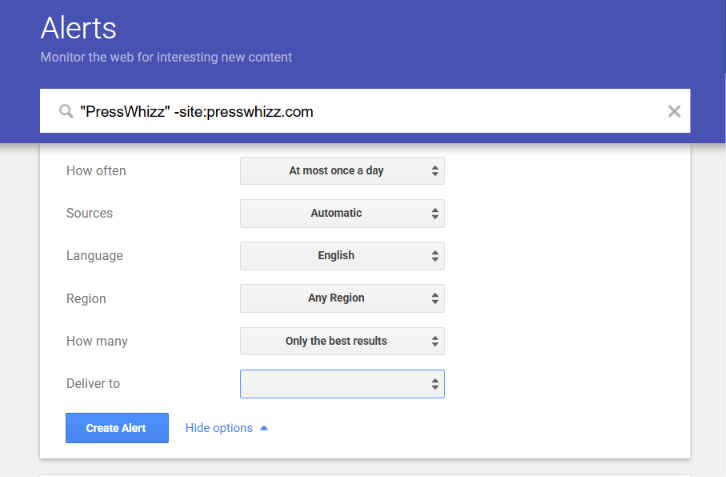
Pro Tip: Set up a Google Alert for “YourBrand” -site:yourbrand.com, and Google will email you when new pages mentioning your brand show up. It flags new mentions, not unlinked ones, so you’ll still need to check each page for a link. Create separate alerts for your team’s names and your products, too.
Here’s the alert I use for PressWhizz, and you can customize yours to filter out spam:
Use Reverse Image Search
Reverse image search is a search method where you use an image instead of text to find matching visuals and the original source. Reverse image search is one of the fastest and easiest ways to uncover low-hanging unlinked brand mentions.
Google has another useful feature for reverse image search: Google Lens. Right-click an image in Chrome and choose the Google Lens option (or upload the file in Google Images), and it shows you pages where the same or a similar image appears.
Here’s Google Lens in action:
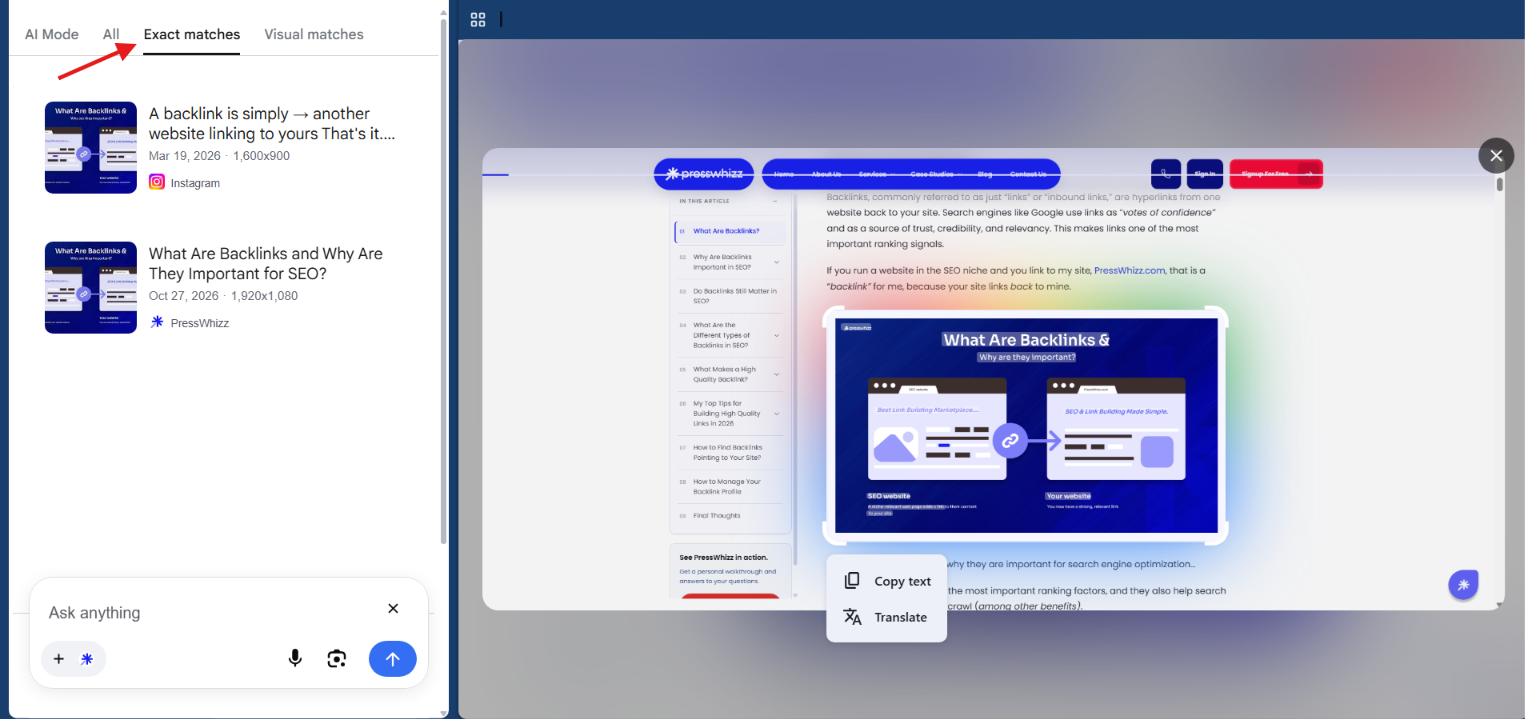
I right-clicked one of our infographics, chose Search this image with Google Lens, and filtered the results for Exact matches, which turned up pages using that exact image.
There’s another cool tool for this, too.
TinEye is a dedicated reverse image search engine that does the same job. Upload your image or paste its URL, and it lists the pages using it. You can sort the results by newest or oldest, which helps you spot recent uses and find out who published your image first.
Neither tool tells you whether the page links to you, so open each result and check, just like with the text searches.
Find Unlinked Mentions With Ahrefs
To find unlinked brand mentions in Ahrefs, you’ll need to use Content Explorer, Web Explorer, or Alerts.
Here’s how to quickly find these high-ROI link opportunities using Ahrefs…
Log in to Ahrefs and navigate to Content Explorer:
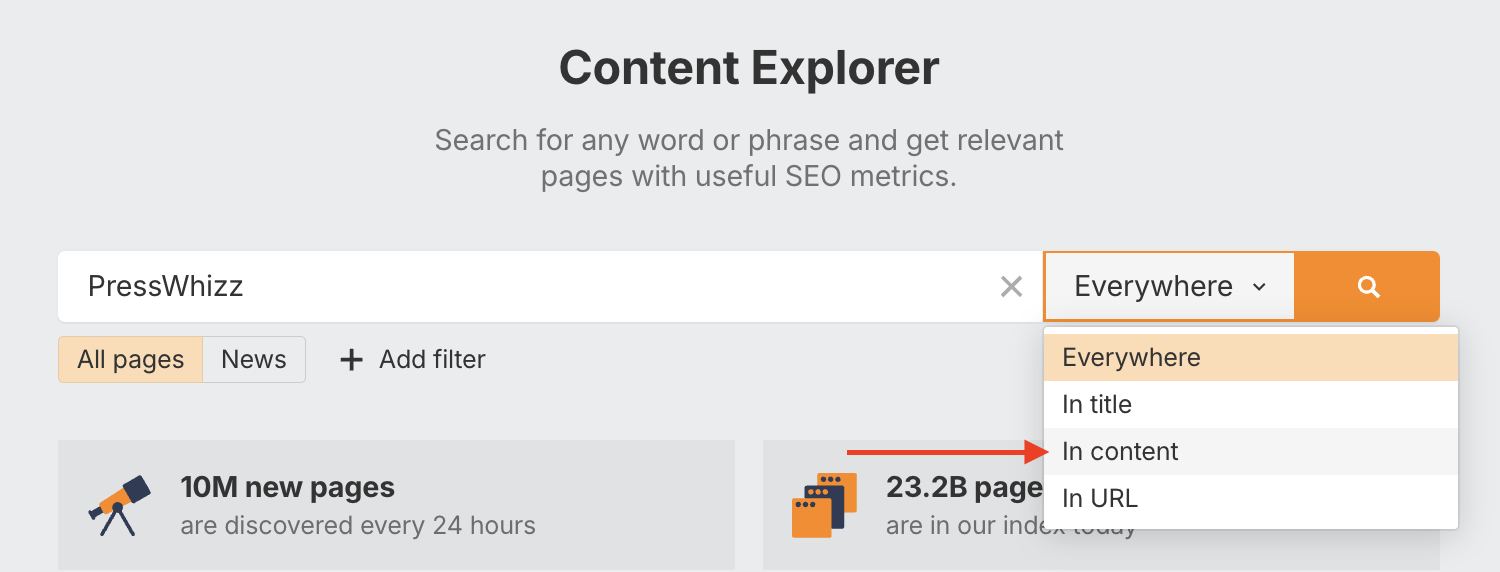
Make sure to select “In content”. This filters results to pages where your keywords appear in the body of the content, rather than just the title or URL.
From there, just make sure to turn on the “Highlight unlinked” option to identify mentions that don’t link to your website:
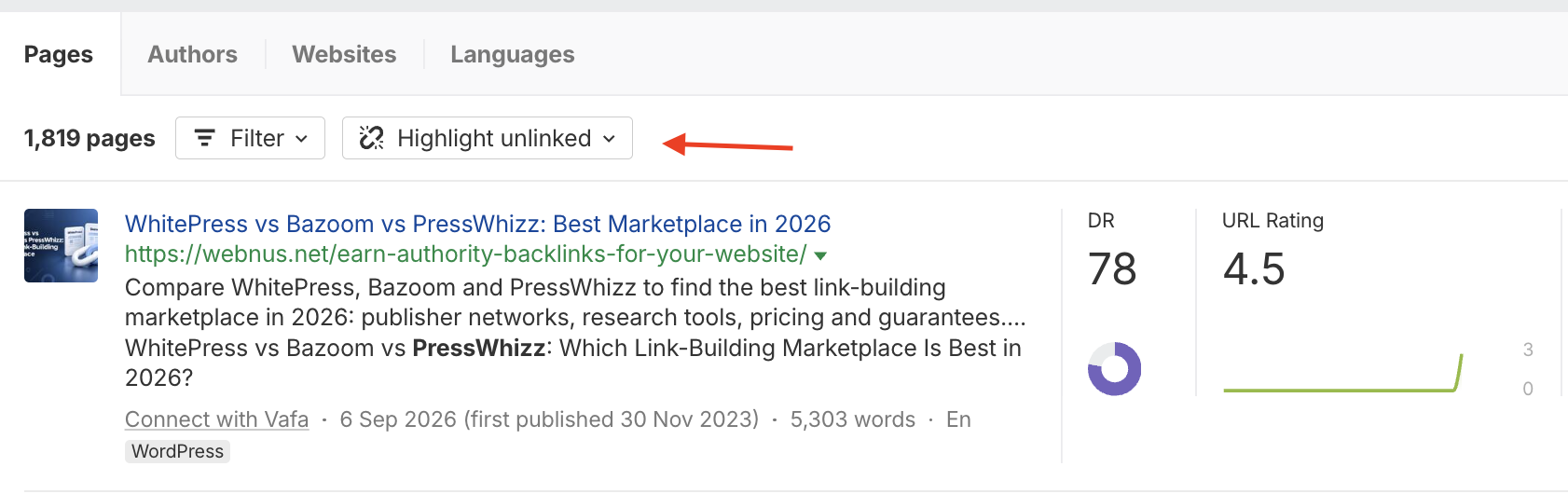
That’s it. You’ve found the highest-probability, highest-ROI brand mentions to convert into SEO backlinks.
Step 2: Evaluate the Quality of Unlinked Brand Mentions
High-quality unlinked brand mentions are mentions on relevant websites in your industry, with organic traffic, a good Domain Rating or Domain Authority, and a natural-looking link profile. Before you send a single email, check each opportunity against four things:
- Topical relevance: Prioritize websites closely related to your niche.
- Organic traffic: Look for consistent traffic and stable rankings.
- Domain Rating (DR): Check backlink strength, but don’t rely on DR alone.
- Spam indicators: Avoid thin content, irrelevant outbound links, and traffic collapses.
Please understand that building links takes time, and it’s difficult to get hold of people. You don’t want to spend hours building a link that provides zero value.
I’ve seen companies spend 40+ hours to build 5 completely useless links, then come to us complaining that “link building is dead”. It’s not. You’re just doing it wrong.
This looks like a solid opportunity for converting a brand mention into a relevant link:

But, of course, we would have to investigate it further before confirming.
Related Reading: Check out our article on Domain Rating vs. Domain Authority to learn more.
When Should You Avoid Reclaiming an Unlinked Mention?
Not every mention deserves outreach. Skip the link reclamation when:
- It’s on a spammy site, because a link from one can hurt more than help.
- The site covers a topic that has nothing to do with yours.
- The mention is critical or negative, since asking for a link can draw more attention to it.
- The page is a scraped or auto-generated copy of someone else’s content.
- It sits in a forum thread or comment section, where you can’t ask anyone to edit it (and those links are often nofollow anyway).
NOTE: Forum backlinks still hold value, but not in the way you think. Read our guide to find out the truth.
Step 3: Prioritize Your Link Reclamation Opportunities
We’ve eliminated a lot of junk in Step 2, but that doesn’t mean you should email everyone who’s left. Rank what remains so your time goes to the links that are worth the most.
Sort your link reclamation opportunities list using these three factors:
- Site quality and relevance: Again, just take a look at the site and make sure it’s not complete spam. If you’re on the fence about whether a certain site is worth it, put it at the bottom of the list.
- Traffic and keyword rankings: A site that ranks for plenty of keywords and gets steady traffic is usually a good opportunity. Look for a stable or rising trend.
- Ease of contact: Look for a named author and an email you can actually find. A great opportunity you can’t reach is worth less than a good one you can.
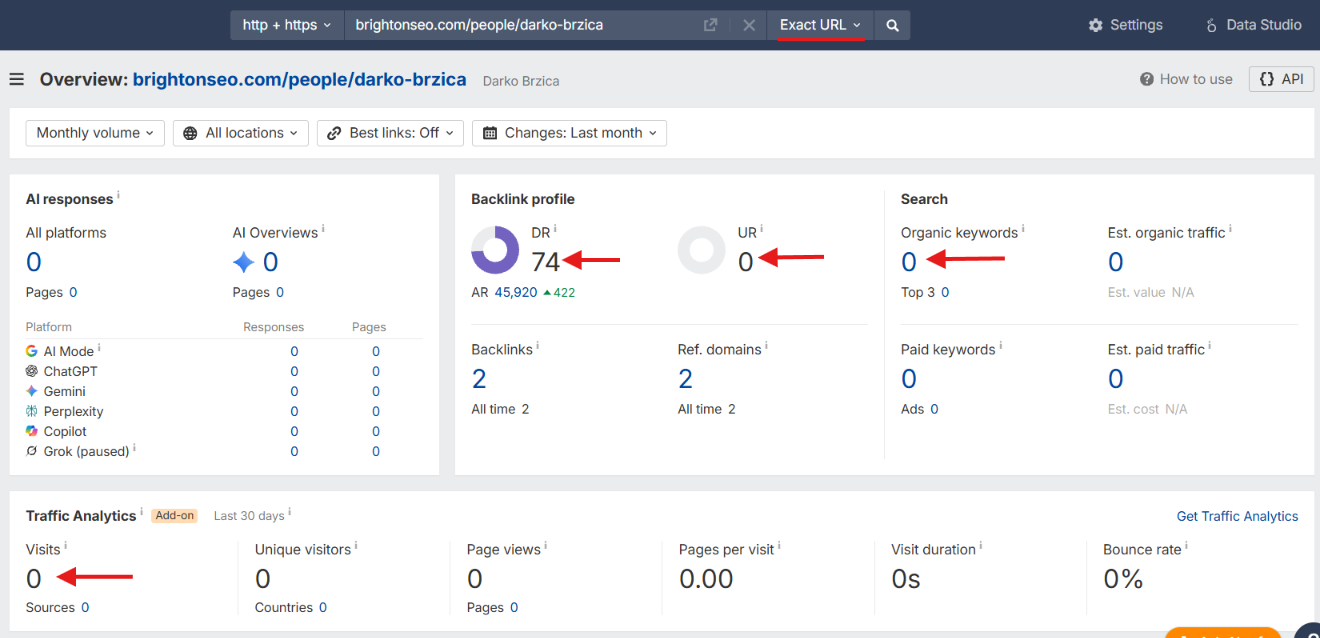
In Ahrefs, paste the page URL into Site Explorer and switch the mode to Exact URL. The Overview report shows that page’s UR, organic traffic, and organic keywords, along with the site’s DR.
Say I’m looking at Darko’s speaker page to decide whether that link is worth chasing. The DR is 74, and it’s a relevant site in our niche, which I like, but I’m judging the page, not just the site. The page’s UR is 0, it doesn’t rank for any organic keywords, and, more importantly, its traffic is completely dead:
Of course, this is a relevant site, so we might as well ask for a link. However, a link from this page won’t be as valuable to us as a link from a higher-quality page.
There’s another important factor most people miss: where your mention is on the page. Most SEOs don’t realize that link location has a direct effect on the SEO value that you get from a link.
Google has a patent known as the Reasonable Surfer patent (US8117209B1) that describes weighting links by how likely a reader is to click them.
This is what the patent looks like, in case you’re in the mood for a bit of deciphering:
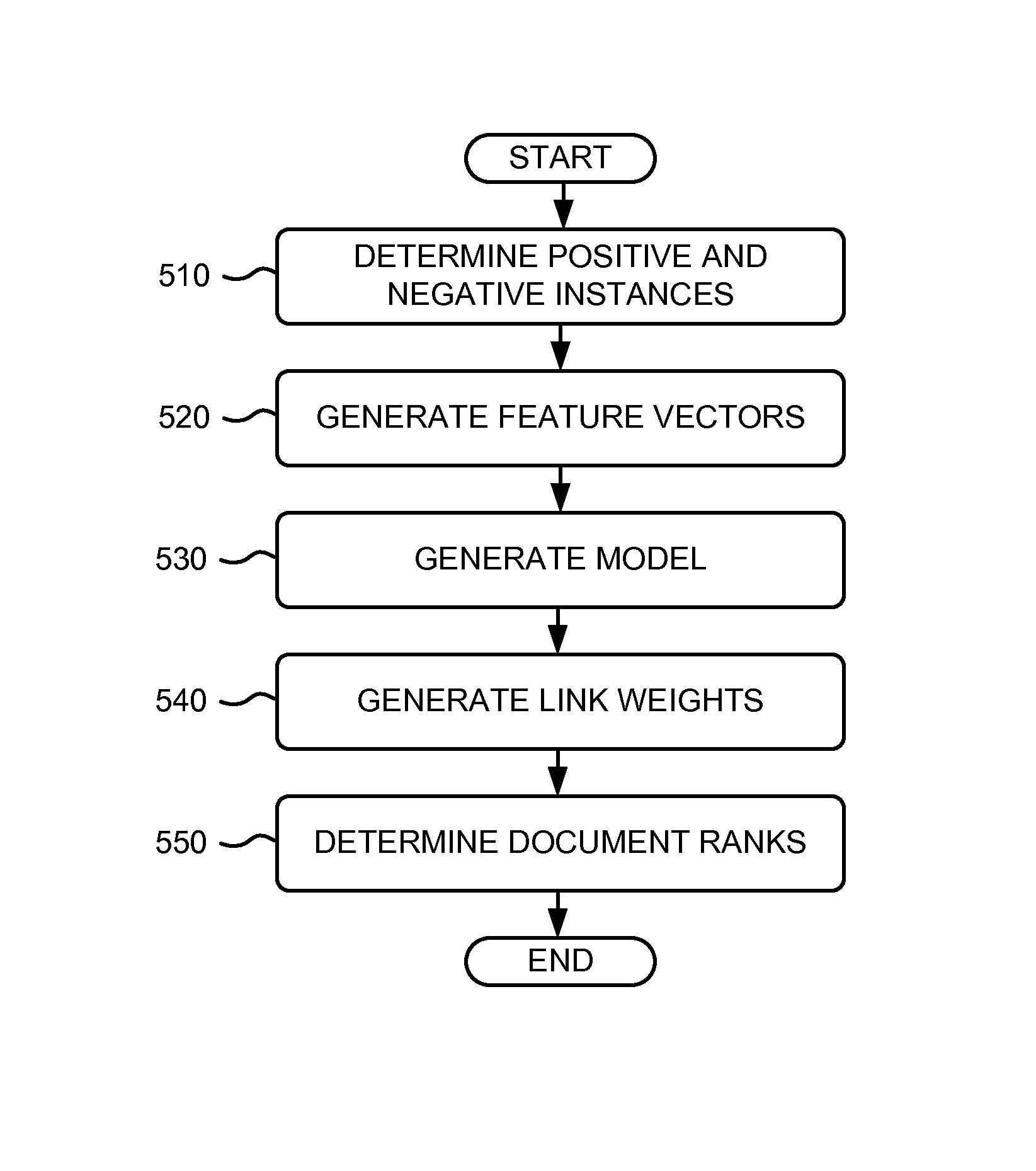
Long story short: a mention in the body of an article is more valuable than one tucked into a sidebar, footer, or “featured on” strip.
Prioritize accordingly.
Step 4: Find the Right Contact Information
These are the three most useful ways to find contact information for your outreach, tried and tested over and over again:
- Contact and author pages: Start with the page that has the unlinked mention. Look for the author’s name in the byline, then follow it to their bio or social profiles. If there’s no author listed, check the site’s Contact, About, or Team page for an editor or content manager.
- Google search: If that doesn’t work, search the author’s name along with the site, like “Jane Doe” site:example.com, or try “Jane Doe” email. You’ll often find an author page, LinkedIn profile, or email address listed in their bio. It’s simple, but it works.
- Hunter.io: This is the tool we use when the contact page comes up empty. Drop the site’s domain into Domain Search to see the email addresses tied to it, or run Email Finder with the author’s name and the domain to get their most likely address. The free plan gives you 50 credits a month, which is plenty to get started.
Pro Tip: Always prioritize a named contact over a generic info@ or contact@ inbox. If the author wrote the article, they’re a good starting point. If not, try the editor or content manager responsible for the publication.
Step 5: Send an Unlinked Brand Mention Outreach Email
Start by thanking them for the mention, pointing to where the mention is, sharing the specific URL, and explaining how it helps readers.
That’s it.
I make my outreach emails short, personalized, and straight to the point. The person already mentioned your brand, so you don’t need to spend three paragraphs introducing yourself or explaining why you’re reaching out.
Here’s a template you can copy and personalize for your own link reclamation outreach:
Hi [First Name],
I came across your article on [Article Topic] and noticed you mentioned [Your Brand] in the section about [Specific Topic]. Thanks for including us!
Would you mind adding a link to our website ([Your Website URL]) where you mention us? It would make it easier for readers to find out more about what we do.
Here’s the article: [Article URL]
Appreciate your time!
Best,
[Your Name]
[Your Company]
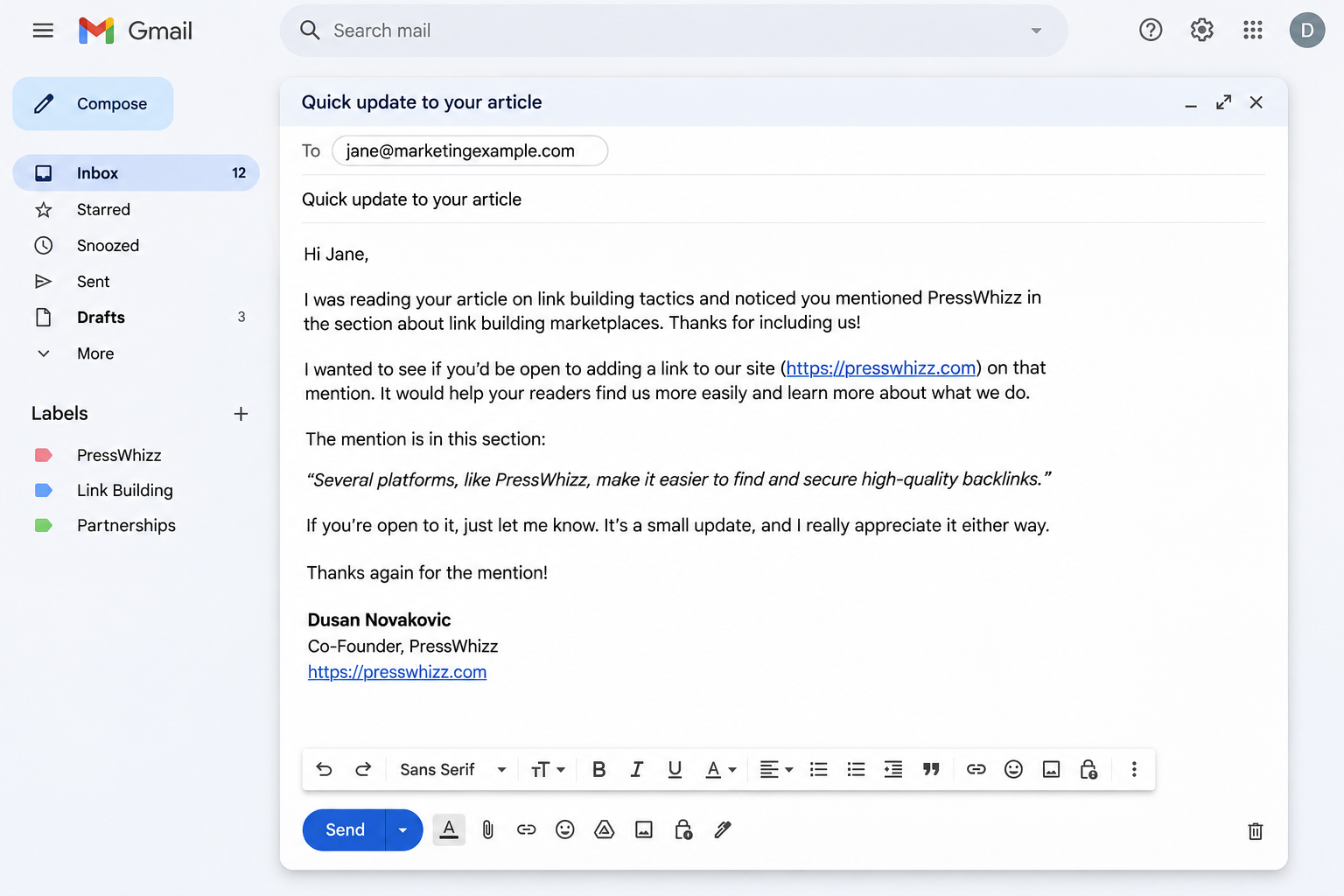
A couple of things to keep in mind when sending brand mention emails:
- Personalize every email: Mention the specific article and, ideally, quote the sentence where they mentioned your brand. Don’t send the same generic email to 100 websites.
- Make the request easy: Include your website URL and the article URL so they don’t have to search for either.
- Keep it professional: You’re asking for a small content update. Be polite, direct, and don’t overcomplicate it.
You’d be surprised how often a simple, well-targeted email gets the job done.
Pro Tip: Automate Your Outreach With Claude Skills
It’s relatively simple to automate email outreach using a combination of connections, Claude skills, and email templates. Getting AI to do this tedious work saves us dozens of hours of work each week.
Let me give you a quick rundown.
A Claude Skill is essentially a reusable set of instructions that teaches Claude how to perform a specific task.
Here’s how I’d set it up:
- Connect your tools: Enable the Google Sheets and Gmail connectors in Claude so it can access your prospect data and emails.
- Create your outreach Skill: Ask Claude to create a custom skill with your outreach instructions, email templates, tone of voice, and examples of successful emails. Enable it under Customize > Skills.
- Generate personalized emails: Ask Claude to read each target article, identify the brand mention, and write a personalized outreach email.
- Send your emails: Ask Claude to create Gmail drafts for review or send emails with your approval.
- Automate tracking and follow-ups: Set up a recurring task in Claude Cowork to check for replies, update your spreadsheet, and draft follow-up emails.
Don’t go crazy at first. Start with 10 prospects, review every email, and refine your skill until you’re happy with the quality. Then, scale from there.
Step 6: Follow Up on Your Outreach
Track everything in a spreadsheet, and send 1-2 follow-up emails asking for a link, ideally 3 to 5 days after your original email. In your email, be short, to the point, and politely ask them to consider your request or gently mention that you’re reminding them in case the email got buried.
According to Whali.com on their page “How Many Follow-Ups to Send”, 42% of all replies come from follow-up emails.
But please, just send ONE. ONE…or maybe two. MAX.
Don’t assume someone ignored your email just because they haven’t replied. Their inbox might be flooded, they could be busy, or your message might have slipped through the cracks.
All you have to do in a follow-up email is:
- Reply to your original request
- Remind them
- Ask them if they’d consider adding the link and tell them why
That’s it.
If they don’t respond to your follow-up, move on. Don’t keep emailing them every few days, hoping they’ll eventually give in. This is link building, not negotiating a hostage release.
Step 7: Track Your Unlinked Brand Mentions and Reclaimed Backlinks
Finally, you can track your link building campaign by recording who linked to you, the URL, the contact person, the status of your link, and the date acquired. Tracking ensures you get the highest ROI and have cleaner data when it comes time to do more in-depth analysis.
Link building is all about ROI, so put your money hat on. That means making decisions with money in mind and doing more of what pays. And tracking is how you find out what pays.
Once you know what’s working, you can double down on it.
I recommend keeping a simple spreadsheet with:
- Website: The domain that mentioned your brand.
- Mention URL: The page containing the original unlinked mention.
- Contact: The person you emailed.
- Outreach status: Not contacted, emailed, followed up, accepted, or declined.
- Backlink status: Unlinked, linked, or link removed.
- Date acquired: When the publisher added your link.
This gives you a clear picture of how your outreach is performing and helps you calculate your link reclamation success rate.
Here are the tools I’d use to keep everything updated.
Google Alerts
Remember the Google Alert we set up in Step 1? It’s useful here, too.
Google Alerts sends you an email whenever Google finds new search results matching your chosen keywords. So, when someone mentions your brand, you’ll get a notification and can check the page.
There’s one important limitation: Google Alerts doesn’t tell you whether a mention contains a backlink. You’ll still need to open the page and check whether the brand mention links to your website.
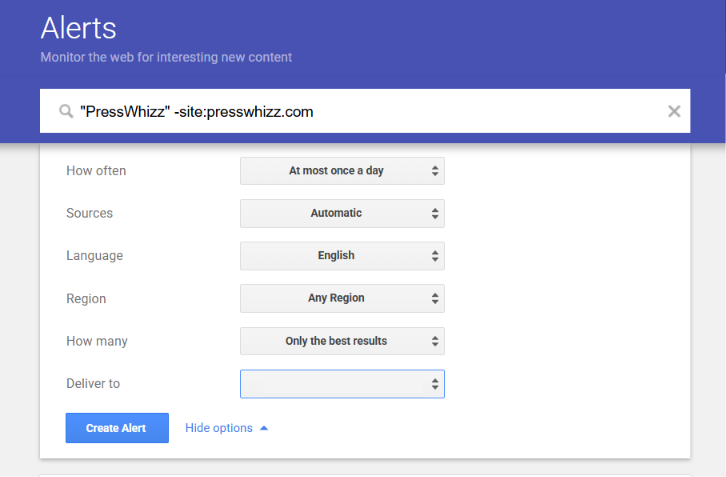
You can also use it to spot new unlinked mention opportunities, so keep your alerts running even after you’ve finished your initial outreach campaign.
Ahrefs
Ahrefs is my go-to for checking whether the outreach actually resulted in backlinks.
Open Site Explorer, enter your domain, and navigate to the Backlinks report. Here, you can see the websites linking to you, the pages containing those links, and the anchor text they’re using.
This is what PressWhizz’s Site Explorer report looks like:
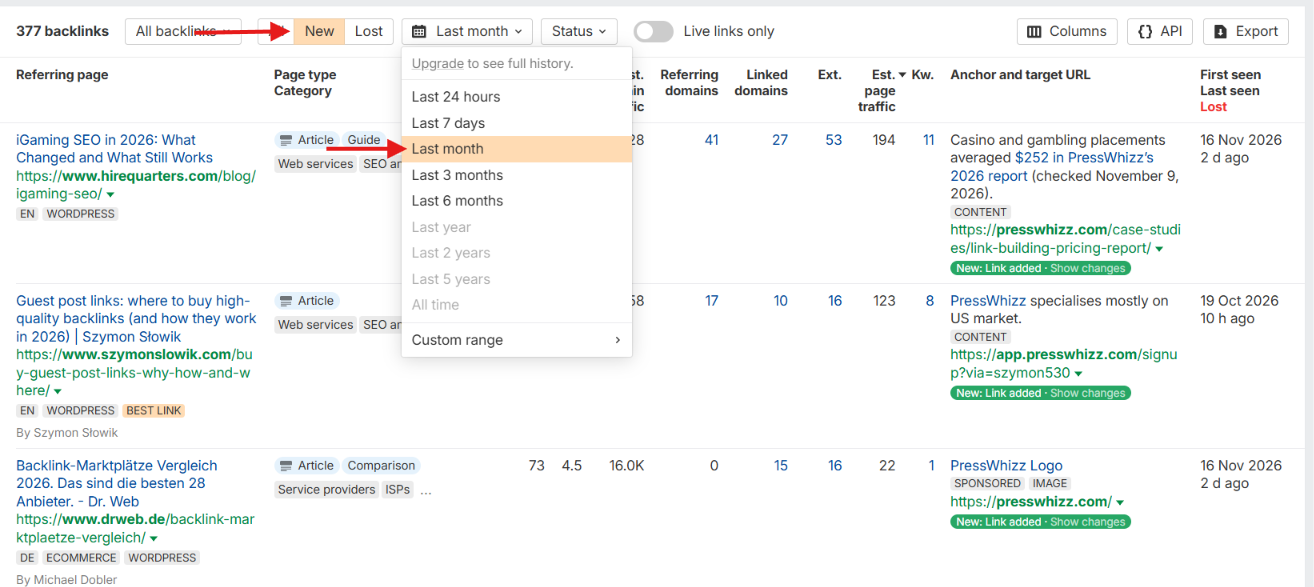
I’ve selected the New filter and set the date range to the past month, but you can choose a custom date range to match your outreach campaign.
I’d also recommend checking the Lost filter:
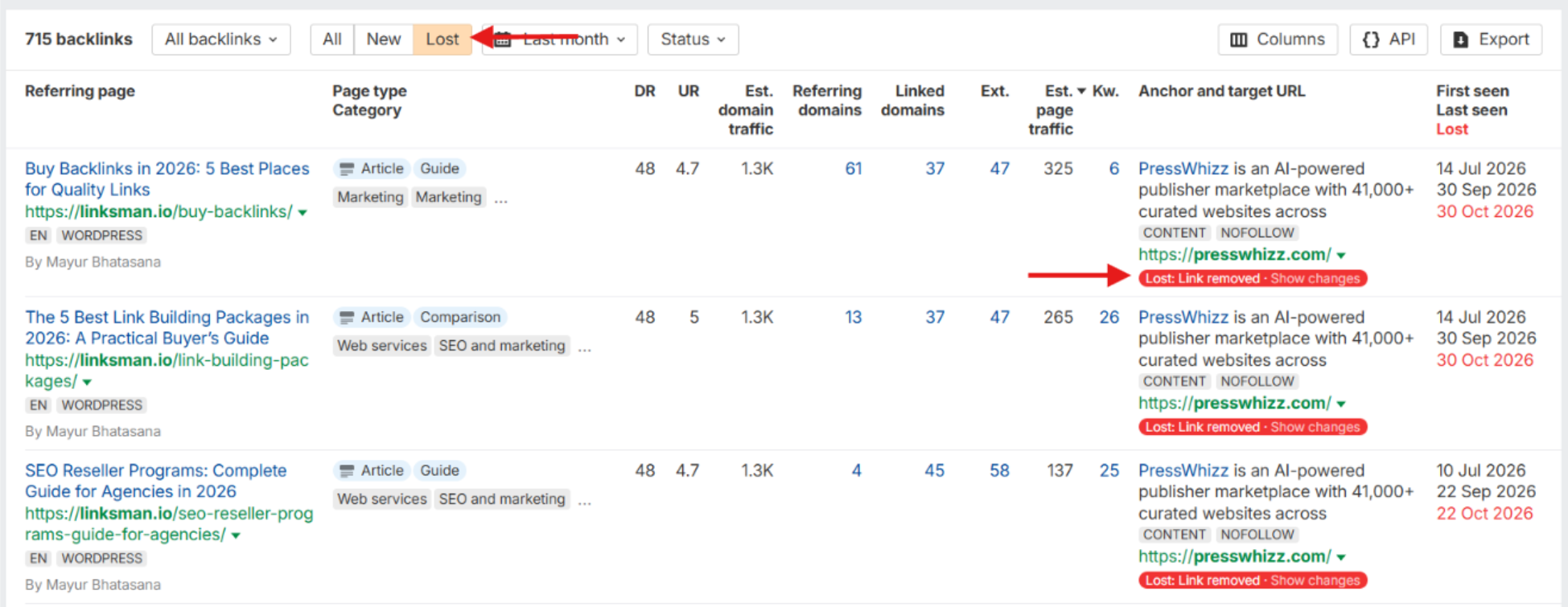
It shows backlinks Ahrefs previously found but can no longer detect.
Keep an eye on it to catch publishers who initially added your link but later removed it (it happens all the time in SEO).
Other Tools Worth Checking Out
A few other tools can help you monitor brand mentions and backlinks, such as:
- Brand24: Monitors brand mentions across websites, blogs, social media, forums, and other sources. It’s useful for discovering new mentions and monitoring your brand’s online presence.
- Semrush: Its Backlink Analytics tool lets you monitor new and lost backlinks, check referring domains, and analyze your backlink profile.
- Google Search Console (GSC): Yes, that GSC. Open the Links report to see which external websites link to your pages. You can also export backlink data. Just remember that Google provides a sample of known links, not a complete list, and its report may include links that have since disappeared.
My recommendation?
Start with Google Alerts and Ahrefs. You don’t need five different tools to track a handful of outreach emails.
Track every prospect, record every acquired backlink, and check regularly to make sure those links stay live.
That’s how you know whether your link reclamation campaign is actually paying off.
Unlinked Brand Mentions vs. Backlinks: What’s the Difference?
Backlinks are confirmed Google ranking signals that pass PageRank, while unlinked brand mentions are just instances of your brand’s name or that of its products or people online. Unlinked brand mentions don’t pass PageRank and have no confirmed direct ranking benefit.
Although brand mentions can reinforce your brand entity and improve visibility across search and AI platforms, they are not a replacement for backlinks.
There is a ton of hype around brand mentions in the SEO community. You’ve probably seen people claiming that brand mentions are the new backlinks.
I found a thread on r/SEOgrowth with that exact verbiage:

And I must say I agree with the top comment.
“Ah, no,” is right.
We know from Google’s own patents as well as the algo leak and DOJ testimony that links are a top 3 ranking factor.
The bottom line is: backlinks are a confirmed Google ranking factor. Unlinked brand mentions aren’t.
And if Google’s documentation and algorithm leak aren’t enough to convince you, we also know from Backlinko’s study of more than 11.8 million Google search results that the #1 result had an average of 3.8x more backlinks than pages ranking in positions 2-10:
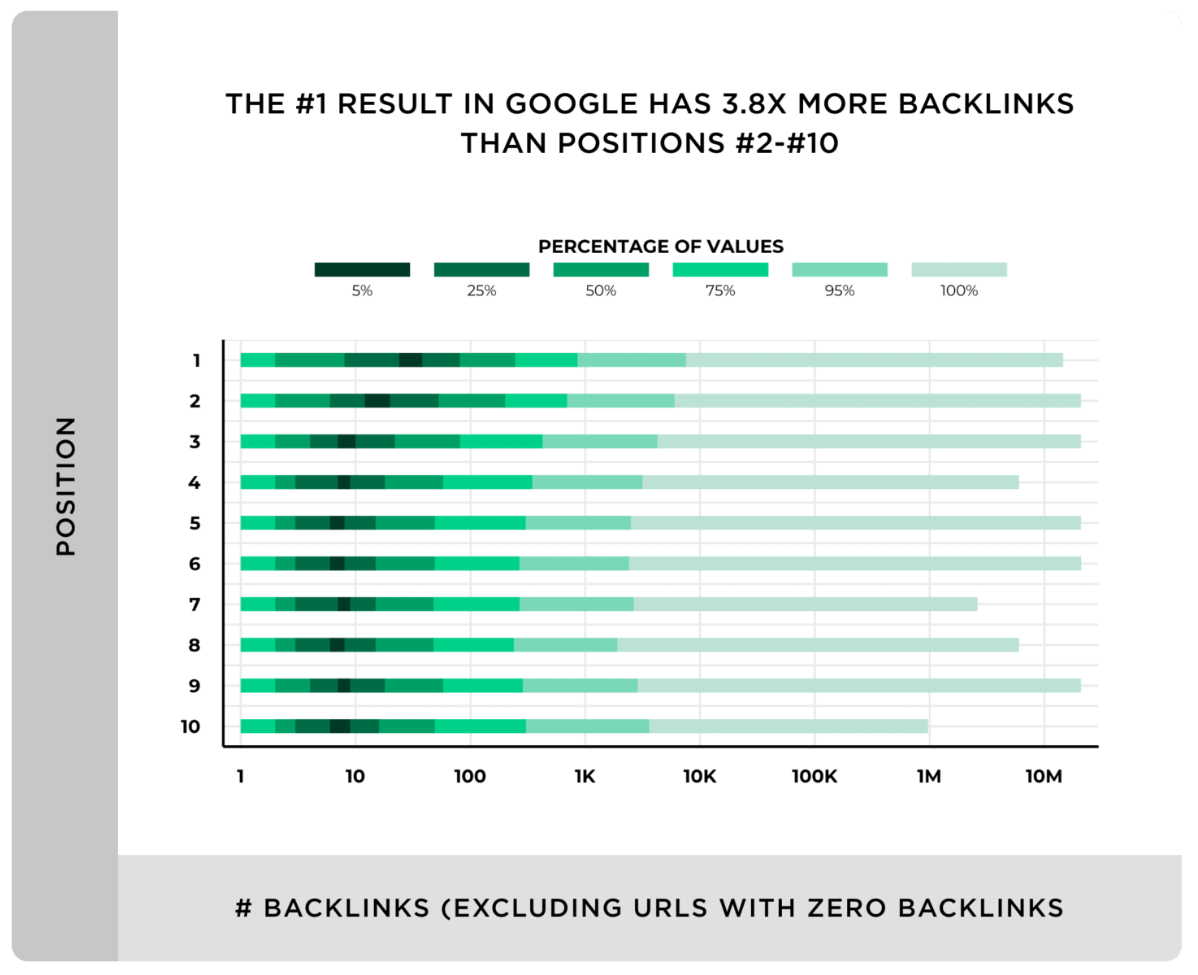
Brand mentions are for sure valuable, but there’s no definitive proof that they have anywhere near the influence on SEO rankings as backlinks do. In case you are on the fence about doing link building or buying backlinks, this should be the proof you need to buy backlinks.
As the #1 link building marketplace, we’ve seen firsthand how quality backlinks contribute to SEO performance across different industries and campaigns.
What Are the Different Types of Unlinked Brand Mentions?
The different types of unlinked brand mentions include company name references, product names, service names, names of key people, images and other visual assets, event promotions, and anything else related to your brand that’s on the web.
Here are the seven types of unlinked brand mentions, with PressWhizz as the example:
- Main brand name: PressWhizz
- Misspellings and common mistakes: Press Whizz, PressWiz, PressWhiz, Press Wizz (yeah… we get a lot of misspellings). A misspelled mention won’t show up in a search for the correct spelling, so make sure to add them.
- Unique product or service names: Names that stand for your brand without saying it. Someone writing about the iPad is writing about Apple, but they might never mention Apple or link to it. If your brand has branded tools, features, or services, search for those names too.
- Brand slogans: “Build Authority. Win Visibility.” Taglines tend to get quoted word for word, so an exact-match search in quotes finds them fast.
- Company representatives: A person’s name often gets published without a link to the company behind it. That includes our founders, our marketing team, and anyone else who gets quoted, interviewed, or credited.
- Event names: Event pages and recaps list speakers and their companies in plain text. That includes events we organize, plus talks our team gives at conferences like Brighton, Shenzhen, and Chiang Mai SEO.
- Copyrighted images: Sites reuse logos and infographics without credit more often than you think.
You’d be surprised at how often people misspell our name…
My advice? Run a search for each type.
Our Favorite Tools for Finding and Reclaiming Unlinked Brand Mentions
The best tools for unlinked brand mention link building are:
- Ahrefs
- Semrush
- Brand24
- Google Search Operators
- Google Search Console
- Google Lens & TinEye
- Google Alerts
- BuzzStream
- Hunter.io
| Tool Name | Purpose | Key Feature |
| Google Search Operators | Find brand mentions across websites. | Free searches using quotation marks and -site: to exclude your own domain. |
| Google Alerts | Monitor new brand mentions. | Free email notifications when Google discovers matching content. |
| Google Lens & TinEye | Find websites using your images without attribution. | Reverse image search for logos, screenshots, and infographics. |
| Ahrefs Content Explorer | Find unlinked brand mentions at scale. | “Highlight unlinked” identifies mentions without backlinks. |
| Semrush Brand Monitoring | Discover and monitor unlinked mentions. | Tracks brand mentions and filters those without backlinks. |
| Hunter.io | Find contact information for outreach. | Domain Search and Email Finder identify relevant email addresses. |
| BuzzStream | Manage and streamline link building outreach. | Personalized email templates, automated follow-ups, and contact management. |
| Ahrefs Site Explorer | Evaluate link opportunities and track acquired backlinks. | URL Rating, organic traffic, referring domains, and new/lost backlink reports. |
| Brand24 | Monitor brand mentions across multiple platforms. | Tracks mentions on websites, blogs, social media, and forums. |
| Semrush Backlink Analytics | Evaluate referring domains and monitor backlinks. | Authority Score, organic traffic estimates, and new/lost backlink tracking. |
| Google Search Console | Check backlinks Google has discovered. | Links report showing a sample of external linking sites and pages. |
Unlinked Brand Mentions and AI Search
Brand mentions are important in AI SEO because LLMs lean on trusted third-party sources, and brand mentions help establish what your brand does, which topics it’s associated with, and when it should appear in AI-generated answers.
This is not our opinion. It’s a well-studied fact.
Let’s go back to that Ahrefs study from before. In that study of 75,000 brands, Ahrefs found that branded web mentions had a 0.664 correlation with AI Overview visibility, compared with just 0.218 for backlink volume.
We also have definitive proof on our end. We are recommended #1 by ChatGPT:
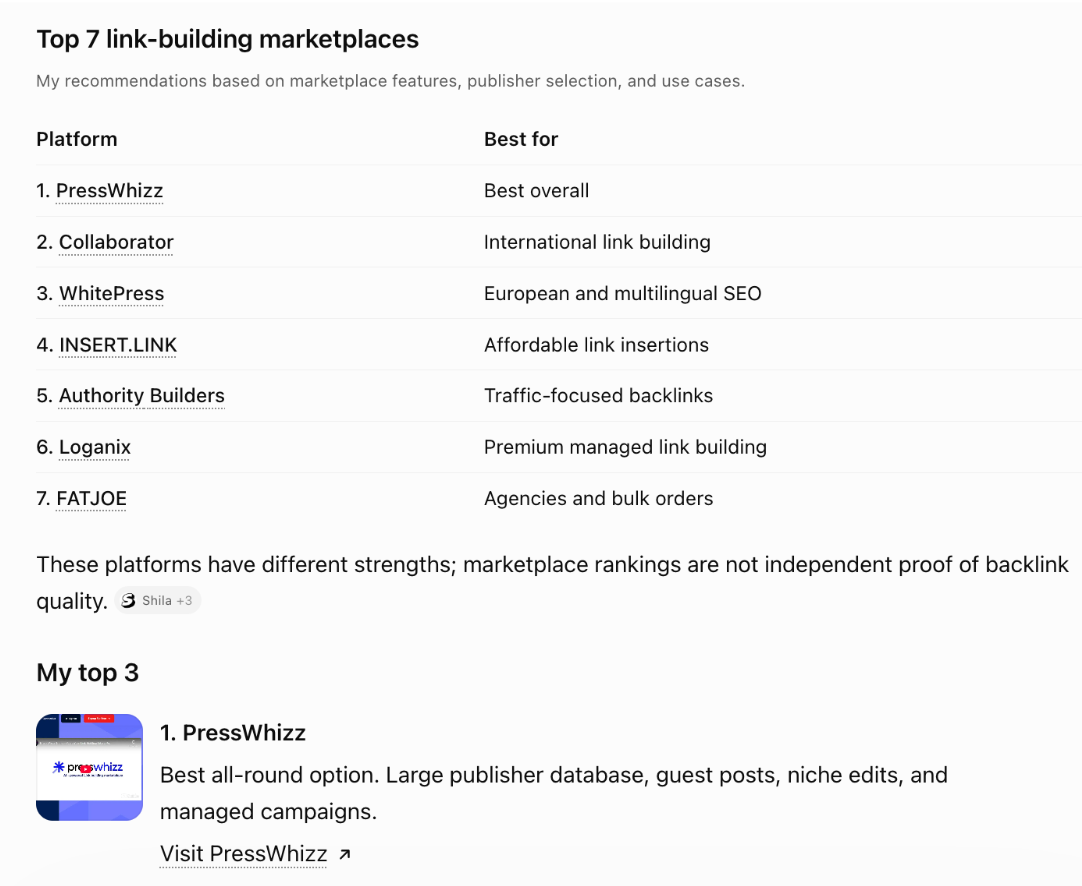
We do this by being mentioned in the sources that ChatGPT trusts for this query:
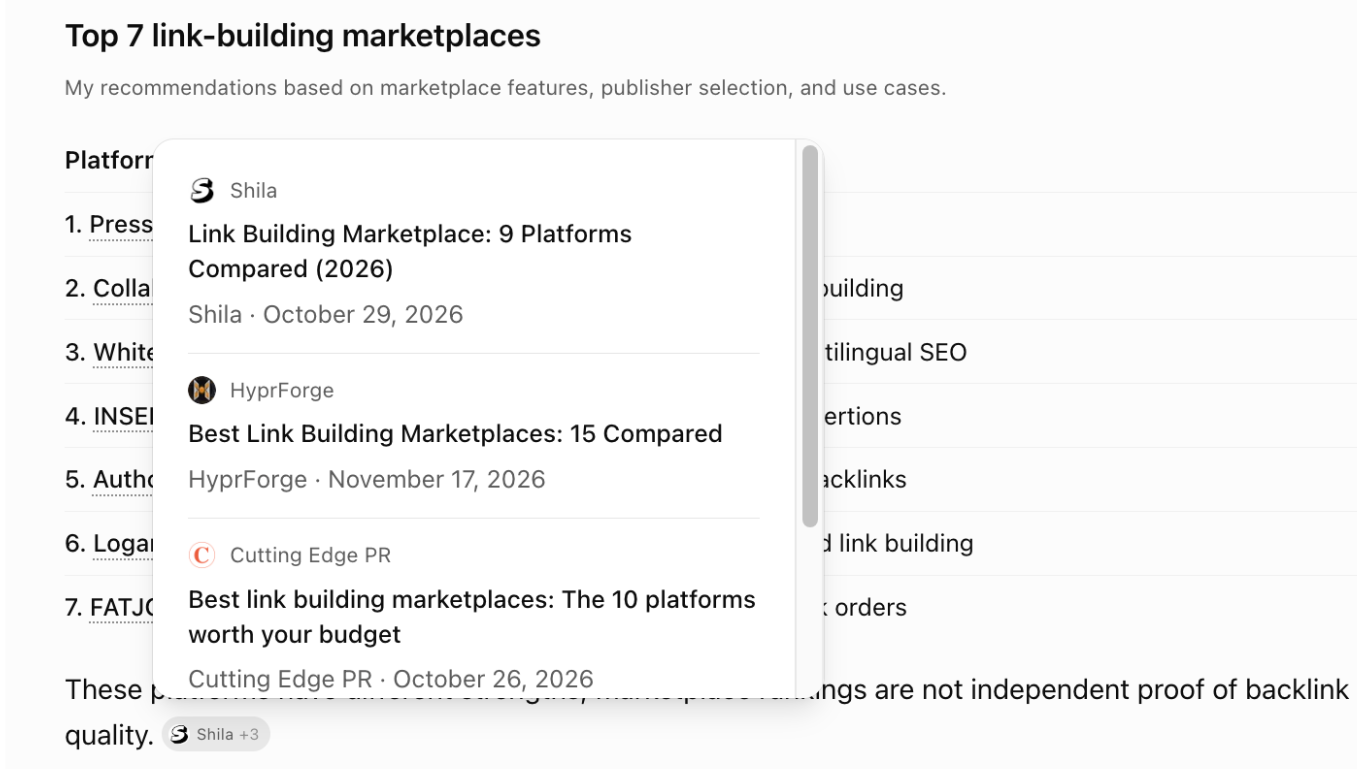
And guess what? Many of these sources don’t link to us! They just mention our brand.
If you want similar results, here’s what actually matters when it comes to AI search and brand mentions:
- Entity recognition: Build consistent mentions alongside relevant products, services, and industry topics to help reinforce how LLMs see your brand.
- Third-party corroboration: We cannot stress this enough. Build placements on independent reviews, publications, comparisons, and industry websites to provide credibility beyond the claims on your own website.
- Relevant sources: Stop wasting money getting mentioned on every website that’ll take your cash. Find the sources AI actually cites for your money queries and go after those instead.
- Measurement: Track brand mentions, AI citations, and competitor share of voice to see whether your visibility is actually improving.
Pro Tip: Track the Mentions That Actually Matter
Use Ahrefs Brand Radar, Profound, or Rank Intelligence Suite to monitor which brands appear in AI-generated answers for your most valuable commercial prompts.
Don’t just count mentions. Track:
- Brand mention frequency: How often your brand appears across repeated AI responses.
- AI share of voice: How often you’re mentioned compared with competitors.
- Citation sources: Which third-party websites AI systems repeatedly cite, especially when recommending competitors.
- Visibility changes: Whether new third-party mentions coincide with improvements in AI recommendations over time.
If you really want to take your AI game to the next level, find the publications AI already cites for your target queries, check whether they mention your competitors but not you, and prioritize those sites for outreach.
Final Thoughts
Unlinked brand mentions are one of the highest-ROI types of backlinks you can build in SEO. Your name is already on the target website. All the site owner has to do is add a hyperlink, and everyone wins. They improve their UX, and you get a link.
This is one of the most powerful link building strategies in existence, and brand mention link acquisition should be worked into every link building campaign (if the opportunities exist).
But it’s not as simple as most SEOs think. You have to do it properly.
Here are the key takeaways from our article:
- Find as many unlinked brand mentions as possible
- Use alternate spellings of your name, along with names of products and people
- Prioritize your opportunities
- Automate outreach while maintaining personalization
- Track everything ruthlessly
Use the data from tracking to constantly improve your outreach campaigns, and you will increase the number of links, improve ROI, and enhance your SEO.
And if you think it’s too much work or you aren’t sure where to get started, you can always outsource link building to teams like ours.
Whatever you choose, I wish you luck.
– Dusan Novakovic
Related Reading:
- Enterprise Link Building: Systems that large brands use to scale backlinks across big sites and multiple teams.
- PR Backlinks: How to earn media links, which is where a lot of unlinked mentions come from in the first place.
- Niche Edits: Pricing, benefits, and the exact process for getting your link added to existing articles.
- Guest Posts vs. Niche Edits: A side-by-side comparison on cost, speed, control, risk, and longevity, so you can pick the right link type for your site.
- Outsource Link Building: An 8-step safety process if you’d rather hand outreach off.
- Tiered Link Building: A guide to backing your best links with tier-2 support, including how to pick which ones are worth the extra effort.
- Podcast Link Building: Our guide on building editorial links via podcasting.