
So, you want to offer a scholarship and build high-DR .edu links?
Great idea. Scholarship link building is a great way to acquire high-quality backlinks from universities, databases, and other high-authority websites.
But I assume you have some questions (or maybe even some fears).
“Does scholarship link building even work in 2026?”
“Will Google penalize me for manipulating its algorithm?”
“Is it still worth the cost?”
The truth is that the scholarship link building strategy is a lot like other forms of link acquisition: If you play by the rules, you’ll be fine. If you abuse the system, you’ll get penalized or algorithmically downgraded. At the very least, you’ll waste money and complain that link building is dead on social media.
Don’t worry, we’ve written this guide to help you build high-authority .edu links easily without getting penalized or suppressed by Google.
Read on to learn:
- What scholarship link building is and how it works
- Whether or not it still works in 2026 and beyond
- What is working on real websites and what doesn’t work
- Industry pricing data
- Our step-by-step process for building high-quality links
What is Scholarship Link Building?
Scholarship link building is an SEO tactic where businesses offer student scholarships to earn backlinks from university websites, particularly .edu domains. Scholarships also attract high-quality SEO backlinks from other sources, like directory sites, news outlets, or even local municipal websites.
A backlink from a trusted university page usually passes valuable PageRank to your website, which strengthens its link authority and improves search engine rankings.
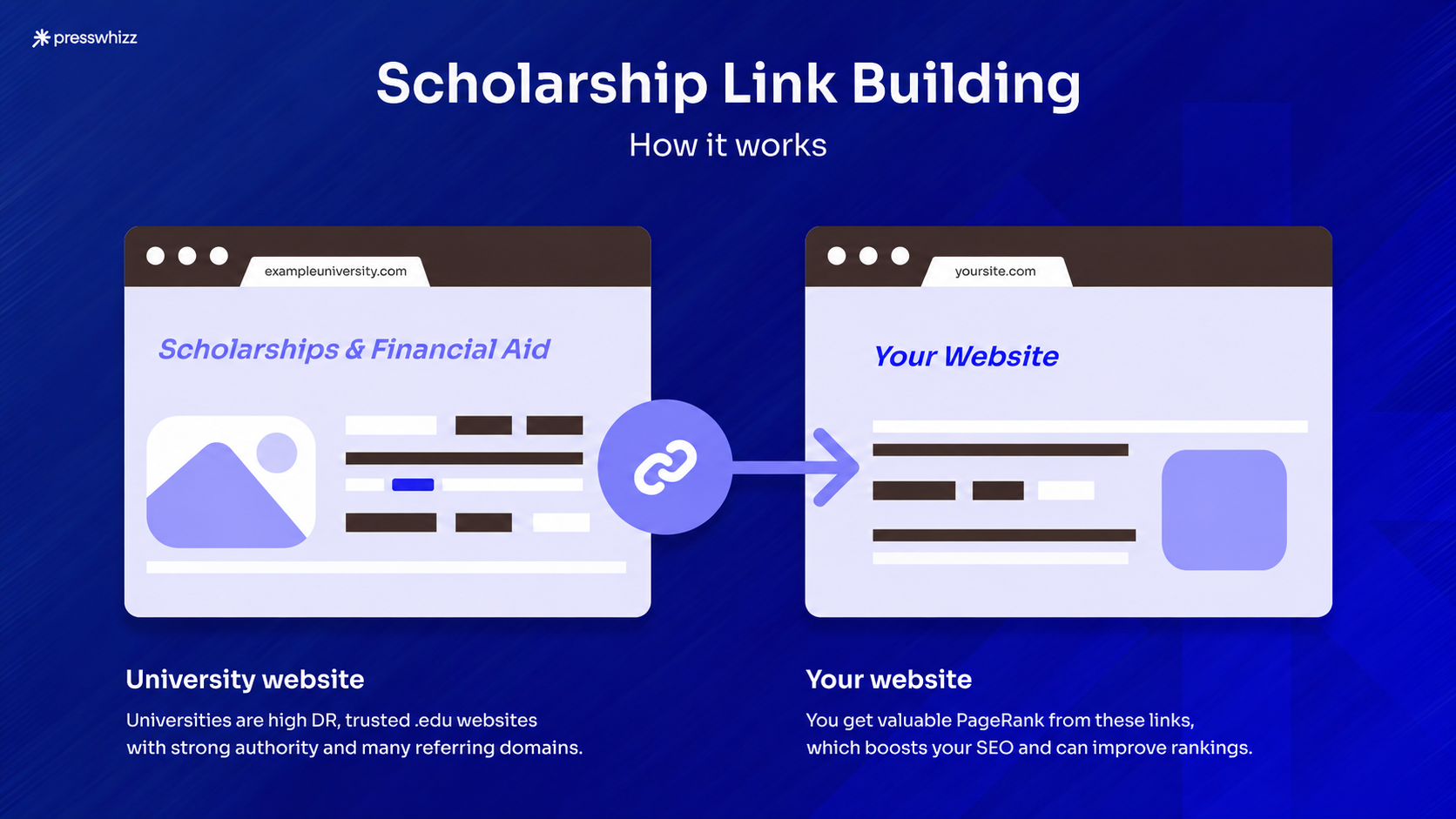
Running a scholarship link building campaign is simple: Businesses create a scholarship, publish a landing page explaining the award and eligibility requirements, then reach out to universities or other websites to have it listed on their financial aid or scholarship pages.
Here’s an example of a legal website offering a scholarship that earned them a high-authority backlink:
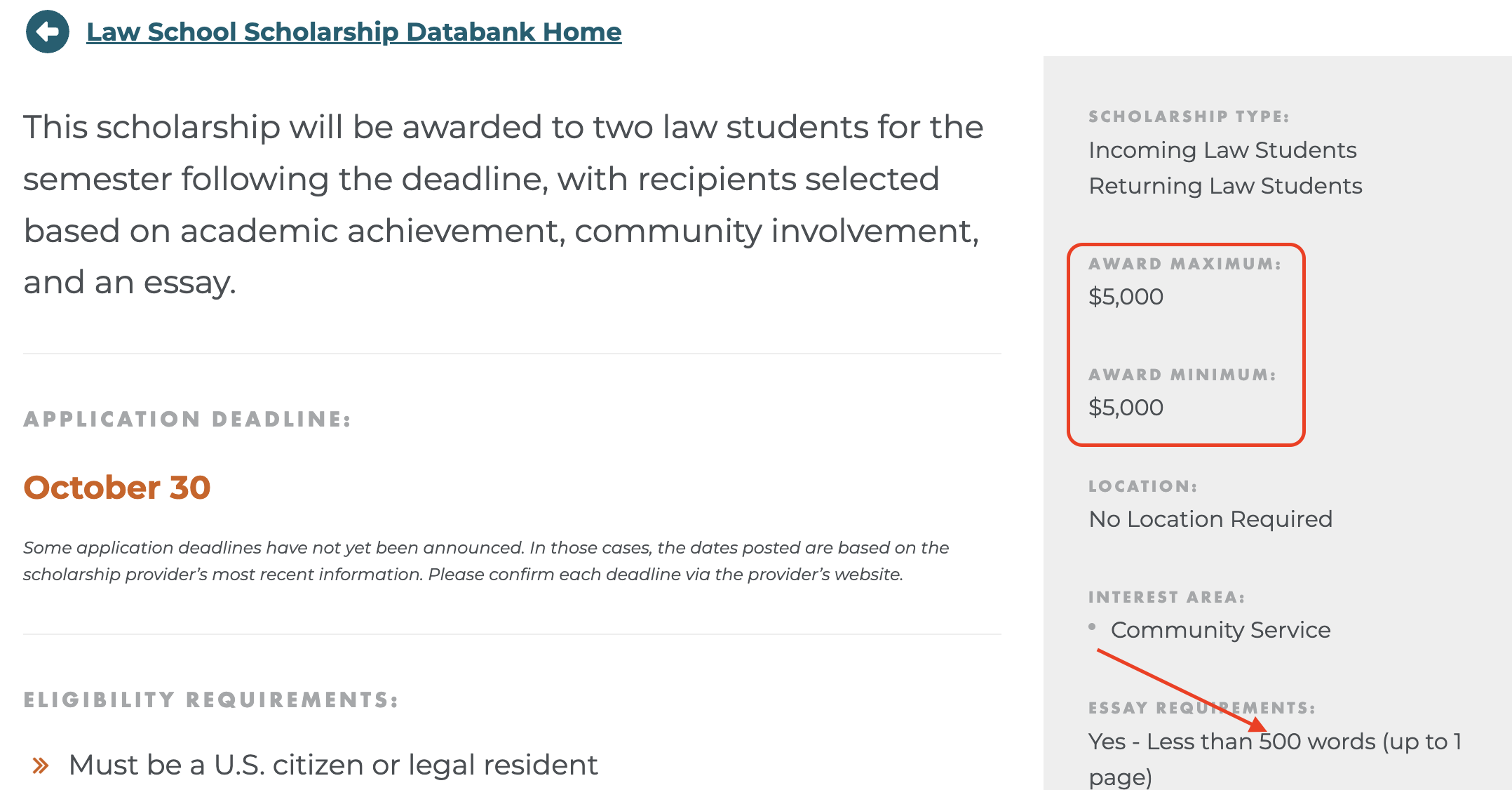
This law firm earned a DR (Domain Rating) 63 backlink by offering this scholarship:
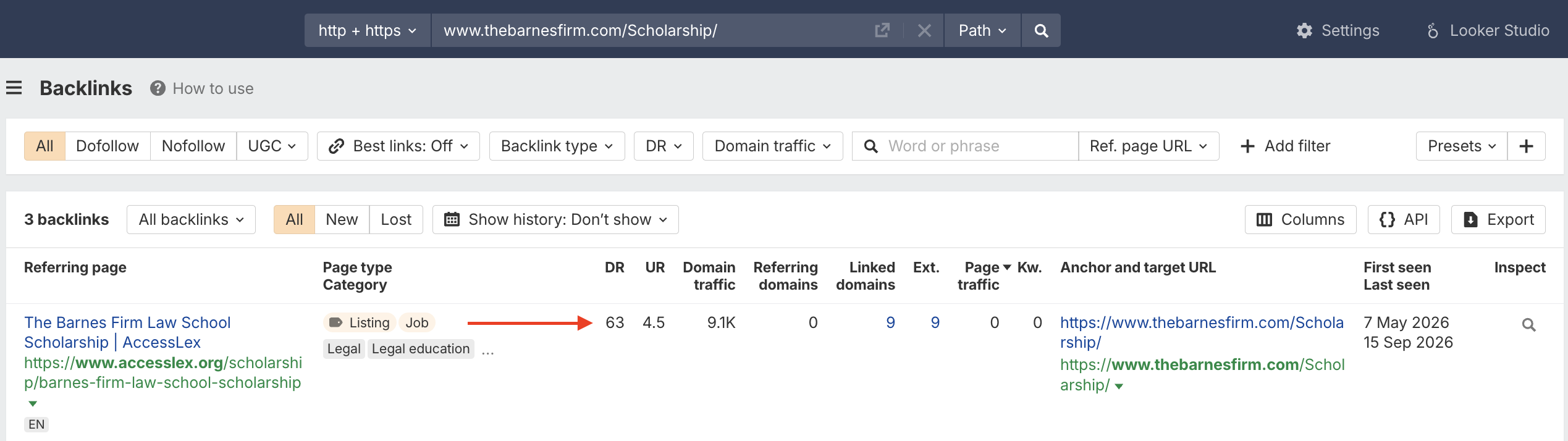
So, why do SEOs love scholarship links? It’s because university websites often have strong backlink profiles, high trust from Google, and established authority. Google doesn’t give .edu links any special treatment, but a backlink from a reputable university is still very valuable.
Think about it…
You can either buy backlinks from regular DR 40 websites with few web mentions and an average footprint. Or, you can create a scholarship and get multiple DR 80+ backlinks with one single campaign. Check out this website’s scholarship page:
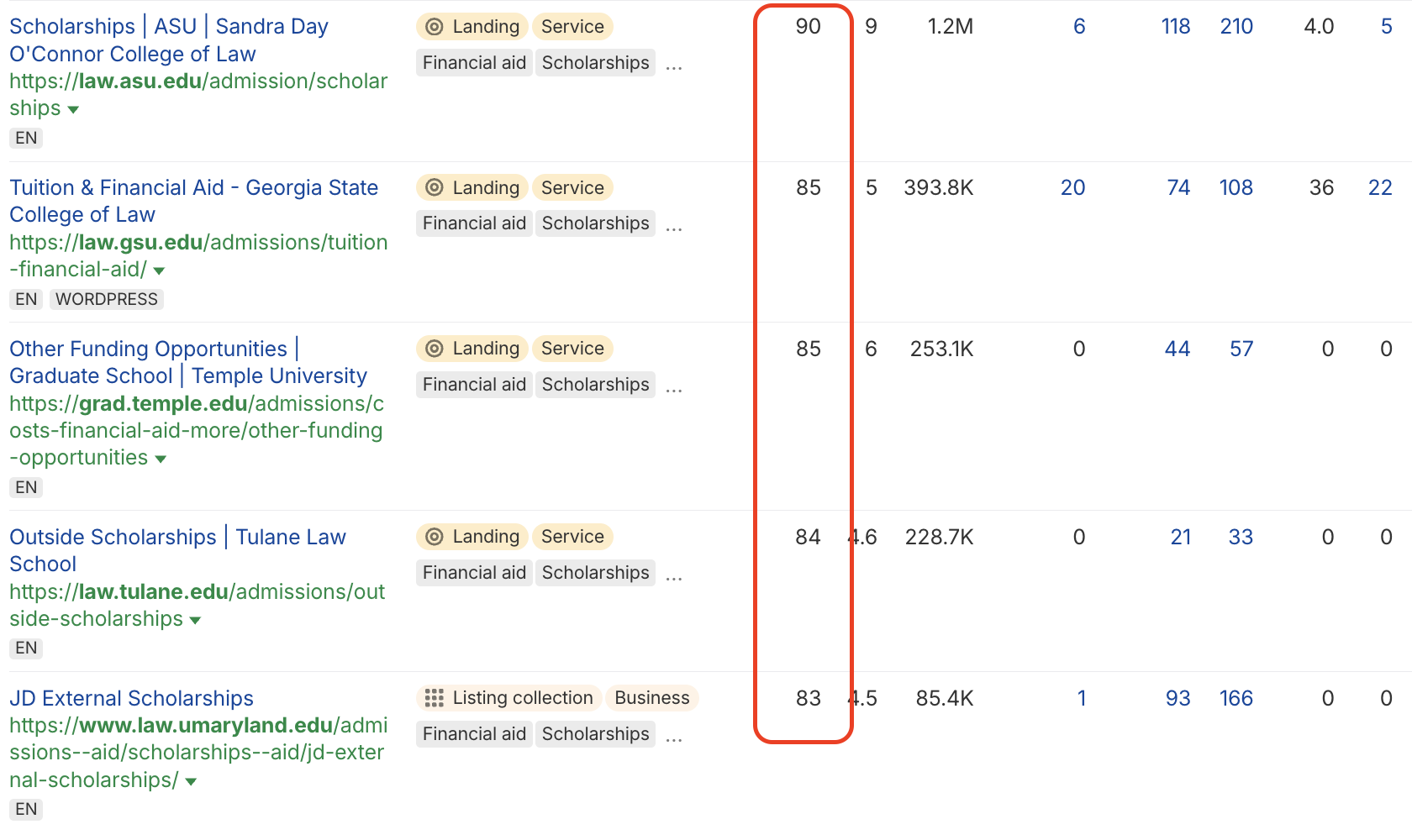
That’s 5 editorial links earned from a single scholarship. Do you know how hard it is to get that many high-authority links? It’s nearly impossible to do without digital PR link building.
For years, scholarships were a relatively cheap way to build authoritative links at scale, but Google cracked down hard a few years ago. Google’s 2021 and 2022 link spam updates made it harder to benefit from manipulative link building tactics. I’ll cover that in more detail further below.
To sum it up, a well-run scholarship campaign can still be extremely effective, particularly when the award attracts links from credible educational institutions.
Further Reading: I mentioned Domain Rating in this section, which is a third-party metric created by Ahrefs to quantify the power of a website’s link profile. You can learn more about Domain Rating and Domain Authority in our article, DR vs. DA.
How Does Scholarship Link Building Work?
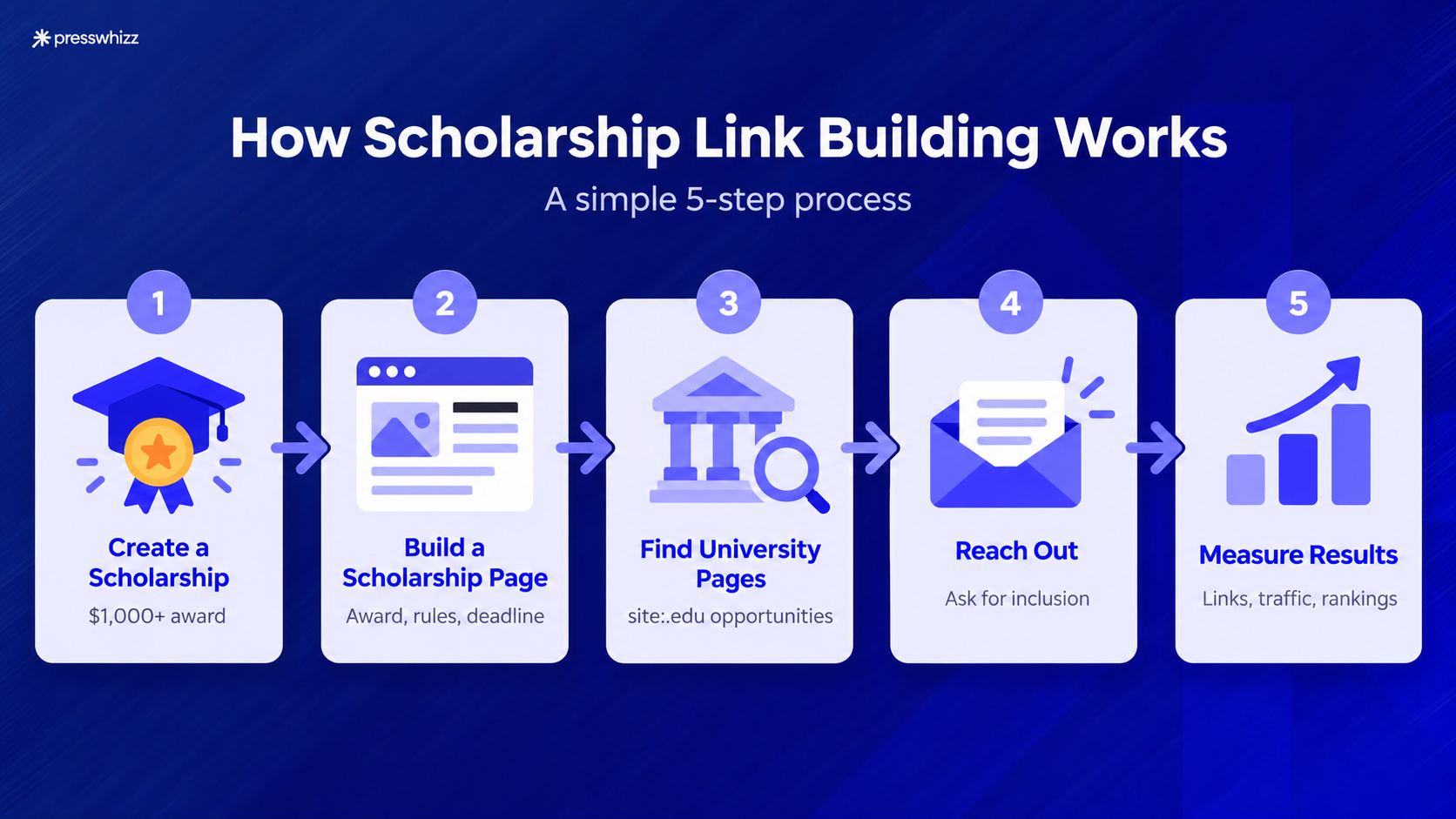
If you want to build scholarship links, you just need to offer students financial aid and get universities to link to your scholarship page from their financial aid or external scholarship directories.
Once you have the reward sum and title in mind, just create a scholarship page, search for university external funding pages, and reach out to them in a friendly manner. With advanced Google search operators and AI tools, finding potential link building partners is fast and easy. It’ll take just a few moments.
That doesn’t sound too bad, right?
Trust me, it’s not hard to give money away.
Here’s how the scholarship link building process typically works:
- Create a scholarship: Offer a genuine financial award, ideally related to your industry. A law firm, for example, could offer a $1,000 scholarship to aspiring lawyers. Establish clear eligibility requirements, application deadlines, and a fair selection process.
- Set up a scholarship page: Create a dedicated landing page covering the award amount, who can apply, how to submit an application, and when the winner will be announced.
- Find university scholarship pages (or other pages): Search Google using operators such as site:.edu “external scholarships” or site:.edu “outside scholarships” to find colleges and universities that list third-party funding opportunities. We cover more on finding potential link opportunities in the “how to” section of this guide.
- Reach out: Find the contact information of the university, staff member, or site owner, and share the details of your award. Just ask if they’d be willing to include it on their website. We suggest explaining why you believe in this scholarship so much and why you created it (don’t tell them it’s for link building, please).
- Measure the results: This is the part that most search engine optimization professionals skip. Don’t be a statistic, please. Track the backlinks you earn, check whether they remain live, and monitor referral traffic and organic rankings.
That’s really all you have to do to build high-authority links using this link building strategy. Since you are trying to give money away, scholarship link building conversion rates are far higher than normal. According to Pearl Lemon, scholarship link building conversion rates are anywhere between 22% and 35%. That is a STAGGERING number.
In other words, you should be able to build a good number of links quickly.
Note: If you aren’t sure how to measure campaign results, read our guide on backlink management. You’ll learn the tools, tips, and tactics our link building services team uses to keep links live and get maximum ROI from our client campaigns.
Does Scholarship Link Building Still Work?
Yes, scholarship link building still works in 2026, but in narrower circumstances. And there’s some risk of algorithmic devaluation if you do it wrong.
Allow me to explain…
Scholarship links are typically high-authority links coming from trusted websites. Of course those high-quality backlinks are good for your SEO.
However, the days of offering a $500 scholarship, picking up dozens of .edu backlinks, and shooting to the top 3 on Page 1 are gone.
Google’s 2021 link spam update and its December 2022 SpamBrain update made it harder to benefit from unnatural backlinks. And Google’s algorithm has become better at recognizing manipulative link patterns. Plus, as we all know, factors like topical relevance, page quality, and the context surrounding a link have become more important.
Translation: Scholarship links from high-authority .edu domains are still worth it, especially for professional fields, law firms, sports companies, and tech companies. But you can’t spam the game like it’s 2016. You need links from relevant universities with well-maintained scholarship pages, and you can’t just assume that you’ll automatically get a massive boost just from .edu links anymore.
Whether a scholarship backlink is worth pursuing comes down to several factors:
- Page authority
- Topical relevance
- Link placement and attributes
- Cost and ROI
If you don’t believe that this link acquisition strategy works, just check out major SaaS companies like Salesforce, Box, Apartment List, and any other big tech name. They ALL OFFER SCHOLARSHIPS, and they probably get easy SaaS links from universities (or databases and other sites) because of it.
Look at Hofstra’s scholarship page:
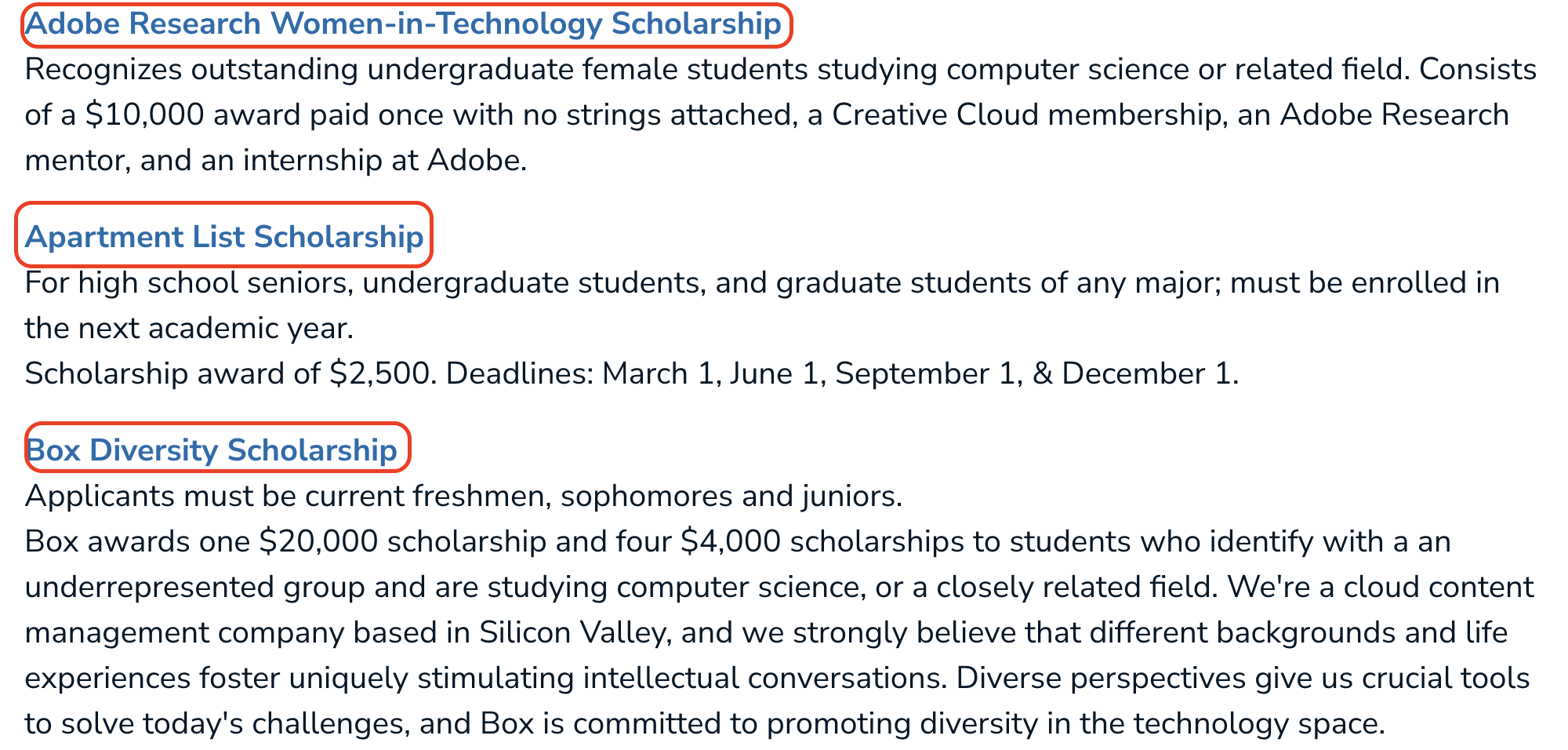
This is not a coincidence.
Bottom Line: Yes, scholarship link building still works. Just don’t mistake a .edu domain extension for a guaranteed ranking boost.
Is Scholarship Link Building Still Worth it? (Comparing Pricing, ROI, and Average Link Costs)
Yes, obtaining high-quality backlinks from high-authority .edu sites is still worth it, but it depends on several factors, such as scholarship cost, time investment, and how many backlinks you obtain.
We hear the question “is scholarship link building worth the investment?” frequently from clients of our link building packages. We’re going to cover the hard truth in this section, including real data, NOT opinions.
Let me start by saying it all comes down to two things: How much you pay vs. how many links you acquire (duh, kind of obvious actually).
Let’s start by saying the average scholarship costs you anywhere from $1,000-$5,000.
Say you fund a $5,000 scholarship and earn 12 high-quality backlinks from trusted college websites. That’s approximately $417 per link. For relevant, authoritative .edu backlinks, that’s a pretty good deal.
For comparison, PressWhizz’s 2026 Link Building Pricing Report, which analyzed 22,703 placements, found an average publisher price of $161 per backlink, with a median of $112.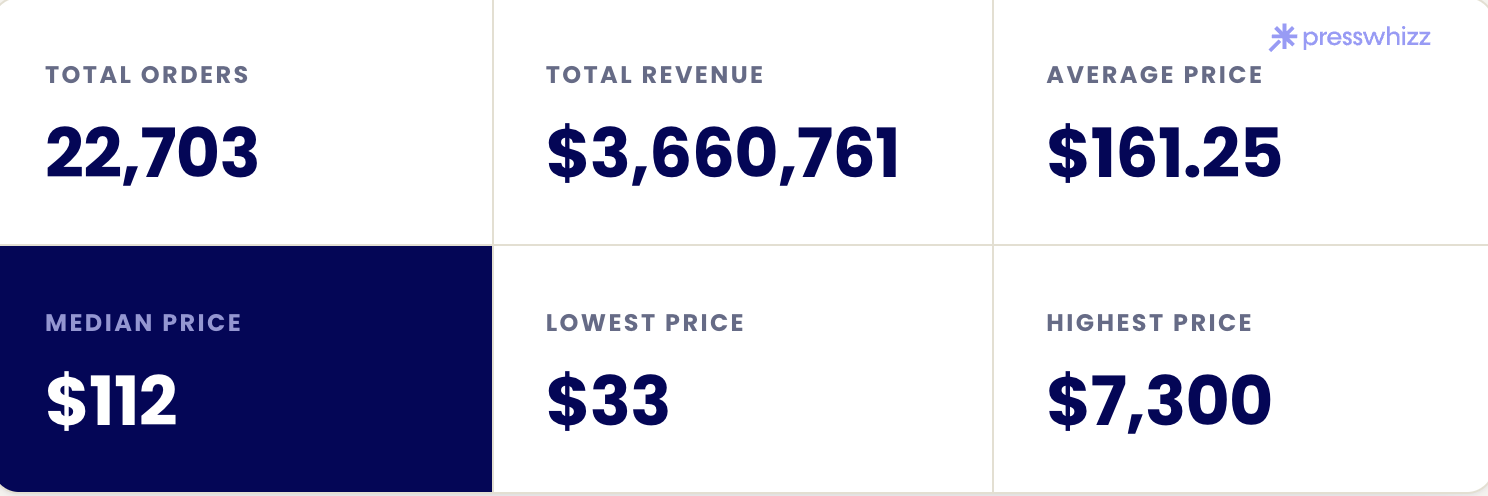
Some link building agencies and freelancers charge $500+ for average links. So, if you get very high-quality backlinks from relevant websites in a 100% natural manner for investing $1,000-$5,000, that’s worth it. We’ve seen cases where a company obtained 10 ultra high-quality links from just a $1,000 scholarship. If you do that, it’s a steal.
Give me a quick second to plug PressWhizz here!
On PressWhizz’s link building marketplace, we have .edu placements available in the $40–$500 range, depending on the publisher and placement.

Not to brag, but our team will also handle the placement and monitoring for you. No outreach or negotiation needed. No pressure! Have a look if you have some free time.
Bottom Line: Scholarship campaigns are 100% worth it when done properly. But we’re interested in ROI, not collecting meaningless vanity links. If you can acquire multiple high-quality links from high-authority pages, it is worth every penny.
What Are the Benefits of Scholarship Link Building?
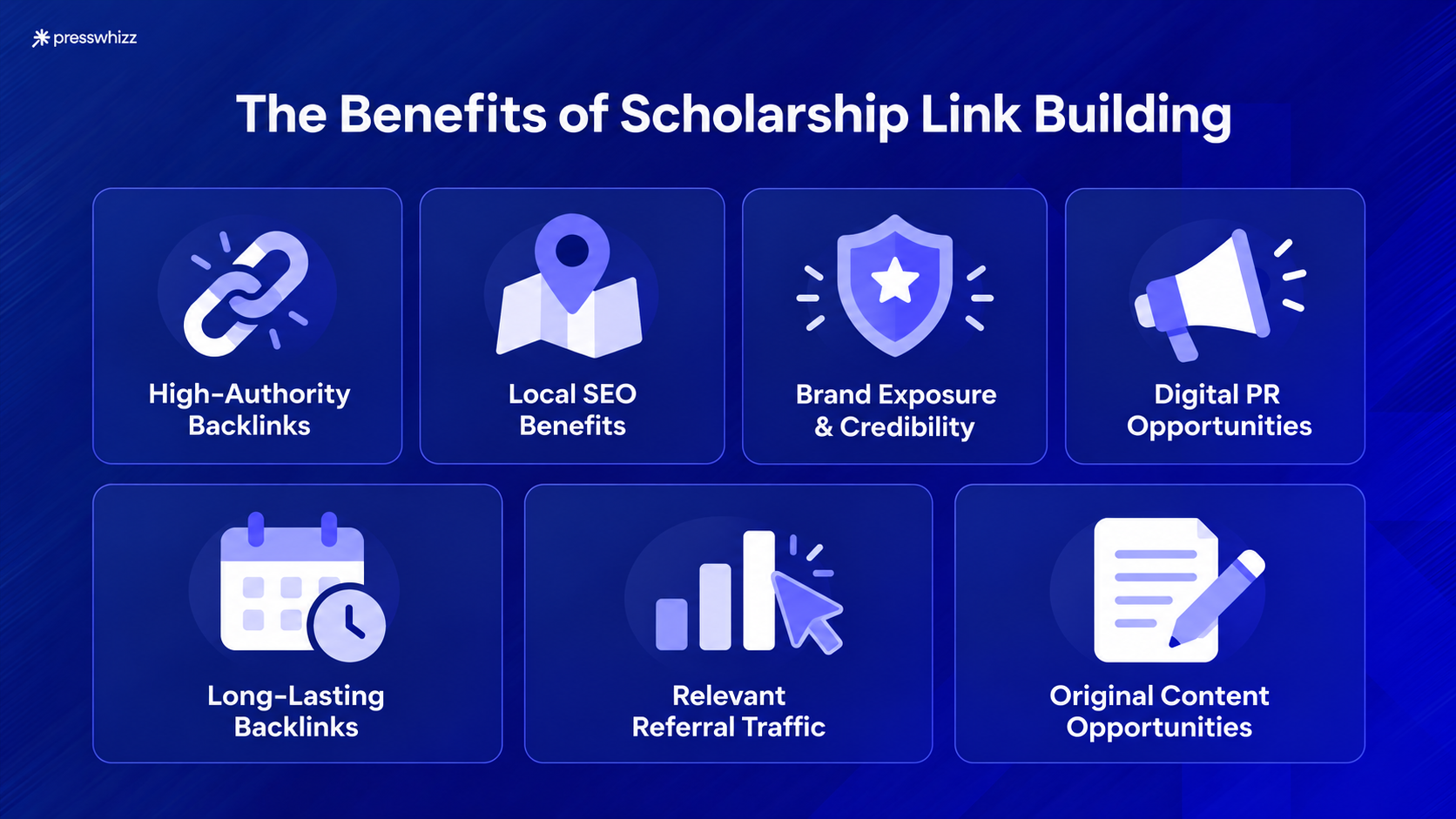
A legitimate, well-promoted scholarship link strengthens your backlink profile, attracts local attention, and builds relationships that continue paying off long after the campaign ends. It also delivers more brand exposure and trust, digital PR opportunities, and even content generation for your site.
Here’s more on the benefits of scholarship link building:
- High-authority backlinks: Universities often have established websites with strong backlink profiles.
- Local SEO benefits: Scholarship links are an excellent local link building technique that can generate ultra high-DR backlinks from the local area. Targeting students in your city or state can earn mentions and backlinks from local universities, news outlets, and even municipal government websites. These geographically relevant links help establish your business’s connection to the local community and can support local organic visibility.
- Brand exposure and credibility: Getting featured on a respected university’s website puts your business in front of students, faculty, and other potential audiences. It also creates an opportunity to associate your brand with a genuine educational initiative rather than another obvious link building campaign.
- Digital PR opportunities: Announcing a scholarship, highlighting recipients, or sharing their achievements can generate coverage from local newspapers, university publications, and industry websites.
- Long-lasting backlinks: Unlike guest posts or paid placements that sometimes disappear after a few months, university scholarship listings often remain live for years.
- Relevant referral traffic: University scholarship directories can send students actively searching for financial aid directly to your website. While they might not become immediate customers, relevant visitors, brand awareness, and potential future business are additional benefits beyond rankings.
- Original content opportunities: Scholarship applications, student essays, winner announcements, and interviews can provide material for original website content. Free content is never a bad thing. You must feed the Google Borg.
Potential Risks of Building Scholarship Links
We just want to quickly cover the downsides, because Google does monitor the web for link spam and unnatural link patterns. As always in SEO, doing things the right way greatly reduces your risk. Here’s what to watch out for when building scholarship backlinks:
- Google penalties: Scholarship campaigns designed primarily to manipulate rankings can violate Google’s link spam policies and potentially trigger manual actions.
- Link devaluation: Google may simply ignore unnatural or low-quality scholarship backlinks, leaving you with little SEO value for your investment.
- Poor topical relevance: Links from unrelated scholarship directories may carry less ranking value than relevant editorial links from websites in your industry.
- Wasted money: Funding a scholarship doesn’t guarantee university backlinks, and a poorly executed campaign can leave you thousands of dollars out of pocket.
How to Build Scholarship Backlinks: Step-by-Step
Follow this process to build scholarship links quickly:
- Research and reverse engineer successful competitors
- Create your scholarship
- Build a scholarship landing page
- Identify university targets and find their contact information
- Reach out to the appropriate people
- Award the scholarship
- Monitor your campaign and calculate ROI
Before we get into more detail, I want to explain something to you.
Scholarship link building is a high-ROI form of link acquisition. If you’re in the SEO industry, you know how agonizing traditional link building can be. You’ve got to reach out to overwhelmed and disinterested websites, negotiate, and pay hundreds or thousands of dollars for the link. Then, you have to pray that they keep it live. And that’s not even mentioning if the link actually provides value or not!
Scholarship links are a bit different.
Universities are normally happy to list your scholarship, and it’s easy to get in contact with them. They’re also quite trustworthy and rarely take financial aid or external funding options down.
Again, it’s not hard to give money away.
That being said, it still does take work. And you’d be surprised at how many SEOs get it wrong. Just follow our step-by-step process, and you’ll be fine.
Step 1) Research Successful Scholarship Link Building Campaigns
The first step to a successful scholarship link building campaign is to find out who’s already earning scholarship backlinks, reverse engineer what they’re doing, and improve on it.
When you reverse engineer competitors, look at:
- How much they award students and other scholarship factors, like the application deadline
- Which universities list their scholarships and the quality of those referring domains
- What their landing page looks like
- How many links they’ve acquired using this tactic (a rough estimate is fine)
- Their keyword rankings (to see if links are helping them)
The reason you should check the quality of the referring domains is you want to verify that it’s actually worth your time and effort. You also want to see if it’s even necessary to build links from universities in your niche.
If you’re a law firm or big SaaS company, I know for a fact without even looking that your competitors are doing this. If they aren’t, they’re bad at SEO.
But for other niches, you may not need a scholarship link building campaign. As always, it depends.
Here’s how to reverse engineer competitors.
Add this prompt into AI:
Find 10 competitors in the [NICHE] industry that offer or have previously offered student scholarships.
For each, provide the company name, scholarship page URL, award amount, and any university .edu websites linking directly to the scholarship.
Prioritize verified examples with live URLs. Don’t invent scholarships or backlinks.
And then use these Google search operators:
Find universities linking to or listing similar scholarships:
site:edu "outside scholarships" "your niche"site:edu "external scholarships" "your niche"site:edu "scholarship" "competitor name"site:edu "scholarship" "competitor.com"site:edu inurl:scholarships "your niche"
Once you find competitors offering scholarships, throw their scholarship page into Ahrefs’ Site Explorer, and click on Backlinks on the left-hand side:
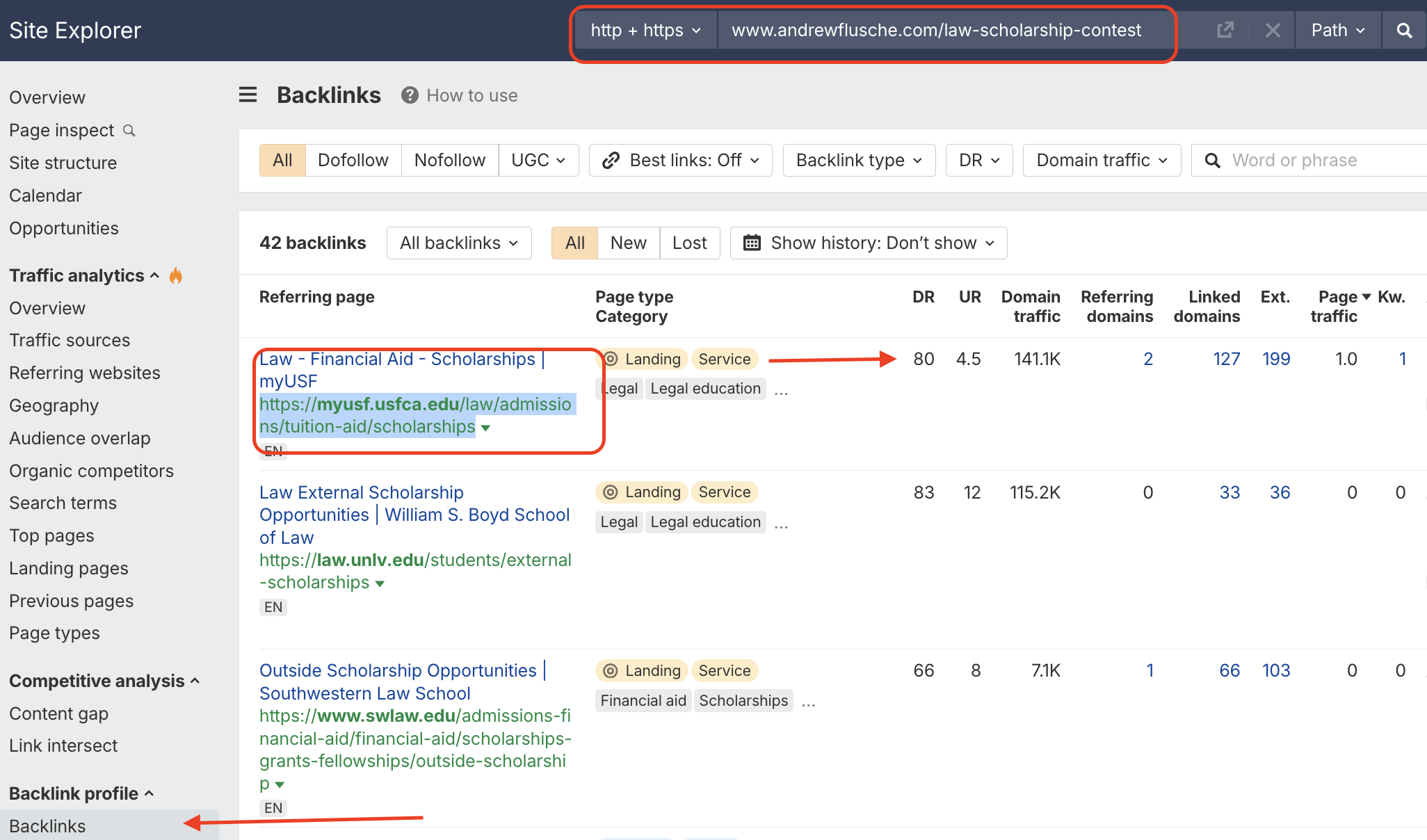
As you can see in the above image, this law firm generated links from the University of San Francisco, the University of Nevada, Las Vegas, and Southwestern University from a single scholarship page.
Now’s a good time to look at their page, too. Check this out:
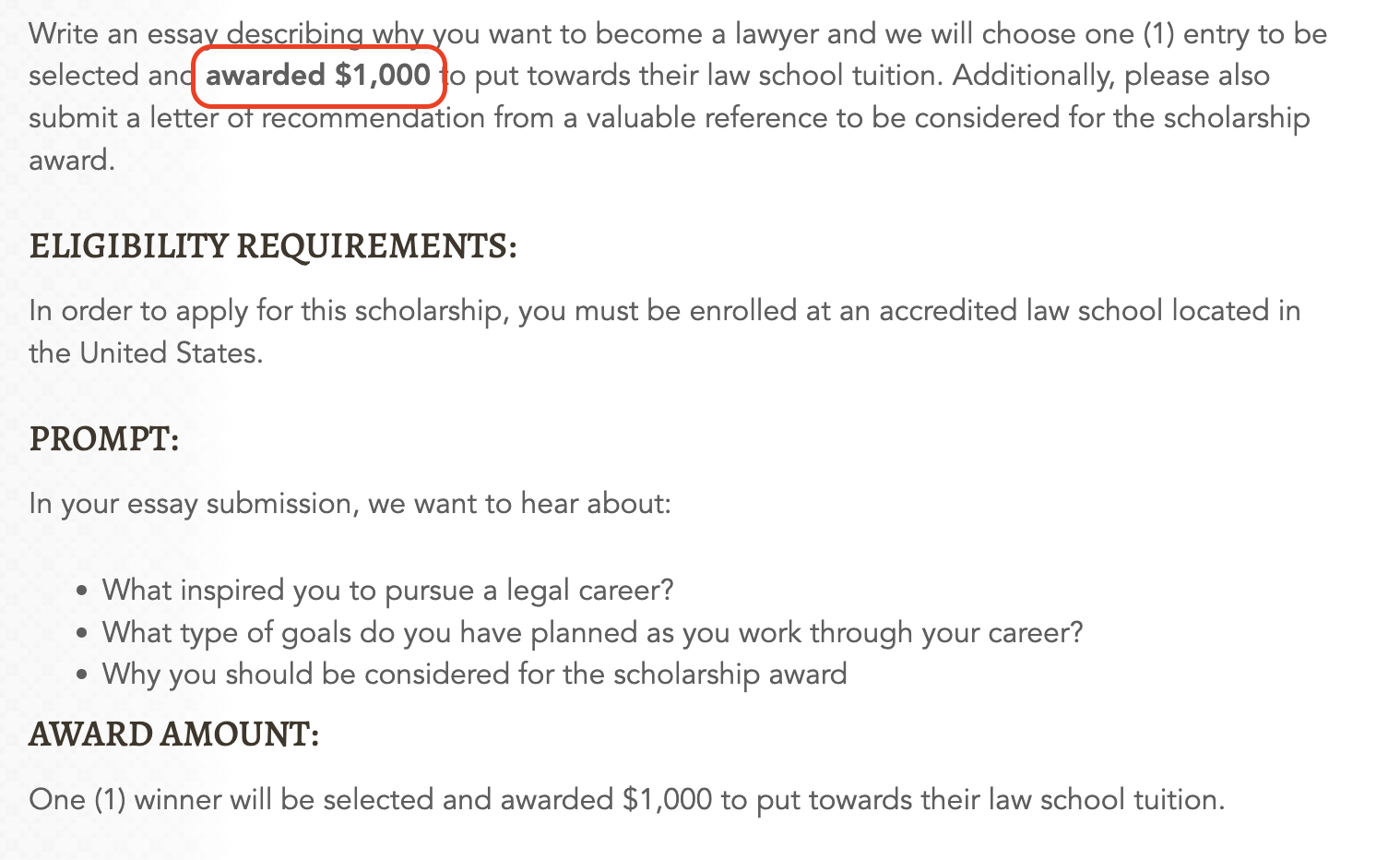
It’s only a $1,000 scholarship! They generated 40+ natural backlinks from a $1,000 scholarship page. That’s great legal link building.
My advice? I would follow their lead:
- Offer a similar scholarship
- Write down all of the universities that list their scholarship
- Repeat this process for all major competitors in your niche
Pro Tip: We recommend keeping a link intersect list. This is when you find websites that link to all of your competitors. If they link to multiple competitors, they will probably link to you, too. That’s your highest ROI target.
Step 2) Choose Your Scholarship, Budget, and Eligibility Requirements
Next up, you need to create a scholarship that universities will actually want to recommend to their students.
Make sure you’ve covered the following:
- Scholarship amount: Typically $1,000–$5,000, although there’s no fixed minimum.
- Industry relevance: Choose a scholarship related to your business, such as a law firm sponsoring aspiring attorneys or a software company supporting computer science students.
- Eligibility requirements: Specify who can apply, including relevant academic programs, enrollment requirements, and any geographic restrictions.
- Application process: Set clear deadlines, selection criteria, and award dates so applicants know exactly what to expect.
You can also ask applicants to submit a short essay related to your industry, which will give the scholarship a more meaningful connection to your business.
Step 3) Create a Dedicated Scholarship Landing Page
Next up, you’ll need to create a dedicated landing page for your scholarship that makes it easy for universities to verify your requirements and fosters trust in decision-makers (and students).
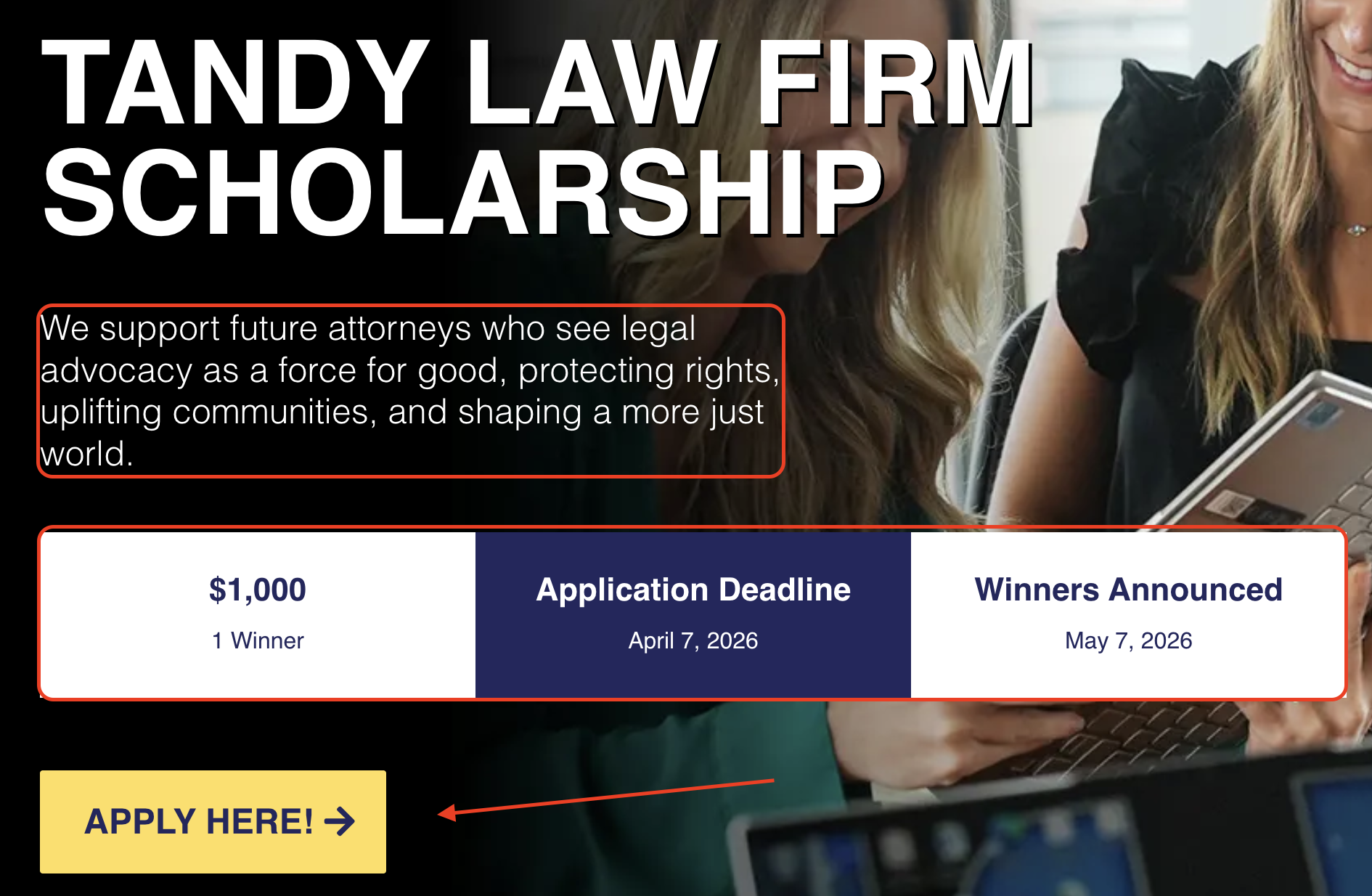
Here is an example of a scholarship landing page from Tandy Law Firm with clear messaging, important information, and a prominent CTA:
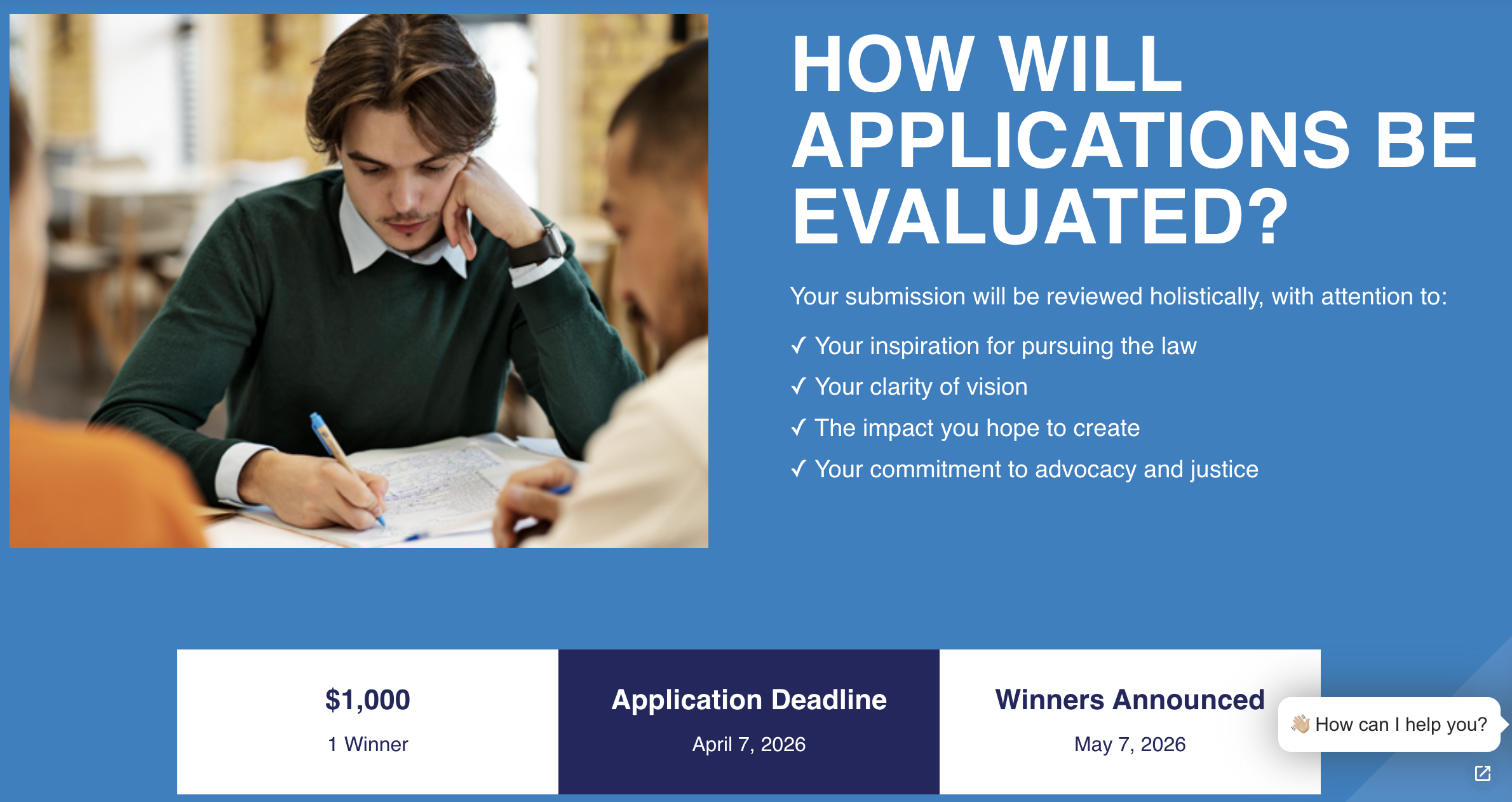
They even include more information below, such as how their submissions will be evaluated:
We’ve seen it time and again in the SEO world: A well-formatted landing page with an optimized layout and design increases conversion rates.
Compare that page to this low-quality design:
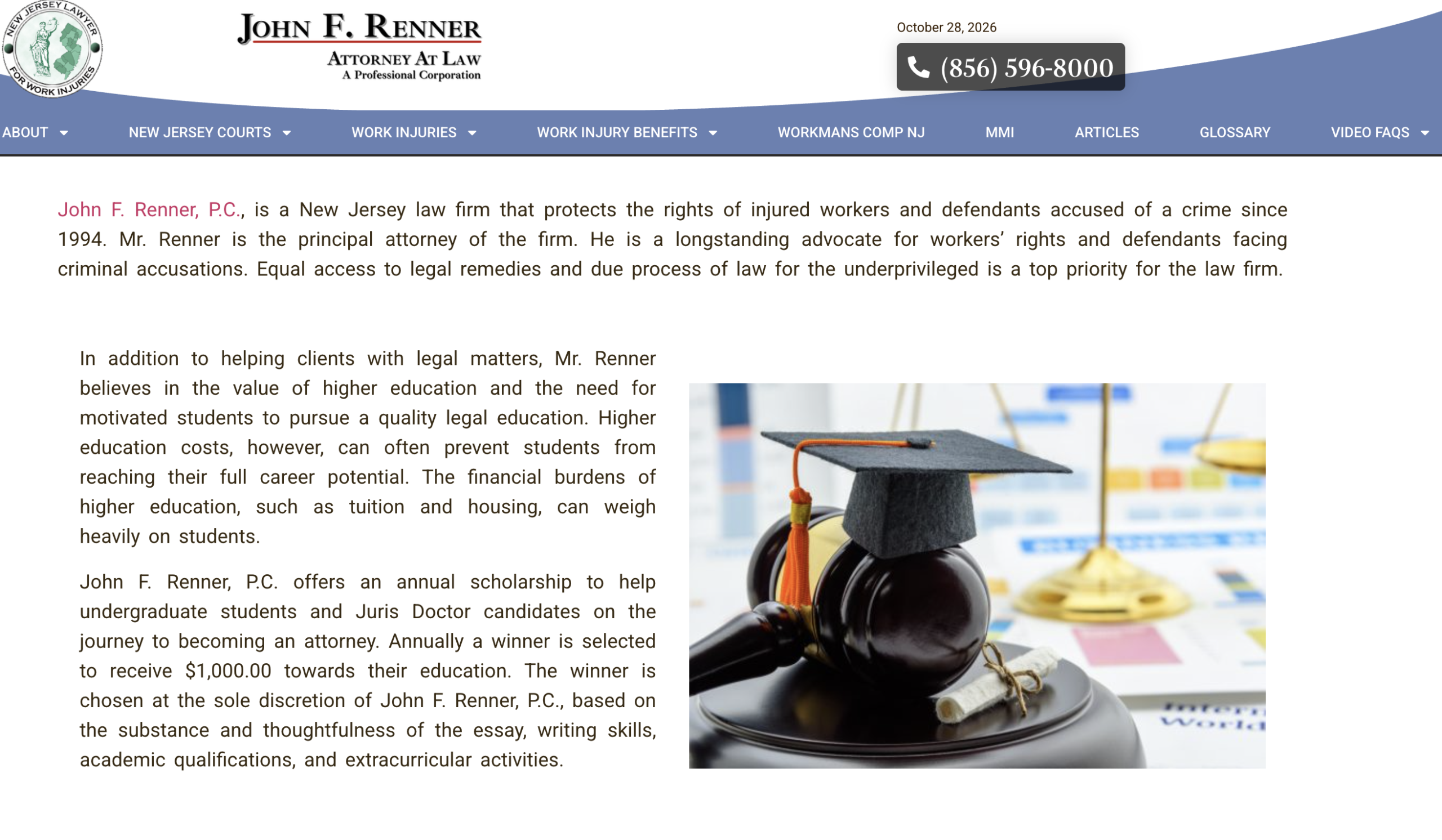
No offense to this firm, but you can’t even read the text or skim to see what the criteria are or how much you’ll be rewarded.
Here’s what to include on your landing page:
- Award amount
- Eligibility requirements
- Application instructions
- Submission deadline
- Selection criteria
- Contact details
Just make it easy for students to understand the opportunity without digging through several pages.
Pro Tip: Create a professional scholarship graphic or downloadable PDF summarizing the details. This gives financial aid departments something convenient to reference or share.
Step 4) Find University Scholarship Pages and Contacts
Now it’s time to build your outreach list.
Before we get into how to find contact information, let’s revisit the competitor backlink analysis we did earlier.
You should have all of the websites that list your competitor’s scholarship rewards in a spreadsheet. If you don’t, go back and do that.
OK, moving on…
Link building outreach can take forever if you let it.
Rather than emailing universities blindly, focus on institutions that already publish external scholarships.
Start by using AI to find scholarship pages. Let’s use a local link building example:
Find universities in [STATE] with external scholarship or financial aid resource pages that list scholarships offered by businesses in [NICHE].
For each result, provide:
- University name
- Direct URL to the university’s scholarship listing page
- Business name and scholarship title
- Direct URL to the business’s scholarship page
- Contact name and job title of the person managing the scholarship page, if available
- Publicly listed contact email or phone number for the scholarship coordinator, financial aid office, or relevant department
Prioritize live university pages with clickable backlinks to businesses’ websites, not scholarship aggregators or associations.
Don’t invent contacts, email addresses, or scholarship listings.
Use these Google search operators to uncover low-hanging fruit opportunities:
site:edu "external scholarships"site:edu "outside scholarships"site:edu "scholarship opportunities" "law students"site:edu "external scholarships" "computer science"
Keep everything organized in a spreadsheet containing the university name, scholarship page URL, contact details, and outreach status. You’ll thank yourself when you’re managing dozens or hundreds of prospects.
Step 5) Reach Out to Universities and Secure Backlinks
Once you’ve built your prospect list, contact whoever is responsible for maintaining those external scholarship pages (or whichever other page/website you reach out to).
My advice? Keep your outreach short, honest, and direct, but a bit personable. Say hello and add a bit of personality to the email.
Explain what the scholarship offers, who qualifies, when applications close, and where students can apply. Include the landing page URL and ask whether the university would consider adding it to its scholarship resources. I would close with adding a touch about your personal reasoning for offering the scholarship. We know the real reason is to build a high-DR backlink, but some emotion never hurts!
Whatever you do, don’t blast the same generic email to 1,000 universities and expect fantastic results (unless your goal is to land in spam folders). Personalize your outreach as much as possible while maintaining scale and velocity.
Here’s what my email would look like if I started a scholarship for PressWhizz:
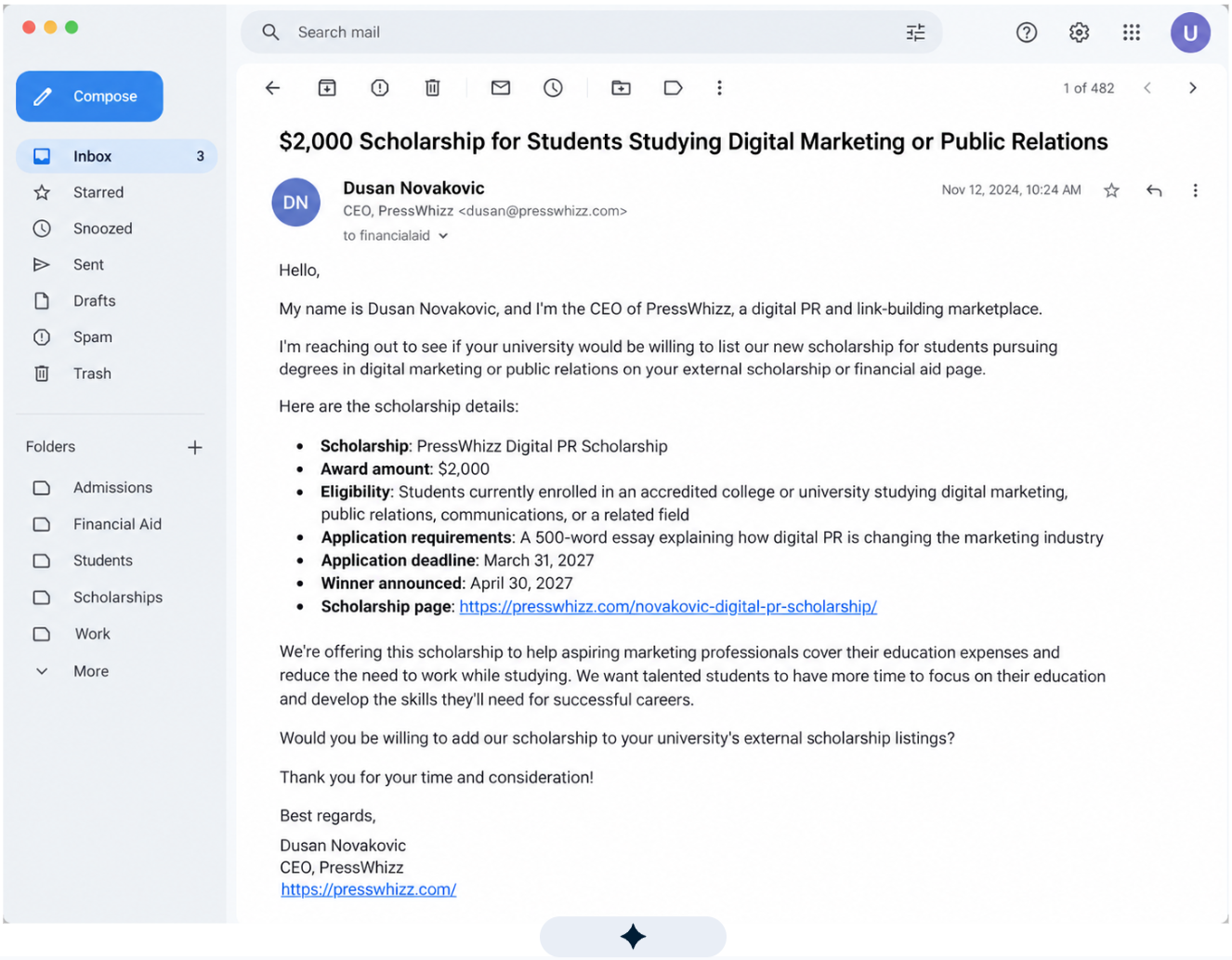
Note: I doubt I will be doing this any time soon!
Step 6) Award the Scholarship
This is very straightforward: Award your scholarship, please. That’s all you have to do.
Review applications against your published criteria, select the winner fairly, and deliver the promised award. You can then announce the recipient on your website and notify participating universities.
Want to earn even more digital PR backlinks? Syndicate some press releases announcing the scholarship winners and ask everyone to share it on social media.
Step 7) Monitor and Measure Your Campaign
Don’t just build links and declare victory. You need to monitor your campaign, measure what’s working, and make adjustments to get the most out of your investment.
Tracking performance helps you identify which universities deliver valuable backlinks, where your outreach is falling short, and whether those links are contributing to better rankings, organic traffic, and ultimately, more revenue.
Here’s what to track:
- Total campaign costs
- Universities contacted
- Outreach response and acceptance rates
- New referring domains
- Backlink quality and topical relevance
- Cost per high-quality backlink
- Link retention
- Organic rankings and traffic
- Referral traffic and conversions
Pro Tip: Review your results every 30 days and compare them against your baseline. Double down on universities delivering strong placements, refine underperforming outreach, and cut opportunities that aren’t worth the cost.
By the way, you’re going to need tools like Ahrefs, Google Search Console, and GA4 to help you measure performance. For more options, check out our link building tools guide.
Further Reading: If you’re interested in earning more high-quality links, check out our guides on how to get .edu backlinks and how to get .gov backlinks.
Final Thoughts
Scholarship link building isn’t dead, and there’s still serious value in earning backlinks from trusted university websites. You just need to be smarter about how you approach it.
Forget chasing .edu links for the sake of impressive DR numbers. Focus on relevant universities, legitimate scholarships, and placements that actually justify the investment.
As we’ve shown, a $1,000 scholarship can potentially generate dozens of valuable backlinks. That’s a pretty attractive return compared to paying hundreds of dollars for individual placements.
But remember, the goal isn’t to collect backlinks. It’s to improve rankings, attract qualified traffic, and ultimately make more money.
Get the quality right, track your ROI, and let the results do the talking.
Good luck.
– Dusan Novakovic