

A link exchange is when two website owners agree to swap links on each other’s websites for the purposes of building valuable SEO backlinks.
Website A links to Website B and Website B links to Website A. This is a reciprocal agreement whose primary goal is to build high-quality, relevant backlinks to improve SEO rankings.
Simple, right?
But if link exchanges are so simple, why is there so much controversy? And why are SEOs worried about penalties?
At PressWhizz, the team behind our link building marketplace has decades of combined link building experience.
We know from firsthand experience with link exchanges that the truth is this:
Google does not care about link swaps unless you abuse the system. Not all exchanges are penalized. Yes, they use SpamBrain and other fancy algos to detect unnatural patterns, but they don’t care…so long as you do it right!
If you abuse the system or make simple, rookie mistakes, you can get manual penalties or be algorithmically downgraded.
So, in this guide, the team and I will walk you through everything you need to know to swap links safely, including:
- What link exchanges are
- How they work
- The risks
- How to do it safely
- Some tips we’ve learned for hiding your swaps from Google
- Google’s true opinion of link swaps
- Red flags to look out for in partner sites
- How to find link swap partners
- And how to ask for link exchanges nicely (with a high-converting template)
Sounds exciting? I guess it is…if you’re into SEO. Let’s go.
What is a Link Exchange?
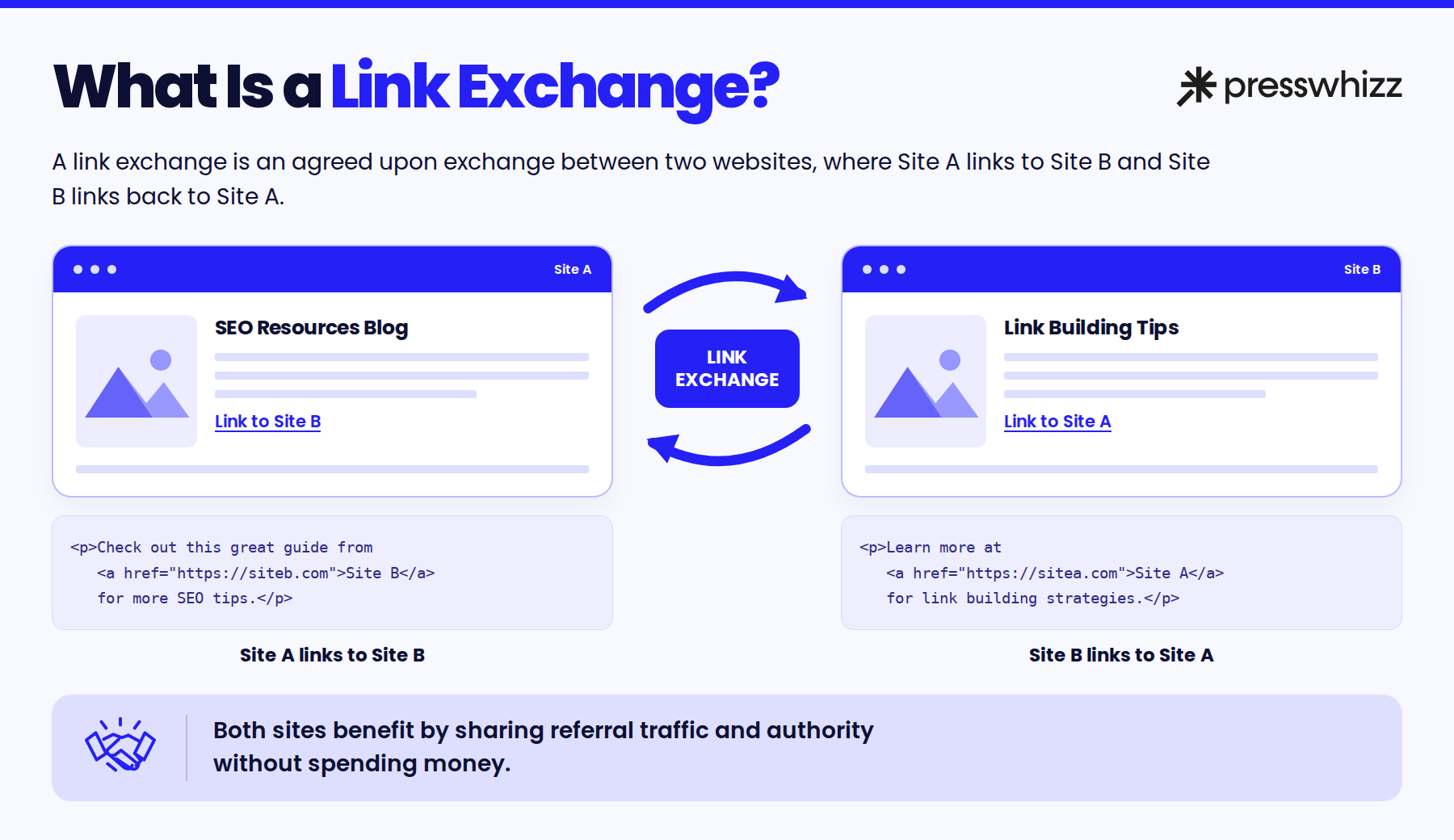
A link exchange is an agreement between two or more website owners to exchange links, meaning they both add links on their sites pointing to the other’s site. You may also hear this referred to as a “link swap” or “reciprocal linking”.
It’s a simple link building technique that is very effective (when done properly). If you’re worried about exchanging links with other SEOs, don’t be. This SEO strategy works.
SEOs use link exchanges because they are an easy and often free way to build links. Instead of cold pitching a website and hoping they link to you, you just offer to link to the other website, and everyone wins (see our outreach template below).
There are several different types of link exchanges, including reciprocal, three-way, and more complex arrangements. We’ll cover each of these further below.
But first, just in case you are worried about Google penalties…
Link exchanges are extremely common.
Ahrefs studied more than 140,000 websites receiving at least 10,000 monthly Google visits and found that 73.6% had reciprocal links. Even among the top-ranking pages Ahrefs analyzed, 43.7% had some reciprocal links.
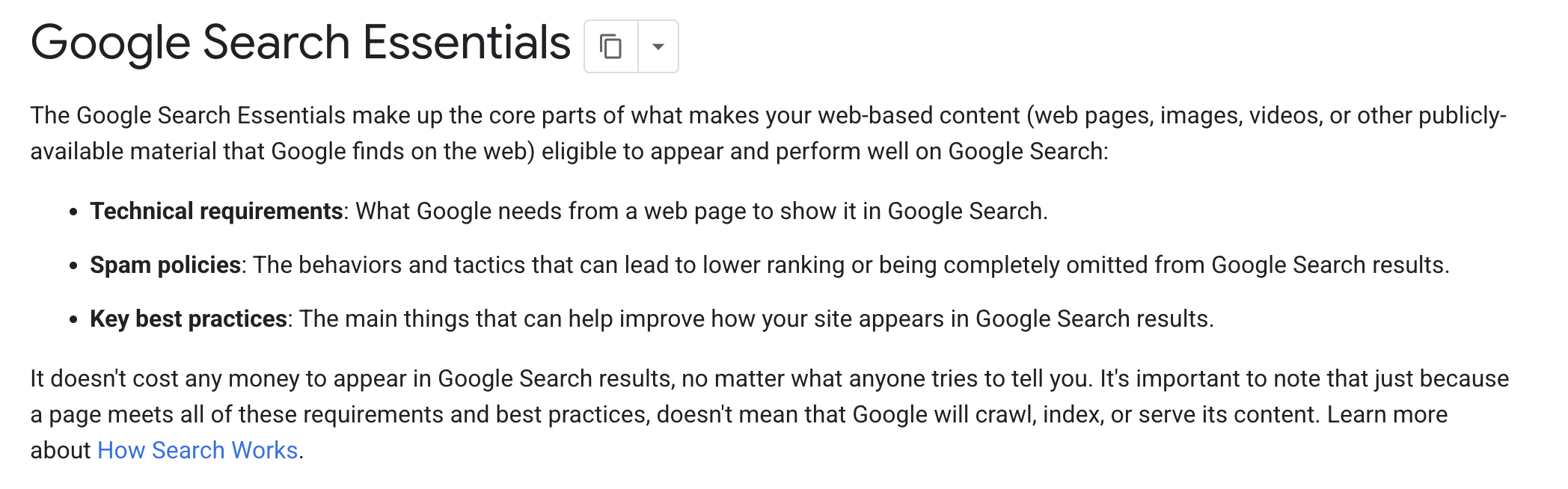
And despite what you may have heard, Google doesn’t prohibit websites from linking to each other. Google’s spam policies specifically warn against “excessive link exchanges” and partner pages created exclusively for cross-linking. Their Search Essentials (formerly Webmaster Guidelines) never say “reciprocal links are against the rules”.
Again, we’ll cover this later. First, let’s cover how link exchanges work.
How Do Link Exchanges Work?
Link exchanges work like a simple swap: Site A links to Site B and Site B links back to Site A.
For example, imagine two SEO websites. Site A publishes a guide to keyword research, while Site B publishes a guide to technical SEO. The owners agree that Site A will add a contextual link to Site B’s technical SEO guide, while Site B adds a relevant link back to Site A’s keyword research guide. Everyone’s happy. Life is good.
The process generally works like this:
- Agreement: The two site owners find each other through email outreach, Slack groups, professional networks, or existing industry relationships and agree to exchange links.
- Placement: Site A places a link to Site B within a relevant page. Site B then places a link to Site A, typically within another piece of contextually relevant content.
- Value sharing: Both parties win here. They each get a relevant, contextual backlink. They can also benefit from referral traffic and, when the links are eligible to pass ranking signals, potential SEO value.
That’s a traditional A-to-B reciprocal exchange. There are other types of link exchanges, though. Let’s move on to that now.
What Are The Different Types of Link Exchanges?
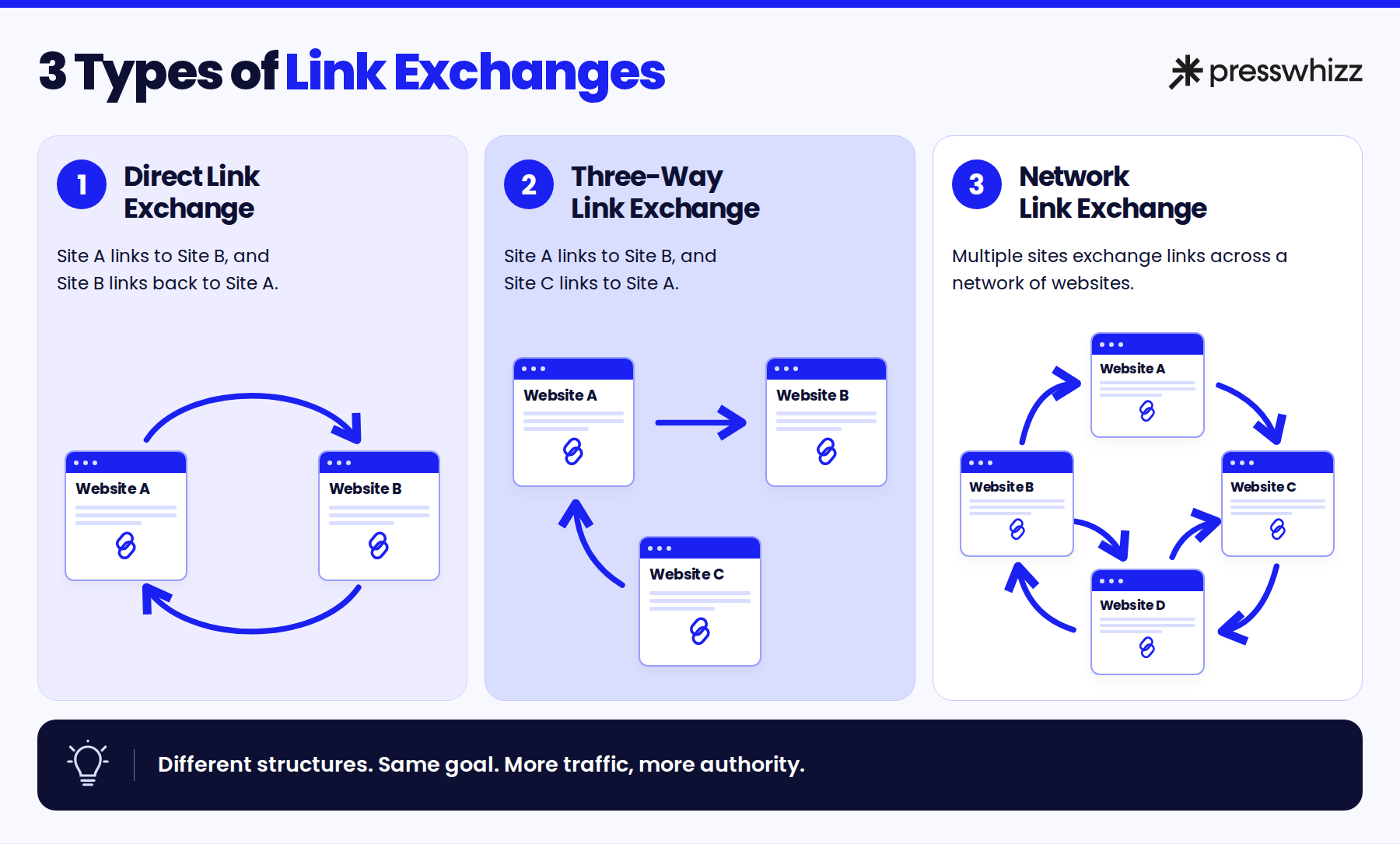
The different types of link exchanges are direct exchanges, three-way exchanges, and network exchanges. Let’s elaborate more on the different types of link exchanges and how each one works:
- Direct link exchange: Direct link exchanges are the most common type of link exchange, and they are also called reciprocal link exchanges. Website A links to Website B, and Website B links back to Website A. Done.
- Three-way link exchange: Now, another website wants to exchange a link with you, too. Website A links to Website B, but Website B doesn’t link directly back. Instead, Website B arranges for Website C to link to Website A. This avoids creating an obvious reciprocal A ↔ B linking pattern. It throws off Google’s police, so nobody gets downgraded for abusing the system.
- Network link exchange: This is when you’re getting into dangerous territory, but when done properly, it shouldn’t be a problem. Network link exchanges are when multiple website owners or SEOs exchange links across several websites. For example, an agency or site owner with access to multiple websites may arrange links between different sites rather than exchanging them directly.
But, in the end, all link exchanges are basically the same: You give me a link and I give you a link.
Why Do Search Engines Not Like Link Exchanges?
Search engines don’t like link exchanges because they can artificially manipulate link signals rather than represent genuine editorial recommendations.
Google’s PageRank system treats backlinks as a signal of a page’s importance. In simple terms, when another website chooses to link to your content, that link can act like a vote of confidence.
The goal of Google’s systems is to rank the pages that deserve to rank because other websites “vote” for them by linking to them.
Link exchanges manufacture these votes, just like link buying does.
See why Google and other search engines discourage mass exchanges?
Instead of earning backlinks by producing great content, you receive one because you agreed to provide another link in return. At scale, this can be seen as abuse (though it’s rarely enforced).
NOTE: Google very rarely punishes link exchanges, even at scale. There is no way they will ever care about your DR 20 PBN exchanging a link with another DR 15 PBN in some distant country. Go ahead, exchange your links and sleep soundly.
What Does Google Actually Say About Link Exchanges?
One of the biggest myths in SEO is that Google outright forbids link exchanges.
It doesn’t.
Google forbids excessive link exchanges and exchanges done exclusively for the sake of cross-linking.
There’s a massive difference. An occasional, relevant, editorially placed link swap is indistinguishable from normal web behavior. The internet is built on reciprocal references.
Journalists cite each other. Brands collaborate. Podcasts link back and forth. Companies co-author content.
There are even entire businesses built around swapping links, like these people:
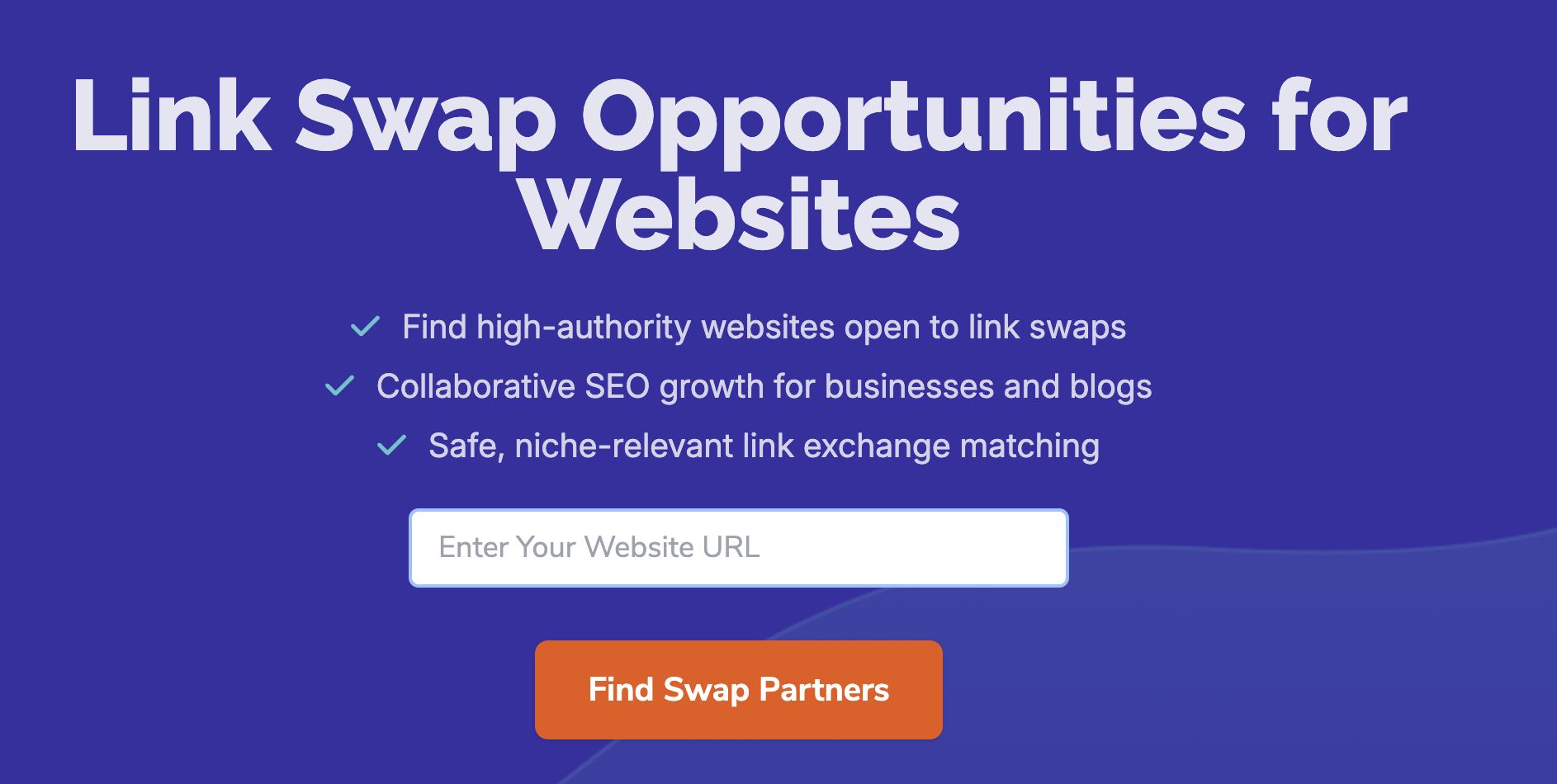
Of course, these links are going to be very low-quality and risky, and I would never use some cheap service like this. But the fact that this business exists is proof Google doesn’t care.
Let’s quote the official Google Webmaster Guidelines (aka, Search Essentials):
“Excessive link exchanges (‘Link to me and I’ll link to you’) or partner pages exclusively for the sake of cross-linking” may be considered a violation.
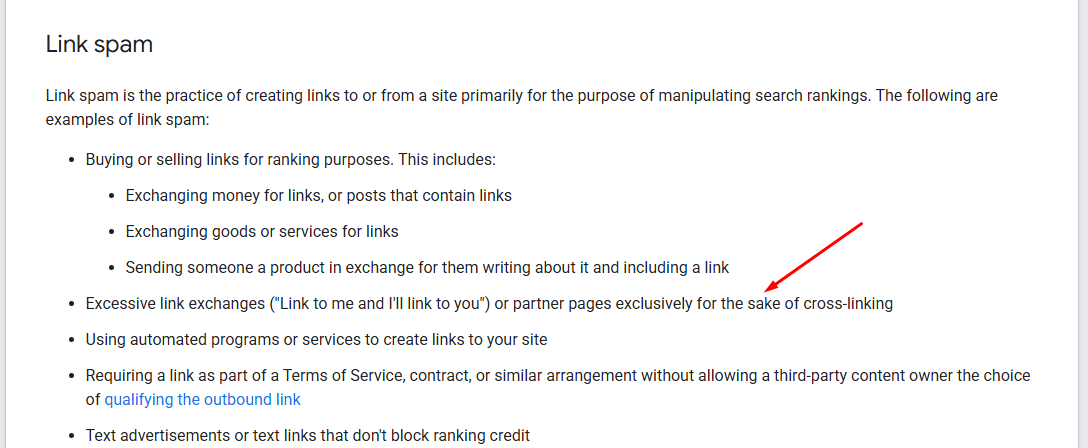
Let me break this down simply for you:
- “Excessive” means too often, too many, too fast, too predictable.
- “Exclusively for the sake of cross-linking” means no context, no value, no content.
They’re not saying link exchanges are actually banned, unlike a LOT of other link building techniques in the same documentation! They’re saying obvious, low-quality patterns of abuse at scale are.
TL;DR: Link exchanges are fine.
Further Reading: Guest blogging is a great way to build links (sometimes for free). Read up on guest blogging for SEO to learn how to add this strategy to your arsenal.
Why Link Exchanges Still Work (And Probably Always Will)
Link exchanges still work because the more backlinks, referring domains, and optimized anchor text you have pointing at your website, the better your search rankings will be. Period.
Backlinks still matter no matter what Google says.
And, despite countless algorithm updates, machine learning improvements, AI ranking systems, and Google’s continued efforts to refine search, PageRank remains a foundational ranking signal. Authority still flows through links, and domains with strong backlink profiles continue to perform well across competitive SERPs.
So, in simple terms, link exchanges help you build more backlinks. And more backlinks, in general, help your SEO (assuming the links are high-quality).
The biggest advantage of a link exchange is control, in my opinion.
With a link exchange, you can influence the context, placement, anchor text, surrounding content, timing, and destination URL. Compared to relying entirely on naturally earned links, that control can be extremely valuable.
NOTE: You also get this level of control if you buy guest posts and most of the same control if you buy niche edits, too.
And let’s not forget pricing. The average price of a link is $112 according to our Link Building Pricing Report while most link exchanges are free.
Link exchanges allow you to:
- Build DR50+ links for $0
- Exchange links with topically relevant websites
- Secure links in valuable placements, including category pages, homepages, and relevant existing content
- Scale link acquisition without constantly asking for favors or writing and paying for 10 guest posts every week
There’s also a significant long-term benefit that most people forget.
If you build a database of reliable link exchange partners, you can return to those relationships for future campaigns, websites, or clients. Over time, this turns individual exchanges into a reusable link building resource.
Further Reading: Read up on the different types of backlinks in SEO so you know which types of links to go after in exchanges.
How To Exchange Links Safely (Step-By-Step)
Now, the part you have been waiting for. Exchanging links safely requires that you vet potential partner websites, avoid obvious risk patterns, work with trusted partners, and make it look like a natural link. This helps you avoid search engine penalties or algorithmic suppression.
Here’s how to exchange links safely step by step:
Step 1: Build a Private Link Partner Network
Don’t just use link swap websites or random Facebook groups. You need a database of trusted swap partners.
These can be:
- Fellow SEOs
- Clients (if you’re an agency)
- Complementary brands
- Niche site operators
You can also get into private Facebook groups for courses (if you’ve bought them) or join SEO-focused Skool groups. These are good places to find safe link exchanges.
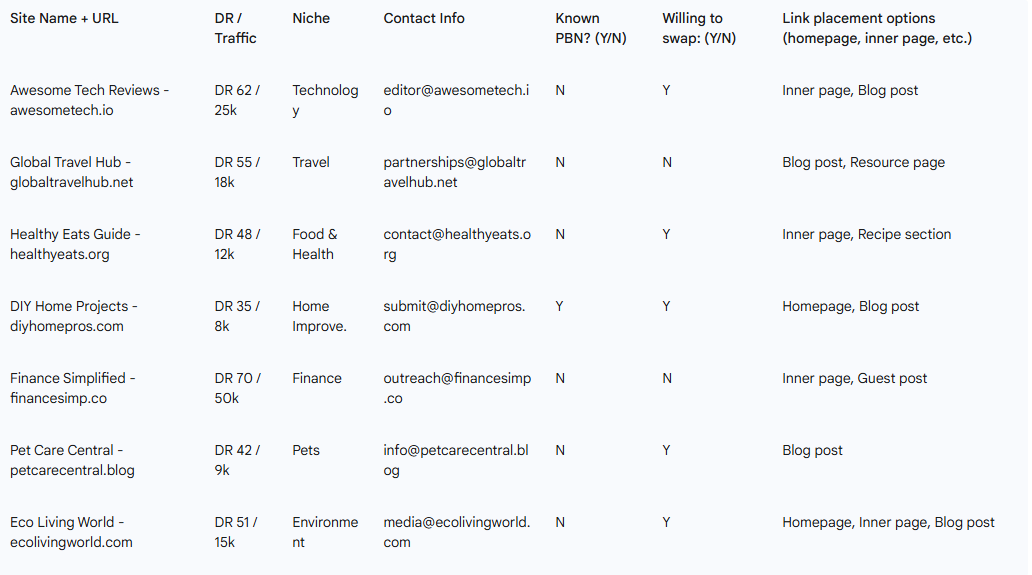
My Advice? Use Notion, Airtable, or Google Sheets and collect:
- Site Name + URL
- DR / Traffic
- Niche
- Contact Info
- Known PBN? (Y/N)
- Willing to swap: (Y/N)
- Link placement options (homepage, inner page, etc.)
It should look something like this:
Pro Tip: Start a Link Exchange Telegram or Facebook group with vetted people in your industry. Keep it invite only. No low effort spam and moderate at least weekly!
Step 2: Analyze Their Site Before You Say Yes
Before you swap links with a site, you must vet it for a few things, such as Domain Rating or Domain Authority, referring domains, organic traffic, and whether or not it’s a real site. Not all DR60s are built the same.
You know as well as we do that SEOs and digital marketers are great at manipulating metrics, and they could easily be swapping a low-quality PBN or link farm link for your editorial link. It could even damage your SEO if the link is spammy or toxic.
Here’s what to do in order to vet a website before exchanging a link:
First, run potential domains through:
- Ahrefs or Semrush: Check anchor profile and outbound links as well as the number of referring domains to outbound links.
- Archive.org: Look for signs of flipping or PBNing.
- GSC: Check for indexing issues (You need to ask for access or see screenshots).
- Make sure that they have real traffic and a legit target audience.
- Look at their blog. Do they have high-quality content?
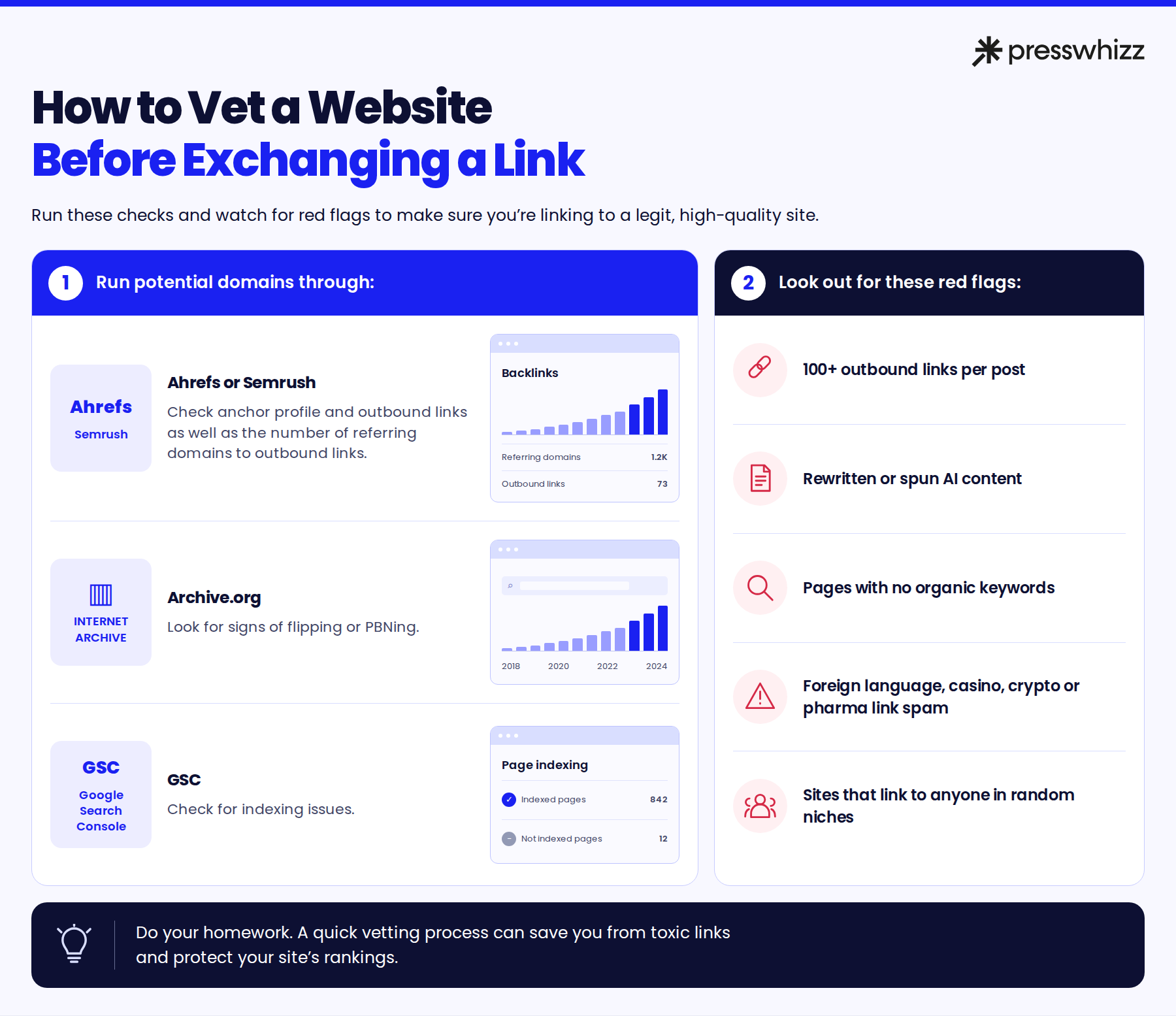
Then, look out for these red flags:
- 100+ outbound links per post
- Rewritten or spun AI content
- Pages with no organic keywords
- Foreign language, casino, crypto or pharma link spam
- Sites that link to anyone in random niches
If it looks like it came off a BHW marketplace spreadsheet, skip it!
You’re going to need link building tools to do this, so I suggest getting Ahrefs or Semrush.
Step 3: Structure It Like a Natural Link
There are five golden rules to making sure Google doesn’t deem your link swaps unnatural:
- Link contextually inside content (never footers or author bios)
- Use natural anchors (partial match, branded, or long tail)
- Place them on aged URLs, not freshly published “partner posts”
- Change your writing style and structure on every placement
- Vary your link type (naked, branded, CTA, image)
Your job is to make it indistinguishable from an organic mention.
Step 4: Use Three-Way or Four-Way Structures
Google can detect reciprocal patterns, and I’ve seen countless sites caught out for going overboard.
To reduce your footprint, try to always structure swaps like this:
- A → B, B → C, C → A
- A1 (your site) → Partner B
- Partner C → A2 (your other site)
Or for agencies:
- Client A links to site B
- Site B links to Client C
- Client C links to A
That way, the pattern looks completely disconnected, even though the juice flows back to you/your sites every time.
NOTE: This is a lot like the tiered link building strategy, though it’s a bit different. Read up on tiered link building to get a feel for building links safely.
Step 5: Keep Logs and Track Everything
If you take one thing away from this article, it’s that you should track EVERYTHING (and link exchanges are safe).
Keep a log of:
- Who you swapped with
- Where your link lives
- Anchor text used
- Placement type (guest post, niche edit, etc.)
- Date placed
- Date rechecked
And re-audit links every 3–6 months!
In this business, swaps die, sites flip, people sell links to god knows who without telling you.
If you’re going to build this network, own it!
How to Ask for a Link Exchange (Example Link Swap Outreach Email)
If you want to outreach to niche sites that you have no prior connection with, then here’s an email template to steal from us:
Subject: Are you interested in a link swap with a DR [x] website?
Hey [Name],
I run [Site A] in the [niche] space.
I’ve got a few relevant sites and I’m looking to swap some contextual links that make sense from a user and SEO standpoint with your site.
I can link to your site from [Site C] (DR [xx], traffic [xx]), and in return, would love a mention on [Page URL or Domain].
No forced anchors. Contextual only. I don’t waste time with spam!
Let me know if you’re open, happy to share ideas and see how we can work together.
Cheers,
[You]
Just edit the parts in brackets.
What Are the Risks of Link Exchanges?
Link exchanges carry risks, such as penalties, SEO devaluation, and algorithmic downgrading, but they’re very rare. Link swaps only cause problems when exchanges are abused at scale or used primarily to manipulate your search engine rankings. The main risks include:
- Google penalties: Google considers excessive link exchanges a form of link spam (or link schemes). If your link profile becomes dominated by obvious link partnerships, those links could be ignored or, in more serious cases, contribute to a manual action.
- Unnatural link patterns: Google knows what “real” link building looks like and what spam looks like. Repeated reciprocal links, irrelevant websites, heavily optimized anchor text, and large-scale cross-linking create patterns that Google will easily snipe as spam.
- Low-quality link partners: This is probably the biggest risk, and it’s the risk I hear about the least. Getting low-quality links from irrelevant websites could hurt your SEO. SEOs are so worried about penalties that they forget the main risk of swaps (including guest post swaps) sitting right under their noses: Lower search rankings.
Don’t worry. These risks shouldn’t scare you away from link exchanges entirely. The key is moderation: exchange links with quality, relevant websites and avoid turning swaps into the majority of your link-building strategy. And of course, your links should come not only from exchanges, but also natural link building, buying links, guest post link building, etc.
| Type of Link Exchange | Risk | Works in 2026? | Safe Setup |
|---|---|---|---|
| Direct A ↔ B swap | 🔴 High | ❌ Not worth it | Avoid unless it’s once per 100+ links. |
| A → B, B → C → A | 🟡 Medium | ✅ Yes | Use different CMS, IPs, and link styles. |
| Guest post swap | 🟢 Low | ✅✅✅ | Don’t use exact match anchors or same authors. |
| Homepage link exchange | 🔴 High | ✅ If rare | Cloak to bots, rotate links, keep below fold. |
| Client crossover swaps | 🟢 Low | ✅✅✅ | Use naturally within relevant content. |
| Niche edit swaps | 🟡 Medium | ✅✅ | Avoid inserting on old pages that never change. |
Final Thoughts
I hope this link swapping guide has helped you see the truth about this valuable link building technique.
Link exchanges are not against Google’s spam guidelines. Only scaled abuse of link exchanges is forbidden. How many link exchanges can you do? There’s no real answer to that. Just don’t abuse the system too much.
My advice to you is to get into private groups on Telegram, Facebook, or Skool or attend in-person events and network with other trusted SEOs. This is the best way to find high-quality link exchange opportunities.
Avoid random people on Facebook and don’t use link swapping services you find on Google, unless you want your rankings to plummet.
Of course, I must also say that link swapping is just one link building method you should be using. You should also be using:
- Digital PR
- Guest posts
- Niche edits
- Cold outreach
- Creating link magnets
- Link reclamation
The goal is a holistic approach to link building that results in a high-quality and diverse backlink profile.
I wish you luck.
– Dusan Novakovic