

Guest blogging for SEO is when you write an article and publish it on another website in your niche in order to earn a backlink, drive referral traffic, and improve your brand’s visibility in Google.
Guest blogging, also known as guest posting, is a common SEO tactic that helps websites earn valuable backlinks that improve their search engine rankings.
If you’re new to SEO or interested in building links to your business’s website, you’re going to love this guide.
In it, our team of link builders will walk you through everything you need to know about guest posts. Everything you read in this guide is based on decades of combined experience in the SEO industry.
This guide to guest posting includes:
- The definition of guest posts
- How it benefits your business
- How to find high-quality opportunities using our proprietary link building process
- How to do guest post outreach properly
- Our favorite sites for building links
And a lot more. And unlike every other guide on this topic, we are not just rehashing whatever influencers say. This is 100% real advice from people who build links for a living in the most competitive niches.
By the end, you’ll know what guest blogging is, how to do it properly, how much it should cost (less than you think!), and how to find high-ROI opportunities that other SEOs miss.
Ready? Let’s begin.
What is a Guest Post?
A guest post is a blog article written by one website or business that gets published on another website’s blog. With guest posting, the host site gets a free blog, while the website that writes the blog gets a backlink and referral traffic. Business owners write guest blogs in order to improve their SEO rankings, increase brand awareness, reach new readers, and build trust online.
Backlinks are a top 3 Google ranking factor. Links act as votes of confidence to Google, so the more high-quality backlinks you have, the better your search engine rankings will be (in general). So, site owners will publish articles on other websites with a link back to their own site in order to improve their SEO.
The guest posting process typically works in the following way:
- You Find a Website: Site owners look for niche-relevant websites to partner with from within their own industry.
- Pitch an Idea: They come up with an idea, either based on business value or SEO keyword research, and send a pitch email asking for a guest post placement on the website.
- Negotiate Terms: This is when you iron out details, such as pricing, dofollow vs. nofollow link status, how long the link will be live, and anchor text.
- Write and Publish: The business owner creates a high-quality piece of content, and the site owner publishes it on their site with a link back to the specified page.
We will cover all of this in much more detail throughout this guest post guide. For now, let’s move on to the benefits of guest posting for SEO (because that’s what we all care about in the end…).
Here’s an example of a guest post we had published on an SEO blog, Serpwatch.io:
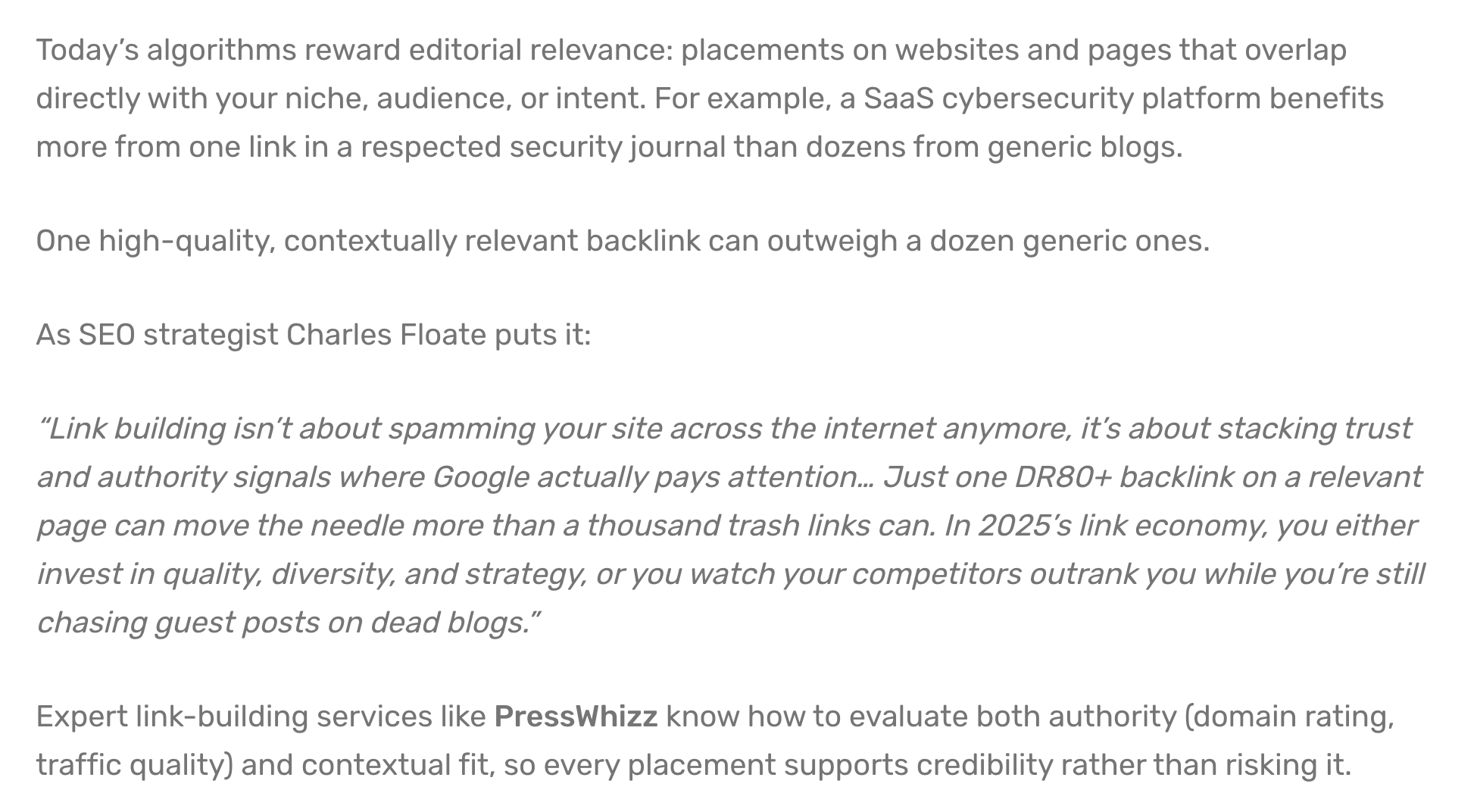
We created an article around the topic of link building, included an expert quote, and provided helpful tips for the audience. The publisher loved it, and we get a backlink.
What Are The Benefits of Guest Posting for SEO?
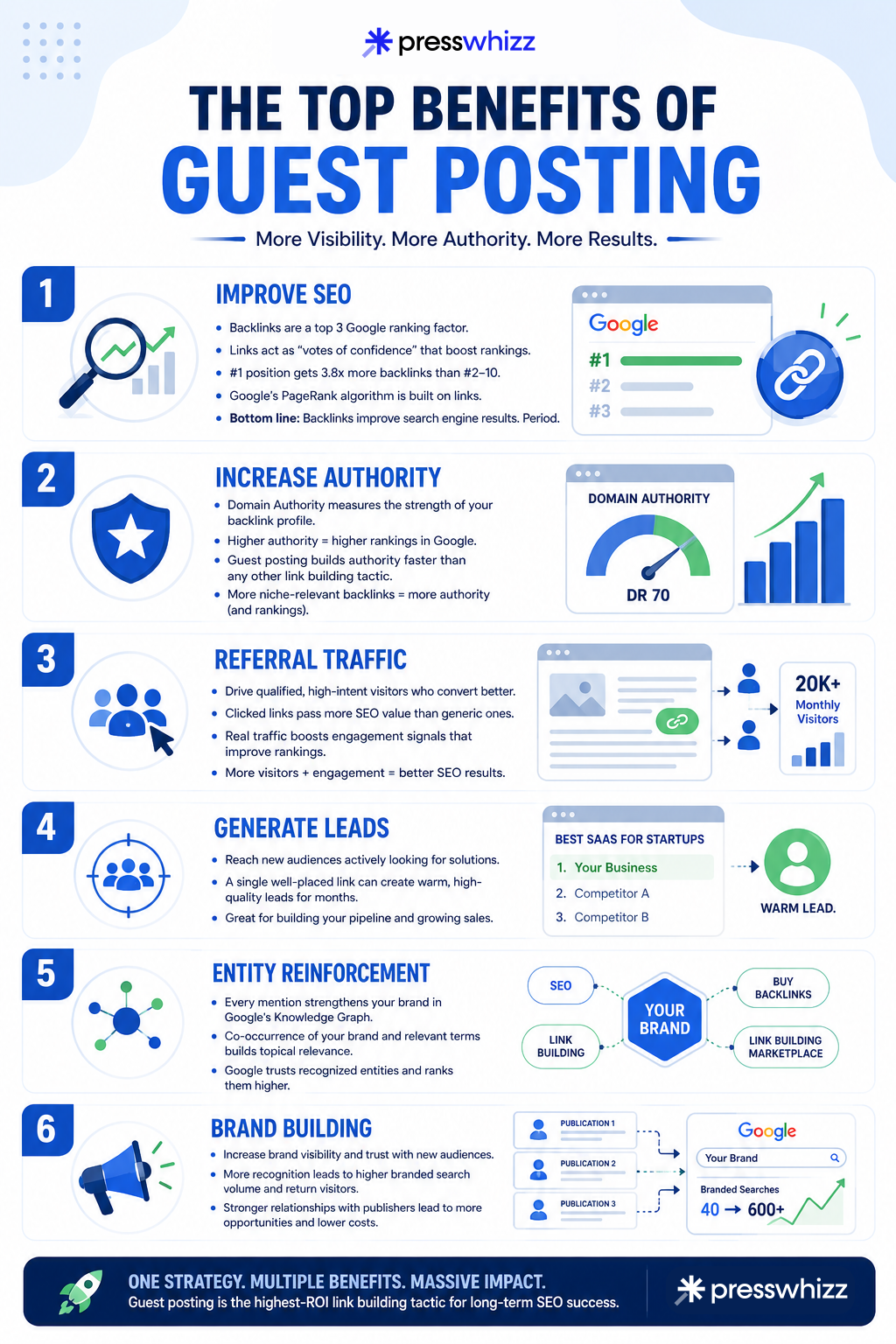
The benefits of guest posting for SEO range from boosting search engine rankings and increasing domain authority to sending referral traffic, generating sales leads, and brand enhancement.
I’ll cover each of these benefits of guest posting in more detail below:
Improve SEO
Backlinks are one of Google’s top 3 ranking factors. When one site links to another site, it acts as a “vote of confidence” in Google’s eyes, which increases your search engine rankings. Backlinko analyzed 1 million search results and found the #1 position pulls 3.8x more backlinks than positions 2 through 10.
Google publicly downplays the importance of backlinks, but their foundational algorithm, PageRank, is actually based on links.
Larry Page filed the PageRank patent (US 6,285,999) in 1998, and it describes ranking pages based on the number of times other websites link to that page. And the 2024 API content warehouse leak then exposed a siteAuthority field inside Google’s quality signals, which they denied for over a decade.
Bottom Line: Backlinks improve search engine results. Period.
Increase Authority
Domain Authority is a metric that quantifies the strength of your backlink profile, and, in general, sites with more authority tend to rank higher in Google. Domain Authority carries less weight today than it did five years ago, but it still decides which pages Google trusts enough to rank for competitive terms.
Authority still matters because it determines how much equity a site has to pass in the first place. The 2024 API content warehouse leak revealed pageRankNearestSeedVersioned, a system that measures a site’s value by its distance from a set of trusted seed sites. A DR 70 publisher three hops from a seed passes valuable SEO equity.
So, how does this relate to guest posting?
Guest posting builds that authority faster than any other link building tactic because you choose the domains, the topic, and the page where you build links. You target publishers in your niche with organic traffic and a clean outbound profile, then place your link inside body content on a website Google already trusts. This results in more niche-relevant backlinks, which increases your authority (and rankings).
Referral Traffic
Referral traffic from a link delivers two separate wins: qualified visitors who convert and a stronger SEO signal on the link itself. A placement on a niche publisher with 20,000 monthly visitors can drive dozens of high-intent clicks per month from people who already trust that publication’s recommendations, and those visitors convert better than cold search traffic because someone they read vouched for you first.
On the SEO side, clicked links pass more weight than generic ones. Google’s Reasonable Surfer patent (US 7,716,225) assigns each link a probability that a user actually clicks it, then weighs the equity accordingly. A link sitting in the third paragraph of an article about your exact topic scores high on that model. The same link buried in a footer, a sidebar, or an author bio at the bottom of a 4,000-word post scores close to zero, which explains why so many DR 70 placements produce nothing.
Real traffic also feeds the engagement signals on your website, which we know to be a Google ranking factor. Visitors who arrive from a relevant publisher tend to stay longer, click deeper, and return through branded search later. Google is well aware of these metrics and factors them into their rankings.
So, by publishing guest posts on relevant industry websites, you get a backlink and interested readers who engage with your content. Both of these results improve your SEO.
Generate Leads
A guest post on a publisher in your industry can generate interested leads if you choose the right sites. If someone searches for “best SaaS for startups” and finds your business on a trusted website’s listicle, they could easily become a warm lead. A well-placed link on a relevant, high-traffic page can easily generate high-quality sales leads for months.
Entity Reinforcement
Google stores your brand as an entity in its Knowledge Graph, and every mention on a relevant publication tightens the connection between that entity and the topics you want to rank for. For example, if a link building marketplace like ours builds links on SEO blogs, this tightens our relevance between SEO terms and our brand. Over time, Google trusts us more when ranking brands for search terms such as “link building marketplace” or “buy backlinks”.
This is something called “co-occurrence”. It’s when your brand name appears alongside terms associated with your industry on different websites. Google reads that repetition as consensus about what you do.
I won’t bother you with the geeky details, but the gist is that Google’s patents on entity salience score how central a named entity is to a document, so a guest post where your brand appears in the intro, the body, and the author bio reinforces the association harder than a single anchor text link at the bottom of an unrelated article.
Google ranks brands it recognizes as authorities on a subject, and recognition comes from consistent mentions in the same topical neighborhood as your competitors. Guest posts on relevant publishers put you in that neighborhood on purpose instead of waiting for journalists to find you.
Brand Building
Last up, guest posting improves your brand visibility and trust with readers. Someone who sees your name across three separate publications they already follow remembers you when they open Google, and that recognition turns into branded search volume and return visitors. I’ve watched clients climb from 40 branded searches a month to 600 over a year of consistent placements, with their non-branded rankings rising alongside it. Recognition also changes how publishers treat you. Once editors know your name, they answer your pitches and quote you without being asked, which turns paid placements into free ones and drops your cost per link.
Advanced SEO Guest Post Strategies
Some of the best guest posting strategies include writing listicles, obtaining PR coverage, and publishing case studies. Here’s more on the best guest post strategies in SEO:
Standard Guest Posts
A standard guest post is a full article you write for another site with a link back to your pages inside the body content. You handle the writing, the publisher handles the audience, and the placement fee covers the editorial access.
In our experience, this is the most common type of guest post.
Follow the site’s guidelines exactly and your posts should get accepted easily. Editors reject far more posts for ignoring the brief than for weak writing, so hit the word count, match their heading format, and cap your outbound links at whatever number they allow.
One more tip: Keep the self-promotion light. One contextual link to a relevant resource plus a brand mention reads as natural, while three links to your pricing page reads as an advertisement and gets stripped in editing.
Guestographics
A guestographic pairs an original infographic with a short intro paragraph you write for the publisher, so they get free visual content, and you get a contextual link inside the post.
The benefits of guestographics are:
- Infographics generate engagement and backlinks at equal to or higher rates than standard posts.
- You don’t need to write a full post. You can just create an infographic with AI and submit it.
- Infographics have the ability to go viral. It’s easy to share an image, which will generate more backlinks for your site.
Here’s an example of a guestographic on a real estate website:

Listicles and Roundups
A listicle guest post is one you write in list format, such as “the 12 best project management tools” or “the top alternatives to Asana”. It’s common for businesses to rank themselves #1 in these listicles, though Google is cracking down on this practice (it may be seen as spam). Listicles typically target buying-intent keywords.
ChatGPT, Perplexity, and AI Overviews also lean on “best of” pages when someone asks which tool to buy, so one placement feeds your rankings and your AI citations. But now that SEOs are spamming listicles, I advise you to practice caution.
A few listicle tips include:
- Don’t always place yourself #1
- Include real notes and testing data
- Don’t publish dozens of lists in a short time frame
Case Studies and Original Data
A case study guest post is a type of guest post in which you present your own campaign results, survey data, or internal numbers, then link back to your website.
Case studies are a great way to promote your business and generate high-quality backlinks at the same time. For one, they are unique and usually helpful to others. But they also add to Google’s Knowledge Graph and paint your business in a positive light.
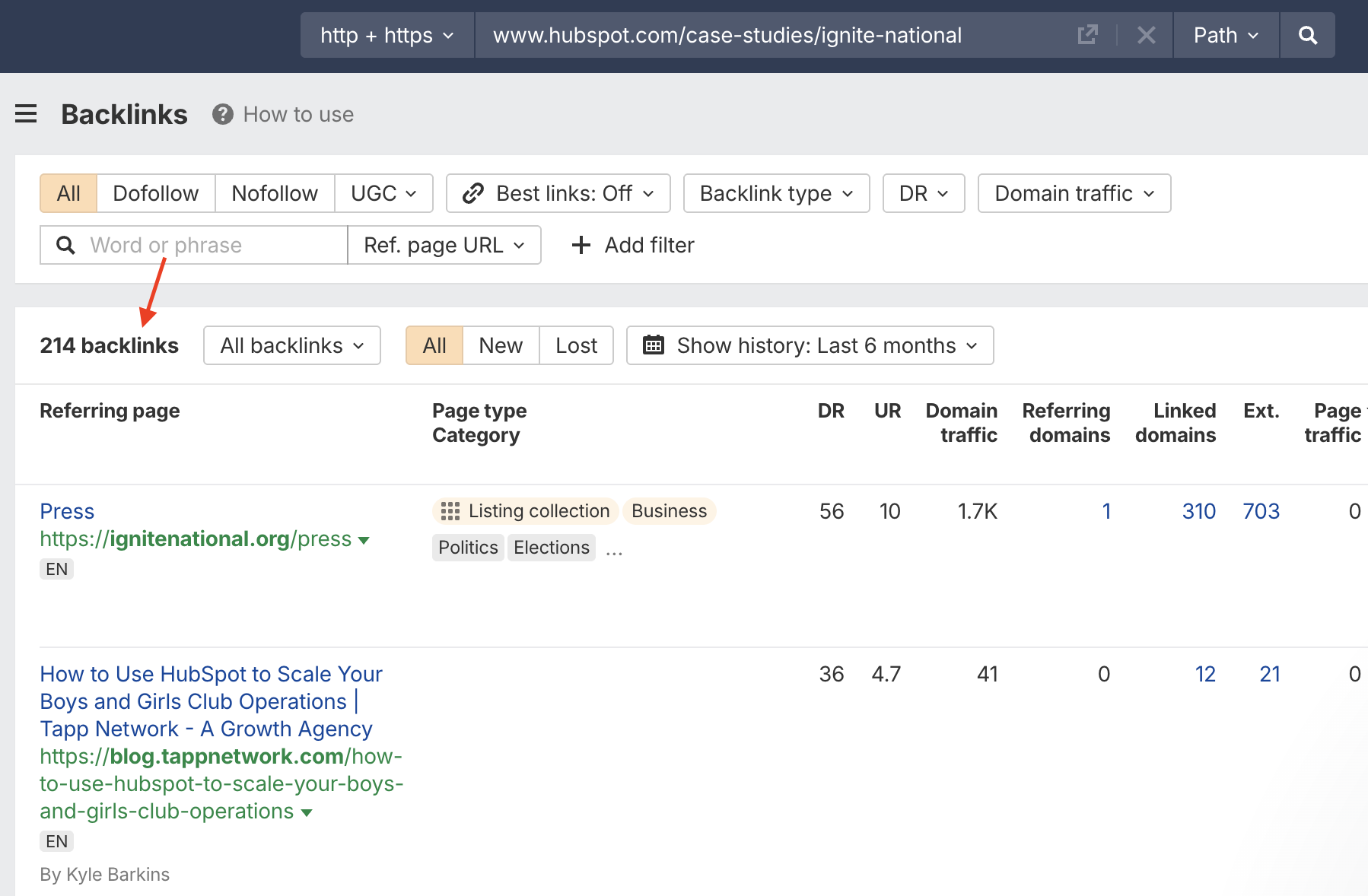
Here’s a great example of a case study from HubSpot that generated more than 200 backlinks:
Pro Tip: If you’re building links for a new website, ask previous clients whether they’ll host a case study about the work you did for them. They get free content that makes their company look good and you get a relevant backlink from an established domain. That’s a win-win for everyone.
Local Guest Posts
Local guest posts are when you publish guest blogs on a city publication, regional news site, chamber of commerce blog, or neighborhood business directory instead of a national industry site.
Local guest post prices are typically lower than national placements in the same niche, often $50 to $200, because these sites get fewer pitches and have no established rate card. They also feed the geographic relevance signals that help businesses rank in the Google map pack and city-level rankings.
Digital PR Placements
Digital PR backlinks are links from large media websites such as Forbes, USA Today, or Yahoo. Digital PR earns you editorial mentions by either buying a feature on these websites or pitching a unique story that the business wants to run (though it’s mostly the former).
For example, you could pay to announce something about your business in Reuters or Forbes, or you could run a relevant news story in a local newspaper. These are some of the best backlinks you can earn in the SEO industry. They are normally high-DR, high-trust, and come with tens of thousands of monthly organic visitors. Even if the links are nofollow, you still get referral traffic and entity reinforcement benefits.
Check out this example of a PR placement from Times Africa:
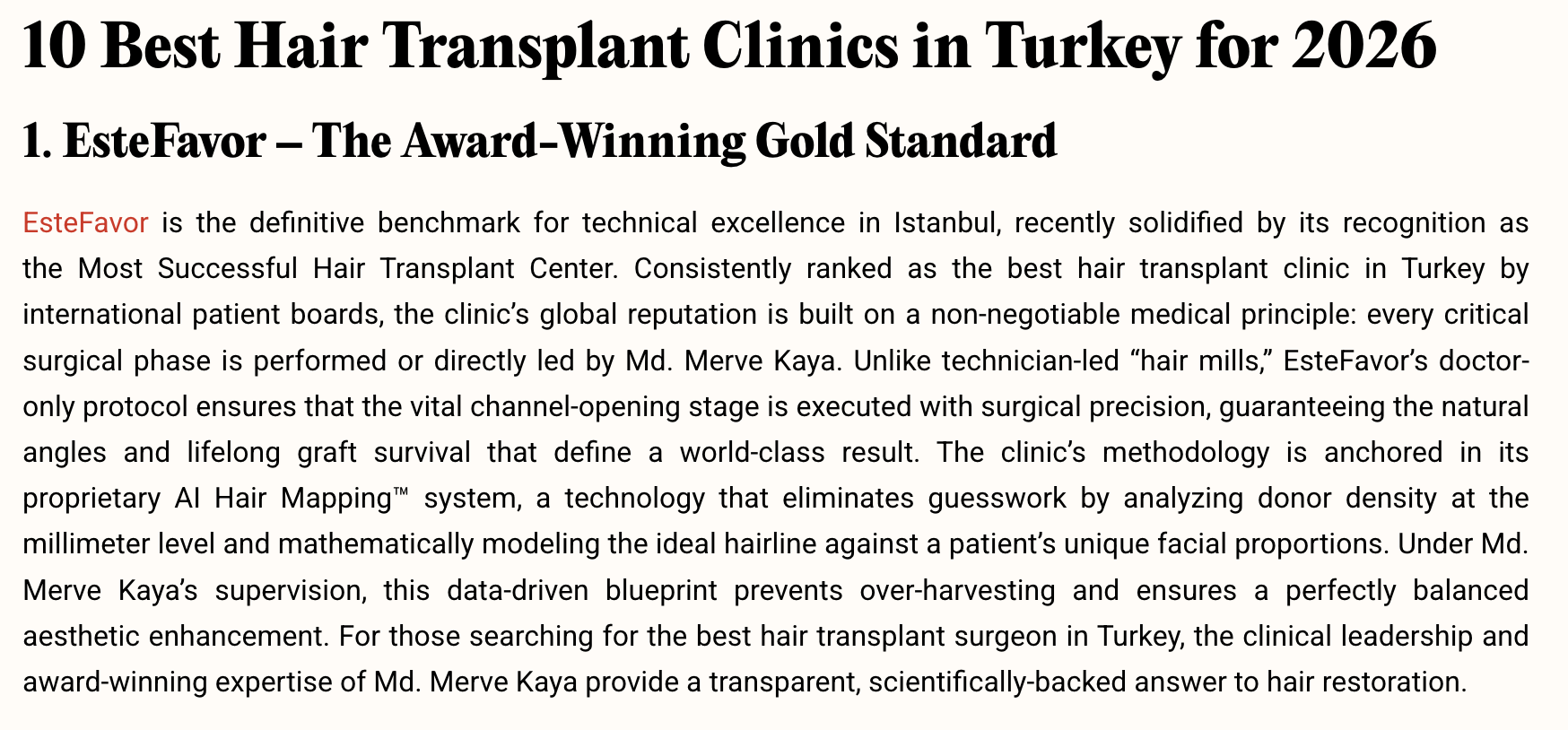
This Turkish hair transplant clinic got a placement on this media site, which is a great link. And it ranks for “hair transplant Turkey” as well.
Guest Post Pricing
The average guest post costs $164 in 2026, based on 12,297 completed guest post orders in our own marketplace data. The three most important factors in guest post pricing are organic traffic, domain authority, and niche. No niche is inherently “more expensive” than the others. It’s supply and demand that results in higher prices. For example, it’s much harder to start a legal blog, AND Google has a higher threshold of trust for legal websites. So, the supply is smaller and the demand is higher, which results in higher link prices.
Every pricing survey you’ve read on this topic asks SEOs and agencies what they charge. Those answers come from people who sell links, which inflates the numbers, and most of them quote whatever an agency quoted them at some point. So we pulled 22,703 real placements worth $3.66 million from our own order data and analyzed what buyers actually paid.
Here’s what the numbers showed:
- The median price of a link is $112
- Guest posts account for 64% of total orders and 75% of revenue
- Traffic is more important than authority
- Casino and gambling links are the most expensive
- Customers prefer media and PR backlinks over other types of guest post link building
I suggest you read the full report for more details on link pricing.
The full breakdown includes anchor text distribution, country data, and niche-by-niche pricing charts. Read the Link Building Price Report 2026 if you want the numbers behind guest post pricing.
How to Do Guest Post Outreach
The best way to do guest post outreach is to choose niche-relevant prospects with real traffic and rankings, reach out with personalized emails, find topics that fit their audience, and pitch with a clear subject line and a concrete offer.
We built a proprietary version of this process over years of managed campaigns and documented all of it in our guest post outreach guide. Here’s the quick rundown on our outreach process:
- Build your prospect list: Stack Google operators like “write for us” and “become a contributor” to find sites in your niche, then reverse engineer competitor backlinks in Ahrefs Site Explorer to find publishers who already sold placements to your competition.
- Verify contact information: Use a mix of tools like Hunter.io and social media plus Google operators to verify contact information.
- Lightly personalize outreach at scale: Volume outreach with light personalization gives you a proven template plus an AI-written opener based on the prospect’s recent content, which lets you send hundreds a week.
- Research topics that fit their site: Read their editorial guidelines, then run a keyword gap analysis in Ahrefs Competitive Analysis tool to find terms their competitors rank for and they don’t.
- Write the pitch and the article: Use a clear subject line, an opener referencing a specific article or content gap, a two-line intro, your three ideas, and a simple question asking which fits. Then create high-quality content. If you want to learn how to write a guest post properly, we have a guide for that.
- Follow up: Send Tuesday through Thursday in the recipient’s morning and their time zone, then check in on day 4 or 5 and send one final note around day 10 to 14.
- Track everything: Log open rate, reply rate, positive reply rate, placement rate, cost per placement, and the DR and organic traffic of every site you land. A/B test one variable at a time so you know which change moved the number.
- Deliver and keep the relationship: Submit an article that needs almost no editing, with original screenshots and data, then promote it across your channels after publication.
There’s no space to go into full detail here in this guest post guide. I recommend you read the full how-to guide on guest post outreach to learn our processes in detail as well as the tools, AI systems, and tactics we use to land link placements.
How to Find Guest Post Opportunities
One of the most common questions we see on social media (and hear at conferences) is “how do I find high-quality guest post opportunities?”. The problem with guest post websites (we cover those below) is that every SEO knows them.
You know how the SEO industry is: Once one SEO knows a trick, everyone in the industry starts repeating it. Now, sites like Medium and Substack are overrun with copycats.
If you want to find legit high-quality guest post opportunities, you need to take things to the next level and put in more effort than your competitors.
To find good link building opportunities that other SEOs don’t know, follow this process:
- Google search operators: Combine footprints like “[keyword]” “write for us”, “[keyword]” “become a contributor”, and inurl:write-for-us, then rotate keywords and search adjacent industries so you’re not pitching the same burned list every agency is using.
- Competitor backlink analysis: Drop a competitor into Ahrefs Site Explorer, open the Backlinks report, filter for dofollow and one link per domain, then look for author bios and contributor pages.
- Free guest posting sites: Useful only for foundation building on a new domain, where a handful of placements diversify your referring domains and validate your brand as a real entity.
- Curated lists: Someone already compiled sites accepting guest posts, usually sorted by niche, which can help you get started. They’ll most likely be burned as well, but not as burned as the free sites. In our experience, prices for these sites have gone up in the last few years.
- SEO communities: Facebook groups, Slack channels, LinkedIn, and X have publishers advertising open contributor slots and link exchanges. Just be careful. There are a lot of scams out there, and even if you get your post published, there’s no guarantee that it’ll stay live for years or pass any value.
- Guest post marketplaces: We are biased, of course, but we think guest post marketplaces (like PressWhizz!) are the best way to buy backlinks these days. You can filter thousands of vetted publishers by DR, organic traffic, country, language, and category, then order without prospecting, negotiating, or chasing follow-ups.
Before moving on, we just want to say that this is easily a full-time job for one person. You may even need a team dedicated solely to guest post outreach. That’s why we recommend using our guest post marketplace. We’ve already done the hard work for you of finding sites, negotiating prices, and building relationships. Feel free to take a look at our database of websites and see if there are any in your niche.
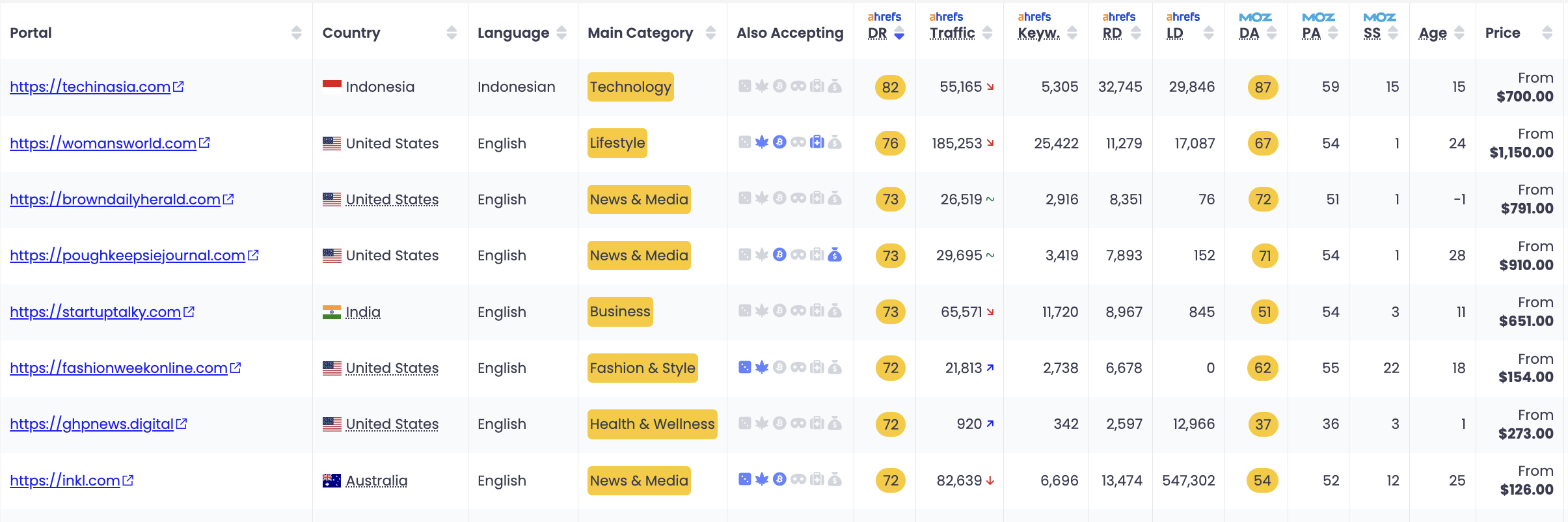
With PressWhizz, you can even skip the hard work and just put in your keyword and see which sites offering guest posts rank for that term. Just type in your keyword:
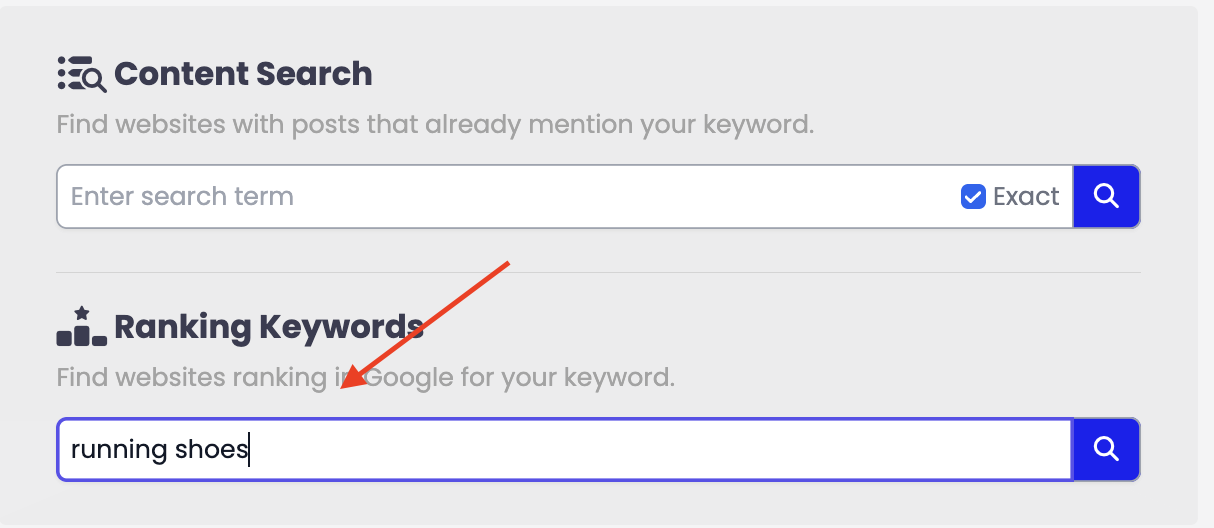
And you’ll see high-quality guest post opportunities immediately:
Best Guest Posting Sites
The best guest posting sites include Medium.com, LinkedIn Pulse, Substack, Search Engine Land, and Entrepreneur.
But keep in mind that these sites are losing value as more SEOs rush to publish low-hanging fruit backlinks. There’s still value in these sites for sure, especially ones like LinkedIn Pulse which also have parasite SEO value (these sites can rank on Page 1 in Google for competitive key terms).
We’ve already written a post on the best free guest posting sites, but a few of our favorite sites include:
- Medium
- LinkedIn Pulse
- Substack
- HubSpot
- Entrepreneur
- Search Engine Land
- Smashing Magazine
NOTE: Sites like HubSpot aren’t technically “free” unless you get a spot as an author. But if you can become a contributor, you’ll be golden.
If you go to our marketplace and sort by Domain Rating, you’ll see some of our best guest post sites at the top with filters such as country, traffic, pricing, and more:
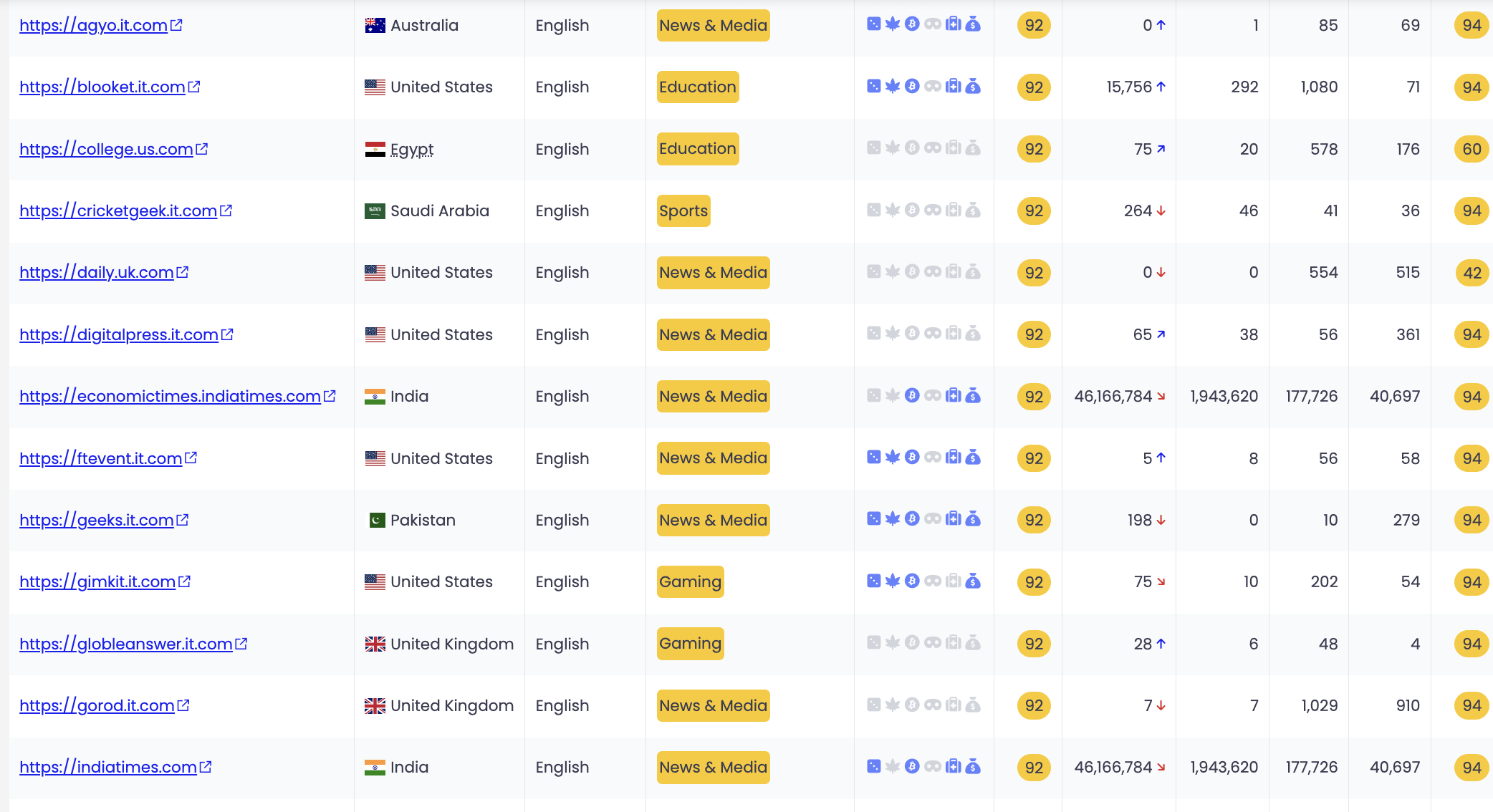
Note: Everyone knows the value of a guest post now, and free guest posting sites are getting devalued. You’ll probably have to buy guest posts to get the best quality, so prepare to budget accordingly.
Buying and Selling Guest Posts: What Does Google Say?
Buying and selling links, including guest posts, is against Google’s spam guidelines. Google explicitly states that buying links to manipulate search rankings is against Google Search Essentials and also a form of link spam.
However, in practice, they do not enforce these rules. Link building is a billion-dollar business, and some of the biggest sites that Google adores openly buy and sell links. There are thousands of marketplaces, agencies, websites, and freelancers openly selling guest post inventory with public pricing and DR filters, and they rarely receive penalties from Google.
Why is this?
Because enforcing the policy would require manually reviewing millions of publisher relationships, and no search engine carries the headcount or the incentive for that. Google’s algorithms handle the obvious patterns instead: publishers pushing out dozens of unrelated commercial posts a week, exact match anchors arriving in bulk, and domains with inflated DR and no organic traffic.
In recent times, we have facilitated tens of thousands of link placements here at PressWhizz with no issues. And collectively, our team has built countless thousands, if not hundreds of thousands, of links for sites in every niche imaginable. Google has never done anything about it unless there’s been some blatantly obvious pattern of manipulation.
Long story short: Buying and selling links is fine so long as you don’t abuse the system.
Guest Post Niches
Last up, we want to provide a list of the different guest post niches. If you’re a website in one of these niches, you’ll find websites offering guest posts specifically to your niche. Due to Google’s increasing sophistication, we recommend you purchase backlinks from niche-relevant websites.
Here are the most common guest post niches:
- SaaS and software
- Finance
- Casino and gambling
- Crypto
- Health and wellness
- Legal and law firms
- Real estate
- Ecommerce and retail
- Marketing and SEO
- Technology and development
- Home improvement and home services
- Travel and hospitality
- Automotive
- Education and edtech
- Pets and animals
Final Thoughts
Guest blogging for SEO is the highest-ROI tactic you can invest in for improving your rankings. Hands down.
Links are without a doubt a top 3 Google ranking factor (if not #1), and high-quality guest posts on niche-relevant websites are the best way to build links.
With guest posts, you get full control over the:
- Website
- Anchor text
- and content (though you do have to follow guidelines)
There’s a reason that the vast majority of our customers choose guest posts over niche edits when building links (though niche edits are still valuable).
My advice to you is…
Ignore what you read from Google and influencers. Instead, focus on what works. Over tens of thousands of link placements, guest posting has proven to be the single most effective tactic for increasing rankings.
Find niche-relevant websites, vet them, pitch unique articles, and track everything so you can optimize your link building campaigns.
I wish you luck.
– Dusan Novakovic