


If you’re wondering how to use ChatGPT for SEO, you’re going to love this guide.
ChatGPT and other artificial intelligence tools have made SEO easier and more efficient than ever before (as well as more competitive).
According to Ahrefs.com, 87% of marketers surveyed are using AI to create content. And according to Semrush, 64% of SEO teams use an AI-assisted workflow.
Here at PressWhizz, our AI SEO services team uses ChatGPT and other LLMs to do better SEO in a much more efficient manner. We are able to write SEO content, improve link building, and complete tasks like keyword research 10 times faster than before.
But you must be careful. ChatGPT is not a magic bullet. It cannot magically do SEO for you. And, if you do it wrong, you’re risking Google penalties, angry customers, and complete banishment from Google search engine results pages.
Don’t worry, in this guide to using ChatGPT for SEO, our AI SEO team will walk you through everything you need to know, including:
- How to use GPT for content writing
- How to use AI for SEO in general
- How to do link building and keyword research with GPT
- How to build systems that run on autopilot
- And how to build better prompts
If that sounds interesting to you, I suggest you read through this entire piece. It’s going to be very helpful.
First, what is the relationship of ChatGPT to SEO?
What’s the Relationship Between ChatGPT and SEO?

ChatGPT is a great SEO tool that HELPS you do SEO. It can research topics, organize keywords, analyze data, create content briefs, write schema, and automate repetitive tasks in a fraction of the time and for a fraction of the cost of a human employee. It can probably even do a better job than your typical junior VA.
…But it can’t do SEO for you.
As with all things AI, artificial intelligence tools should handle the tedious work while the SEO expert does the thinking and SEO strategy.
Yes, it’s true. We still need to work on SEO these days. Robots can’t do it for us…yet!
Anyways, marketers are already using AI heavily.
According to Ahrefs on its page, “Marketers Using AI Publish 42% More Content,” 87% of the 879 marketers surveyed use AI to help create content. ChatGPT was also the most commonly used AI tool, with 44% of respondents using it. So, GPT is ultra popular, and if you aren’t using it, you’re behind the curve.
There’s also another side to the relationship.
ChatGPT is becoming a search surface itself. People now use ChatGPT and AI Overviews to find information, compare products, and research companies. That means SEO increasingly includes getting your content mentioned or cited in AI-generated answers.
So, we’re really talking about two things: Using ChatGPT to do SEO more efficiently and doing SEO to increase your visibility in AI search. We will cover that latter topic in a guide on how to do SEO for ChatGPT.
Moving on, let’s get to the SEO tasks we use ChatGPT for…
SEO Tasks We Use ChatGPT For
We mainly use ChatGPT for content writing, AI link building, and other manual tasks. We also use ChatGPT for keyword research (especially for sorting, merging, and analyzing keyword lists).
If a task involves sorting thousands of relevant keywords, checking hundreds of pages, or repeating the same process over and over, there’s a good chance AI can help.
If it involves thinking, strategy, branding, or in-depth expertise, we use our own brains (they still work!).
Some of the SEO tasks we use ChatGPT for include:
- Keyword research and clustering
- Content briefs and outlines
- Metadata and on-page optimization
- Schema markup
- Competitor and SERP research
- Link building and outreach
- Content audits and quality control
The highest-value tasks usually have clear inputs, clear instructions, and a predictable output. Give ChatGPT a keyword export and clustering rules, for example, and it can complete hours of manual organization in minutes.
We also use it for oversight. ChatGPT can check AI-generated content against a predefined quality-control checklist and flag issues an editor might miss.
What we don’t give it is final judgment or any high-level-thinking SEO tasks. That’s a recipe for disaster. Strategy, client context, prioritization, and important editorial decisions still stay with experienced SEOs.
The goal isn’t to replace your SEO team. It’s to remove as much tedious work from their day as possible.
Ok, enough rambling. Here’s how to use ChatGPT for search engine optimization.
7 Ways to Use ChatGPT for SEO
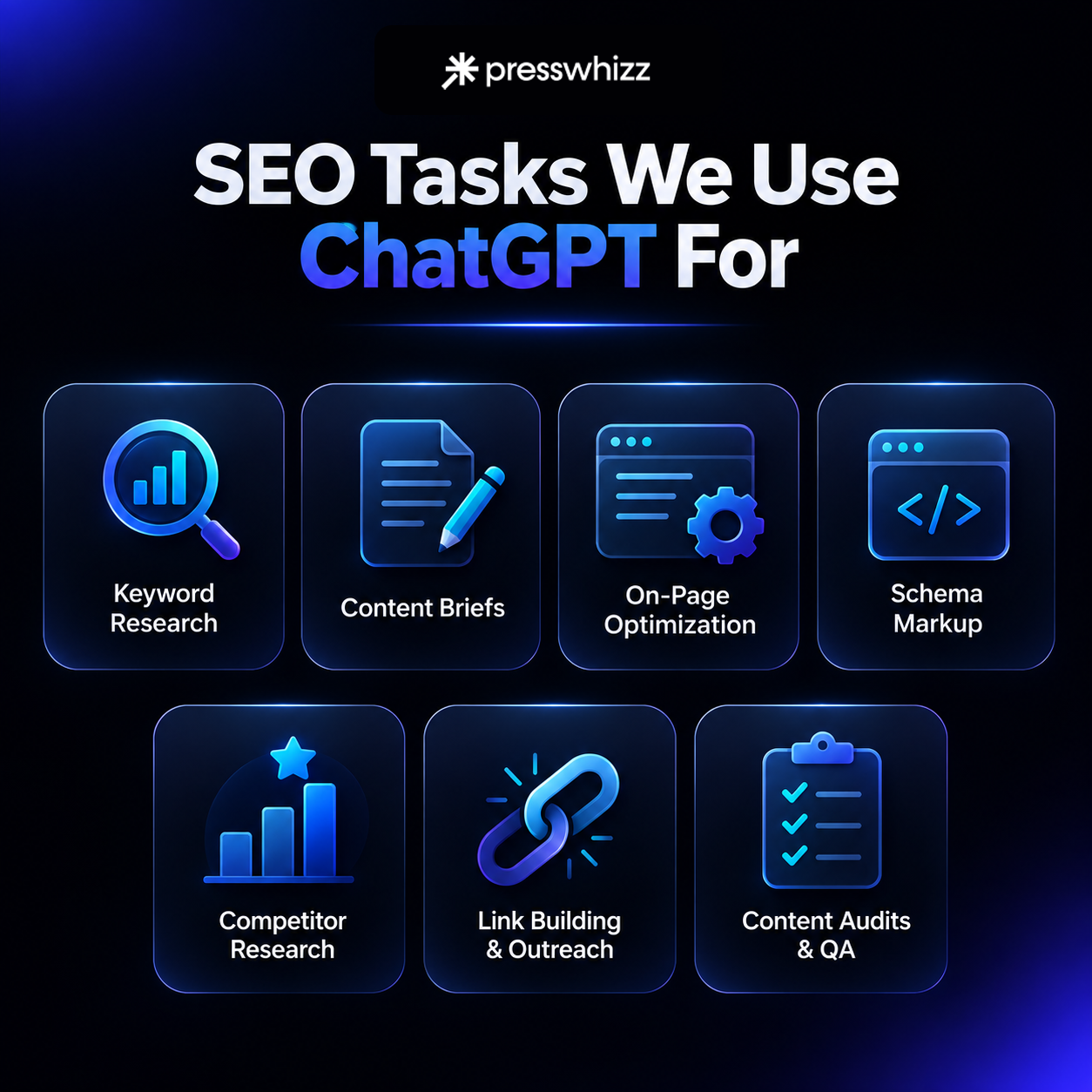
We use ChatGPT for SEO tasks such as keyword research, content planning, on-page optimization, link building, technical SEO, and AI visibility.
Here are the ways we use ChatGPT for SEO in more detail:
1. Keyword Research
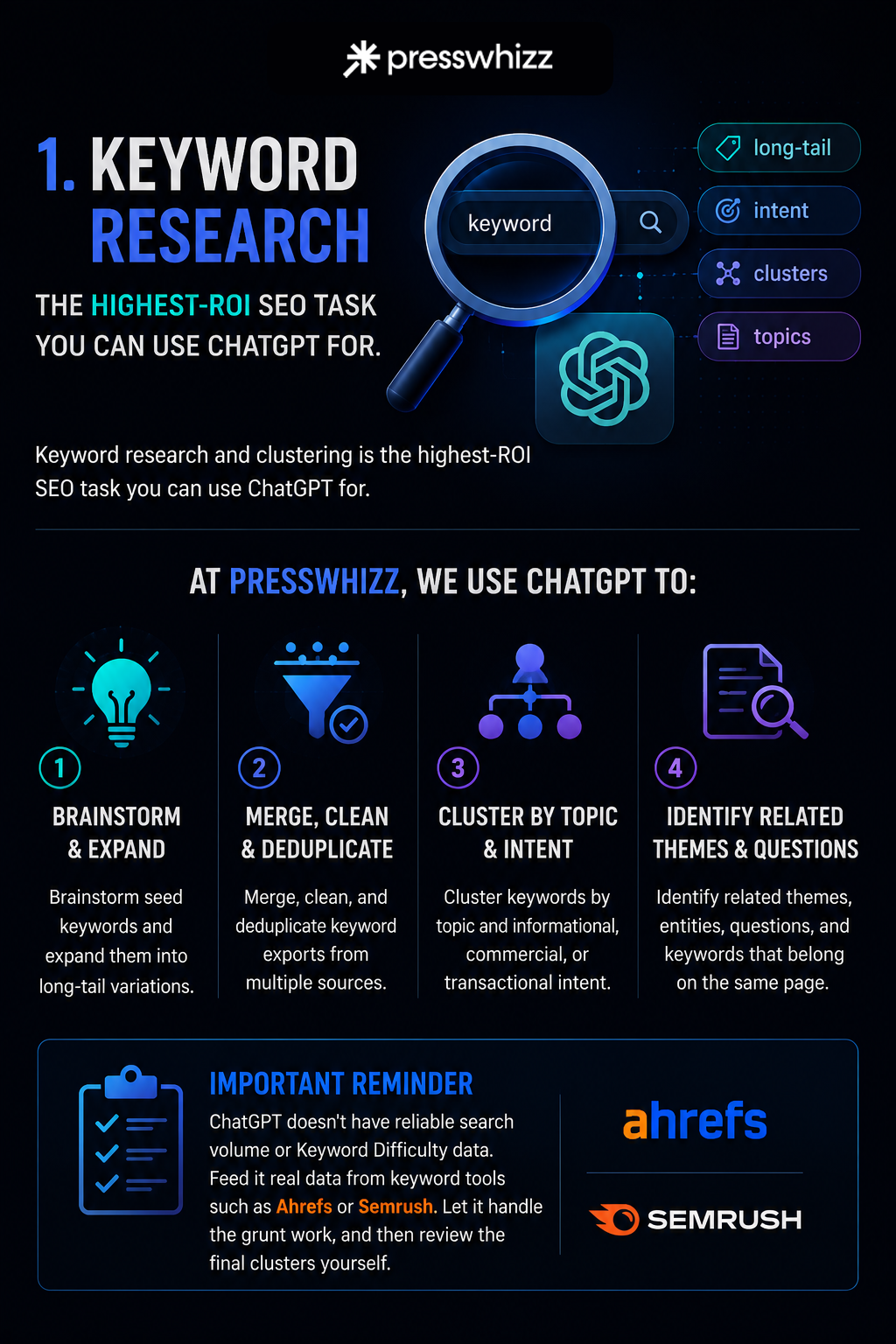
Keyword research and clustering is by far the highest-ROI SEO task you can use ChatGPT for.
A human can spend days sorting through thousands of keywords, removing duplicates, identifying intent, and deciding which terms belong on the same page. ChatGPT can do much of that work in minutes.
ChatGPT is excellent at this SEO task because analyzing keywords and turning them into keyword clusters is repetitive and pattern-based. AI can compare thousands of terms and remove duplicates, detect gibberish, remove irrelevant terms, and merge near-match terms quickly…and all without getting tired, losing focus, or becoming inconsistent halfway through a spreadsheet (like most humans do…and it never asks for sick days).
At PressWhizz, we use ChatGPT to:
- Brainstorm seed keywords and expand them into long-tail variations
- Merge, clean, and deduplicate keyword exports from multiple sources
- Cluster keywords by topic and informational, commercial, or transactional intent
- Identify related themes, entities, questions, and keywords that belong on the same page
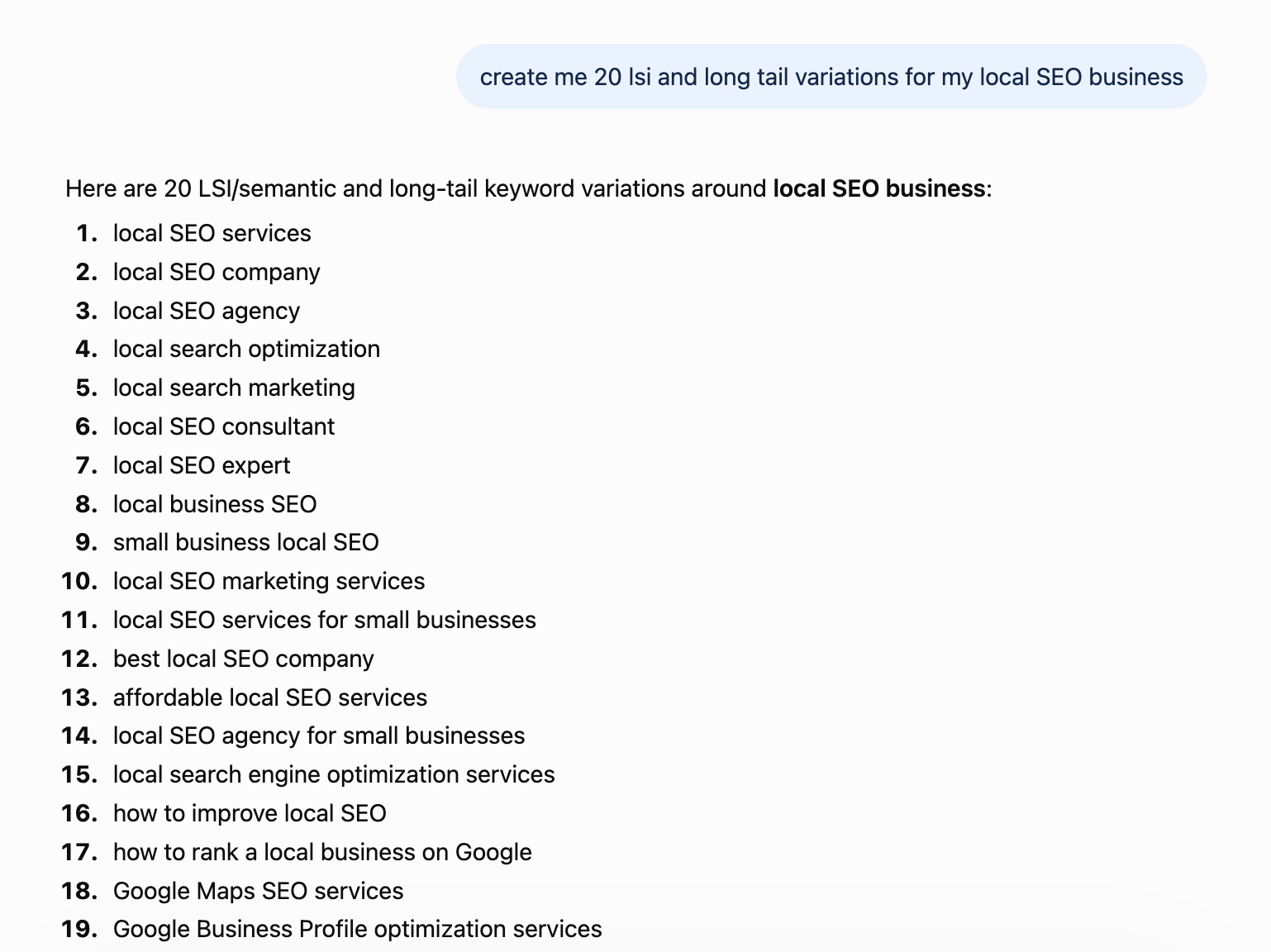
Look at how many keyword ideas you get just by asking:
Just remember that ChatGPT doesn’t have reliable search volume or Keyword Difficulty data. Feed it real data from keyword tools in the SEO industry, such as Ahrefs or Semrush. Let it handle the grunt work, and then review the final clusters yourself.
For more information, see our full guide on ChatGPT for keyword research.
2. Content Briefs
ChatGPT is great for creating content briefs because briefs are structured, repetitive, and heavily research-based. Once you give it the right data and instructions, it can turn hours of SERP research into a detailed document for your writer.
Adding this ChatGPT SEO content strategy into your daily processes could easily save you hours of work (and even lean out your team a bit).
Ask almost any SEO and they’ll tell you the same thing: they hate content briefs. Researching competitors, pulling headings, finding questions, assigning word counts, and writing talking points for every section gets tedious fast.
Here’s what to do:
- Give ChatGPT your primary keywords, user intent, internal links, target audience, secondary keywords, and search intent
- Feed it headings and topics from the top-ranking competitors
- Add relevant SERP questions, entities, Reddit research, and other useful information
- Ask for H2s, H3s, word counts, and detailed talking points for every section
This content brief was created in seconds flat and includes SERP research, AI overviews, ICP, and a lot more:
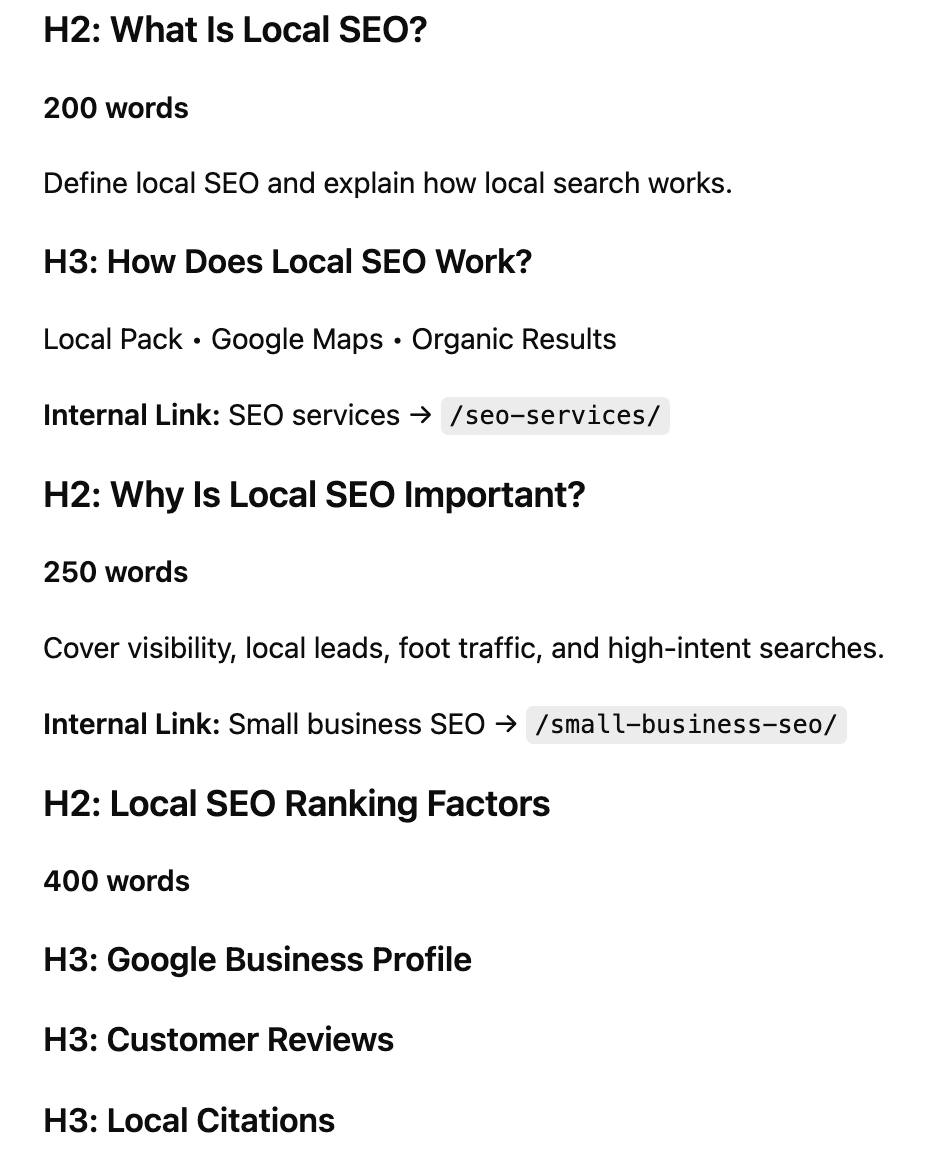
At PressWhizz, we also give ChatGPT examples of our existing briefs so it understands exactly how we want them structured.
You still need to review the finished brief, but ChatGPT can eliminate most of the repetitive research and formatting.
3. On-Page Optimization
ChatGPT is a godsend for on-page SEO, which has always been one of the most tedious and time-consuming parts of the job. We all remember having teams of SEO VAs writing meta descriptions for days on end.
Before AI, agencies often needed teams of VAs doing boring, assembly-line SEO work: writing hundreds of meta descriptions, optimizing title tags, checking headings, adding alt text, and reviewing pages against the same checklist. It was the worst part of running an SEO agency.
Thank science for AI. ChatGPT can now handle much of that work in minutes.
We use AI for on-page SEO tasks such as:
- Write and optimize title tags, page titles, and meta descriptions around target keywords
- Review headings, anchor text, image alt text, and keyword usage
- Batch-optimize hundreds of pages during content refreshes and site migrations
- Check pages against predefined on-page SEO requirements and flag anything that’s missing
The key is giving ChatGPT enough context. You can’t just say “do my on-page SEO”, go make a coffee, and expect to get it done right.
Instead, you need to feed it the page content, target keywords, search intent, and examples of properly optimized pages.
You can even give it your exact on-page checklist and have it review every page against the same standards, which leaves your SEO team time to focus on decisions that actually require judgment.
And, as always, oversee it and make sure it’s doing a good job. Correct its mistakes, show it why it’s bad, and watch it learn and improve.
We go into a lot more depth on using ChatGPT for technical and on-page SEO tasks in our guide on using ChatGPT for affiliate marketing.
4. Link Building and Digital PR
ChatGPT can help with almost every repetitive part of link building and obtaining digital PR backlinks, especially prospect research, qualification, outreach, and campaign planning. It can’t go knock on doors and get the highest-quality links for you, but it can help automate all the grunt work that comes with running a link building department.
At PressWhizz, we don’t use AI to decide whether a backlink is good based on one metric.
Instead, we give ChatGPT real prospect data and use it to help analyze relevance, traffic, authority, content quality, and whether the site actually makes sense for the target page.
You can also use ChatGPT to:
- Qualify large lists of link prospects using predefined criteria
- Analyze websites, journalists, and editors before outreach
- Write personalized outreach using information about each prospect
- Review backlink profiles and help plan anchor text distribution
- Find statistics, story angles, and hooks for digital PR campaigns
This is where AI can completely change how you structure a link building department. Prospecting, qualification, personalization, outreach preparation, follow-ups, and reporting traditionally require multiple people doing repetitive work every day.
With the right combination of AI workflows, templates, skills, and automations, you can automate much of that process while keeping humans in control of quality and strategy.
A small team can qualify thousands of prospects, prepare personalized outreach, manage campaigns, and review results at a scale that previously required an entire link building department.
For more information, check out our guide on AI link building with ChatGPT.
5. Content Writing
ChatGPT is incredible at writing SEO content.
It can create blog posts, landing pages, product copy, FAQs, introductions, and other website content in minutes. Like we said before, 87% of marketers are using AI to write content. I think you can see why.
With the right instructions, AI can produce engaging, natural-sounding copy at a fraction of the cost and time of a traditional human writing process. The important phrase there is “with the right instructions.”
Basic ChatGPT-generated content is awful, and readers and Google hate it.
Asking ChatGPT to simply “write me an SEO article” is usually how you end up with generic AI content. Nobody wants to read AI slop. Even worse, you might get penalized or suppressed for trying to game Google’s algorithm.
You need a high-quality style guide at the very least to get started. Here’s a good example:
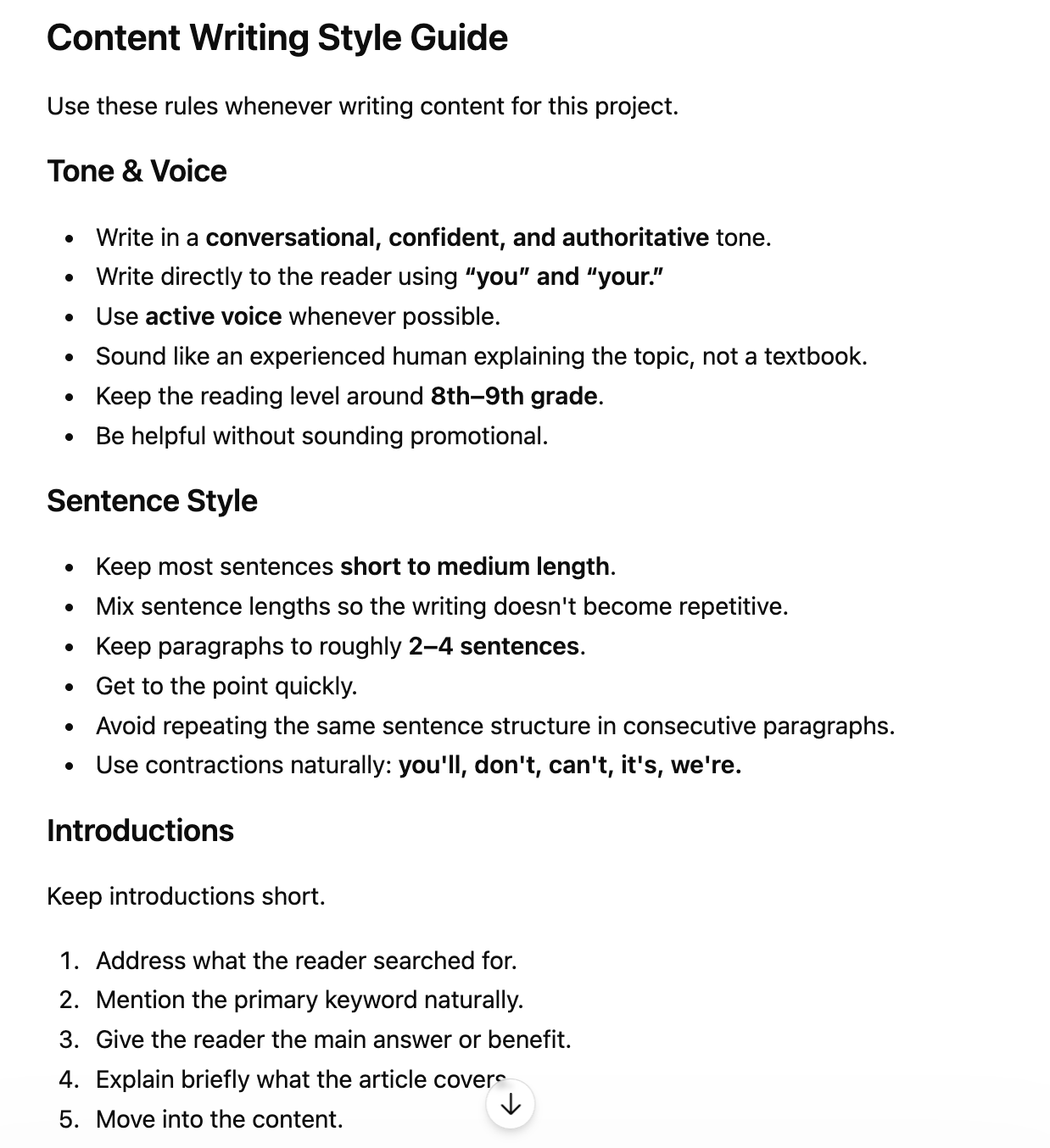
Here are a few tips for writing better content with ChatGPT:
- Give ChatGPT a detailed content brief with headings, talking points, keywords, examples, and sources
- Load your brand voice, style guide, banned phrases, and examples of writing you want it to emulate
- Write articles section by section rather than generating an entire 2,000-word article with one prompt
- Fact-check the finished content and add original expertise, opinions, examples, and experience before publishing
ChatGPT can dramatically reduce the costs of content production and produce quality content at scale, but the quality of the finished article still depends on the system, training data, and editorial process around it.
Many of our content team members can write high-quality guest posts and informational articles at lightning speed by using ChatGPT to brainstorm, edit, write, and optimize. That said, we still use human experts to write many of the articles and oversee AI.
Pro Tip: For landing pages, come up with a template and a custom project with specified rules for things like metadata, schema markup, content optimization tips, and then use GPT to generate. You’ll find that when you feed ChatGPT the right prompts and information, you can generate entire pages instantly that are SEO-optimized.
For further reading, check out our guide on ChatGPT for content writing.
6. Technical SEO and Schema Markup
ChatGPT is extremely useful for technical SEO, especially if you’re an SEO who understands what needs to be done but doesn’t want to write every piece of code manually.
You can describe the problem in plain English and have ChatGPT generate schema markup, redirects, hreflang tags, robots.txt rules, regex, and other technical SEO code in seconds. You can also upload Screaming Frog exports or page HTML and have it categorize technical issues, identify patterns, spot potential template-level problems, and suggest fixes.
This can save hours of manual work, especially across larger websites.
7. AI SEO
AI SEO is the process of optimizing your website so your brand and content appear in AI-generated search results, such as ChatGPT, Google AI Overviews, and Perplexity.
If you’ve worked in SEO for more than a few years, you are probably already doing AI SEO. Rankings and traffic still matter, but now clients also want to know whether they’re appearing in ChatGPT, AI Overviews, Perplexity, and other AI search tools.
And this isn’t some hypothetical future trend. Ahrefs analyzed 3,000 websites and found that 63% received at least one visit from an AI source, with ChatGPT accounting for half of the AI traffic in that study.
ChatGPT can help you research which competitors are getting mentioned, analyze the pages AI systems cite, compare those pages against yours, and identify potential content gaps. You can also use it to restructure content with clearer definitions, direct answers, useful statistics, tables, and sections that answer specific questions.
Quick aside: Don’t fall for the idea that AI SEO has completely replaced traditional SEO. Ahrefs found that 38% of URLs cited in Google AI Overviews also appeared within the first 10 traditional SERP blocks.
For now, the smartest approach is to treat AI visibility as another layer of SEO, not an entirely separate discipline.
Building SEO Systems With ChatGPT
The biggest value of ChatGPT for SEO isn’t writing a blog post or clustering one keyword list. It’s building large systems that let you do SEO at scale for a fraction of the traditional cost.
Instead of prompting ChatGPT manually every time, build repeatable workflows around it. Give the system persistent instructions, templates, examples of good outputs, real data, and clear rules for each step.
Start small. Pick a repetitive process, document exactly how your team currently does it, and break it into individual steps. Then automate the predictable parts while keeping human approval wherever judgment matters.
Take link prospecting and outreach as an example. A basic workflow might look like:
Find prospects → pull SEO metrics → qualify sites → research each prospect → write personalized emails → human approval → send outreach → follow up → track responses
ChatGPT can handle or assist with almost every step in that chain.
Once you start thinking in systems instead of individual prompts, the economics of SEO change dramatically. One person isn’t simply working faster; a small team can start producing the volume of work that previously required an entire department.
How Can You Build Better ChatGPT Prompts?
You can write better prompts by giving ChatGPT more context, clearer instructions, and a specific idea of what the final output should look like. You should also include guardrails, heuristics, and stop points for human review.
The more ambiguity you remove, the more useful the response usually becomes.
Here’s a simple step-by-step process to follow:
Step 1: Tell ChatGPT EXACTLY What You Want
Start with the exact task you want completed.
Instead of:
Write about keyword research.
Try:
Write a 200-word section explaining how SEOs can use ChatGPT for keyword research.
This gives ChatGPT a clear objective and keeps the response focused.
Step 2: Add Context
Next, explain what the content is and who will read it. Context helps ChatGPT make better decisions about terminology, depth, examples, and structure.
For example:
This section is for an article teaching beginner and intermediate SEOs how to use ChatGPT in their daily workflow.
You can also provide background information, source material, keyword lists, product details, or anything else the model should understand before answering.
Step 3: Give Formatting Rules
Tell ChatGPT exactly how you want the answer structured.
You might specify:
- Word count
- Number of paragraphs
- Headings
- Bullet points
- Tables
- Examples
- Step-by-step instructions
For example:
Use a short introduction followed by five numbered steps. Keep each step under 80 words.
This is much more reliable than asking ChatGPT to simply “make it easy to read.” If you don’t do this, you will get a wall of text. Trust me.
Step 4: Define the Tone and Writing Style
Tell ChatGPT how the content should sound.
For example:
Use a conversational, direct tone. Write at roughly an eighth-grade reading level. Avoid jargon, filler, and overly promotional language.
For important content, you can go even further and provide examples of writing you want ChatGPT to imitate. Remember, this will just be for inspiration. Don’t copy directly. Examples often work better than vague instructions such as “make this engaging.”
Step 5: Add Rules and Constraints
Now tell ChatGPT what it should and should not do.
For example:
Use active voice. Keep sentences concise. Do not repeat points. Avoid generic AI phrases. Do not invent statistics or facts.
Constraints are especially useful when you repeatedly encounter the same problems in AI-generated content.
Step 6: Give It Source Material
Give ChatGPT a few pieces of helpful information. But not too much. You don’t want to give it too much context.
You can upload:
- Competitor articles
- Research
- SEO briefs
- Keyword exports
- Brand guidelines
- Previous articles
- Product documentation
- Examples of your writing
Then explicitly tell ChatGPT how to use those materials.
For example:
Use the attached brief as the factual source for this section. Do not introduce claims that aren’t supported by the brief.
Final Thoughts
ChatGPT is the most valuable SEO tool ever created. I really believe that. There’s no hyperbole in that statement.
LLMs like GPT are capable of doing keyword research in minutes, writing entire articles in 30 seconds flat, and automating tedious tasks that used to take teams of humans a day to do (and high salaries, too).
Using ChatGPT for search engine optimization tasks has helped our link building marketplace reach record numbers with incredible efficiency, and we are still lean to this day.
But you need to understand the fundamental relationship between AI and human experts first.
AI is just a tool. It does the tedious work while YOU do the strategy. You can’t just say “do my SEO”. That will not work.
But if you give ChatGPT examples, steps, guardrails, formatting guidance, processes, documentation, and skills, it can do many of the SEO tasks that take up most of your day.
Even with this help, many businesses still choose to use an AI SEO agency. SEO is a ton of work, and sometimes it’s better to have experts in control, especially in an industry that changes as often as AI SEO/GEO.
I wish you luck in whatever you choose.
– Dusan Novakovic