


Are you looking for ways to use ChatGPT in your affiliate marketing business?
Maybe you’ve tried some generic prompts for ChatGPT and got low-quality output, and now you want to figure out how to really use artificial intelligence tools to take your affiliate game to the next level.
If that’s the case, you’re going to love this guide to using ChatGPT for affiliate marketing.
Look…
AI tools like ChatGPT are revolutionary for online businesses. You can save countless hours of work, improve outputs, AND reduce overhead expenses…and that’s all while doing things with precision and efficiency never before seen in the business world.
As an AI SEO company, our team uses ChatGPT for researching, prospecting, writing, email marketing, SEO tasks, video script writing, and a ton more. We save somewhere in the vicinity of 40-50 “employee work hours” per week with it.
BUT…
If you use it the wrong way, it can alienate your audience, make bad business decisions, or ruin your SEO.
In this blog post, we’ll cover our top ChatGPT prompts for affiliate marketing, plus you’ll get examples of the prompts we use AND guidance on writing your own prompts (and how to use AI the right way).
Ready? Let’s begin.
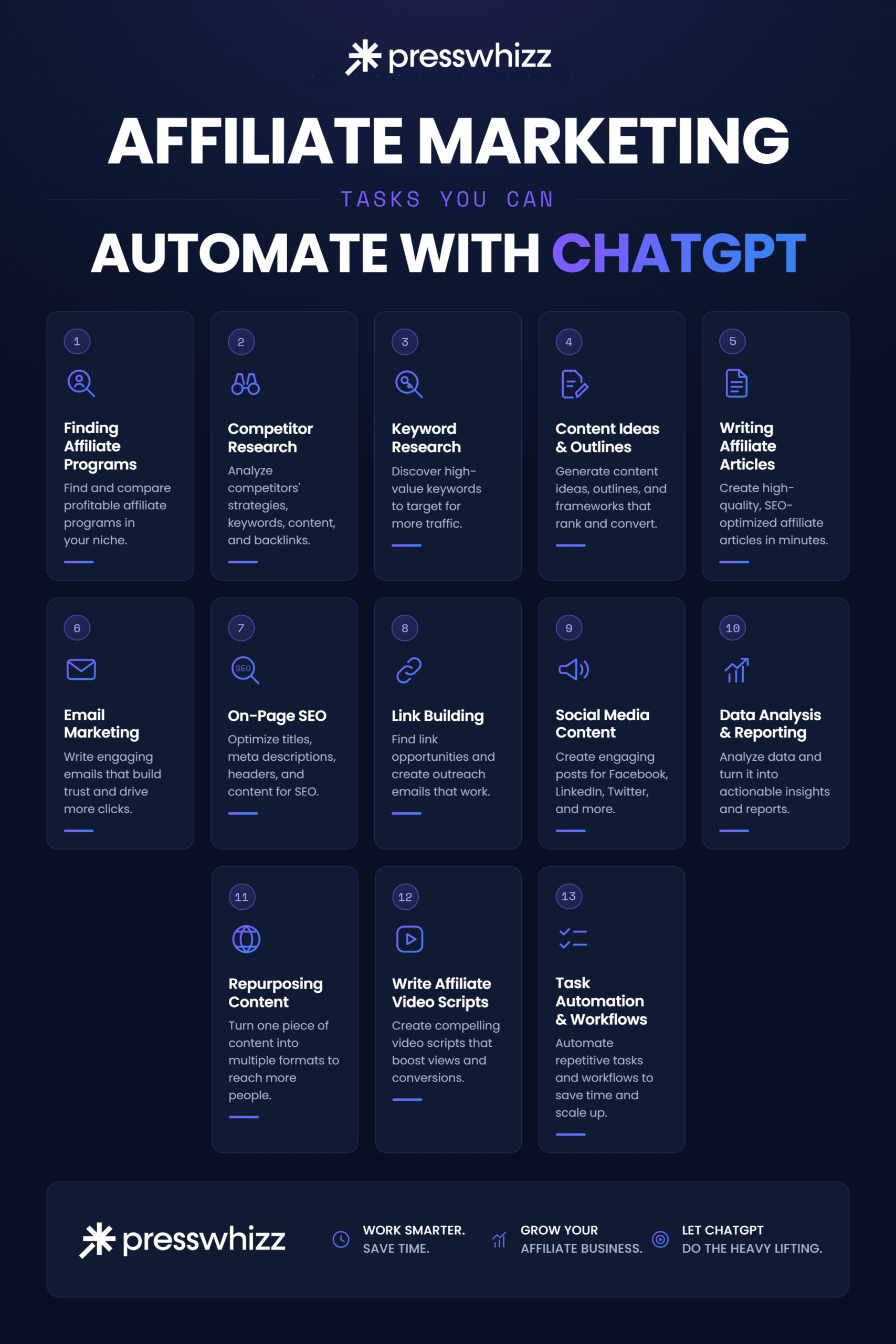
1. Finding Affiliate Programs
Finding affiliate programs is a high-ROI affiliate marketing task you can automate with ChatGPT very easily.
In case you aren’t aware, an affiliate program is an arrangement where a company pays you a commission for sending customers its way through a tracked affiliate link. If you’re reading this article on ChatGPT prompts for affiliate marketing, you probably already know that.
Anyways…
Finding good affiliate programs manually takes a lot of time and research. You need to search for companies in your niche, visit their websites, check whether they offer an affiliate program, and compare details like commission rates, cookie duration, payment terms, and eligibility requirements.
Do that across 10 or 20 companies, and it gets tedious fast.
ChatGPT can automate most of this research for you. Give it your niche and criteria, and it can search the web for relevant affiliate programs, collect the important details, and organize everything into a table so you can quickly compare your options. It can even provide detailed recommendations.
Search the web for affiliate programs in the [NICHE] niche.
Find at least [NUMBER] relevant programs and provide the following information for each:
- Company and affiliate program name
- Products or services offered
- Commission rate
- Cookie duration
- Payment terms
- Affiliate network, if applicable
- Requirements to join
- Link to the official affiliate program page
Organize the results in a table. Prioritize reputable companies with active affiliate programs and verify all information against current sources. Flag any information you cannot confirm rather than guessing.
2. Competitor Research
Competitor research is when you reverse-engineer your top-ranking competitors and review their keyword map, marketing strategy, and overall business to see what’s already working in your niche.
You can see which products they promote, what topics they cover, which keywords they target, and how they structure reviews, comparisons, and buying guides. Why reinvent the wheel when all of the info is out there?
The problem is doing all of this manually takes time.
Without artificial intelligence, you’d have to find your main competitors, go through their websites, review their content, identify the products and affiliate programs they promote, and look for patterns in their strategy. If you’re researching several sites, that can quickly turn into hours of clicking through pages and taking notes.
Normally, we’d hire 1-2 assistants to do this job. Now, we have ChatGPT (sorry, job market).
ChatGPT can automate most of the competitor research process. Give it a list of competitors and tell it exactly what you want to learn, and it can research the sites, compare them, and organize the findings for you. You’ll still need to review the results, but most of the legwork is done for you.
Thanks, Sam Altman.
Pro Tip: When doing competitor link analysis, export your competitor’s link profiles from Ahrefs and throw them into AI. ChatGPT can analyze it much faster than a human can.
Research the following affiliate marketing competitors: [COMPETITOR URLs].
Analyze each website and identify:
- Main topics and niches they cover
- Products and brands they promote
- Types of affiliate content they publish
- Product reviews, comparisons, and buying guides
- Keywords and topics they appear to target
- How and where they use affiliate links and CTAs
- Strengths of their content strategy
- Topics, products, or angles they appear to be missing
Compare the competitors and identify common patterns across their strategies.
Finish by giving me 5–10 specific opportunities I could use to differentiate my affiliate site or cover topics my competitors have overlooked.
Use current information from the websites. Clearly flag anything you cannot verify.
3. Affiliate Keyword Research
Keyword research is one of the most important SEO tasks. Keyword mapping determines what you write about and how your entire site fits together. Picking keywords one article at a time can leave you with random content, missed topics, and multiple pages competing for the same searches.
The industry standard is to build a topical map first where you map out all of your keywords, clusters, topics, and page types before creating content. This gives you a bird’s-eye view of your site architecture, including your main topics, subtopics, supporting articles, and commercial pages. It also helps you spot content gaps, plan internal links, and prevent keyword cannibalization before you start writing.
Doing this manually usually requires Ahrefs, Google Search Console, Google, competitor sites, and other tools (for clustering or analysis).
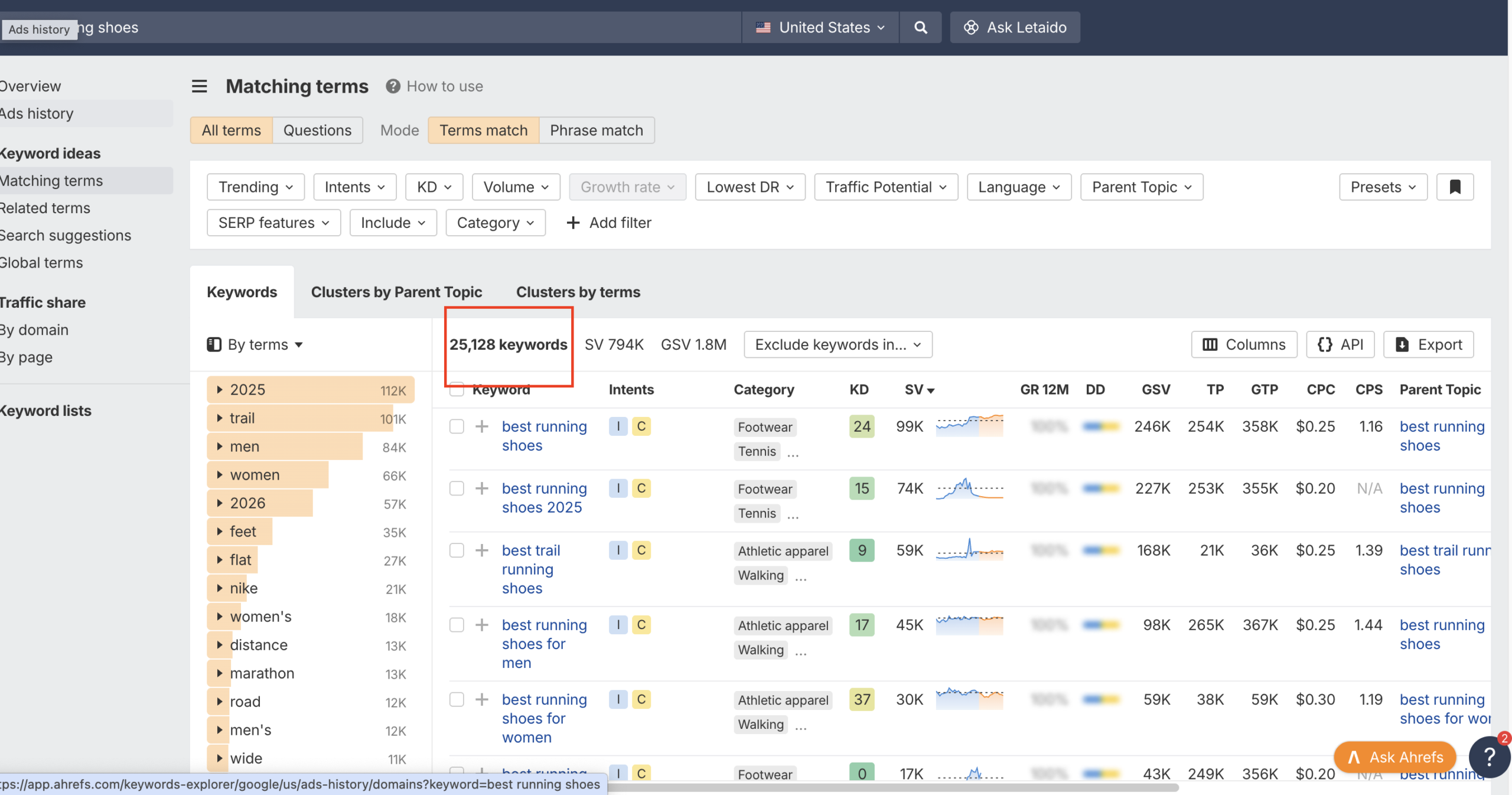
For example, if you were building a site around running shoes, here’s how many keywords you’d have to sift through:
Enjoy…
ChatGPT is an absolute godsend for keyword research. It does things in minutes that used to take TEAMS of humans days. For example, spreadsheet cleaning and topical clustering. AI can do this in 5 minutes. A team of humans could take 2 days or more.
Just give it your seed topics, competitor data, existing URLs, and keyword exports, and it can cluster keywords, identify search intent, find gaps, flag potential cannibalization, and organize everything into a topical map. You’ll still want to verify the data, but the tedious sorting and planning can largely be automated.
Conduct keyword research for [WEBSITE] in the [NICHE] niche. The primary goal is to build a complete topical map rather than generate a random list of keywords.
Analyze [SEED KEYWORDS], [COMPETITOR URLS], and any provided Ahrefs, Google Search Console, or keyword data.
For each opportunity:
- Identify the primary keyword and relevant secondary keywords.
- Determine search intent (informational, commercial, transactional, or navigational).
- Cluster keywords that should target the same page.
- Recommend a page/article topic and SEO-friendly title.
- Organize topics into logical parent topics and subtopics.
- Flag potential keyword cannibalization with existing content.
- Identify obvious content gaps competitors cover that [WEBSITE] does not.
Build the final output as a topical map, showing the recommended site architecture and relationship between pages. Add categories for blogs, landing pages, reviews, roundups, and comparison pages.
Prioritize keywords based on relevance, business value, ranking opportunity, and topical coverage. Do not create separate pages for keywords with substantially overlapping search intent.
4. Generating Affiliate Content Ideas
Affiliate content ideas are topics that give you a natural opportunity to recommend products and earn affiliate commissions. Instead of writing whatever gets traffic, you focus on searches where the reader is researching products or getting closer to making a purchase.
Some examples of affiliate content ideas are “best running shoes for beginners,” “iPhone 17 vs. Galaxy S26,” or “best project management software for agencies.” These topics let you target commercial keywords while connecting readers with relevant affiliate offers (and generating commissions for yourself).
Finding these opportunities manually means researching keywords, checking SERPs, studying competitor affiliate sites, finding products with affiliate programs, and figuring out which topics actually have buying intent.
ChatGPT can speed up the process by combining these steps. Give it your niche, existing content, affiliate programs, and keyword data, and it can find commercial topics, categorize them by content type, match products to each topic, and prioritize ideas by potential value.
Generate 20 affiliate content ideas for [WEBSITE] in the [NICHE] niche.
Use [AFFILIATE PROGRAMS/PRODUCTS], [KEYWORD DATA], and [EXISTING CONTENT] to find topics with clear commercial or buying intent.
For each idea, provide:
- Primary keyword
- Article title
- Content type (best-of, comparison, review, alternative, etc.)
- Products or affiliate programs to feature
- Search intent
- Why the topic has affiliate potential
Avoid topics already covered on the site and flag any ideas that could cause keyword cannibalization.
5. Create an Affiliate Content Plan
An affiliate content plan is a strategic roadmap that defines what you’ll publish, which keywords you’ll target, and how each page supports your broader SEO and revenue goals. A high-quality content plan typically includes target keywords, article titles, search intent, content type, priority, and the relationship between supporting and commercial pages.
Before we get into using artificial intelligence to create a content plan, you need to understand the SEO snowball effect. The SEO snowball effect refers to how, in SEO, ranking for lower-competition, long-tail keywords builds topical relevance, links, and authority across your site, which leads to better rankings in the future. As those pages build ranking equity, you can more easily rank for “head terms” that would have been difficult to rank for from day one.
Building a content plan manually can easily take 15 hours or more. You have to research competitors, gather keywords, cluster topics, map search intent, identify opportunities, and prioritize everything. Again, this is a task you’d typically hire someone to do.
But not with ChatGPT!
ChatGPT can compress much of that 15-hour process into roughly 15 minutes by analyzing your inputs and organizing them into a structured content plan. You still make the final strategic decisions, but the heavy research and organization are handled for you.
Create a 6-month affiliate content plan for [WEBSITE] in the [NICHE] niche using [KEYWORD RESEARCH], [COMPETITOR DATA], [EXISTING CONTENT], and [AFFILIATE PROGRAMS].
Organize topics strategically so easier long-tail keywords build topical authority and support more competitive commercial head terms.
For each article, provide:
- Target keyword
- Recommended title
- Search intent
- Content type
- Affiliate products/programs to feature
- Supporting pages and internal linking opportunities
- Priority and recommended publishing order
Avoid keyword cannibalization and duplicate topics. Prioritize content based on ranking difficulty, topical relevance, traffic potential, and affiliate revenue potential.
Output the final plan as a month-by-month publishing calendar with [X] articles per month.
6. Write Product Reviews
AI is incredibly effective at writing high-converting product reviews, but only when you give it the right training, prompts, and workflows.
You can’t just tell ChatGPT, “write me a high-converting best running shoes article” and expect expert-level content. We aren’t at that level of AI yet (despite what AI propagandists say).
If you want to use ChatGPT for content writing the right way, it requires clear instructions for tone, style, structure, reading level, examples, formatting, and writing rules. Without those guardrails, you’ll usually get generic affiliate content that sounds like AI (a.k.a., AI slop).
You also need to give ChatGPT the right context. That means providing product data, review templates, brand guidelines, and genuine subject-matter expertise. The AI needs to understand both the product and what the buyer actually cares about in order to produce a good product review.
Once those pieces are in place, the quality can go beyond what you’d typically get from a human writer. And, unlike a human, the process becomes nearly automatic (and cheap!).
Instead of spending five hours researching, outlining, writing, and editing each review, you can build a workflow that handles most of that work for you. You can use that time you saved to add real value to your business instead of writing (which nobody likes).
Prompt:
Write product review content using the following guidelines:
Tone: Down-to-earth
Style: Short paragraphs, active voice
Reading Level: 8th-grade reading level.
Rules: Be specific. Explain why features matter rather than simply listing them. Include concrete examples where useful.
Banned Words/Phrases: delve, crucial, game-changer, robust, unlock, elevate, revolutionary, cutting-edge, seamless, “in today’s world,” “whether you’re X or Y.”
Context:
Product: [PRODUCT]
Target audience: [AUDIENCE]
Product research: [RESEARCH]
Expert insights: [EXPERT INPUT]
Article template: [TEMPLATE]
Sectional Prompt:
Write the section [SECTION HEADING] in approximately [WORD COUNT] words using all of the tone, style, writing rules, research, and context provided above.
Cover these points:
- [POINT 1]
- [POINT 2]
- [POINT 3]
Start with a direct answer or takeaway. Do not add information that cannot be supported by the provided research.
7. Write Product Comparisons
Product comparison articles, also known as “A vs. B” articles, are some of the highest-converting affiliate marketing articles in the game. With a comparison search query, the reader has narrowed their options down to two or three products, so they’re ready to make a purchase.
The problem is that good comparisons are painstaking to create. You need to research specifications, features, pricing, strengths, weaknesses, customer feedback, and use cases for each product. Then you need to compare everything fairly, decide which product wins each category, and explain who should buy which option and why.
Does that sound fun? No, it doesn’t.
Comparison articles usually take hours of jumping between product pages, review sites, spreadsheets, and notes before you even start writing.
But if you give ChatGPT a proven comparison template, accurate product data, customer research, brand context, writing guidelines, and clear instructions for how products should be evaluated, it can take that mountain of research and turn it into a structured, detailed comparison that covers the factors buyers actually care about.
Instead of spending hours researching and writing, you can spend 10 minutes reviewing the finished comparison, checking the facts, and adding any expert insight AI can’t provide.
Write a comparison of [PRODUCT A] vs. [PRODUCT B].
Tone: Helpful, confident, authoritative
Style: Direct, natural, concise
Reading Level: 8th-grade reading level
Rules: Compare products directly
Banned Words: delve, crucial, game-changer
Context: Product research, reviews, expertise
Template: [COMPARISON TEMPLATE]
Sectional Prompt:
Write [SECTION HEADING] in [WORD COUNT] words using all of the factors and context above.
Compare:
- [FACTOR 1]
- [FACTOR 2]
- [FACTOR 3]
Give a clear winner and explain why.
8. Write Meta Descriptions
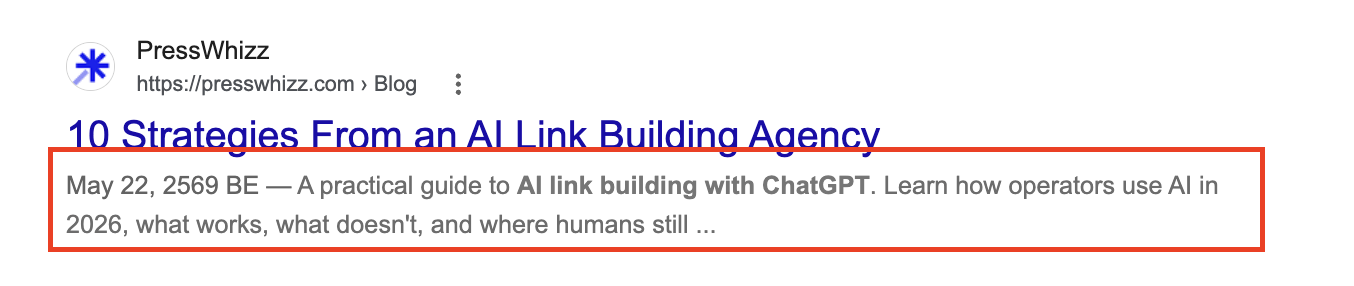
Meta descriptions are the short snippets that summarize your page and can appear underneath your title in Google’s search results. While they aren’t a direct ranking factor, a good meta description can make your result more appealing to searchers and encourage more clicks.
Writing one meta description isn’t particularly difficult.
But…
Writing dozens or hundreds of good ones is a nightmare.
Again, this is a job where you’d hire a virtual assistant just to complete tedious digital marketing tasks like meta descriptions, title tags, schema, etc.
This is exactly the kind of repetitive task ChatGPT handles well.
Give it your URLs, page titles, target keywords, and a few rules or examples, and ChatGPT can generate optimized meta descriptions for an entire site in minutes. You can even have it organize the results in a spreadsheet alongside each URL and title.
Instead of writing every description manually, you can review the output, make a few edits, and move on.
Prompt:
Write an SEO meta description for [PAGE].
Keyword: [TARGET KEYWORD]
Length: 140–160 characters
Tone: Clear, natural, helpful
Style: Direct, concise, specific
Intent: Match search intent
Rules: No keyword stuffing
Avoid: Hype, clickbait, filler
Example: [INSERT EXAMPLE]
Include the primary keyword naturally and accurately describe what the reader will find on the page.
Return only the meta description with no explanation or additional text.
9. AI Link Building
Link building is the process of getting other websites to link back to your site. These links back to your site are known as “backlinks”. Link building strengthens your site’s authority and boosts your search engine rankings, because links act as votes of confidence in Google’s search engine algorithms.
We will save the science behind link building for another time. Just know that links are especially important in competitive affiliate niches where dozens of sites may be targeting the same commercial keywords.
However, AI link building is tricky. You can’t simply ask ChatGPT to “build backlinks” and expect quality links to appear. AI works best when you use it to automate individual parts of the link building process while keeping strategy, quality control, and relationship building in human hands.
Some of the best link-building tasks to use AI for include:
- Outreach: Write and personalize outreach emails at scale.
- Prospecting: Find and qualify relevant websites for potential placements.
- Email Automation: Create follow-ups, sequences, and personalized responses.
- Competitor Research: Analyze competitor backlinks to find sites and link opportunities worth pursuing.
If you use ChatGPT the right way, it can remove a huge amount of manual work from link building without sacrificing the human judgment needed to land quality backlinks.
Prompt:
Analyze the backlink profiles of three competitors and identify the highest-ROI backlinks for [WEBSITE] to pursue.
Website: [INSERT WEBSITE]
Competitor 1: [INSERT PROFILE/DATA]
Competitor 2: [INSERT PROFILE/DATA]
Competitor 3: [INSERT PROFILE/DATA]
Evaluate opportunities based on:
- Relevance: Topically relevant site
- Authority: Strong backlink profile
- Traffic: Real organic traffic
- Replicability: Realistic to acquire
- Value: Potential SEO impact
- Overlap: Links competitors share
Give extra priority to domains linking to two or more competitors, as this suggests they regularly link to sites in this niche and may be easier to acquire.
Exclude spam, irrelevant sites, scraper links, and unrealistic opportunities.
Rank the top 20 opportunities by expected ROI and provide the referring domain, which competitors have the link, link type, likely acquisition method, reason it’s valuable, and recommended outreach approach.
10. Writing Affiliate Email Sequences
Email sequences are one of those content creation tasks that AI is almost perfectly suited for.
With the right mix of workflow automations, proven templates, and project-level training or skills, you can teach ChatGPT how your brand communicates and automate a huge chunk of the process. Before AI, our team spent countless hours on email, both for ourselves and for clients of our link building packages.
A basic AI email workflow might look something like this:
New subscriber → Identify audience/offer → Choose template → Generate email → Human review → Schedule → Send follow-ups based on behavior
The key to automating emails with ChatGPT is giving the AI enough context.
Feed ChatGPT your best-performing emails, tone and style guidelines, banned phrases, audience research, product information, offers, and CTA rules. Once it understands how you write and what you’re trying to accomplish, it can produce surprisingly consistent emails.
And this is where you really feel the difference AI makes.
Before AI, building a sequence was painstaking. You had to research the audience, plan every email, write subject lines, create variations, edit everything, and then repeat the process for the next campaign.
Now, you can build the system once and let AI handle most of the repetitive work.
Write an affiliate email promoting [PRODUCT/OFFER].
Audience: [TARGET AUDIENCE]
Goal: [EMAIL GOAL]
Tone: Friendly, conversational, helpful
Style: Short, direct, natural
Length: 150–200 words
CTA: [INSERT CTA]
Avoid: Hype, jargon, filler
Example: [INSERT EXAMPLE]
Template:
Subject: [Attention-grabbing subject]
Opening: Introduce a problem or situation the reader recognizes.
Problem: Explain why this problem is frustrating or important.
Solution: Introduce the product naturally and explain how it helps.
Benefit: Give 2–3 specific reasons the reader should care.
CTA: Finish with one clear next step.
11. Create Affiliate Social Media Content
Social media posts are a huge competitive advantage for affiliate businesses. Social media marketing keeps your brand visible, distributes your content, builds an audience, and reinforces the connection between your brand and the topics you want to be known for.
That last point is especially interesting for affiliate sites. Consistently publishing around the same products, categories, people, and topics can reinforce your brand’s entity associations across the web. While posting on social media isn’t some direct shortcut to higher Google rankings, it creates a clearer and more consistent digital footprint around your brand.
Social media posts can even rank for relevant keywords now and bring in search traffic, especially posts on Facebook, Pinterest, LinkedIn, and Medium.
The problem is keeping up with it. It’s a full-time job in and of itself. Writing posts, repurposing articles, adapting copy for different platforms, and maintaining a consistent publishing schedule quickly becomes another full-time task.
AI can handle much of this repetitive work. You can use it to:
- Write Posts: Generate platform-specific copy.
- Repurpose Content: Turn articles into multiple posts.
- Create Variations: Test different engaging hooks and CTAs.
- Plan Content: Build weekly or monthly calendars.
- Schedule Posts: Connect AI with automation and scheduling tools.
With the right workflow, one finished affiliate article can become weeks of social content with very little additional work.
Create a 30-day social media schedule for [BRAND] based on [CONTENT/ARTICLES].
Platforms: [INSERT PLATFORMS]
Frequency: [POSTS PER WEEK]
Audience: [TARGET AUDIENCE]
Tone: Natural, helpful, conversational
Goal: Traffic, engagement, awareness
Topics: [CORE TOPICS/ENTITIES]
CTA: Relevant, non-salesy CTA
For each post, provide:
- Date: Publishing date
- Platform: Where to post
- Topic: Primary subject
- Copy: Finished post copy
- Link: Relevant article/page
- CTA: Recommended action
Repurpose existing content where possible, vary the hooks and formats, and avoid repeating the same message.
Output everything as a calendar table organized by date that’s ready to add to a social media scheduling tool.
12. Write Affiliate Video Scripts
AI can write surprisingly good YouTube video scripts, but the quality depends heavily on the instructions and examples you give it. Asking ChatGPT to “write a YouTube video about the best running shoes” will usually get you a generic script that sounds like every other AI-generated video online.
The approach we recommend is to give it a proven formula, script template, examples of successful videos, tone guidelines, audience information, and detailed research BEFORE generating.
For example, your template might follow:
Hook → Problem → Promise → Main Points → Examples → Recommendation → CTA
You can then provide transcripts from your best-performing videos as examples so ChatGPT understands your pacing, sentence structure, humor, transitions, and overall voice.
At that point, you provide the topic and research, generate the first draft, and focus your time on reviewing the script and adding the personal insights that make it yours.
Prompt:
Write a video script about [TOPIC] for [AUDIENCE].
Goal: [VIDEO GOAL]
Length: [VIDEO LENGTH]
Tone: Natural, confident, conversational
Example: [INSERT SUCCESSFUL SCRIPT]
Script Formula:
Hook → Problem → Promise → Main Points → Examples → Takeaway → CTA
Template:
Hook: Open with [HOOK FORMULA]
Problem: Explain [VIEWER PROBLEM]
Promise: Tell them [WHAT THEY’LL LEARN]
Main Point 1: [INSERT POINT]
Main Point 2: [INSERT POINT]
Main Point 3: [INSERT POINT]
Example: Demonstrate [CONCEPT/RESULT]
Takeaway: Summarize [KEY LESSON]
CTA: Ask viewer to [ACTION]
Examples to Model:
- [INSERT SCRIPT/TRANSCRIPT #1]
- [INSERT SCRIPT/TRANSCRIPT #2]
- [INSERT SCRIPT/TRANSCRIPT #3]
Follow the formula and template exactly. Use the examples to model the pacing, hooks, transitions, sentence length, and overall writing style without copying their wording.
Make the finished script sound natural when spoken aloud rather than like a written article.
13. Write Affiliate Ad Copy
Affiliate businesses rely on high-converting ad copy to bring in direct leads from Google, social media, or other avenues. And ad copy needs to be high-quality. There’s no room for error. When you’re paying for every impression or click, weak copy equals wasted money. And it’s even bad for SEO if someone clicks to your site and bounces.
This is one place where ChatGPT can both help you and hurt you. For one, AI slop can really hurt you. People are increasingly familiar with generic AI writing: predictable hooks, fake enthusiasm, unnecessary adjectives, and the same recycled phrases. If your ad sounds like hundreds of other AI-generated ads, it’s easy to scroll straight past it.
But if you do it right, you can automate your entire ad copy department for pennies on the dollar.
That’s why prompting matters so much with ad copy.
Start by mapping out your audience, search or purchase intent, offer, pain points, brand voice, and desired action. Then give AI proven ad templates, examples of successful copy, tone guidelines, banned phrases, and clear rules for what good copy looks like.
Once those pieces are in place, AI becomes much more useful. You can quickly generate headlines, hooks, body copy, CTAs, and dozens of variations for testing without sacrificing your brand voice.
Pro Tip: Generate several variations of headlines to see which ones you like best.
Prompt:
Write ad copy for [PRODUCT/OFFER] targeting [AUDIENCE].
Intent: [PURCHASE/SEARCH INTENT]
Goal: [CLICKS/LEADS/SALES]
Voice: [BRAND VOICE]
Tone: Natural, direct, persuasive
Pain Point: [PRIMARY PAIN POINT]
Benefit: [PRIMARY BENEFIT]
Offer: [INSERT OFFER]
Example: [INSERT WINNING AD]
Template:
Hook: [Grab attention]
Problem: [Relevant pain point]
Benefit: [Why they should care]
Offer: [What they get]
CTA: [Clear next step]
Follow the voice, structure, and pacing of the example without copying it.
Avoid generic AI language, hype, clichés, fake urgency, and unnecessary adjectives. Make every sentence earn its place.
Provide 5 variations with different hooks while keeping the audience, intent, offer, and brand voice consistent.
How to Write Better ChatGPT Prompts
Writing better prompts with ChatGPT requires specificity, context, examples, guardrails, and proper formatting. If you want to create better prompts with AI, you need to give it enough direction to understand exactly what you want and what a good output should look like.
The more ambiguity you remove, the less editing you’ll have to do afterward.
Here are the key factors you need to take into account for creating good ChatGPT prompts:
- Be Specific: Tell ChatGPT exactly what you need. Define the task, audience, word count, goal, tone, and any important context rather than asking it to simply “write an article.”
- Set Guardrails: Give ChatGPT rules to follow. Specify your reading level, banned words, style requirements, things to avoid, factual limitations, and other constraints that keep the output consistent.
- Provide Examples: Give ChatGPT strong exemplars, so it has a much clearer reference for tone, structure, sentence length, depth, and overall writing style.
- Ask for Formatting Help: Don’t waste time manually organizing prompts. Instead, ask ChatGPT how to format the prompt for maximum quality output. You’d be surprised at the little details you miss here and there.
Final Thoughts
ChatGPT and other large language models are the single greatest competitive advantage in all of affiliate marketing.
With artificial intelligence, you can automate tedious tasks that used to take hours of time and cost hundreds, even thousands, of dollars in salaries for low-efficiency employees.
At PressWhizz, we use ChatGPT and other AI tools to at least partially automate:
- Research
- Competitor analysis
- Writing
- Emails
- Video script writing
- Content scheduling
- Customer support
- Minor SEO tasks like meta descriptions
We are now more efficient, productive, and profitable than ever before, and that’s with a smaller staff than most companies of our size.
But please heed my warning about ChatGPT.
These prompts for affiliate marketing will make you faster, more efficient, and less expensive. But they won’t do the job for you. YOU still need to make decisions, add value, and understand the broader context of your business.
If you just put these prompts into ChatGPT, you’ll definitely see good results. But you’ll leave so much on the table, and it’s a big risk. Instead, use these prompts as step 1, then add your own expertise and factor it into your decision-making.
Those who will succeed in the coming years will be the ones who use AI better than their competitors.
I wish you luck.
– Dusan Novakovic