95% of people are doing AI link building the wrong way, and that includes most of our link building marketplace competitors.
Most AI link building advice takes one of two forms: Either “use Chat-GPT to generate content ideas” or “automate emails through AI workflows”.
The real value of AI in link building campaigns is using artificial intelligence tools like Chat-GPT, Claude, and Pitchbox to automate repetitive tasks. That alone will massively reduce your operational costs and improve link quality through better link prospecting, outreach, and nurturing.
Automations also free up my time to focus on higher value SEO tasks such as relationship building and strategy. I can either spend 20 hours a week talking to decision makers and signing deals or I can spend 20 hours a week researching competitor links and managing outreach strategies. Which is better for the business?
If you’re not using AI to accelerate repetitive link building processes like identifying opportunities, analyzing competitors, and improving efficiency, you’re:
- Wasting money
- Wasting time
- Or worse, both AND ranking content that won’t survive the next core algorithm update
So, what’s next?
In this guide, I’m going to share our top AI link building strategies that we use for our clients as well as our automated link building tools stack. I’ll cover examples, prompt templates, and actionable tips for high quality link building as well.
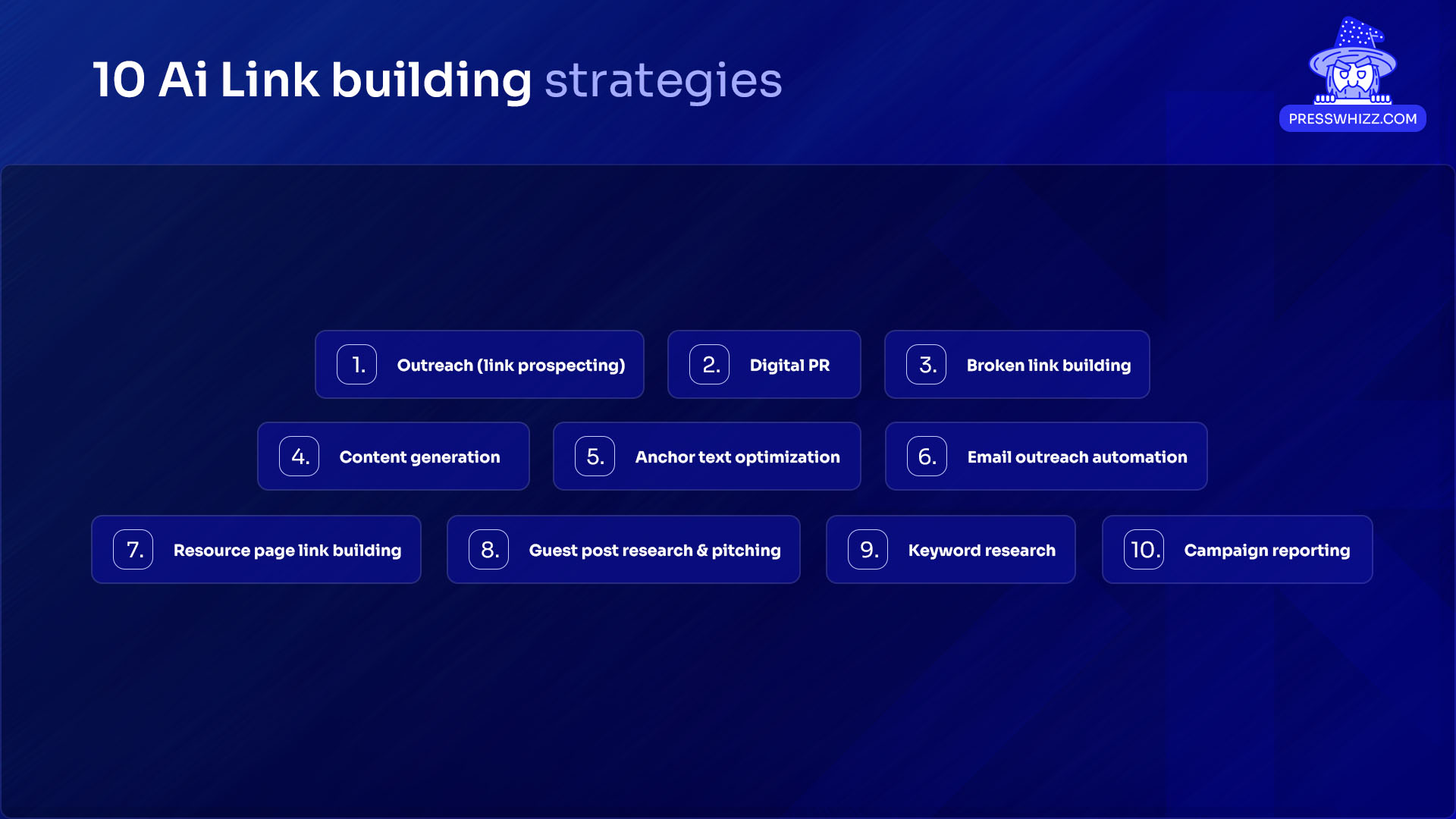
Here are my top strategies for using AI tools in your link building department…
Outreach Campaigns (Link Prospecting)
Using AI for link building outreach campaigns is my #1 AI link building tip because it’s where artificial intelligence creates the biggest operational advantage. AI tools like Chat-GPT can drastically improve success rates and operational efficiency while reducing operational costs simply by improving link prospecting.
Most people use AI to write outreach emails, but that’s the least valuable part of the process in my opinion (aka, FACT).
The real benefit of AI for outreach campaigns comes from creating an entire outreach workflow, including filtering, qualifying, and prioritizing link opportunities, which will drastically increase your conversions and reduce time spent manually filtering prospects.
Before AI, my team wasted untold hours manually checking websites, categorizing potential leads, and brainstorming outreach angles. Now, AI does that automatically. Instead of paying VAs to work 40 hours a week on hard labor (that word sure has changed meaning since the advent of the web), I can have my team spend their time on tasks that actually increase our bottom line.
My typical AI link prospecting workflow looks like this:
- Scrape competitor backlinks
- Enrich domains with SEO data
- Classify topical relevance
- Identify link intent/opportunity type
- Remove spam or low quality sites
- Generate outreach angles
- Prioritize by ROI and difficulty
I can now use AI to automatically find and classify information that would’ve taken an SEO VA multiple work days to complete.
Once you get your prospects into a spreadsheet, get AI to enrich the sheet with more data, such as:
- DR/authority metrics
- Estimated organic traffic
- Top ranking keywords
- Country/language
- Niche/category
- Outbound link patterns
- Indexed pages
- Traffic trends
- Contact info
- Social profiles
The link prospect spreadsheet would look something like this: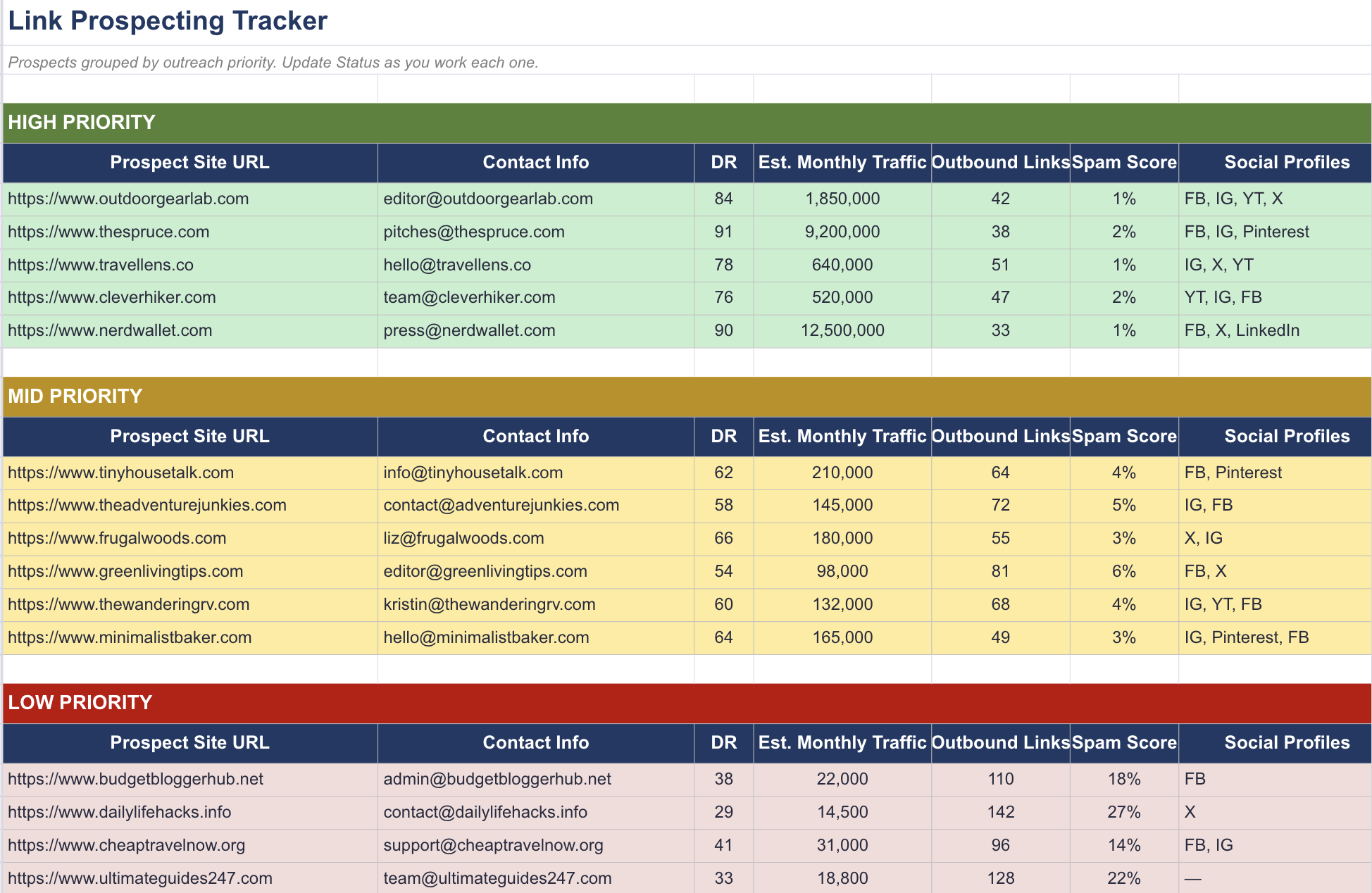
And now, the real AI magic can begin. Here’s what to do next…
Action Step
Instead of just using AI to write the same “I love your blog” emails that literally no company responds to anymore, you should be using it to enhance overall efficiency.
How do you do that? By using multiple time saving tools connected via advanced workflows.
Now that you’ve got your prospects list, connect it to a tool like Pitchbox that automates personalized outreach campaigns at scale.
Pull prospect data from Ahrefs -> Use AI to scrape the data, categorize, filter, and generate angles -> Create a spreadsheet -> Connect to Pitchbox -> Begin outreach campaigns -> Automate follow ups
Note: You should use N8N or Make.com to connect your workflow.
Digital PR
AI has massively changed digital PR by automating repetitive tasks like analyzing industry data, tracking recent news for reactive PR, drafting pitches and writing content, and competitor analysis for identifying opportunities at scale.
I can’t stress to you enough how much digital PR has changed over the last few years. It used to be “get mentioned in Forbes. Print $$$.” That is still kind of true. But now, it’s more about:
- Knowing which media links move rankings
- Reinforcing entities and brand trust
- Strengthening authority around your high priority keyword clusters
You also have to take into account things like brand mentions, branded search (e.g., will a PR piece result in more searches of your company name?), and referral traffic from relevant sources.
With AI, you can automate huge parts of the digital PR and link acquisition process that used to require entire outreach teams.
Instead of manually researching journalists, performing competitor link analysis, writing pitches, sorting media opportunities, and tracking campaigns, ChatGPT and Claude can process all of this in minutes. Combined with workflow tools like N8N, you can build systems that continuously monitor competitor links, identify new media opportunities, generate personalized outreach, enrich contact data, categorize placements by SEO value, and even trigger follow up sequences automatically.
This works great for:
- HARO Automations: You can build entire pitch automation workflows that analyze journalists’ questions, generate responses, and automate follow ups. By the way, I have an entire article on HARO alternatives in case you aren’t using this platform currently.
- Data Analysis: You can have AI clean and categorize entire spreadsheets of PR opportunities.
- Outreach and Writing: I like to build projects or Claude Skills to write emails or articles.
- Campaign reporting: I’ll cover this in more depth below, but AI is great at taking your campaign data, parsing it out, and giving feedback on what’s working and what isn’t.
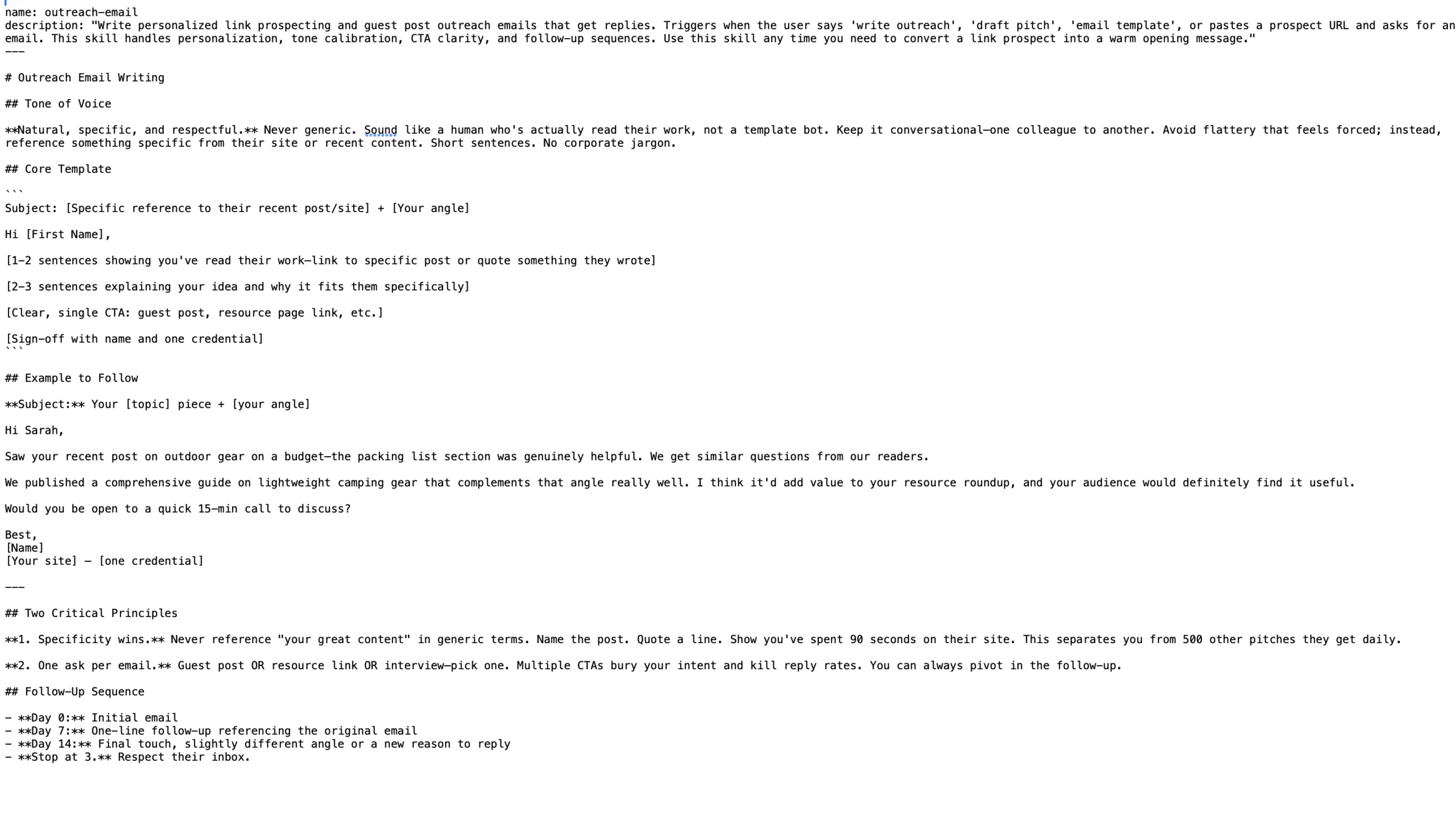
Here’s a basic Claude skill for writing emails to get you started. Obviously, you’ll need to adjust to your templates and brand voice, but this should get you going in the right direction:
Action Step
Here’s how to make the most of AI for PR:
- Pull competitor backlinks and recent media mentions from Ahrefs or Google News.
- Use ChatGPT or Claude to categorise opportunities by authority, topical relevance, and placement type.
- Trigger N8N workflows to enrich contact details and organise outreach targets automatically.
- Use AI to generate personalised HARO responses, journalist pitches, or press release variations at scale.
- Automatically score placements based on SEO value, traffic, indexation, and competitor overlap. You may also want to create a spam score or confidence score.
- Trigger follow-up outreach sequences for non-responders.
- Push acquired links into reporting dashboards and monitor ranking impact automatically.
- Feed successful placements back into the system to continuously refine future outreach targeting.
Broken Link Building
Broken link building is one of the easiest strategies to speed up with AI. What used to be hours of agonizing research, qualification, and writing work can now be fully automated (with human oversight, of course).
Instead of manually hunting resource pages for dead links, you can have AI find the broken links, read the original page, brainstorm replacement asset ideas, write the outreach email, and even write a replacement article for you. And all of that can be done 10x faster than before. It’s truly incredible how AI contributes to strategic link building these days.
All you have to do to get started is to find your competitor’s broken backlinks using Ahrefs. Pop a site into Ahrefs’ Site Explorer and click the Broken Backlinks tab on the sidebar:
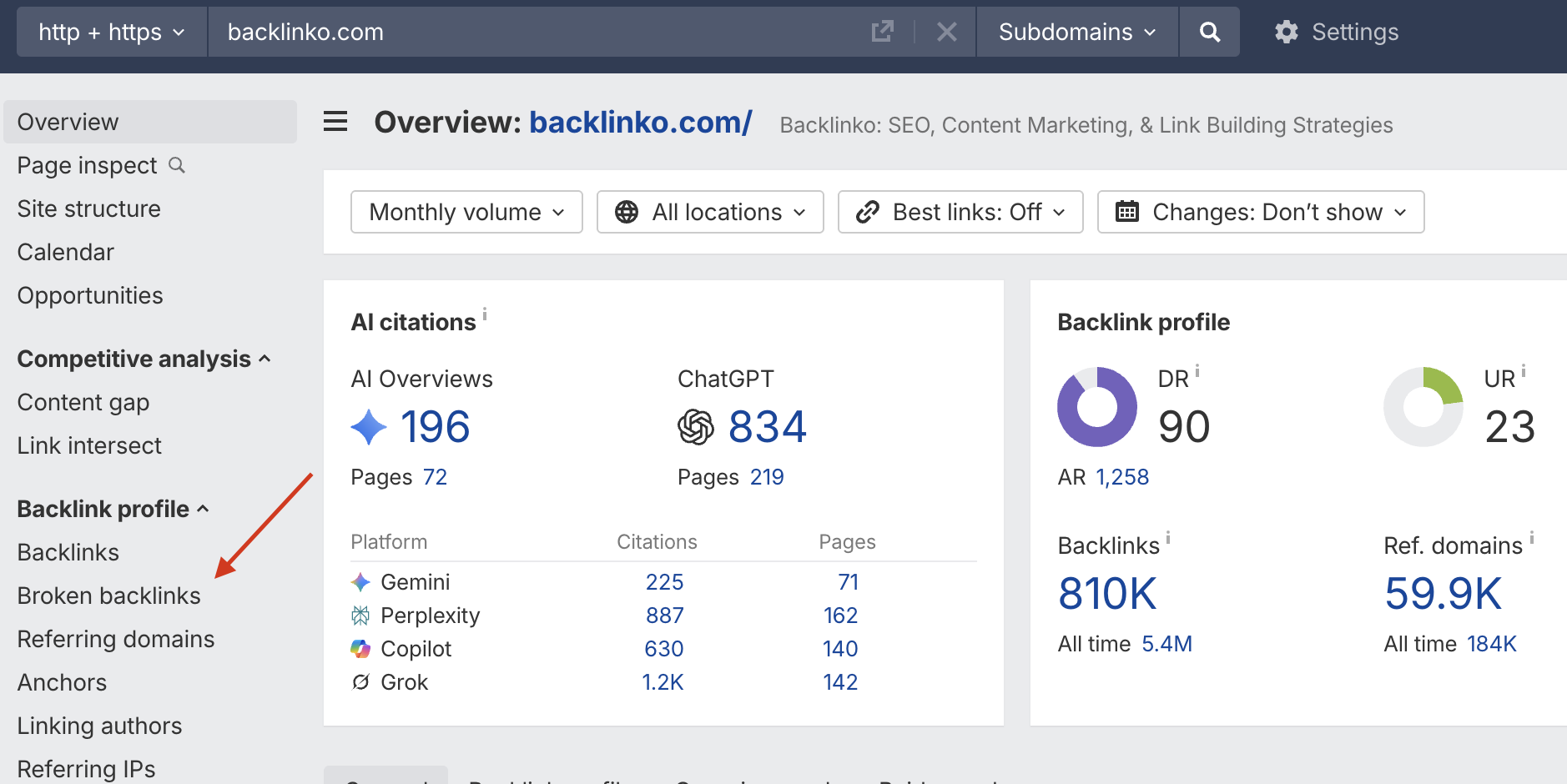
Then, export the list and pop it into AI.
Or, if you really want to go next level broken link building, you can click the Best By Links tab on the sidebar:
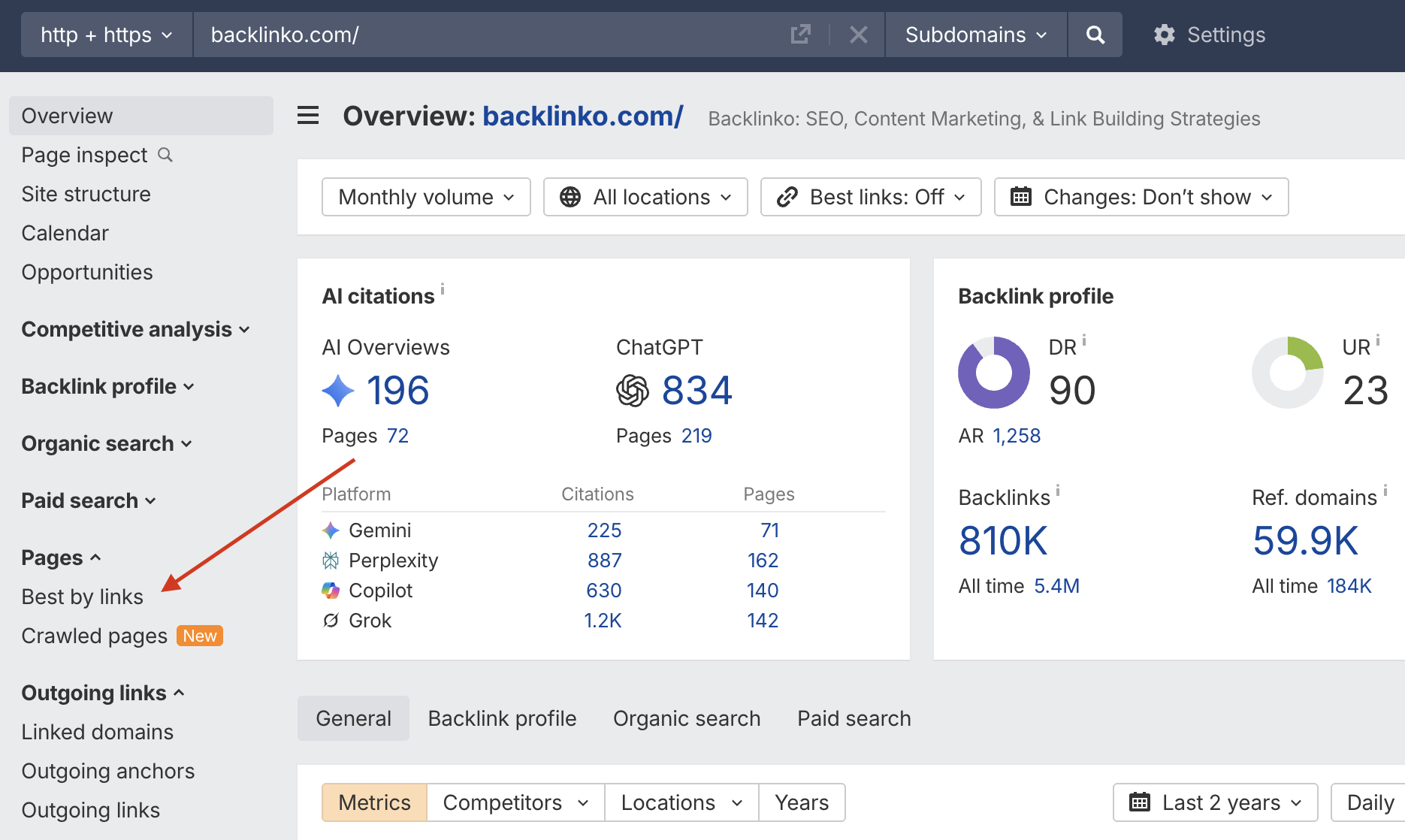
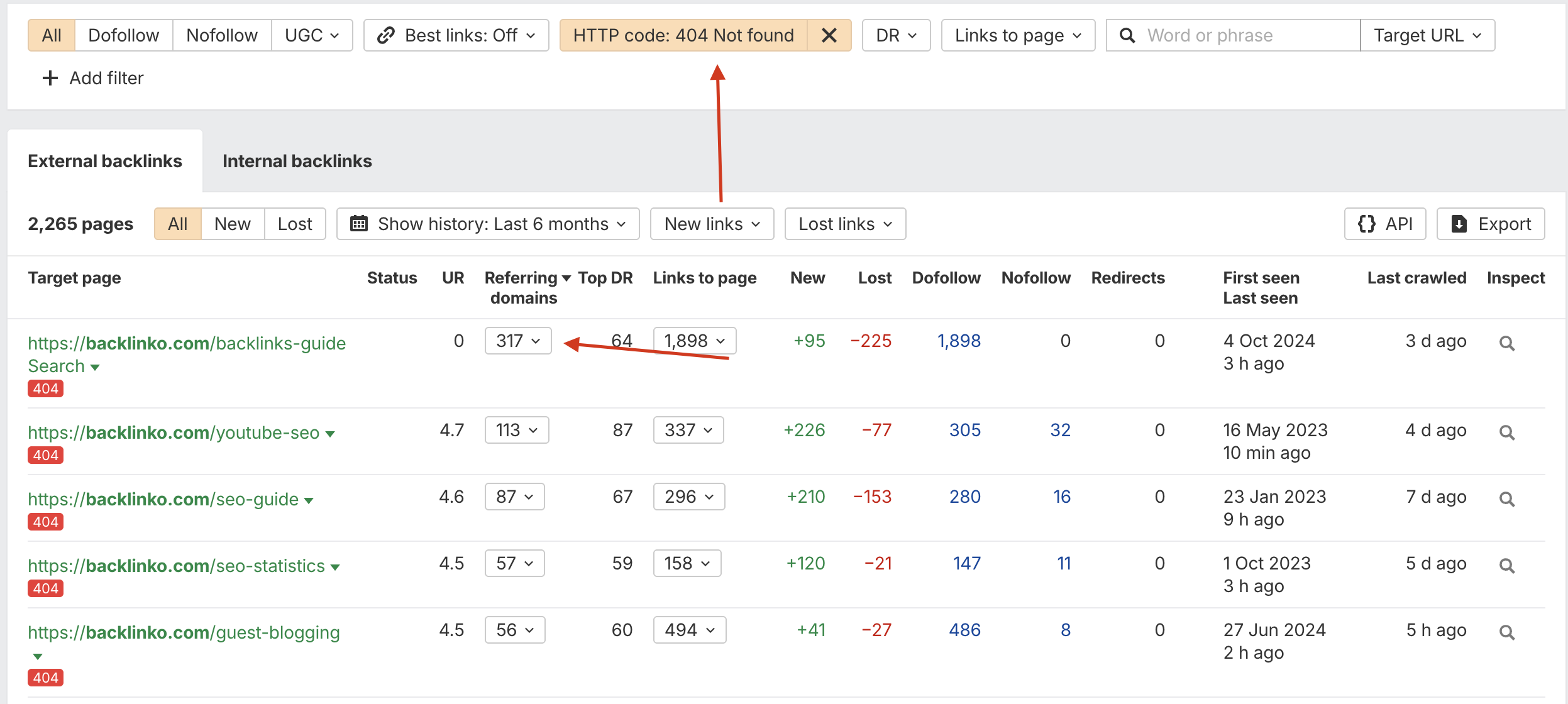
Then filter by HTTP code “404 not found” and click the drop down where it says “referring domains”:
I remember back in 2014 when you needed someone on staff whose sole job was to analyze broken links, check the Wayback Machine, find contact info, draft replacement pages, and then write an email begging to link to our page instead.
Now, AI does that mostly for us.
Action Step
You’ll need an orchestration layer (N8N or Make.com) to tie this all together. I prefer N8N personally. It’s one of the best AI link building tools out there (it essentially connects AIs together to create workflows).
Create different agents to analyze whether pages are worth targeting or not, and check the previous version of the dead page. Then, generate a replacement article and contextual outreach angles. From there, your qualified prospects get added to Pitchbox, and that launches a customized outreach email sequence.
Content Generation
AI content generation is one of the biggest advantages in modern link building because it dramatically reduces the time needed to create linkable assets, content that supports your main pages, outreach assets, and topical authority pages.
Generating high quality content for guest posts or outreach emails used to be a major bottleneck for us. Now, we use AI to automate most content production and save us countless hours on outlining, writing, optimizing, and quality control.
With the right prompts, training, and examples to follow (and human oversight), AI can produce high quality content like blog posts, emails, or other assets in minutes. And it’s all fully integrated into our link building workflows.
Of course, we still have humans to write when necessary (like this blog you’re reading now) or to edit AI outputs. But it’s easily saved us 80% of the time we used to spend on content creation.
Remember, it’s all about creating leverage, improving operational efficiency, and freeing up your time to focus on higher value tasks.
We’re using AI for content generation in the following ways:
- Writing guest posts for our sites or our clients’ sites
- Creating linkable assets, (case studies, stats pages, guides, etc.)
- Creating outreach emails (beyond just the “dear sir/madam trash”)
- Creating press releases for digital PR
NOTE: We used AI to help build one of our most successful link magnets, this page on 50+ link building statistics.
Action Step
My advice to you is to create Projects in ChatGPT or Claude with your knowledge baked in, as well as Claude Skills for each step in your process. My workflow for content creation looks something like this (I can’t give away all of my secret sauce…):
Research -> Outline -> Draft -> Optimize -> Quality Control -> Push to CMS
Here’s the prompt template I’d use for a GPT Project or Claude:
Tone: Down to Earth
Style: In the style of (website)
Reading level: 10th grade
Format: Short paragraphs and mix of short and long sentences.
DO NOT: (add banned words) (add banned phrases) (add rules on humor, analogies, and other behaviors)
Remember: (add brand style points and rules)
Example: (add 100 words of text that you like)
Always have a human in the loop to improve articles, maintain your brand voice (or your link partner’s voice), and make sure everything is properly optimized. Search engines like Google are getting better at spotting AI slop and banishing it.
Anchor Text Optimization
Anchor text is the visible, clickable text in a hyperlink that’s usually blue. In case you aren’t aware, this is extremely important for your website’s SEO.
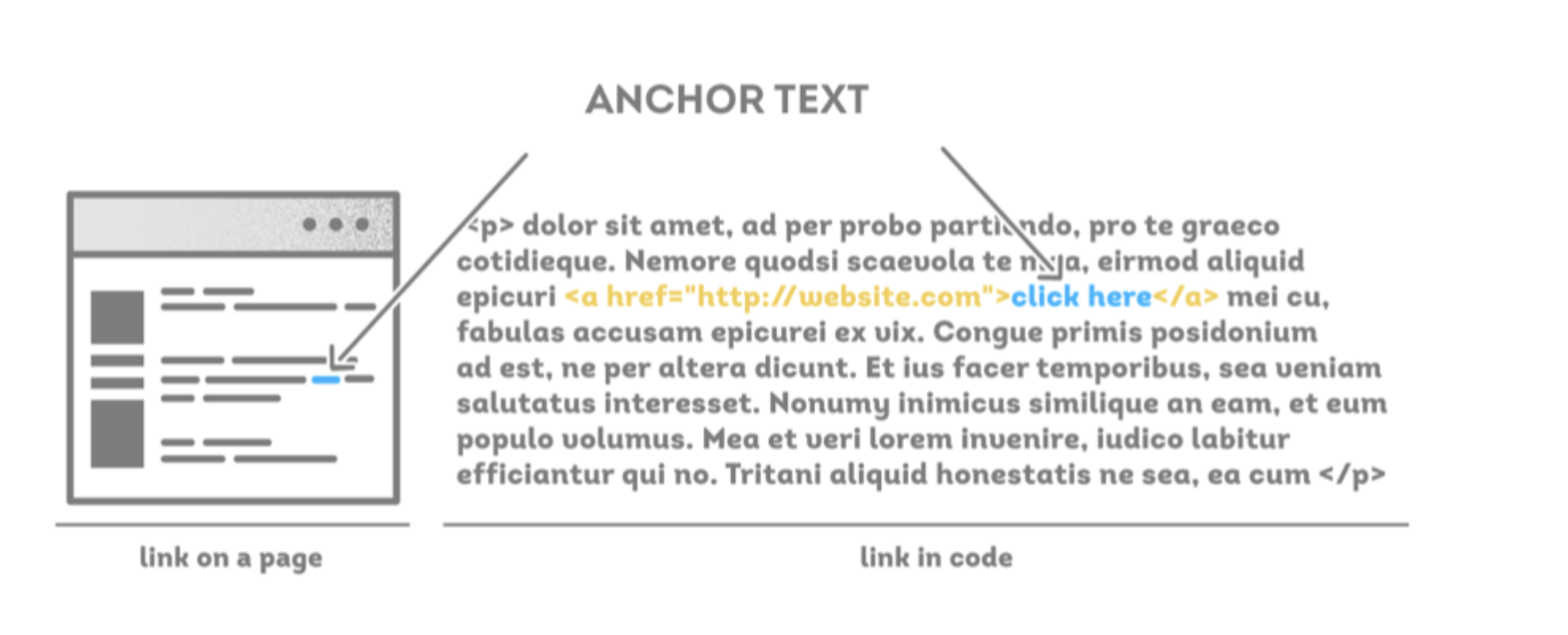
I wrote an entire article on anchor text, so I won’t go into the details here. But I want you to know that AI saves you countless hours of manual research, categorization, calculation, and anchor text profile auditing.
Without AI, you’d need to analyze competitors (every niche is different), categorize your anchor text (more on this below), map your anchors out, calculate percentages, identify issues, generate natural variations, and then execute those changes. I’m getting PTSD flashbacks to 2015 just thinking about this.
By the way, if you get this wrong, you absolutely can get a manual penalty or your site could get algorithmically suppressed.
Personally, my team and I use ChatGPT to:
- Analyze competitors’ distribution
- Analyze our own anchor text distribution
- Categorize anchors (branded, exact match, partial match, generic, topical, and natural)
- Calculate distribution percentages
- Detect spam patterns, such as overused exact match anchors
I can’t stress to you enough how important this is for a link building campaign. At the beginning of a new campaign, you can map out the entire anchor text distribution for guest posts, niche edits, press releases, etc., and ensure you have a natural looking profile that’s 100% Google safe. You can do it all 10x faster than before, and you don’t need a salaried employee to do it.
Action Step
With anchor text, your goal is to build a strong profile that supports your website without looking like an SEO planned it out in an office.
How do you do that?
I’m going to show you…
I recommend using Ahrefs to export your backlinks as well as those of your competitors.
Then you’re going to feed them into ChatGPT and use this prompt:
I am going to provide you with a list of backlink anchor texts.
Your job is to:
- Categorize each anchor into ONE of the following:
- Branded
- Exact Match
- Partial Match
- Generic
- Naked URL
- Topical/Natural
Return the output in a table format with:
- Anchor Text
- Category
- Risk Level (Low / Medium / High)
- Notes
Identify:
- Overused anchor patterns
- Potential over-optimization
- Spam signals
- Unnatural repetition
- Missing anchor diversity
Estimate the overall anchor distribution percentages.
Suggest:
- Safer anchor variations
- More natural semantic alternatives
- Which pages may be over-optimized
Definitions:
- Branded = company/brand names
- Exact Match = exact target keyword
- Partial Match = contains target keyword variation
- Generic = “click here”, “this website”, etc.
- Naked URL = raw URLs
- Topical/Natural = contextual anchors that naturally reference the topic
When analyzing:
- Prioritize natural-looking distributions
- Flag manipulative patterns
- Compare anchor diversity against what would appear editorially natural
- Be conservative with exact-match recommendations
After you throw this prompt into your AI, you should follow these steps:
- Analyze competitor ratios to find the ideal ranges
- Identify problems in your profile
- Build out an anchor map
- Match anchor text to the type of link (e.g., branded or exact match for digital PR)
Email Outreach at Scale
I covered this a bit above, but AI can completely change email outreach efforts for AI link building campaigns by letting you conduct targeted, large scale outreach, all while reducing manual work (and still making emails BETTER).
In my experience, SEOs get email outreach totally wrong. They think AI is great for blasting thousands of dear sir/madam emails with “creative copy” that doesn’t sound remotely human.
The real value in artificial intelligence for email outreach is actually in the following areas:
- Improving prospect targeting (I covered this above…in case you skipped down)
- Drafting high converting emails
- Automating email sequences
- Classifying and managing responses
Again, remember what I’ve been saying all along: The advantage of AI is in operational efficiency and time savings by executing repetitive tasks that your human team members shouldn’t waste time on.
Instead of the old school workflow of “human researches, human writes, human sends email, human follows up,” you can now automate all of that with N8N, Claude Skills, ChatGPT Projects, and tools like Pitchbox.
Action Step
I recommend doing the following immediately:
- Finding relevant sites that link to your competitors
- Export them to Google Sheets
- Use AI to enrich the prospects with data such as traffic and DR
- Use AI to analyze those prospects and categorize them into different tiers
- Use a ChatGPT or Claude Project to write an email in your tone of voice based on a successful template
- Set up an email sequence in Pitchbox
- Pitchbox handles delivery and sequencing
This should drastically improve your open rates, response rates, and eventual conversions.
Here’s an actual email that we used to start building a publisher relationship:
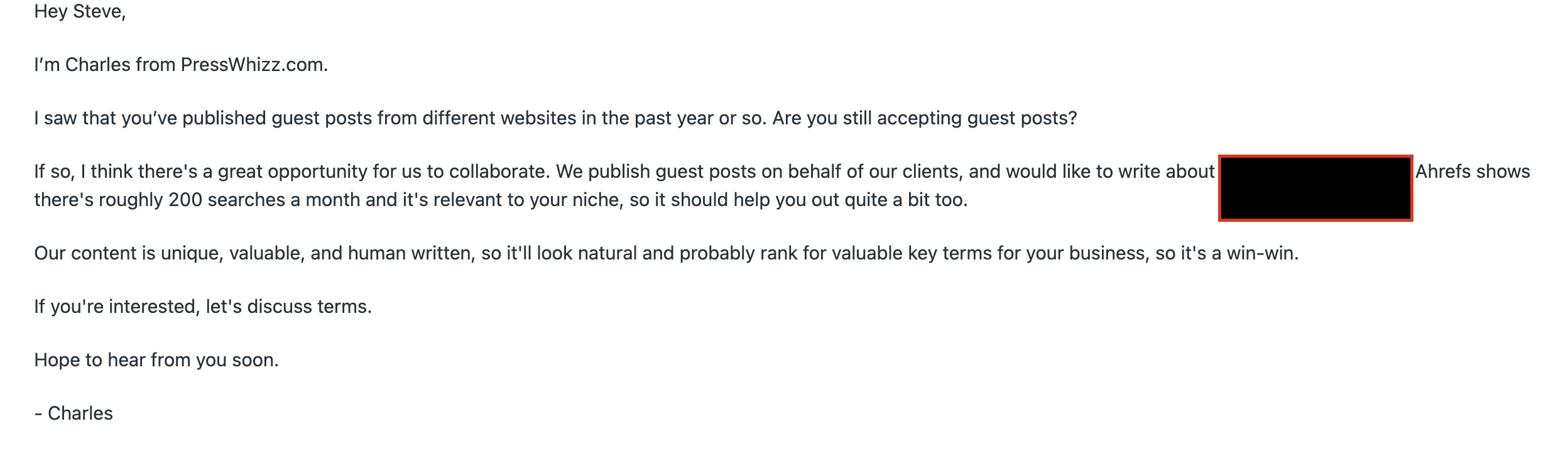
Notice how it’s not cringe at all, and there’s no BS “I was having my morning coffee when I just happened to end up 45 pages deep on your random DR 20 niche blog” nonsense? Publishers have heard that same pitch 1,000 times. Be honest. Be direct. No fluff. That’s what wins.
Pro Tip: The workflow can be a bit confusing if you’re new to AI. Start by creating a sequence and an email template inside Pitchbox. Then use AI like Claude or ChatGPT to generate the custom parts of the email. Your system will send that info to Pitchbox, which then automatically updates the template and pushes it to recipients.
Resource Page Link Building
Resource page link building is a link acquisition method where you reach out to relevant websites with curated lists of helpful resources in your niche and ask to be added to those lists.
Examples of resources pages are:
- 50+ SEO resources for beginners
- 40 best math resources for students
- Columbia University’s guide to New York City
Resource pages are one of the highest ROI link building tactics out there, especially .edu ones.
.edu resource pages are incredible opportunities to score editorial links, both for traditional and local SEO link building. Imagine getting a DR 91 local link for your restaurant in New York from Columbia, like these small shops that are probably crushing local results:
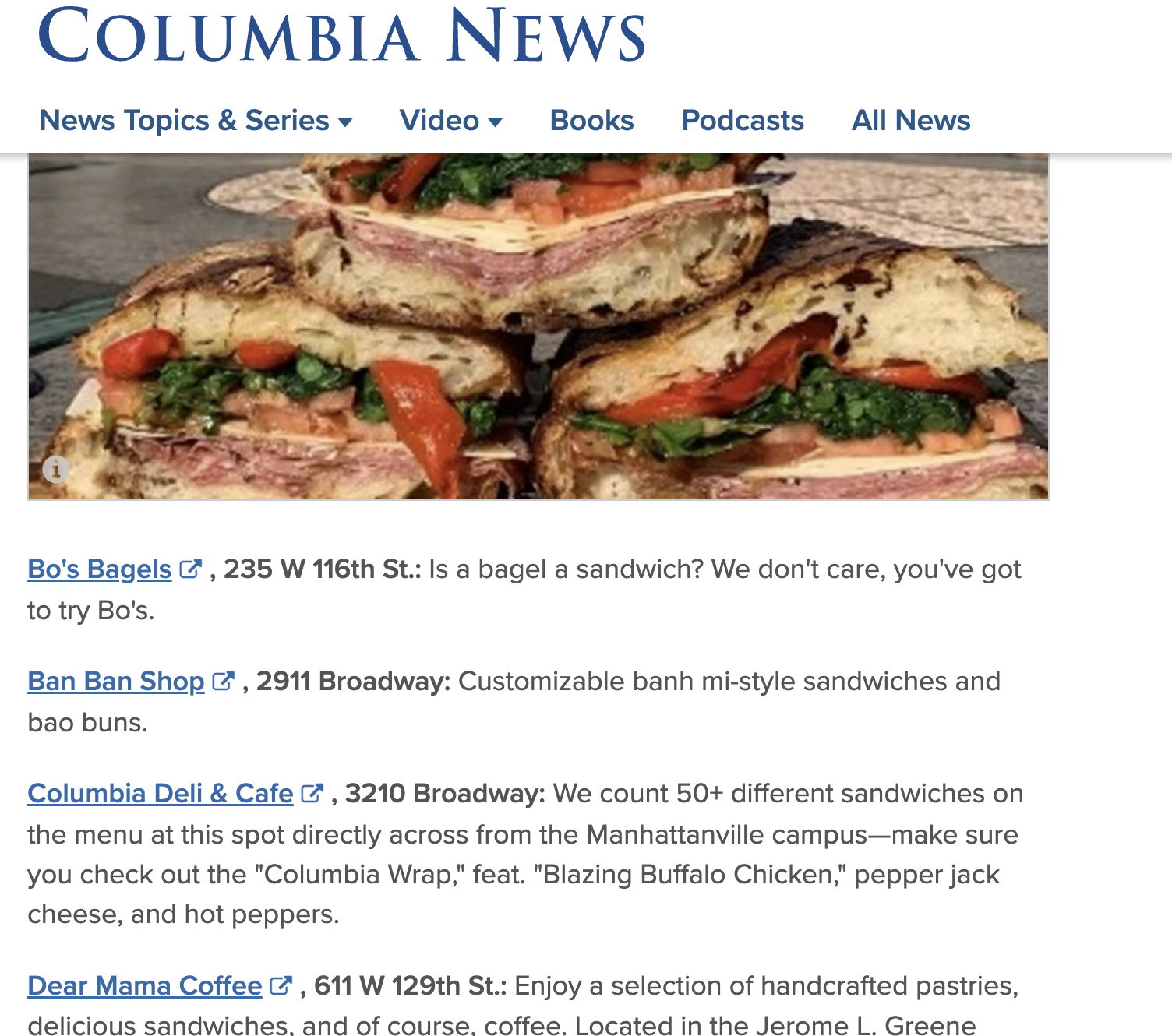
AI helps scale resource page link building by dramatically reducing the manual research normally involved in finding and qualifying opportunities.
Finding good resource pages is NOT easy. You’ve got to search on Google, check if the pages are active, check metrics (DR, outbound links, traffic, etc.), and find contact info. IF the website owners respond, you might get one link after days of back and forth with them (if you find the right person!). It doesn’t matter if these are valuable backlinks. It’s a pain.
But with AI powered resource page link building, you can build high quality backlinks much more quickly because AI can do all of the things I mentioned above in minimal time. It can scrape Google, analyze each page, classify relevant prospects, create a blogger outreach angle, and draft an email.
Action Step
Start by creating a workflow that covers scraping Google and classifying prospects, then pushes that data to a spreadsheet. Then, create a Claude skill for writing an email, which then pushes things to your outreach platform of choice.
Here’s the prompt I use for scraping Google:
Find resource pages related to [NICHE] using Google search operators.
Search for:
intitle:resources [NICHE]inurl:resources [NICHE]"helpful links" [NICHE]site:.edu [NICHE] "resources"site:.edu [CITY] student guidesite:.edu "local resources"site:.edu "new to [CITY]"site:.edu [NICHE] links
For each result:
- Determine topical relevance
- Identify whether the page links externally
- Classify authority/trust
- Identify outdated or missing resources
- Suggest whether [MY RESOURCE] fits naturally
- Generate a short outreach angle
Return results in a table with:
URL | Relevance | Opportunity Type | Outreach Angle | Quality Score
Guest Post Research and Pitching
Guest post qualification and outreach used to take hours of manual labor. You had to go through your competitors’ links and look for niche relevance, traffic, DR, number of external links, and a bunch of other metrics that matter for SEO link building.
Then, if you were lucky, you had to spend hours more drafting outreach emails.
Thankfully, with AI, that can (mostly) all be automated. Guest post outreach is honestly one of the areas where AI saves me the most time because the manual process is unbelievably repetitive at scale.
My entire process looks like this: competitor backlink data -> AI analyzes and filters for me -> AI generates pitch angles and article ideas -> AI creates personalized emails -> emails get pushed to an automated sequence -> AI handles follow ups.
You’ll see a lot of things repeated across these sections. As always, the value here is in reducing your manual work and software expenses while simultaneously IMPROVING your outreach success (and preserving your sanity).
Action Step
Take the guest posts from your competitors and combine them with your normal guest post prospects list, then use this prompt:
Analyze these guest post prospects for link building.
For each domain:
- Classify topical relevance
- Estimate quality/DR/traffic value
- Detect spam signals
- Identify whether the site accepts guest posts
- Flag high-conversion outreach targets
- Score backlink potential from 1-10
- Suggest a short outreach angle
- Generate 2-3 guest post topic ideas
Prioritize:
- Relevance over DR
- Editorial quality over quantity
- Real traffic over inflated metrics
Return results in a markdown table.
Now, this is where the AI chaining, writing skills, and outreach platform come back into play. If you’re not too techy, just export the highest quality prospects to PitchBox and use a template. But if you have the resources and time, use N8N to build a workflow where the AI writes the emails, then sends them into Pitchbox, which sends the emails out.
Keyword Research
AI has revolutionized how I do keyword research for building links.
AI now allows SEOs to analyze search intent, cluster semantically related keywords, identify which pages actually deserve links, and reverse engineer competitor authority structures at scale.
Here’s a simpler way to think about it: AI tools like ChatGPT allow you to build a complete topical map with search intent, topical clusters, and SEO data like volume and keyword difficulty, PLUS invaluable competitor data. This 10,000 foot view of your keyword strategy lets you build a clear link building campaign with answers to key questions like:
- Which pages deserve links?
- How will authority flow through my website?
- Which pages are my competitors powering up with links?
- How do we link each page internally?
- How do we prioritize links to high ROI pages?
Your internal sheet should look something like this, with columns for search intent, primary keyword, ranking data, referring domain data, priority, and anchor text suggestion:
Action Step
If you’re working on an existing website, start by going to Ahrefs and pulling your ranking keywords. Put your site into Site Explorer and go to Organic Keywords, then click Export:
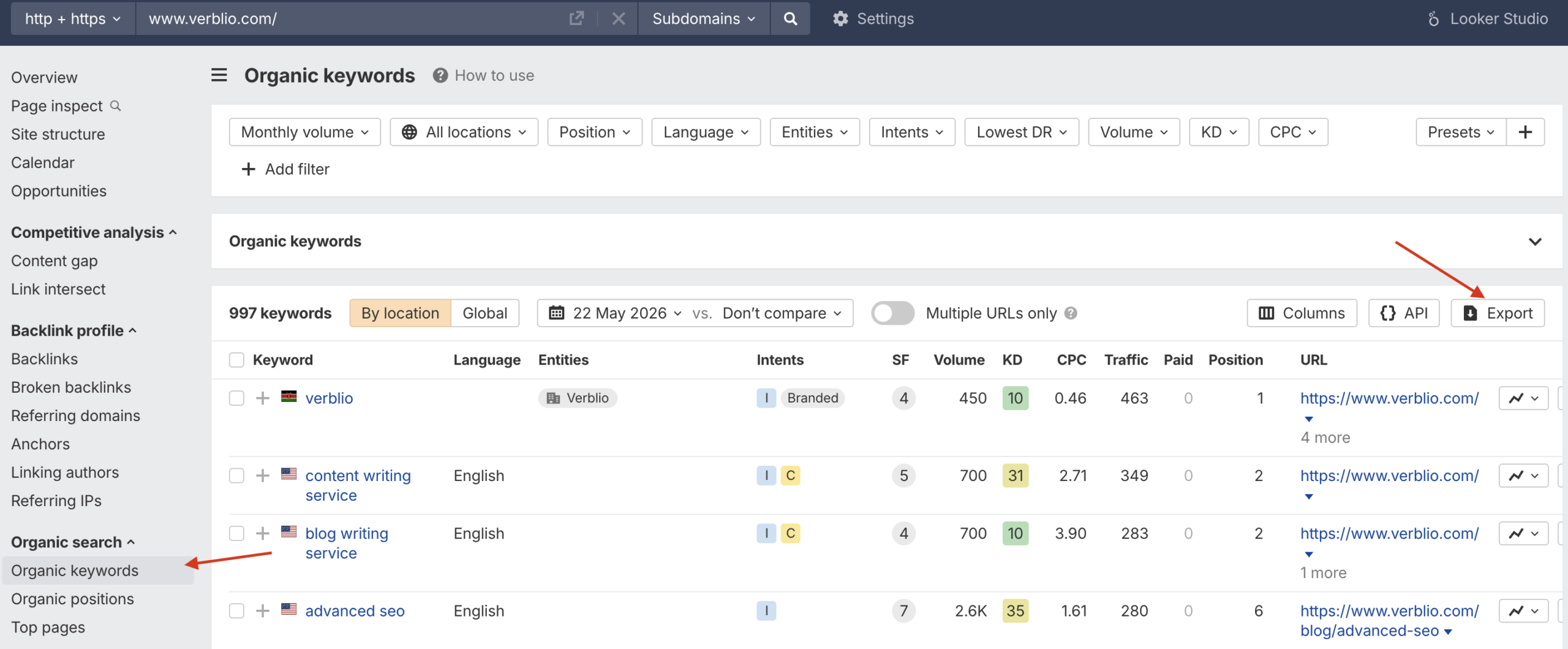
Next, pull the organic keywords from your competitors using the same process, and export everything into a spreadsheet. Have AI combine the sheets into one massive sheet and deduplicate everything.
You now have a keyword masterlist.
From there, follow this process:
- Group the keywords into clusters
- Map the keywords to URLs (new page, existing page, etc.)
- Pull competitor URL data from Ahrefs and map authority gaps
- Prioritize pages (pages where there are gaps, important commercial keywords, keywords ranking low on Page 1 or Page 2)
Campaign Reporting
Last up, I want to cover how AI has changed campaign reporting and backlink management. AI tools have turned what used to be a full time job and multiple support staff into a day of analysis by one person (unless you’re running a massive enterprise link building campaign).
If you’re anything like me, you remember entire weeks spent poring over data from Ahrefs, Google Search Console (GSC), GA4, and your own spreadsheets. It was absolute madness.
How much did this link cost? Did our rankings move at all? Did we hit link targets? What were our outreach conversion rates?
Now, all you have to do is export that data, feed it into AI, and use the right prompts. You’ll get all of the data at a glance in minutes flat. You, of course, need to know what you’re looking for (AI never does all of the work), but what used to take multiple days and burn your brain (and budget) now takes a few hours.
Here are all of the ways you can use AI for campaign tracking and reporting:
- Ranking Changes: GPT can analyse backlink growth, keyword movement, and ranking fluctuations together to help explain why certain pages improved or declined. I use it to quickly identify whether rankings changed because of domain authority gains, internal linking, competitor movement, or potential over optimization.
- Identifying Weak Pages That Need Links: This is a next level SEO strategy and one of the best link building tips you’ll ever learn. AI helps prioritize which pages are closest to breaking into higher positions. When I see this data, I know it’s time to throw some links at a particular page.
- Analyzing Anchor Text Patterns: ChatGPT can review anchor text distributions and identify whether a profile looks over optimized, unnatural, or lacking semantic diversity.
- Competitor Strategies: You can provide competitor backlink exports and ask GPT to explain how competitors are distributing authority across their sites. This helps uncover which pages they are actively powering up and how their internal linking structure supports rankings.
- Analyzing Your Own Campaign Data: You can add your own spreadsheets into AI with things such as the number of emails sent, pricing, which providers produced the best results, and more. See the value here? I always say that link building is now a systems game. Whoever builds better links at higher volume and with more efficiency is going to win in the long run.
Here’s an example of what your reporting dashboard might look like, complete with info like number of links built, cost, average price per link, ROI, and other metrics:
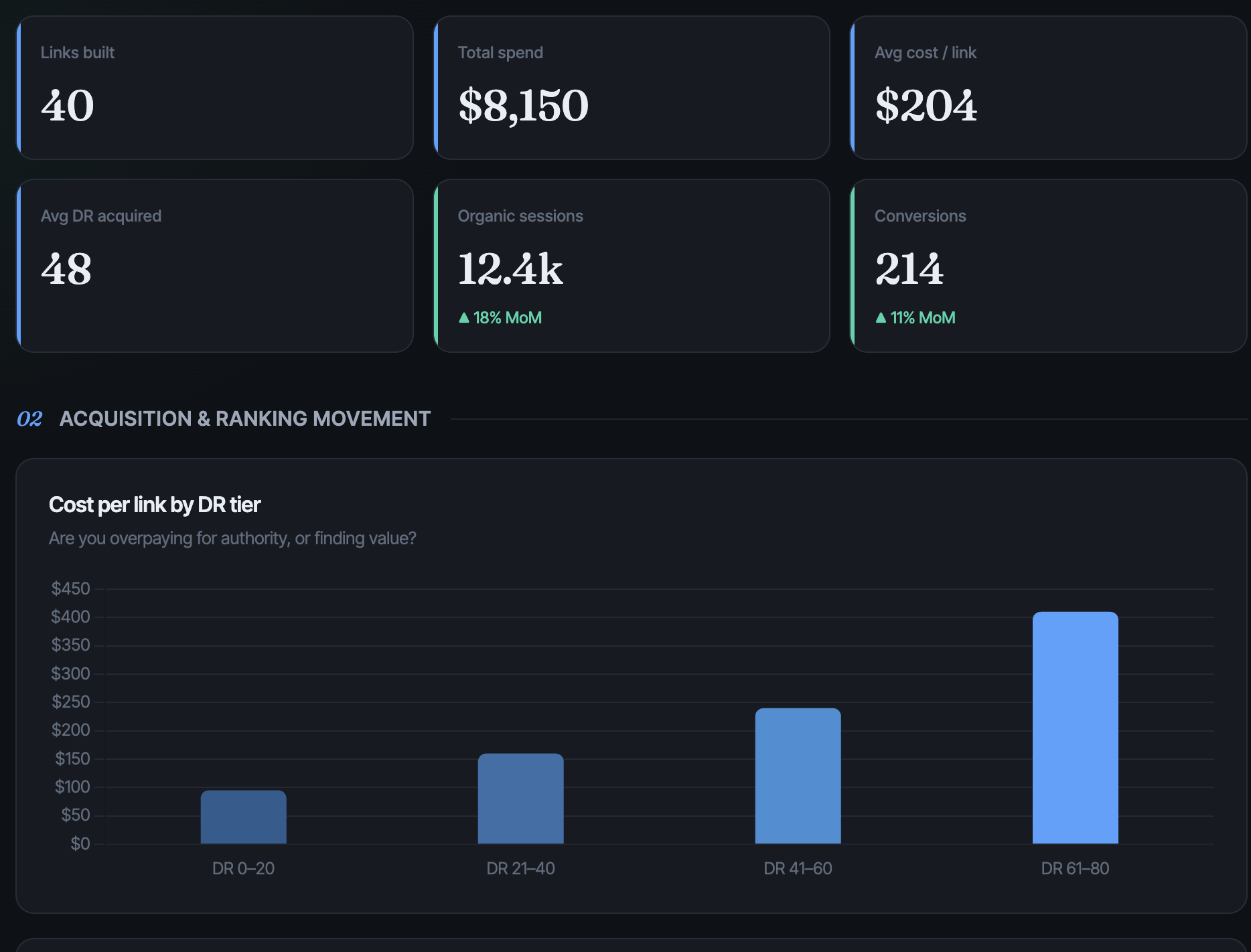
Action Step
Start by taking all of your link building spreadsheets (I hope you have these…) and throwing them into AI. Then, ask AI to analyze total spend, links built, average ROI, and total amount spent per provider. Next, feed it data from Ahrefs over the same period of time and see if you can gain any top level insight into how your campaigns are working.
While you’re there, you can use AI to monitor link velocity and detox in real time.
Train ChatGPT on your backlink profile history:
- Feed in Ahrefs CSV exports monthly
- Include anchor text breakdown
- Use Gemini or Claude if over 100k rows
Then use this prompt:
Here’s our last 6 months of link data.
Analyze for:
- Over-optimized anchors
- Unnatural velocity spikes
- DR spread volatility
- TLD distribution
- Branded vs. commercial balance
Recommend:
- Disavow candidates
- Tiered link plans
- Anchor correction strategy
Final Thoughts
If you aren’t integrating AI into your link building efforts, you are behind the times and in danger of going out of business. That’s not an exaggeration.
You can and should be using AI in all its forms (tools, LLMs, N8N, etc.) to improve link acquisition results.
And I don’t just mean the BS advice like “use GPT for emails.” AI is about improving operational efficiency, reducing costs, and freeing up valuable time for higher leverage tasks.
So, when using AI for building links, don’t think “how can AI help me do this task?” Think, “How can we leverage AI by automating repetitive tasks and building workflows that take the manual labor out of SEO and free our time to focus on what really matters?”
I also want you to understand that link building is no longer just a numbers and DR game. It’s a systems, scale, relationships, and efficiency game. Whoever builds the best links in the fastest time frame while spending the least money will win. If you aren’t using AI to do that, you are behind.
My advice? Take the tips and prompts I’ve given you in this article and implement them immediately.
Best of luck.