



If you’re interested in how to use ChatGPT for keyword research, you’re going to love this guide.
ChatGPT and other AI tools have completely revolutionized how SEOs research keywords, cluster topics, build topical maps, and plan content ideas.
What used to take a human being days of work (just to produce imprecise results…) now takes AI minutes flat.
As an AI SEO company, we use ChatGPT for keyword planning, research, clustering, ideation, finding long-tail variations, and even analyzing AI Overviews. And it’s all done automatically (more or less).
In this guide to ChatGPT keyword research, I’ll be sharing all of the ways our SEO team uses AI to find high-value keyword ideas, so you can start getting better results faster (and for less money).
AI won’t do all of the work for you, but it can speed up and improve results.
Here’s what to do.
Using ChatGPT for Keyword Research Overview
- ChatGPT is invaluable for SEO keyword research because it can handle time-consuming analysis and organization at scale.
- You can use it to brainstorm seed keywords, find long-tail ideas, cluster keywords, analyze SERPs, research Reddit, and identify related terms.
- ChatGPT becomes even more powerful when you give it real keyword data from tools like Ahrefs to merge, deduplicate, organize, and analyze.
- However, ChatGPT doesn’t have reliable search volume, Keyword Difficulty, or complete ranking data, so you still need traditional SEO tools.
- Used correctly, ChatGPT can save days of manual work and thousands of dollars in labor, especially when working with large keyword lists.
- You still need to review its output and make the final SEO decisions yourself, particularly when clustering keywords or determining search intent.
Can You Use ChatGPT for Keyword Research?
Yes, you can use ChatGPT for keyword research, but only for specific tasks like brainstorming, clustering, merging lists, and finding long-tail keyword ideas.
ChatGPT doesn’t have reliable real-time search volume, keyword metrics like Keyword Difficulty or Traffic Potential, or SERP data. So it can’t tell you “these are the best keywords to target and here’s the search volume”.
What GPT can do is the grunt work and ideation. Don’t use AI to find volume, organic rankings, traffic, or other data (it can’t). Instead, use it to do all of the hard, time-consuming tasks related to finding the right keywords to target.
For example, you can use GPT to suggest keywords or find potential keywords that your competition isn’t using. Or, it can help generate blog post ideas.
We mainly use ChatGPT to speed up the parts of keyword research that normally require manual analysis. For example, you can give it a list of 1,000 keywords and ask it to remove duplicates, group similar terms, categorize them by search intent, or identify recurring topics.
It’s also useful for expanding seed keywords. Give ChatGPT a broad topic, and it can generate related questions, problems, modifiers, and long-tail variations you may have overlooked.
We’ll cover all of this and more in the rest of this AI keyword research guide.
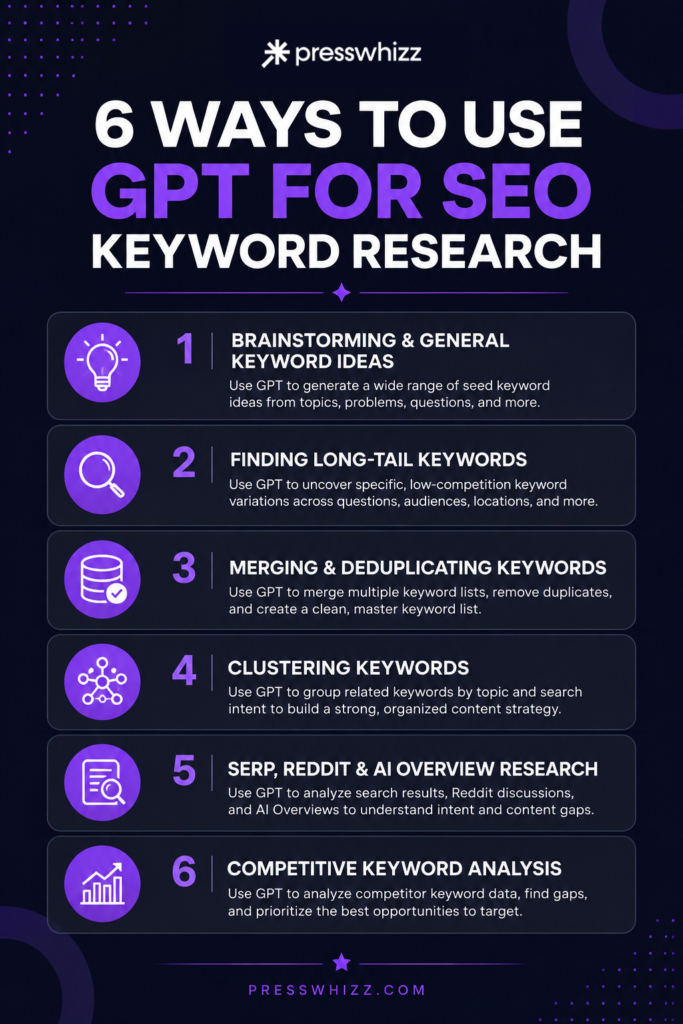
ChatGPT for SEO Keyword Research: 6 Ways to Use AI to Improve Your Research Processes
The best ways to use ChatGPT for keyword research include brainstorming, generating keyword ideas, finding long-tail variations, and doing the manual work of merging, de-duplicating, and clustering of key terms.
Here are the ways to use AI for keyword research in more detail:
Brainstorming and General Keyword Ideas
Brainstorming is probably the #1 keyword research task we use ChatGPT for. AI is incredible at taking a broad topic and quickly exploring dozens of related directions that humans would never think of.
Start by giving ChatGPT your product, service, audience, or general topic. You can then ask it to generate seed keywords based on customer problems, features, use cases, questions, industries, or different stages of the buying process.
For example, if your seed topic is “link building,” ChatGPT might suggest related concepts like guest posting, link outreach, backlink analysis, broken link building, and link reclamation.
Or, imagine you are building out a silo of informational content on local SEO and you want to come up with some seed keyword ideas. ChatGPT can do that instantly:
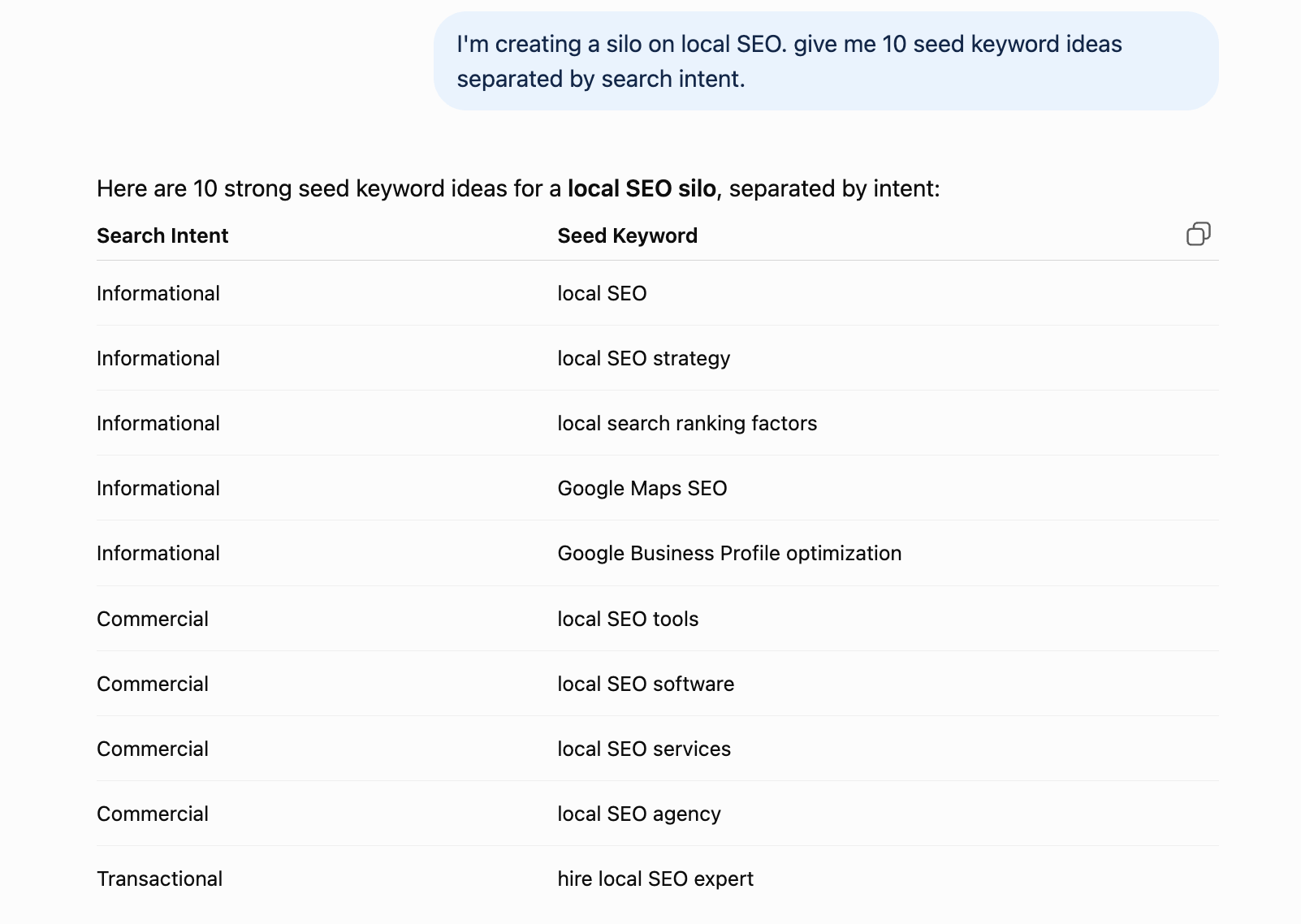
Some of these are excellent. Hire local SEO expert, Google Maps SEO, local search ranking factors…I hadn’t even thought of those. I’ll add them to my list now…
This is where ChatGPT saves us the most time with keyword research. Instead of manually thinking through every possible direction, we use it to create a large starting pool of ideas.
Once we have those seed keywords, we plug them into a keyword research tool to find related keywords and validate them using actual search data. More on this later.
ChatGPT Prompt for Brainstorming Keyword Ideas
I want to brainstorm SEO keyword ideas for [TOPIC/PRODUCT/SERVICE].
My target audience is [AUDIENCE], and my main goal is [TRAFFIC/LEADS/SALES/etc.].
Generate 50 seed keyword ideas across different categories, including:
- Customer problems and pain points
- Questions people might ask
- Products or services
- Features and use cases
- Industries and audiences
- Commercial and transactional searches
- Informational searches
- Related topics I may not have considered
Group the ideas by category and search intent.
Do not provide search volume or Keyword Difficulty. I will validate the keywords using traditional keyword research tools, like Ahrefs.
Finding Long-Tail Keywords
Long-tail keywords are lower-volume search queries that tend to be more specific than broad head terms. They’re also one of the best keyword research tasks to give ChatGPT because AI can generate hundreds of variations in seconds.
Humans aren’t particularly good at this kind of brainstorming.
After 10 or 20 variations, you naturally start running out of ideas for relevant keywords (if you can even get to 10, that is!). ChatGPT can keep exploring different questions, audiences, problems, locations, features, and modifiers without much additional work. It can come up with thousands of long-tail keyword ideas in minutes.
For example, you might start with a broad head term like “local search engine optimization” and uncover a long-tail variation like “local SEO for multi-location businesses.”
You can then run these ideas through Ahrefs and look for keywords with actual search demand and relatively low Keyword Difficulty. Long-tail keywords are generally less competitive, although that isn’t always the case.
Here’s an example of the keyword data for “local SEO for multi-location businesses”:
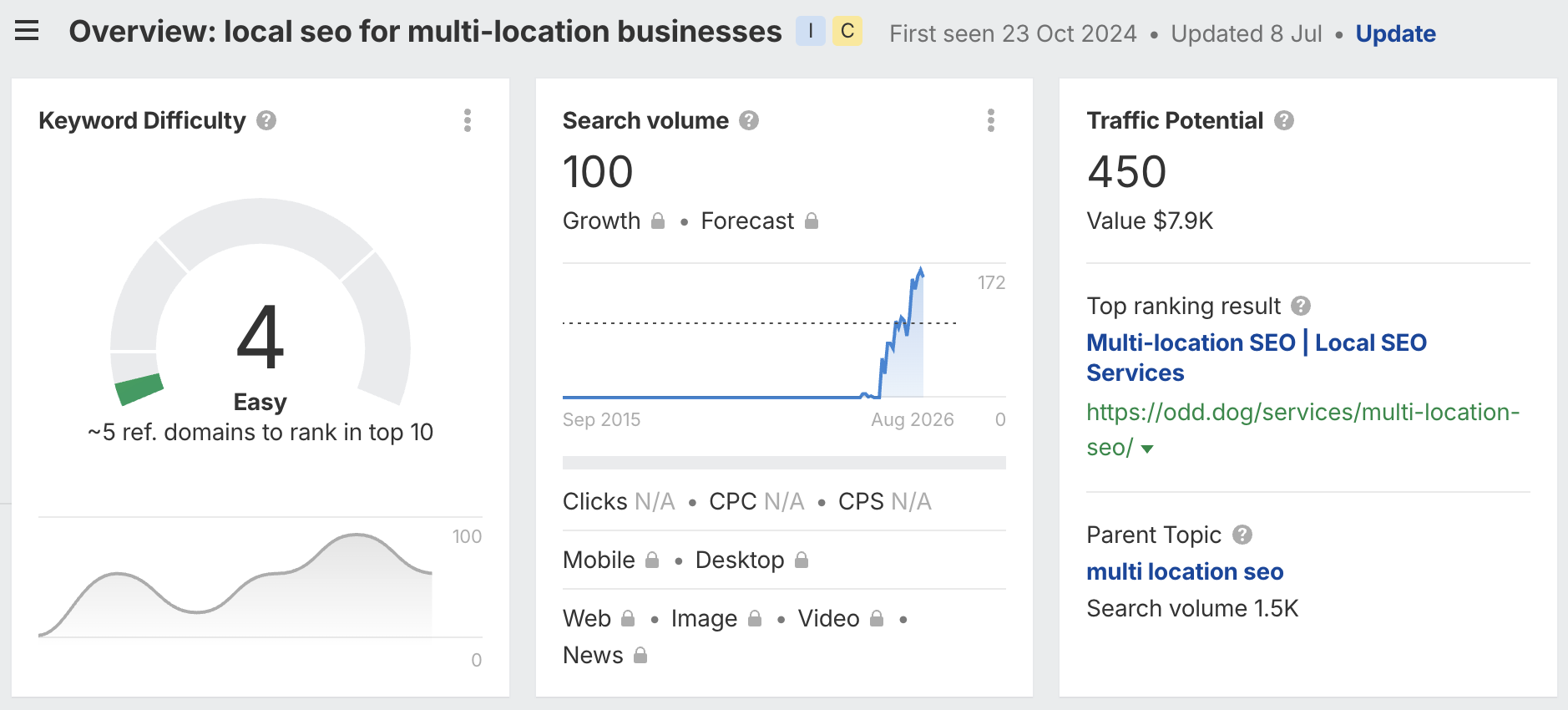
100 monthly searches, 450 traffic potential, and 4 Keyword Difficulty. This is a high-intent, buy-now keyword that’s not very hard to rank for. Have at it! Thanks, ChatGPT.
Pro Tip: Always validate AI keyword ideas with a real keyword research tool, like Ahrefs or Semrush. These tools have access to real keyword search volumes.
Next, we’ll move into clustering, where ChatGPT can legitimately save you days of manual work and thousands of dollars in salaries.
ChatGPT Prompt for Finding Long-Tail Keywords
Generate long-tail keyword ideas related to [MAIN KEYWORD].
Explore variations based on:
- Questions
- Problems and pain points
- Specific audiences
- Industries
- Locations
- Features
- Use cases
- Comparisons
- Buying intent
- “How,” “why,” “best,” “for,” and other useful modifiers
Prioritize specific searches that someone might realistically type into Google rather than simply creating longer versions of the same keyword.
Group the results by topic and search intent.
Generate at least 100 ideas. Do not invent search volume or Keyword Difficulty. I will validate the final list using Ahrefs or Semrush.
Clustering, Merging, and De-Duplicating Keywords
Keyword clustering is grouping related keywords that can reasonably be targeted on the same page based on their topic and search intent. Keyword clustering is vital to modern SEO strategy for a few reasons. For one, it helps you avoid creating duplicate pages. And two, clustering helps you build deep topical authority on a subject, which then supports your “money pages” in search results.
So, how does clustering relate to using GPT for keyword research?
Well, this is probably the single highest-ROI keyword research task you can use AI for.
Normally, clustering keywords would take a human being 10-15 hours. Seriously. With AI, it takes 10-15 minutes MAX.
Here’s how we use ChatGPT to help with our keyword grouping processes…
Start by exporting your keyword lists from Ahrefs:
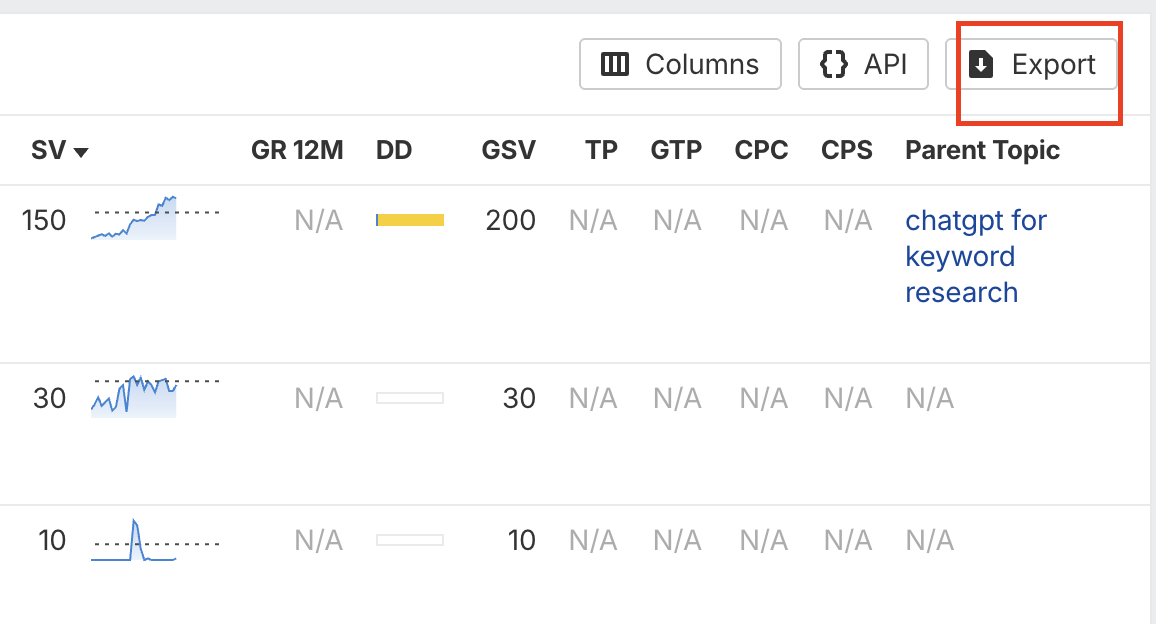
NOTE: You’ll want to take the organic keywords from 4-5 of your top-ranking competitors.
Next, merge everything into a single spreadsheet and remove any duplicates:
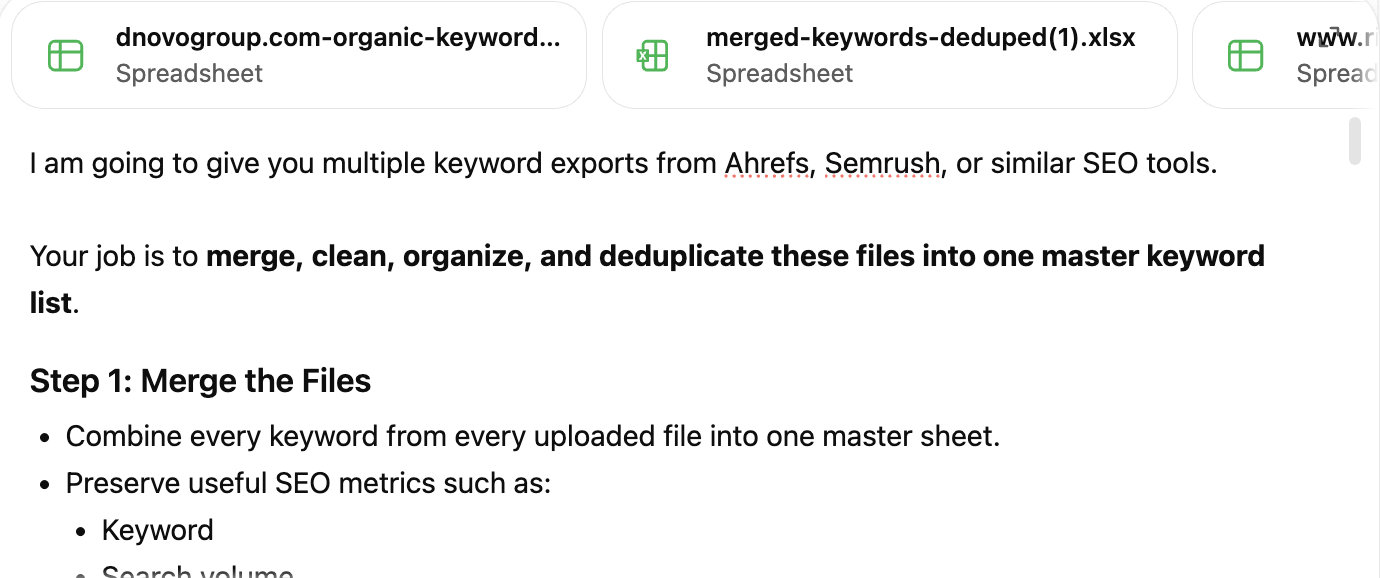
At PressWhizz, we always download as a CSV, then upload it to GPT and ask it to merge and “de-dup”.
You can then give the cleaned list to ChatGPT and ask it to organize the keywords into clusters, identify intent, choose a primary keyword for each cluster, and assign supporting keywords.
However, you must give AI the proper prompt instructions. You can’t just say “cluster these keywords”.
Give ChatGPT clear rules for what should and shouldn’t be grouped together (known as guardrails), along with examples of correctly clustered keywords. You should also manually review the finished clusters and check questionable groupings against the SERPs.
See how valuable this is?
Without AI, you or an employee would have to review thousands of keywords individually, compare their intent, group them, and clean the spreadsheet manually. That’s potentially days of work that ChatGPT can reduce to a fraction of the time.
ChatGPT Prompt for Merging and De-Duplicating Keywords
I am uploading multiple keyword exports from Ahrefs, Semrush, or another SEO tool.
Merge every file into one master keyword list.
Then:
- Remove duplicate keywords
- Treat capitalization and minor formatting differences as duplicates
- Preserve useful metrics such as search volume, Keyword Difficulty, traffic, CPC, position, and URL
- Standardize columns that represent the same metric
- Remove blank rows and obvious formatting errors
- Do not rewrite keywords simply because they sound awkward
When the same keyword appears in multiple files, keep the most complete available data.
Return one clean master spreadsheet ready for keyword clustering and analysis.
ChatGPT Prompt for Clustering Keywords
I am uploading multiple keyword exports from Ahrefs, Semrush, or another SEO tool.
Merge every file into one master keyword list.
Then:
- Remove duplicate keywords
- Treat capitalization and minor formatting differences as duplicates
- Preserve useful metrics such as search volume, Keyword Difficulty, traffic, CPC, position, and URL
- Standardize columns that represent the same metric
- Remove blank rows and obvious formatting errors
- Do not rewrite keywords simply because they sound awkward
When the same keyword appears in multiple files, keep the most complete available data.
Return one clean master spreadsheet ready for keyword clustering and analysis.
ChatGPT Prompt for Clustering Keywords
I am uploading a keyword list. Organize these keywords into logical SEO clusters based primarily on topic and search intent.
For each cluster:
- Select one primary keyword
- Add closely related supporting keywords
- Identify the dominant search intent
- Suggest a page/topic for the cluster
- Keep keywords separate when they represent meaningfully different search intents
Do not group keywords together simply because they share similar words.
When you are uncertain whether two keywords belong on the same page, flag the cluster for manual SERP review instead of guessing.
Return the results in a table with:
Cluster | Primary Keyword | Supporting Keywords | Search Intent | Suggested Page | Manual Review Needed
Finding LSI Keywords
Latent semantic indexing (LSI) keywords generally refer to words and phrases that are semantically related to your main topic. While Google doesn’t technically use “LSI keywords” as an SEO system, related terms can help you cover a topic more completely and naturally.
ChatGPT is useful here because it can quickly identify concepts, entities, questions, and terminology associated with a topic.
For example, if your main keyword is “local SEO,” ChatGPT might suggest Google Business Profile, local citations, NAP consistency, map pack, reviews, and local search rankings.
Once you have these terms, review them for relevance and incorporate the useful ones naturally into your headings and content. Don’t force every keyword onto the page.
ChatGPT Prompt for Finding LSI Keywords
My primary keyword is [KEYWORD].
Identify words, phrases, concepts, entities, questions, and terminology that are semantically related to this topic.
Group them into:
- Core concepts
- Entities
- Related terminology
- Questions
- Products/services
- Problems and pain points
- Processes or methods
- Relevant subtopics
Focus on terms that would help someone cover the topic comprehensively rather than simply providing synonyms of my primary keyword.
Return the results in a table and briefly explain why each term is relevant.
Do not recommend forcing every term into the content. Prioritize natural topical relevance.
Research SERPs, Questions, Reddit, and AI Overviews
Keyword research isn’t only about finding keywords. You also need to understand what people actually want to know when they search for them.
This is another area where ChatGPT can save you a ton of manual research. Give it a target keyword and have it research the SERPs, ranking pages, common questions, Reddit discussions, and available information from Google’s AI Overviews.
Reddit threads are everywhere in the SERPs now. Here’s the SERP for the query “best AI SEO services”:
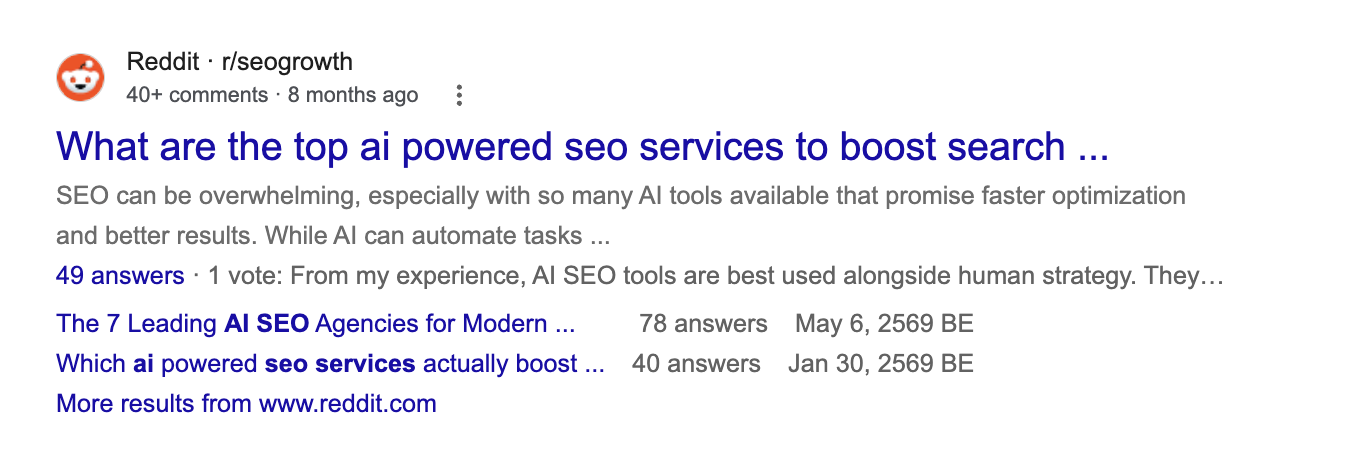
ChatGPT can then pull out useful information such as:
- Questions people repeatedly ask
- Common problems and pain points
- Topics covered by ranking competitors
- Important entities, products, and terminology
- Opinions and experiences from Reddit
- Topics and sources appearing in AI-generated search results
The real advantage is what you can do with all this information afterward.
Instead of opening 20 tabs and taking notes manually, have ChatGPT organize the research into a table showing the source, topic, search intent, common questions, and potential content opportunities.
You can then turn that research directly into your content brief. Recurring questions become FAQs, important subtopics become headings, Reddit discussions give you real-world examples, and competitor gaps become opportunities for additional information.
You’re essentially turning the entire SERP into structured data that you can use to write better content.
ChatGPT Prompt for SERP, Reddit, and AI Overview Research
Research the keyword [TARGET KEYWORD] using current Google search results and available web sources.
Analyze:
- Top-ranking pages and the topics they cover
- Common questions people ask
- Search intent
- Reddit discussions and real user experiences
- Problems and pain points
- Important entities, products, and terminology
- Google AI Overview themes and cited sources, if available
- Content gaps or topics competitors overlook
Organize your findings into a table showing:
Source | Topic | Key Insight | Search Intent | Common Questions | Content Opportunity
Then summarize what someone searching this keyword appears to want and recommend the main topics, headings, FAQs, and unique information that should be included in a comprehensive article.
Competitive Keyword Analysis
ChatGPT can help with competitive keyword analysis, but probably not in the way you think.
Competitive keyword analysis means comparing your keyword profile against competing websites to find topics they rank for that you don’t.
Why do this? Because it helps you identify gaps in your content strategy and see where competitors are already capturing search traffic.
Again, we want to drive this point home: ChatGPT isn’t a replacement for Ahrefs here.
It doesn’t have Ahrefs’ or Semrush’s proprietary keyword databases, accurate search volumes, Keyword Difficulty scores, or complete competitor ranking data.
Where ChatGPT becomes useful is after you collect the data.
Export keyword data for several competitors from Ahrefs, upload the files to ChatGPT, and have it:
- Merge multiple competitor exports into one master spreadsheet
- Remove duplicate and irrelevant keywords
- Cluster thousands of keywords into logical topics
- Identify keywords and clusters shared by multiple competitors
- Analyze search intent and broader patterns in the data
- Suggest which topics should become individual pages
- Prioritize opportunities based on the metrics included in your exports
- Recommend a logical order for creating the content
In other words, let Ahrefs collect the competitive data and use ChatGPT to help you make sense of it.
ChatGPT Prompt for Competitive Keyword Analysis
I am uploading keyword exports for [NUMBER] competitors from Ahrefs or Semrush.
Analyze the actual data in these files. Do not invent missing search volumes, Keyword Difficulty scores, traffic, or rankings.
Please:
- Merge the competitor exports
- Remove duplicates and irrelevant keywords
- Cluster keywords into logical topics
- Identify keywords shared by multiple competitors
- Find topics competitors rank for that my site does not
- Analyze search intent
- Identify recurring themes and patterns
- Suggest which clusters deserve individual pages
- Prioritize opportunities using the metrics provided
- Recommend a logical content creation order
Return the final opportunities in a table with your reasoning for each recommendation.
Final Thoughts
ChatGPT is an invaluable tool for SEO keyword research for a few reasons:
- It can brainstorm and ideate far better than humans
- It can do grunt work like de-duplication and merging far quicker and more accurately than a human
- It’s great at analyzing high-level data and finding patterns people miss
Artificial intelligence tools have completely changed how we do SEO here at PressWhizz. They save us dozens of hours per week, keep our team lean, and improve our outputs exponentially.
If you aren’t using AI to help with your SEO, you are far behind every other agency out there.
My advice is that you start small. Use GPT for content writing, keyword research, and AI link building. Then, you can build into higher-level AI SEO tasks, like using ChatGPT for affiliate marketing. Together, these AI SEO tactics will help you rank in overviews, LLM citations, and organic rankings.
Just be sure to understand that GPT is not the same as a “real keyword research tool”. It doesn’t have real search volumes or any proprietary difficulty metrics. It also doesn’t know which topics will cannibalize each other, and it can’t make a true topical map without your input.
As always, use AI as a tool, not a replacement. Oversee the entire operation and check AI’s performance, and you’ll be just fine.
– Dusan Novakovic