

Welcome to PressWhizz’s guide on how to do guest post outreach the right way. This guide contains our in-depth blogger outreach process exactly how we would do it for a real link building client.
Over our decades of experience in the link building industry, we’ve managed countless guest post link building campaigns. And, through PressWhizz’s guest post services, I have personally overseen tens of thousands of successful link placements.
We know how to find prospects, qualify them, create emails that convert, write high-quality articles, and nurture editor relationships. And today we are going to share our secrets with you.
This is not your typical “use Google search operators and ask for a link” guidance. This is real, battle-tested advice along with step-by-step instructions on how to land sponsored post opportunities on high-quality, relevant websites.
We’ll cover:
- Building a prospects list
- Qualifying them
- Finding contact information
- Creating high-converting emails
- Using outreach tools to make the process easier
- How to build basic AI automations to personalize outreach
- Creating your guest submissions
- Tracking campaigns and ROI
- A/B testing
And we even provide you with a checklist and a guest post outreach email template, too.
Grab a coffee and let’s begin.
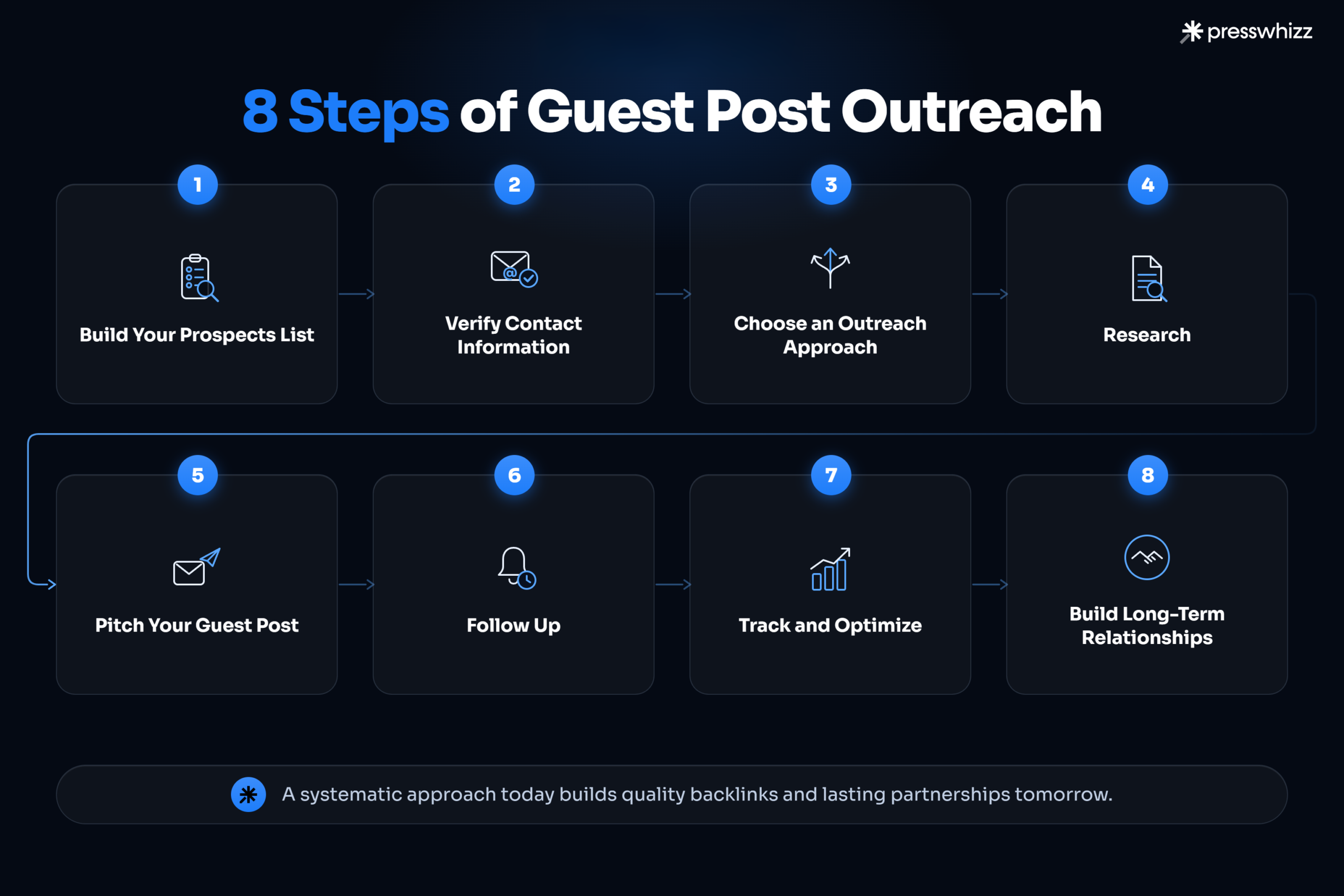
Step 1: Build Your Outreach List
First up is building your list of guest post site prospects.
Building a targeted guest post prospect list is the most important part of the entire outreach process.
Yes, doing it the right way takes more time than scraping thousands of random websites, but the payoff is higher-quality backlinks, better response rates, and far less wasted outreach.
If you’ve ever wasted entire weeks reaching out to dead ends with nothing to show for it, the problem is almost certainly your prospect list.
In the following sections, I’ll walk you through the most effective ways to build a prospect list that consistently produces results.
Use Google Search Operators That Find Contributor Pages
Google search operators are still the best way to quickly find guest post opportunities and build a prospect list. Full stop.
Advanced Google searches let you uncover websites actively accepting sponsored content, which means they’ll be easier to contact and more likely to convert.
In my experience, most SEOs get this part wrong. They either approach it the wrong way or put in 50% effort (then complain on Twitter that link building is dead).
Copying the same operators everyone else uses, then blasting generic emails to every result doesn’t work.
Sorry, but this isn’t 2016 anymore. The link building game has evolved. That approach just produces bloated prospect lists full of dead pages and low-quality sites.
I’ll show you the right way to use search operators to uncover fresh, relevant opportunities that your competitors are probably missing. Start by using these search operators:
- “write for us” [NICHE]
- “guest post” [NICHE]
- “become a contributor” [NICHE]
- “contribute” [NICHE]
- “guest article” [NICHE]
- “submit an article” [NICHE]
- “submit a guest post” [NICHE]
- “guest author” [NICHE]
- “editorial guidelines” [NICHE]
- “contributors” [NICHE]
But how do you take it to the next level so your list actually converts and you uncover unique opportunities other SEOs don’t have in their lists?
Stack operators together.
Don’t just stop at Page 1 after you search. For example, you can combine “write for us” OR “guest post” OR “contribute” OR “become a contributor” plus your keyword to find more in-depth opportunities. You can narrow your search even further with operators such as “inurl” or “intitle”.
Pro Tip: Always go levels and levels deeper into the results.
Next up, we’ll get to analyzing your competition to find high-ROI guest post opportunities.
Reverse-Engineer Competitor Backlinks
One of the fastest ways to build a high-quality guest post prospect list is by performing competitor backlink analysis.
Instead of trying to guess which websites might accept guest posts, you use tools to discover sites that have already linked to businesses ranking for your target keywords.
In just a few minutes, you’ll see exactly who links to your competitors, which is essentially your blueprint for building a link profile and outranking them.
If several competing websites have earned links from the same publication, there’s a good chance that publication is open to similar contributions.
Reverse engineering also helps you prioritize your outreach. Instead of emailing thousands of random websites, you can focus your time on publishers who have already shown you they are willing to sell guest posts.
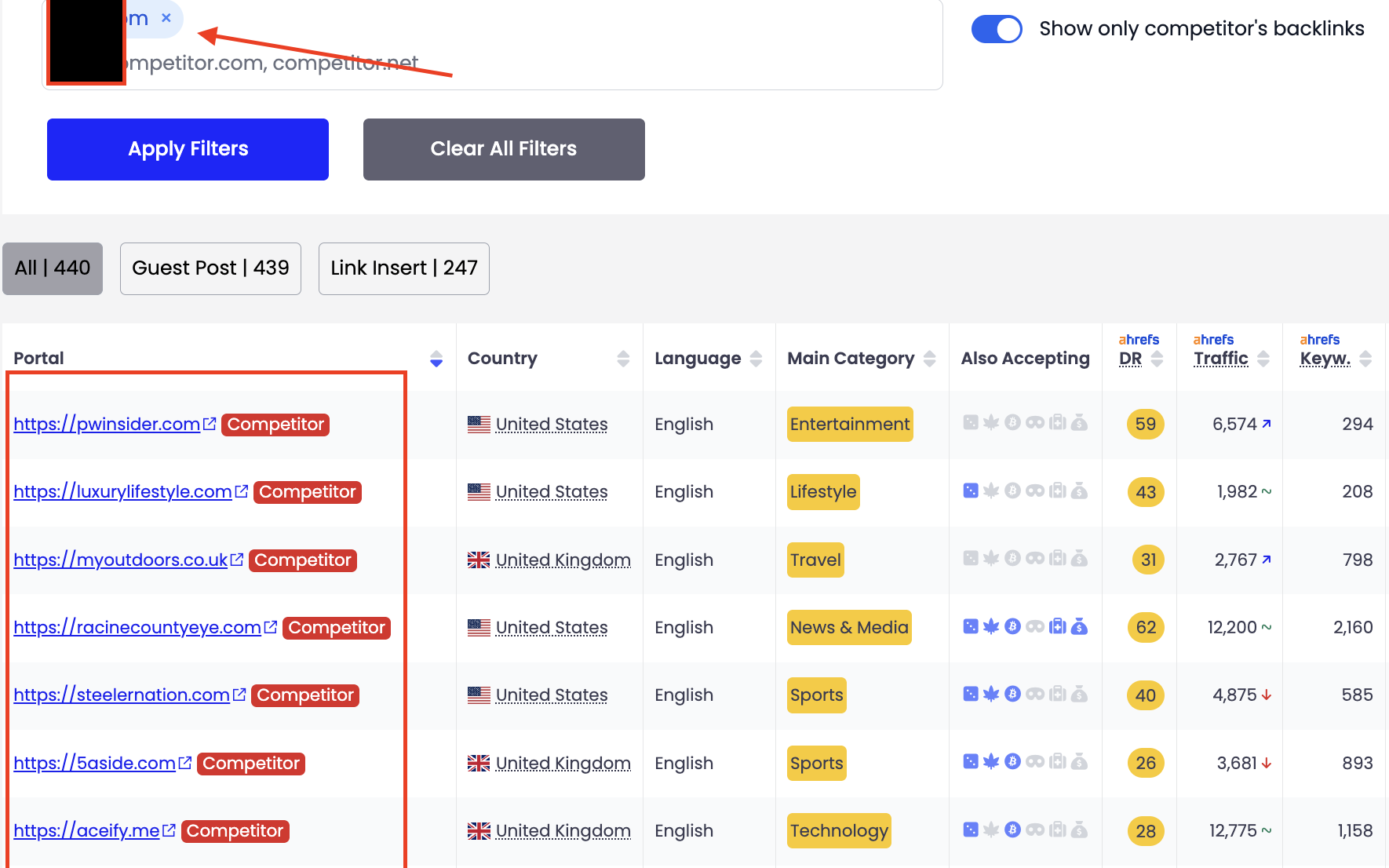
The easiest way to do this is with PressWhizz’s Competitor Backlink Analysis and Keyword Research tools.
Just put your competitor’s website into our marketplace’s tool, and you’ll see which sites on our website already link to them (and will accept a post from you):
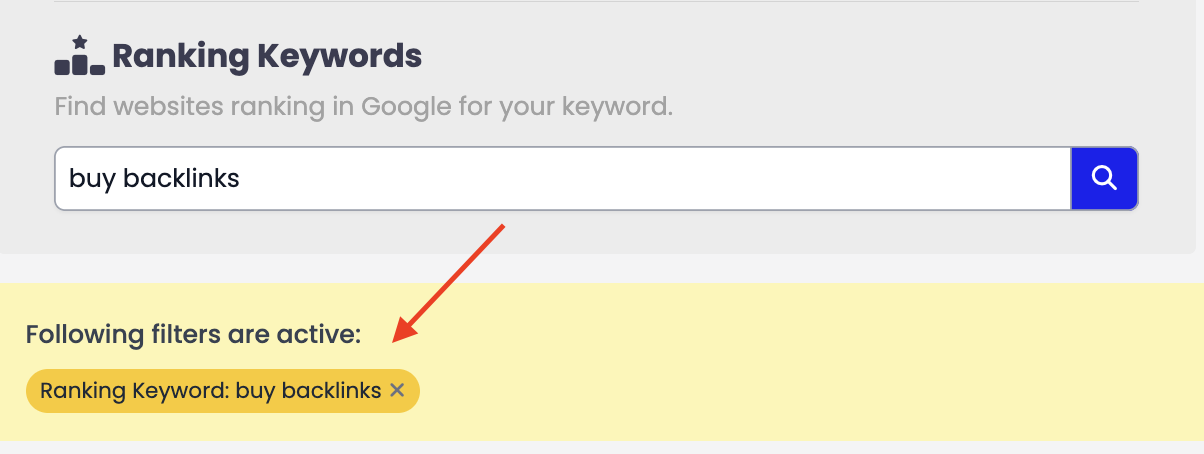
You can also do this by using keywords that you wish to rank for:
This alone will save you countless hours of manual research.
Of course, there are other tools that help you with competitor reverse engineering. Let me walk you through how to do it with Ahrefs.
How to do Competitor Backlink Analysis With Ahrefs
You can also perform competitor backlink analysis using Ahrefs Site Explorer.
Thankfully, it’s quite easy.
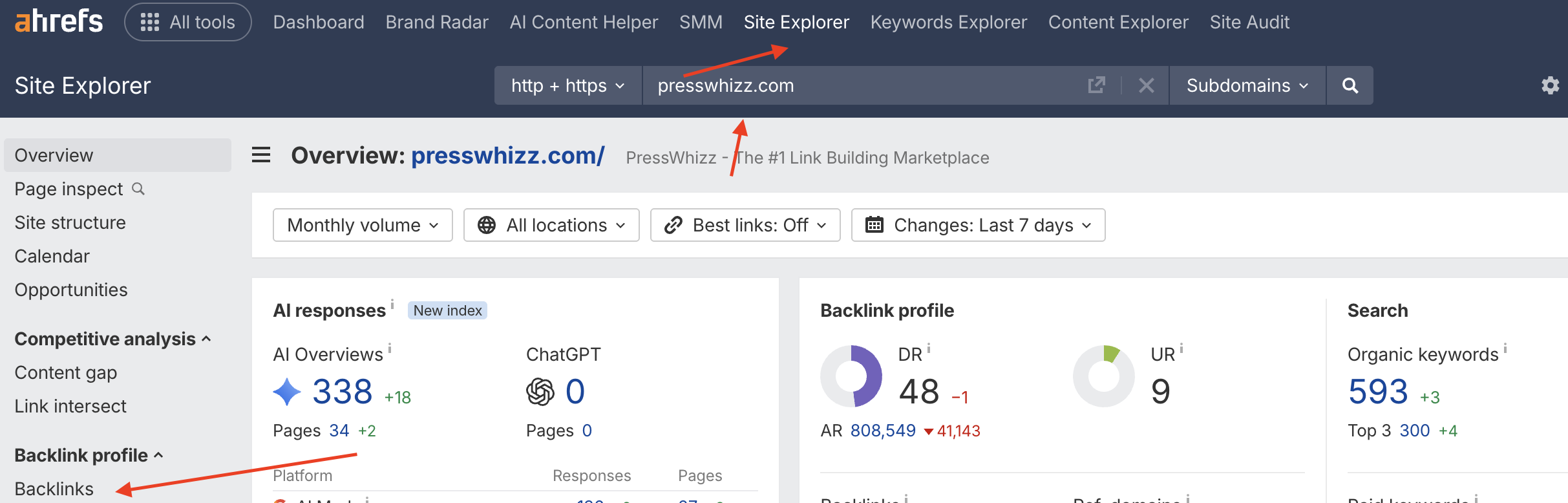
Simply enter a competitor’s domain into Site Explorer and click Backlinks on the left-hand side:
You’ll get a list of links to their website that looks like this:
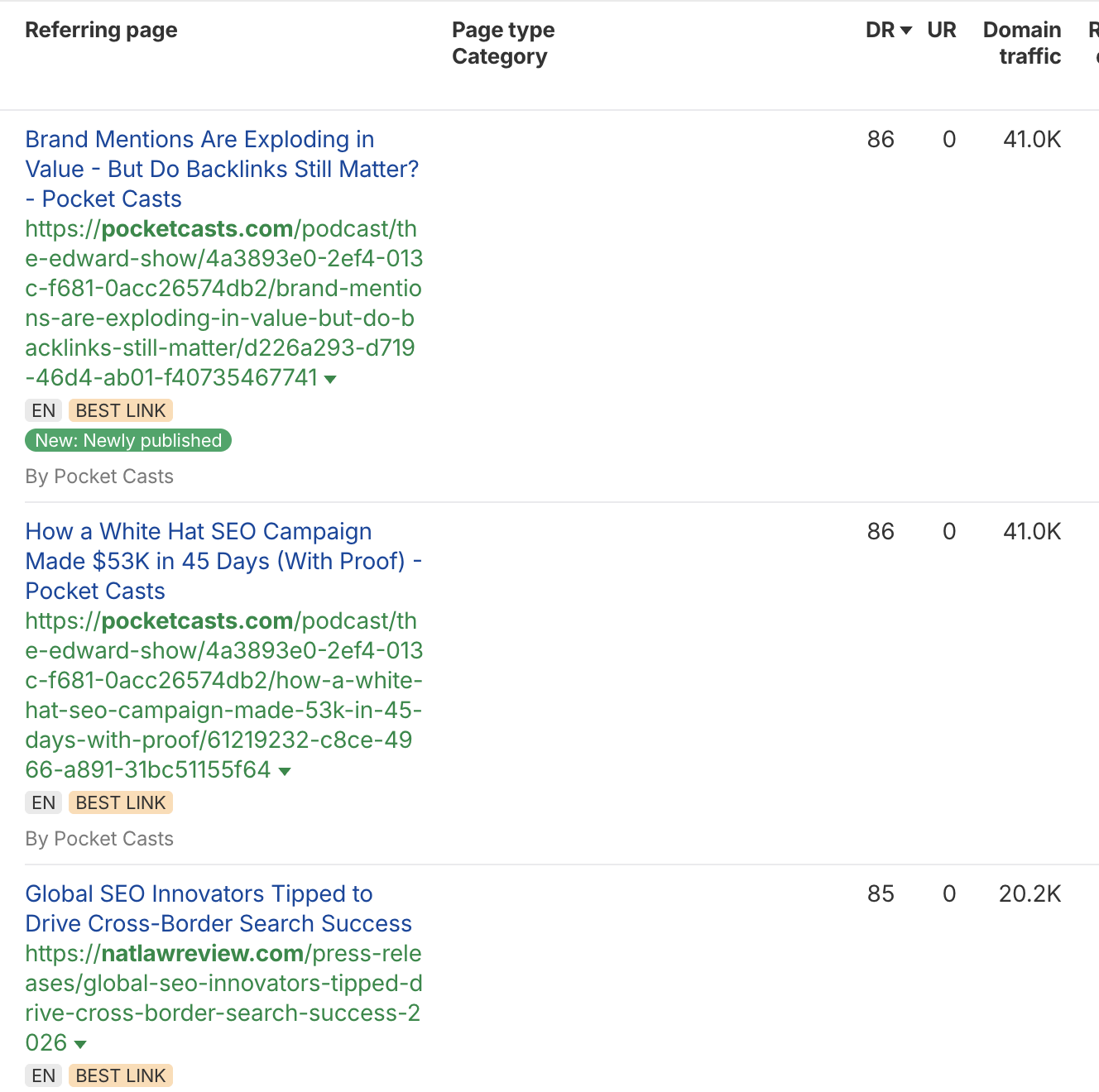
Start reviewing the referring pages.
Here’s what to look for…
Look for links that were likely acquired through guest posting or editorial outreach. Obviously, you are trying to buy guest posts on these sites and not build natural links, so you need to find sites that have already sold placements. By the way, make sure you know how to buy backlinks safely before initiating a campaign. Chances are you won’t have any issues, but it’s best to know how Google actually polices link building, so you can avoid algorithmic suppression or penalties.
These are usually easy to spot once you know what to look for.
Some common indicators include:
- The article is written by a named author with an author bio.
- The content is educational rather than promotional.
- The backlink appears naturally within the article instead of being placed in a sidebar or footer.
- The publication regularly features multiple external contributors.
- The author has written articles for several different websites in the industry.
If you’re unsure, click through to the referring page and look for an Author page, contributor profile, or a “Write for Us” or “Become a Contributor” link in the site’s navigation or footer.
Pro Tip: Make sure to export the links and build a spreadsheet of these opportunities as you go.
How to Qualify a Site Before You Pitch
By this point, you should have a solid list of guest post prospects. Now comes the part that will determine whether you land SEO-boosting guest post placements or waste your time: qualifying each website before you reach out.
Sorry, but this step is non-negotiable. Again, just blasting out emails to every site accepting guest posts is why most SEOs suffer conversion rates of 1% or less.
The problem is that most people are just contacting the wrong websites! There are plenty of high-quality sites accepting guest posts, so why waste your time with link farms?
It’s not uncommon to waste 40+ hours every week emailing sites that never reply or, worse, will accept your sponsored post but will actively hurt your organic SEO.
Seriously, it takes just a minute or two.
Before adding any website to your outreach list, run through this quick checklist:
- The site is actively publishing content: Check that new articles have been published within the last few months. An inactive blog is unlikely to respond.
- Do they accept external contributors?: Look for author bios, contributor pages, or multiple writers outside the core team.
- Is the content relevant to your niche?: A contextual backlink from a closely related website will almost always outperform a random general blog.
- Does the site receive real organic traffic?: Use Ahrefs or a similar SEO tool to verify that the website ranks for keywords and attracts genuine search traffic.
- Are the articles well-written and edited?: Avoid obvious AI spam, thin content, and sites publishing hundreds of low-quality posts every month.
- Does the backlink profile look natural?: If every article is stuffed with commercial anchor text and outbound links, it’s probably been abused by link sellers.
OK, I hope that’s making sense. You’ve now got a high-quality guest post prospects list. It’s time to verify contact details.
Note: While they don’t provide as much value as before, free guest posting sites still can boost your authority and solidify your entity with Google. They are worth checking out if you are a new website.
Step 2: Verify Contact Information
Once you have your list, the next step is identifying the person who actually has the authority to review guest post submissions and verifying their email address.
Most articles will tell you to just use the contact@, info@, or hello@ email address, upload it into an outreach tool, and blast thousands of emails.
Again, I’m sorry, but 2016 was 10 years ago (noticing a pattern?). You need to step your verification game up to succeed at link building these days.
My advice?
Spend a few minutes finding the decision-maker.
Look for:
- Content Editor or Managing Editor
- Editor-in-Chief
- Content Manager
- Marketing Manager (for smaller businesses)
- SEO Manager (if they manage partnerships)
- Founder or Owner (for small blogs and niche websites)
Here’s a great example of a website that lists real, contactable people:
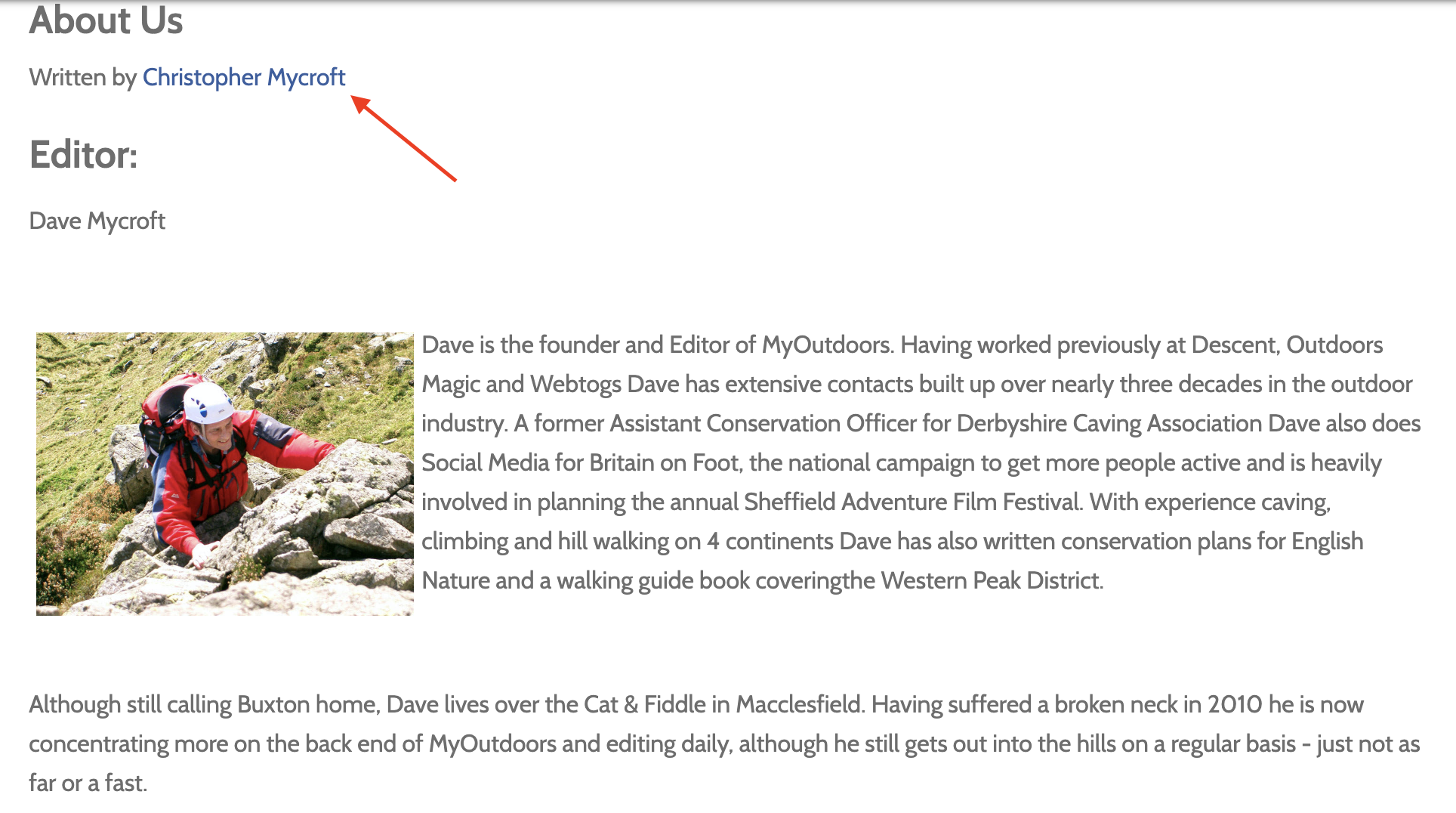
These are the types of sites that you should contact. You’ll have a much better chance of landing the post.
Who you contact often depends on the size of the company:
- 1–10 employees: Founder or Owner.
- 10–50 employees: Marketing Manager or Content Manager.
- 50+ employees: Editor, Managing Editor, or Editorial Team.
Look on their website, check social media, check LinkedIn, or Google “company” + “name” + @. I like to use a hack where I search (name)@(businessname.com) and see if it pops up in the search results at all. That’s proof that the email actually exists.
Taking the time to identify the correct person will pay off in the long run.
A Backlinko analysis of 12 million outreach emails titled “We Analyzed 12 Million Outreach eMails. Here’s What We Learned” found that contacting multiple relevant people at the same company increased response rates by 93%, while personalized outreach consistently outperformed generic campaigns.
So, finding the relevant people and addressing them directly will improve your success rates. It’s worth the time.
Step 3: Choose Your Outreach Approach
Next up is outreach. It’s impossible to overstate how important this step is.
According to that same Backlinko analysis of 12 million outreach emails, only 8.5% of outreach emails receive a reply. You have to make each email count if you want to land high-quality placements.
And, of course, the better and more targeted your emails are, the higher your conversion rates will be.
In this section, we’ll cover two outreach approaches that consistently work in the SEO industry, when to use each one, and how to build a process you can scale without reducing response rates.
The two outreach approaches I recommend are…
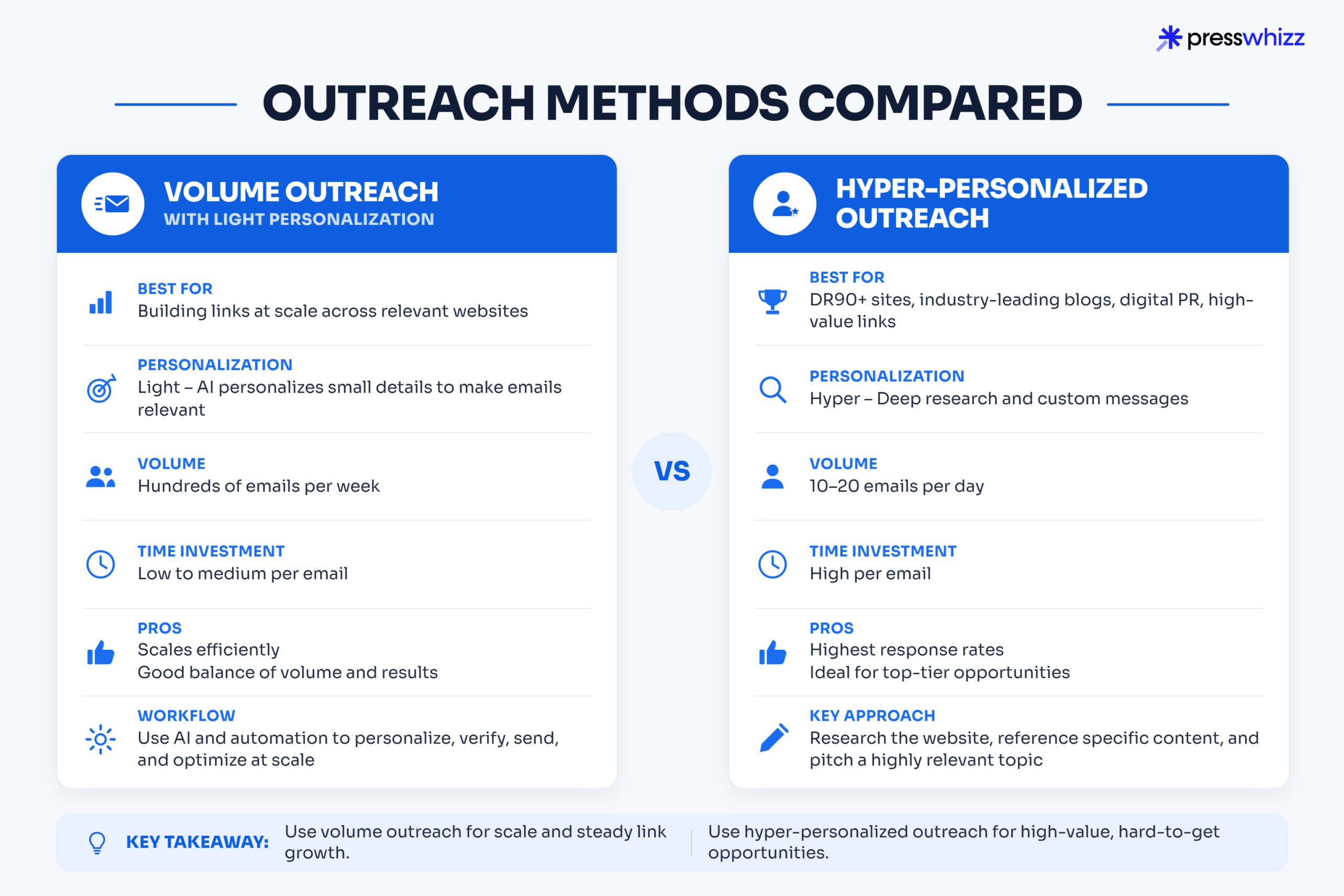
Volume Outreach With Light Personalization
This is my preferred outreach approach because it offers the best balance between scale, efficiency, and response rates.
Fully custom emails simply don’t scale, and fully automated outreach gets almost no replies. You need to find a middle ground that A) makes business sense but B) produces results.
That’s why I prefer light personalization. Every email feels relevant to the recipient, but your team can still send hundreds every week.
Here’s how to do it.
Build a proven outreach template, then use AI (we use Pitchbox) to personalize the small details that make each email feel unique, like greetings or those “I loved your article” pleasantries that probably don’t even work anymore.
AI can analyze the target website, reference a recent article, explain why your content is a good fit, and populate those variables into your template. It’s truly incredible what technology can do these days.
The result is mass outreach that still feels targeted.
Here’s the workflow I recommend:
- Build a master outreach template that has already proven it can generate replies.
- Scrape key information from each prospect, including their name, website, latest articles, and niche.
- Use AI to generate a one or two sentence personalized opener based on their website or recent content.
- Merge the personalized introduction into your outreach template automatically.
- Verify every email address before sending.
- Send campaigns in controlled batches to protect your sender reputation.
- Track opens, replies, and placements, then feed the best performing data back into your prompts and templates so the system continuously improves.
Hyper-Personalized Outreach
Hyper-personalized outreach works best when every link has a high commercial value.
If you’re pitching DR90+ publications, industry-leading blogs, digital PR backlinks, or websites that are notoriously difficult to get on, spending extra time on each email is usually worth it. You may only send 10 to 20 emails a day, but each successful placement can have a significant impact on your campaign.
This level of personalization requires that you read the website, understand the editor’s audience, look at the type of content they’ve published recently, and come up with a genuinely relevant angle.
When pitching, make sure to reference a specific article, then pitch a topic that fits naturally alongside their existing content. The more obvious it is that the email was written specifically for them, the better your chances of getting a reply.
Step 4: Research Topics
This is one of the biggest mistakes we see in the guest post outreach process. A link builder thinks of an “amazing” topic that they love, then they send the pitch.
In our opinion, this is the wrong way to do it. It’s not about you. It’s about the website and the editor in control of the blog. You need something that matches their style, fits their audience, and catches their attention…and one bite at the apple isn’t enough.
We’ll cover how to find a topic that lands more often than not in this section.
Read Their Editorial Guidelines First
The first thing you should do before pitching any website is read its editorial guidelines. I know it sounds obvious, but you’d be amazed how many people skip this step, then wonder why they never get a reply.
Put yourself in the editor’s shoes. If you owned the website, would you want to read another generic email from someone who clearly hasn’t spent two minutes looking at what you publish? Neither would I.
Editorial guidelines explain the topics they accept, the writing style they prefer, formatting requirements, word count, whether they allow backlinks, and sometimes even what they don’t want pitched. Make sure to reference them in your pitch and ensure that the topic you choose fits what they typically publish.
Even if the site doesn’t have a dedicated “Write for Us” page, spend a few minutes reading recent articles. You’ll quickly get a feel for the type of content they publish.
How to Run a Keyword Gap Analysis
A keyword gap analysis shows you which keywords your competitors rank for that your site does not. For guest post pitching, this gives you topic ideas backed by real search demand, so you can approach editors with content they are missing instead of sending random suggestions.
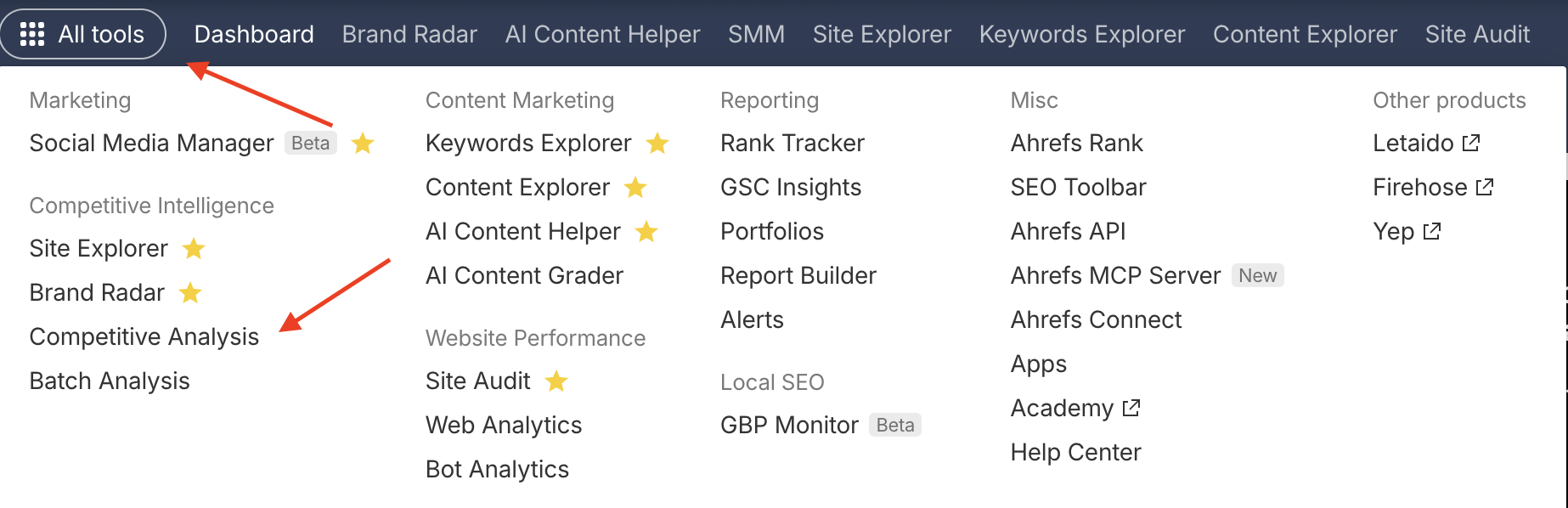
Here is how to run one in Ahrefs:
Go to All Tools and choose Competitive Analysis:
Then input your target guest post site’s domain and 1-2 of their competitors, then choose Organic Keywords:
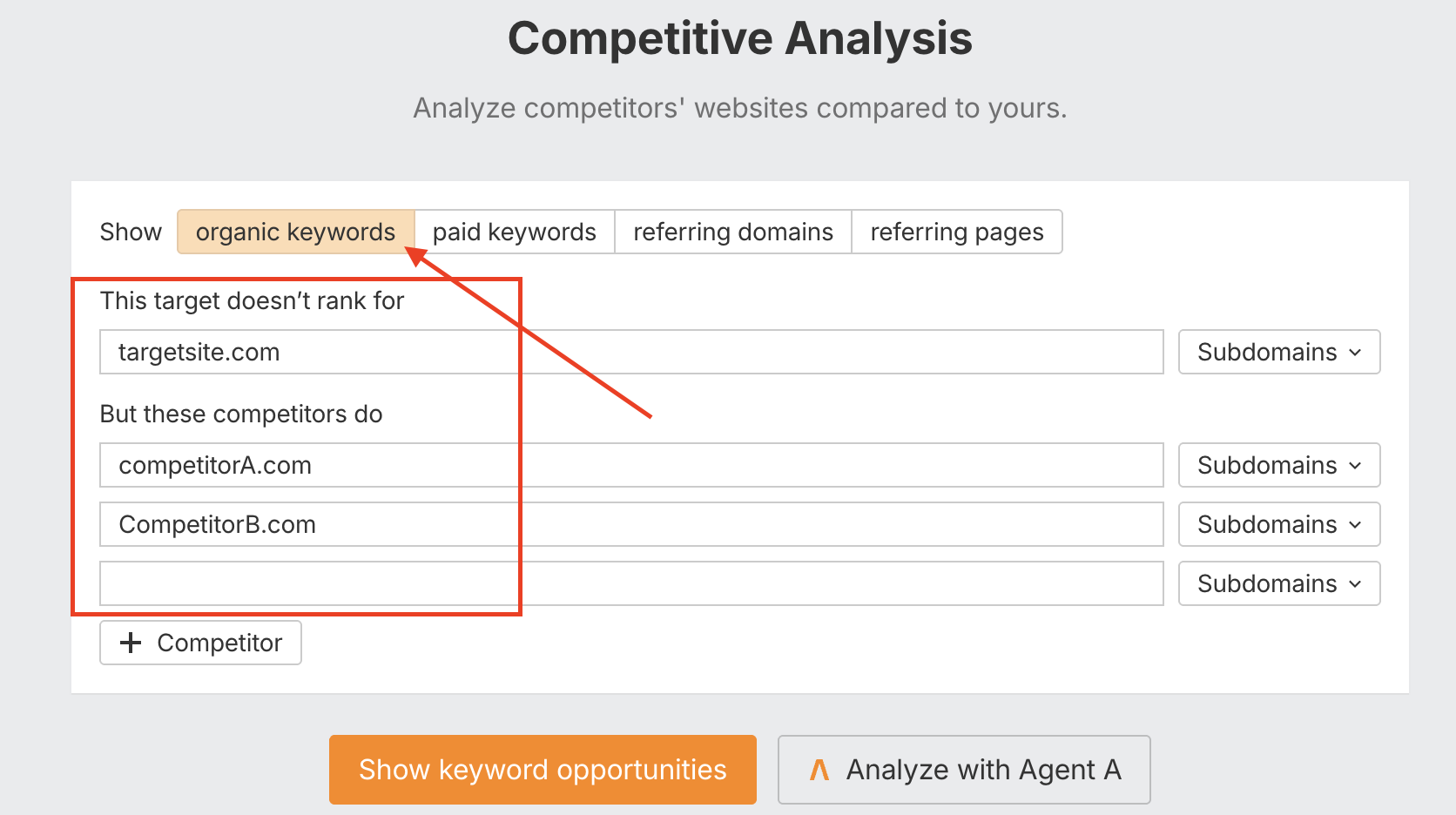
This will show you keywords that the site doesn’t rank for but their competitors do. You can add this into your pitch to improve conversions. Just say “I noticed you weren’t ranking for this important keyword with (traffic potential). Can I write this article for you?”.
Pitch Three Topics
Word of advice: Never pitch a single topic.
If the editor doesn’t like it, they’ll close the window and you’ll never get a response. And you probably won’t get their attention again.
Giving them three topics to choose from makes their job easier and gives you multiple chances to get a yes.
For example, if you’re promoting a SaaS project management tool, you could pitch:
- 10 Project Management Mistakes That Cost Growing Startups Thousands
- How AI Is Changing Project Management Workflows in 2026
- A Complete Guide to Choosing Project Management Software for Remote Teams
This is pretty straightforward. Pitching 3 topics gives you a better chance at landing a guest post placement rather than 1.
Step 5: Write the Pitch Email
OK, you’ve got your list, verified your contacts, and come up with 3 awesome guest post topics.
Now it’s time to pitch your post.
Most outreach gets ignored. Remember how only 8.5% of emails get a response? It’s true. All the data and my own anecdotal experience prove that emails rarely get responses.
Generic “dear sir/madam” or “I was eating breakfast and just happened to reverse engineer your entire link profile and land on a suspiciously relevant blog post from 4 years ago and write this email” pitches do not work.
My years in the link building industry have taught me that well-written pitches consistently outperform lazy outreach.
Editors don’t care about you, your company, or that their name came up in a fictitious conversation. They care about what’s in it for them: a topic that fits their audience and how much you will pay.
That’s it.
By the way, if you’re interested in how much the average guest post costs, check out our guide on guest post pricing. It’s more affordable than you might think.
Our team at PressWhizz writes outreach emails that smash normal conversion rates for our managed link building service clients, and I’m going to walk you through our exact process.
The Anatomy of a Great Pitch
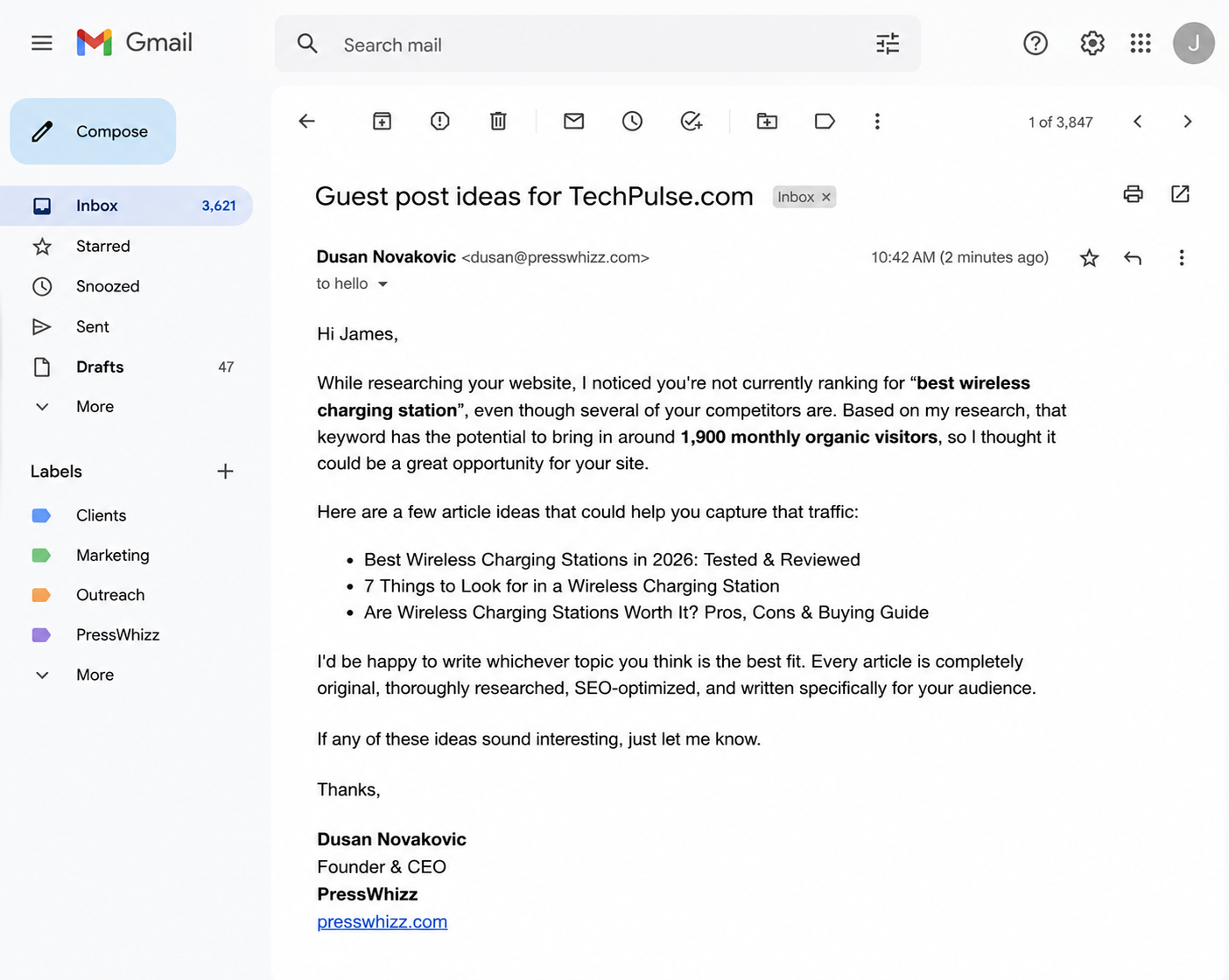
A great guest post pitch is short, relevant, and easy to reply to. Editors don’t want your life story. They want to know who you are, why you’re emailing them, and whether your content is worth publishing.
Every successful pitch contains the same building blocks:
- A clear subject line that tells the editor exactly what the email is about.
- A personalized opening that proves you’ve actually looked at their website.
- A short introduction explaining who you are.
- Three article ideas that genuinely fit their audience.
- A clear value proposition explaining why readers will benefit.
- A simple call to action asking whether they’d like one of the articles.
- A professional signature with your name and website.
Keep it simple and don’t be cheeky.
How to Write a Subject Line That Gets Opened
Your subject line has one job: get the email opened.
A simple, descriptive subject line almost always performs better than childish clickbait, because it immediately tells the editor why you’re contacting them.
Good subject lines include:
- Guest post ideas for [Website]
- Three content ideas for [Website]
- Guest article proposal
- Content contribution for [Website]
- Topic suggestion for your blog
- Hey (name), Are You Accepting Guest Posts?
Avoid subject lines like:
- Quick question…
- Partnership Opportunity
- 🚀 Increase your traffic
- You won’t believe this…
This is what all the SEO bros did 10 years ago, and people are tired of it. We all know the game now.
One simple trick I like is including the website or contact’s name in the subject line. It immediately shows the email was written specifically for them instead of being blasted to thousands of websites.
Personalize the Email
You can personalize your outreach emails in a few ways to help improve conversion rates, and none of them are difficult at all.
Just spend two or three minutes reading the site. Look at their latest articles, the categories they cover, and the type of audience they’re writing for. That’s usually enough to write an opening that grabs their attention and proves you aren’t a spammer.
Good things to mention include:
- A recent article they published.
- A topic they cover regularly.
- A content gap you noticed.
- Why your article would fit their audience.
For example:
I was reading your recent guide on CRM implementation and noticed you’ve covered setup in detail, but not much around AI workflow automation. I thought your readers would find that useful, which gave me a few content ideas.
Then move straight into your pitch.
If you’re doing outreach at scale, AI can handle most of this for you.
You’ll need to build a workflow combining tools with n8n and Claude Skills, but it’s worth the effort.
You can feed AI the homepage, recent articles, or About page and have it write a one or two sentence opener. Review it, make any obvious edits, and drop it into your template. That could easily save you hours every week.
Guest Post Outreach Pitch Template
I wanted to include this guest post pitch template to help you get the ball rolling. If I were starting a campaign from scratch without any of the in-house automations we have, I’d use something like this…
Subject: Guest post ideas for [Website]
Hi [First Name],
I was reading your recent article on [Topic] and really enjoyed it. I noticed you’ve been publishing quite a bit around [Topic], so I thought I’d send over a few article ideas that I think would fit your audience.
Here are a few ideas:
[Topic #1][Topic #2][Topic #3]
I’d be happy to write whichever topic you think is the best fit. The article will be completely original, well researched, and written specifically for your readers.
If any of these sound interesting, just let me know.
Thanks,
[Your Name]
[Company]
[Website]
Pro Tip: Keep testing and making small improvements. Try different subject lines, stronger openers, different topic formats, and better follow-ups. You’d be surprised at the conversion rate you can achieve with incremental improvements.
Step 6: Follow Up
The key to success in this business is following up without being annoying. Editors are inundated with guest post requests, so emails will slip through. We are all busy.
My advice is to nail the best time of day to improve your chances of grabbing attention, then follow up without being annoying or pushy.
This section will cover our best tips on sending and following up.
Best Days and Times to Send
There’s no magic day that suddenly doubles your reply rate, but there are patterns worth following.
Outreach emails sent during the work week consistently outperform weekends, and Wednesday has a slight edge over every other day according to Backlinko’s analysis (thanks again, Brian!).
We generally schedule outreach between Tuesday and Thursday, and try to send during the recipient’s morning. That puts your email near the top of their inbox before meetings take over the day. And make sure to send according to their local time zone, not yours.
Don’t obsess over timing, though. A good pitch sent on Monday will outperform a poor pitch sent on Wednesday every time.
The Follow-Up Timeline
Most people either give up after one email or follow up incessantly. Both are mistakes.
My process is simple:
- Day 1: Send your original pitch.
- Day 4-5: Send a short follow-up asking whether they had a chance to look at your ideas.
- Day 10-14: Send one final follow-up with a different angle or mention one of the topics again.
Keep every follow-up short. There’s no need to resend your entire pitch or guilt someone into replying. A simple reminder is usually enough.
If you still don’t hear back after three emails, move on. There are thousands of other websites to contact, and your time is better spent finding new opportunities than chasing one editor who isn’t interested.
Step 7: Track and Optimize
I know you’ve been working hard, but the job isn’t done. It’s time to learn some backlink management and campaign tracking skills.
Sorry, but you still need to track performance, run tests, and optimize to get the best ROI and SEO results.
I never said this was going to be easy.
Which Metrics to Track
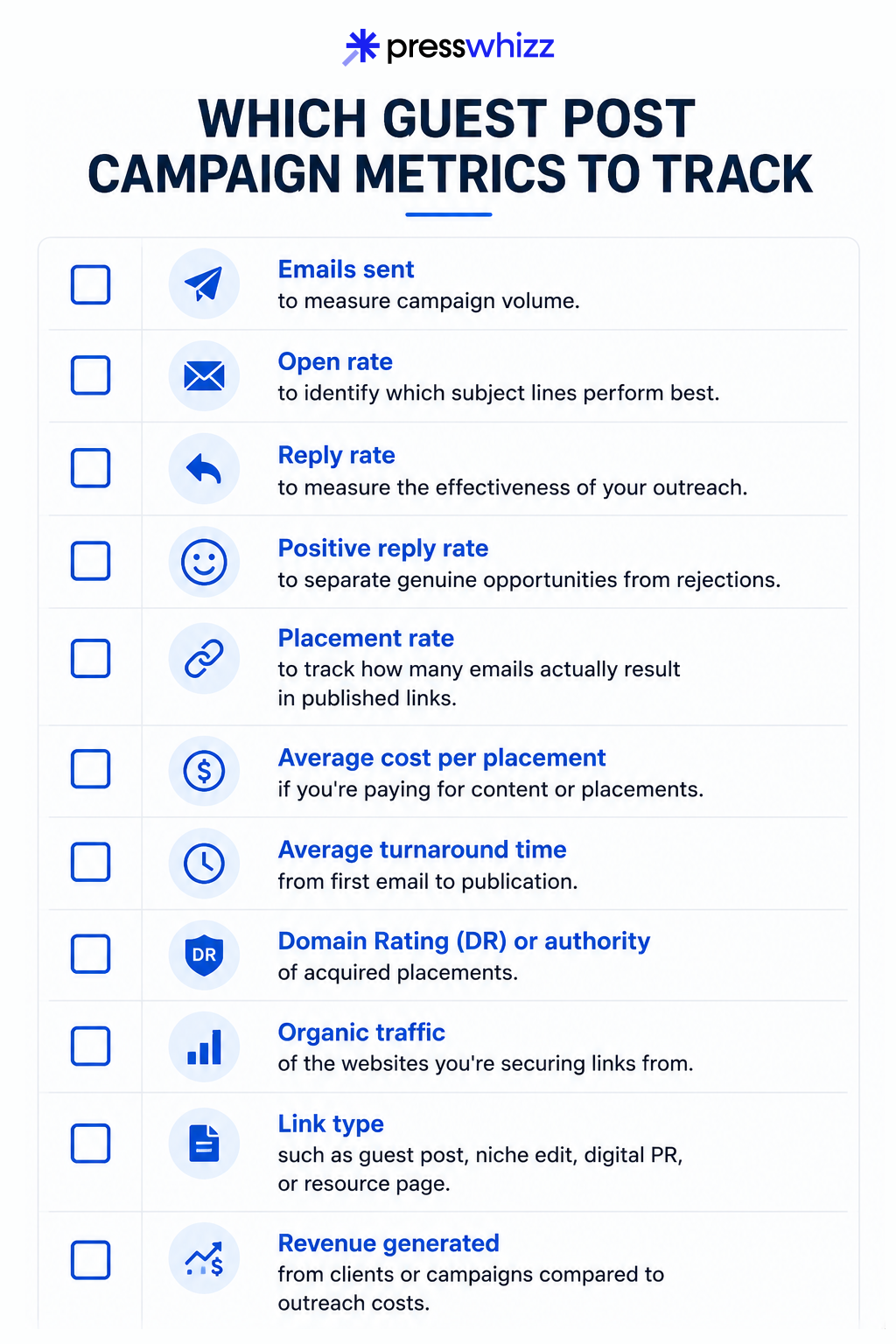
To measure and improve your guest post outreach campaigns, focus on the following 3 metrics:
- Email performance (deliverability, open rates, and conversion rates)
- Target site quality (do they respond? Are they reasonably priced? Do the links help SEO?)
- SEO results (do the links actually improve search engine rankings?)
SEO is not a “set it and forget it” business. If you want to succeed, you need to continuously track, tinker, and optimize. You’ll build better links, spend less time on outreach, and spend less money.
Who doesn’t want those things?
Tracking your outreach gives you a feedback loop. You’ll quickly identify which subject lines get opened, which templates generate replies, which niches convert the best, and which team members consistently land placements. Instead of relying on opinions, you can make decisions based on data and continuously improve your campaigns.
At a minimum, you should be tracking:
- Emails sent to measure campaign volume.
- Open rate to identify which subject lines perform best.
- Reply rate to measure the effectiveness of your outreach.
- Positive reply rate to separate genuine opportunities from rejections.
- Placement rate to track how many emails actually result in published links.
- Average cost per placement if you’re paying for content or placements.
- Average turnaround time from first email to publication.
- Domain Rating (DR) or authority of acquired placements.
- Organic traffic of the websites you’re securing links from.
- Link type such as guest post, niche edit, digital PR, or resource page.
- Revenue generated from clients or campaigns compared to outreach costs.
How to A/B Test Emails
One of the easiest ways to improve your outreach is by A/B testing your emails.
Whatever you do, please test just one variable at a time.
Send each version to a large enough sample, compare the results, then keep the winner and move on to the next test.
Here are the elements of your emails you should be testing:
- Subject line to improve open rates.
- Opening sentence to see which personalization style gets more replies.
- Email length, testing short emails against more detailed pitches.
- Call to action, such as “Would any of these topics be a good fit?” versus “Interested?”
- Number of topic ideas, testing two, three, or four suggestions.
- Topic title format, comparing benefit-driven titles against question-based or list-style headlines.
- Follow-up timing, such as 3 days versus 5 days.
- Follow-up copy, testing a simple reminder against a new angle or additional topic.
Always let the data make the decision. If Version B consistently generates more positive replies than Version A, make it your new control and start testing something else.
Pro Tip: Don’t just track opens and replies. Track the ROI of every campaign. Some templates might generate fewer responses but consistently land higher-authority websites, better traffic, or more revenue for your business. Again, track everything and take your emotions out of it. If one works better, keep it.
Step 8: Deliver the Article and Build the Relationship
Congratulations. You’ve landed the guest post.
Now what?
Sorry, but your work isn’t over. Isn’t SEO fun?
Now you actually have to write a high-quality article that delivers value, and you need to treat the website owner like they are a valuable asset to your business (because they are).
I spoke to my content team about how to write great guest post articles and to our managers about maintaining relationships.
Here’s what they had to say.
Write High-Quality SEO Articles
Writing a high-quality guest post article requires keyword optimization, readability, human engagement, proper formatting, and meeting the company’s guidelines. You also need to add value rather than just regurgitating whatever is ranking.
Remember, your goal isn’t just to get a backlink. Your goal is to become someone editors enjoy working with.
If your article drives traffic, ranks in Google, and requires very little editing, you’ll get more link opportunities and perhaps even lower prices (and this compounds over time).
Every article you submit should:
- Meet the publication’s editorial guidelines and formatting requirements.
- Follow Google’s quality guidelines by providing original, helpful content written for people first.
- Answer the search intent better than the articles already ranking.
- Include original insights, experience, or examples instead of repeating what’s already online.
- Support key points with data, reputable sources, or statistics where appropriate.
- Include original images, screenshots, charts, or diagrams to increase value.
- Use clear headings, short paragraphs, and formatting that’s easy to read.
- Avoid obvious AI writing patterns, repetitive phrasing, and generic filler.
- Naturally include your backlink where it genuinely helps the reader instead of forcing it into the article.
- Proofread everything before submitting so the editor isn’t fixing basic grammar or formatting mistakes.
Think like an editor.
If your article lands in their inbox and can be published with minimal changes, you’re already ahead of 98% of contributors.
Promote the Post After Publication
One of the easiest ways to stand out from other contributors is to actively help the publisher get more visibility. If you help drive traffic to the article, you’re far more likely to be invited back, and it will be better for your SEO long term.
Start by sharing the article across your social media channels, email newsletter, and relevant communities where it’s appropriate. If you have relationships with other website owners, link to the article from relevant content where it adds value. Every additional reader and engagement signal is a bonus for the publisher.
If you’re operating at scale, you can also use tier-2 link boosting. Tiered boosting is an SEO technique that involves building links to your guest post rather than directly to your own website. This powers up those links so they drive even more SEO value to your website. Think of it like building links to your links.
The better the article performs, the happier the publisher will be.
Build Your Author Portfolio
Every guest post you publish should become an asset you can use to land the next one. Instead of starting from scratch every time, build an author portfolio that showcases your best work and demonstrates your credibility to editors.
Create a simple page on your website listing your published articles, or keep a spreadsheet with links to every guest post you’ve written. As your portfolio grows, you’ll be able to show editors that you’ve contributed to respected publications in your industry, making it much easier to earn their trust.
📋 Download the Guest Posting Checklist
Use this checklist every time you launch a guest posting campaign.
The checklist covers:
- Prospecting and building your target website list
- Qualifying websites for relevance, traffic, authority, and spam
- Finding and verifying the right outreach contact
- Preparing personalised guest post pitches
- Outreach, follow-ups, and campaign tracking
- Writing, submitting, and promoting the guest post
- Recommended guest posting and outreach tools
Recommended Outreach & Guest Posting Tools

Our favorite link building tools for outreach include Ahrefs, Pitchbox, Hunter.io, and our own research tools on our guest post marketplace.
We’ll cover those more in depth here.
These are the tools I use and recommend for finding prospects, managing outreach, and scaling campaigns.
- Ahrefs: My go-to tool for competitor backlink analysis, keyword research, and uncovering guest posting opportunities.
- Semrush: Great for identifying keyword gaps, researching competitors, and validating content ideas before you pitch them.
- PressWhizz Marketplace: If you want to scale faster, this gives you access to vetted publishers for guest posts and niche edits without having to build every relationship from scratch.
- Pitchbox: I use Pitchbox to manage outreach campaigns, automate follow-ups, and keep large prospect lists organized.
- Hunter.io: Finding and verifying editor email addresses is quick and reliable, helping protect your sender reputation.
- Apollo.io: Perfect for discovering decision-makers, enriching prospect data, and finding verified business email addresses.
- Google Sheets: Don’t underestimate it. A well-organized spreadsheet is still one of the best ways to track prospects, replies, placements, costs, and campaign ROI.
You can build an entire guest posting operation with these tools, whether you’re running outreach yourself or managing a team at scale.
Why Using a Guest Post Marketplace is Better Than Guest Posting Outreach
Guest post outreach absolutely works, but it’s also one of the most time-consuming parts of SEO.
Finding prospects, qualifying websites, verifying email addresses, pitching topics, negotiating pricing, chasing follow-ups, writing content, and managing relationships is a full-time job for a salaried employee that could easily take 30-40 hours per week of work.
Even then, a typical outreach campaign only converts a small percentage of prospects into live placements.
That’s exactly why we built PressWhizz, a guest post marketplace.
Instead of spending weeks building relationships from scratch, you’re tapping into a network of publishers we’ve painstakingly built over our years in the SEO industry.
Every publisher has already agreed to accept guest post submissions through the platform, so you can skip almost all of the manual work that normally comes with outreach.
You search for websites using filters like niche, country, language, Domain Rating, traffic, price, and dozens of other SEO metrics. Once you’ve found the right opportunities, place your order, submit your article or content brief, and we’ll handle the publisher communication, approval process, and publication.
With PressWhizz, you get access to thousands of guest posting opportunities from a single dashboard, which allows you to build links faster, more predictably, and with far less operational overhead.
Have a look at our link building marketplace, and you’ll find thousands of high-quality guest post and niche edit opportunities that you can build in minutes rather than months.
Further Reading: Not sure if you should try guest posts or niche edits? Check out our guide on guest posts vs. niche edits for a full breakdown of when to use which type of link.
Final Thoughts
Guest post outreach is still a viable link building strategy when done properly, but it takes more effort (and money) than ever before. That’s one of the main reasons why so many digital marketing experts prefer to buy guest posts rather than commit intense resources to acquiring them manually.
You must properly qualify prospects, conduct personalized outreach, build automations, write high-quality content, and nurture relationships so you gain advantages in the long run.
The ROI is worth it, though. SEOs and businesses who put time and effort into their blogger outreach benefit from:
- Lower link spend
- More efficient processes
- Higher-quality links (which equal better rankings)
But I never said it would be easy.
Most SEOs struggle with link building because they think putting in 50% effort is enough. It’s not.
In today’s SEO industry, you need to outwork your competition.
If you follow the advice I’ve given you in this guide, I am confident you will succeed. But if you find the time and effort is too intense or you just want to save time and money while improving link quality, consider buying guest posts from a marketplace or using link building agency services.
– Dusan Novakovic