

If you’re wondering how much guest posts cost in 2026, we have some surprising news.
You want the truth?
Guest posts cost just $164 on average based on our analysis of 22,000 real link placements from our link building marketplace.
Yes, that’s true.
The average price of a guest post in 2026 is just $164, which is far less than other studies online claim.
Look around the web and you’ll see some insane link prices. Our initial research for this article found the following:
- One study claiming the average vendor charges $461 for a guest post
- Another study claiming $459 as the average guest posting price (and the lowest price as around $250)
- A Reddit thread claiming $200-$300 for links (surprisingly, this was the most accurate)
- A LinkedIn post claiming a guest post costs at least $351 for just a DR 11-DR 40 website
These prices are insane, and it’s one of the reasons we (and most SEOs) are so frustrated with guest posting services and the entire link building industry.
So, why are industry prices so much higher than what we charge at PressWhizz? There are a few reasons:
- Companies factor in things such as agency markup and hidden fees
- Many of these studies are based on opinions
- Website owners tend to negotiate hard, and will give you very high prices at the beginning when you ask how much they charge for a link (unless you have very good relationships with them)
So, we decided to get to the real truth. How much does it truly cost to buy guest posts in 2026?
We analyzed more than 22,000 real link placements from our very own marketplace. These are real prices. Not speculation. Each data point came from a real sale that resulted in a real guest post being published rather than what a guest posting service says it should cost.
Key Takeaways
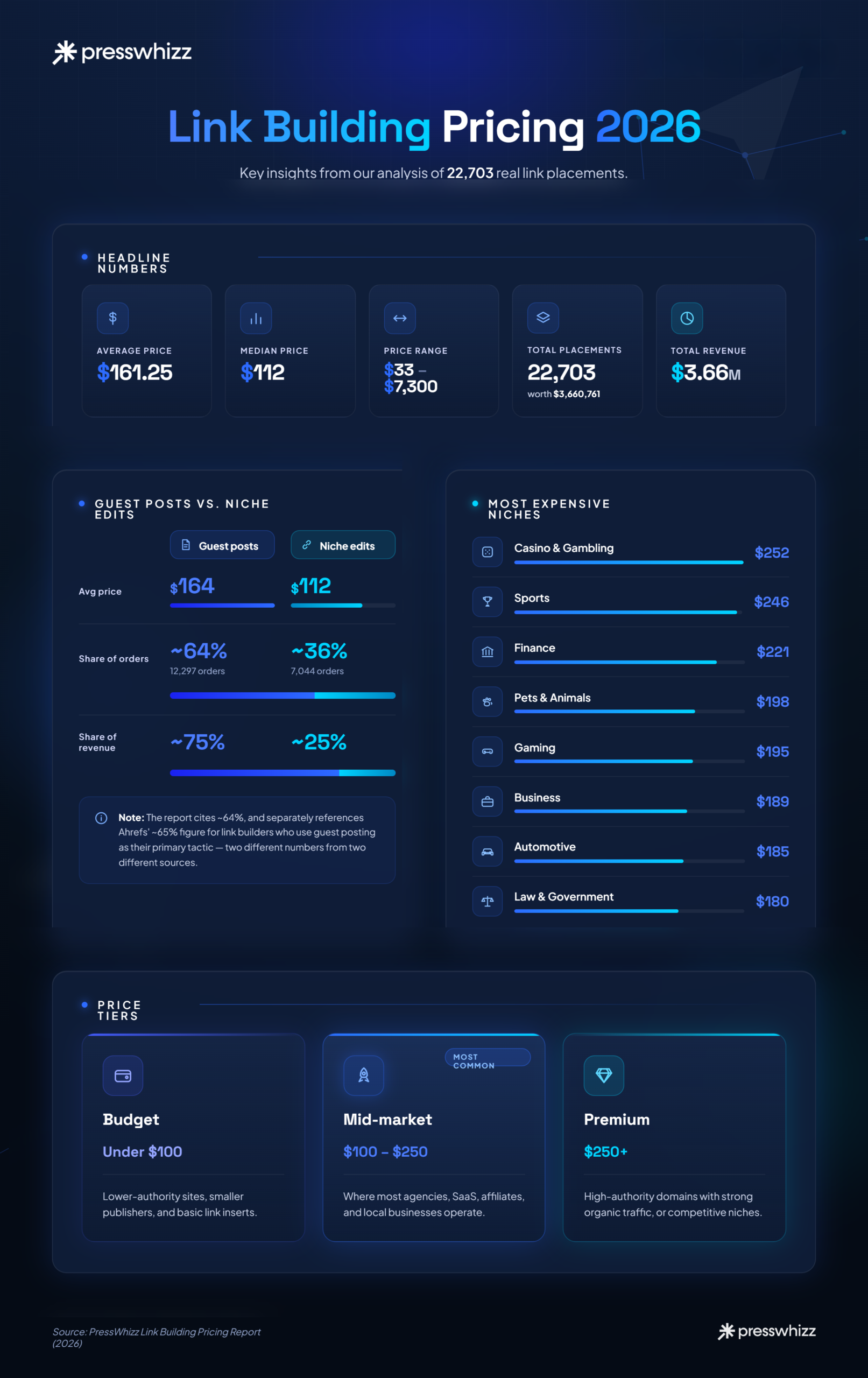
Our key findings on the average guest post cost include:
- The average guest post price is $164
- The median price of a paid link is $112
- Casino and iGaming links are the most expensive at $252
- Guest posts accounted for 64% of orders and 75% of revenue
- There is a large market for budget and mid-tier links (from under $100 to about $250)
Methodology: How Did We Analyze the Cost of Guest Posts?
This analysis draws on 22,703 completed link placements from the PressWhizz marketplace, representing $3,660,761 in total transaction value.
Rather than surveying SEO professionals or agencies, whose quoted figures reflect what they charge rather than what links actually sell for, we pulled real order data and examined it directly.
We looked at every price in the dataset, sorted them into budget, mid-market, and premium ranges, then dug into the details behind the sponsored posts: niche, link type, anchor text, buyer location, and organic search traffic.
This is as close to pure data as the industry gets, because it shows what site owners are actually charging for placements, without agency markup layered on top.
Guest Post Pricing 2026: What’s the True Cost of a Guest Post Link?
The average price of a guest post based on our data is $164.
This price was calculated based on the 12,297 guest post orders we fulfilled at PressWhizz during the time frame of this pricing report.
But to truly understand the real pricing of the average guest blogging opportunity, you need to dig deeper into the data.
These guest post prices are highly skewed by premium guest posts on high-authority sites. That small number of high-end links at the very top drags the average price much higher than it truly is.
The median price for a link in our study was just $112. That means half of all the links that we sold during this time frame cost LESS than $112.
This is incredible, especially when you see other websites claiming that links are $300+ or even $500 just for normal links. Do you see the insane markup they are charging?
Actually, there are several tiers of links, with affordable options in each one:
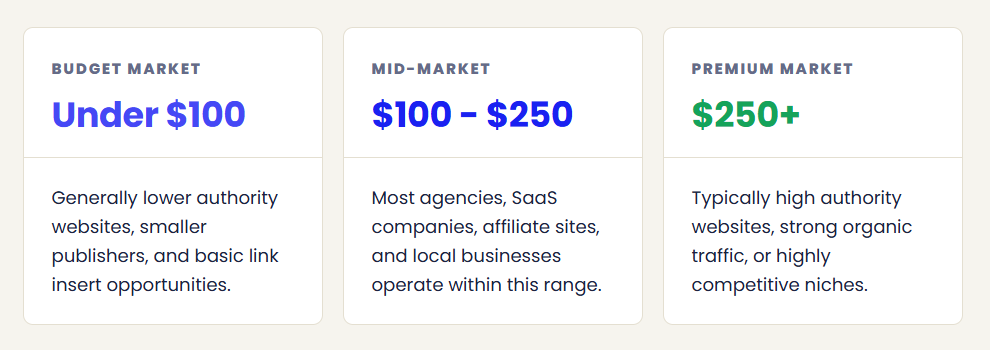
If you were to check our marketplace, you’d see sites with decent DR and real organic traffic charging just $40 or so for a guest post:

As you can see, there are plenty of budget links. And good mid-tier links can be found for $100-$200, especially for SaaS backlinks.
Are These High-Quality Guest Posts?
We understand if you are skeptical. This is SEO. You should always be a bit skeptical.
We also understand that if you’ve used link building services before, maybe you have been burned or, at the very least, overcharged for links.
When you see paid guest posts for $100 or less, maybe you are worried that these are private blog networks, link farms, or other low-quality links.
All of the guest posting sites included in our data are 100% real, high-quality websites with real organic traffic. No PBNs or link farms are listed on our marketplace.
Here is just a random snapshot of our guest post marketplace:
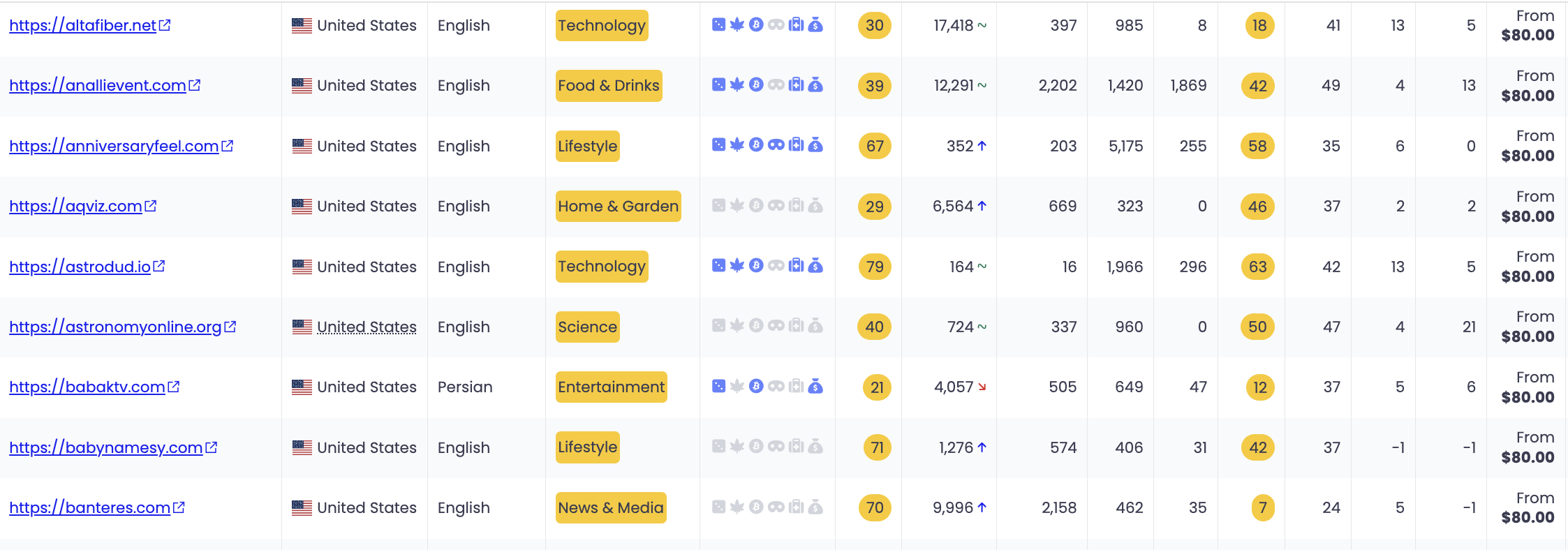
As you can see, these websites have Domain Authority, traffic, organic keyword rankings, and real referring domains.
So long as you select a niche-relevant guest post provider, these will all be high-quality backlinks.
So, yes, you can find high-quality backlink opportunities in all different ranges.
Further Reading: Check out our top free guest posting sites.
Guest Post Prices by Niche
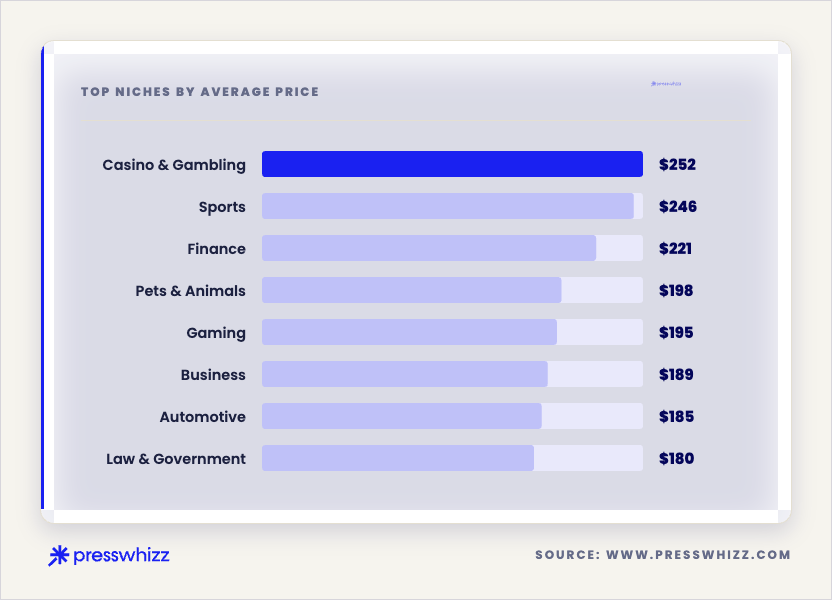
The spread between the priciest niche and the market median is only about 2.25x, which is narrower than most buyers expect. Even casino and gambling at $252 sits well below the $500 figure the industry routinely quotes.
What sets the top tier apart is economics instead of just “authority”:
- Casino & Gambling ($252) and Finance ($221) have customer lifetime values in the thousands, so a link is worth more per placement.
- Sports ($246) links are more expensive due to gambling adjacency and thin publisher supply rather than their own commercial value.
- Automotive ($185) and Law & Government ($180) cost less despite respectable CLV, simply because supply is deeper and demand is thinner due to high barriers to entry (for law and government entities).
The useful takeaway here is that supply and demand, not just Domain Rating, is what sets the price.
Other niches that we offer that do not appear in this study include:
- Real estate guest posts
- Health and fitness guest posts
- Travel guest posts
- Tech guest posts
And a lot more. But that’s not what you’re here for. Let’s get back to link pricing.
Factors That Influence Guest Post Pricing
Let’s get into some of the main factors that influence the price of your guest post placements.
You might think it’s just Domain Rating, but that’s actually not the case. DR is a good 10,000-foot metric to evaluate a link opportunity, but it’s actually organic traffic that affects link pricing the most.
Let’s get into more details:
1. Organic traffic
Organic traffic is the single strongest driver of guest post pricing.
Links from sites with more than 100,000 monthly organic visits sell for roughly 218% more than sites with fewer than 1,000 monthly visits. The reasoning is that traffic is a Google signal, while DR is a third-party estimate. A site pulling real visitors who click, stay, and return is ranking, whereas “authority” is just a measure of the backlink profile (even though it is useful).
Key Takeaway: Google’s algorithm has changed. You can’t just buy high-DR guest posts anymore and immediately rank. You need “real websites” from within your industry, meaning sites with organic keyword rankings and traffic from Google to pass PageRank to you. And it needs to be a relevant site.
2. Domain Rating/Authority
The influence of a site’s authority on pricing appears surprisingly limited until the very top end.
If you browse our marketplace, you’ll see sites with low DR charging relatively higher prices and vice versa. Sometimes, you’ll see sites with very high DR going for much lower than you’d expect. It all depends. This isn’t 2016 anymore. DR is not everything!
The problem is manipulability. We all know how good we SEOs are at making sites look better than they really are! Especially when they know that others are willing to pay for a guest post on the site.
Expired domains, redirects, and manufactured profiles make it easy to inflate DR. And Google now relies on more nuanced metrics, such as traffic and rankings, as we’ve said over and over.
Key Takeaway: Backlink price is more dependent on traffic data, niche relevance, and supply due to changes in how search engines evaluate link quality. So, while authority still matters in link building pricing, you should not evaluate guest post opportunities solely off of DR anymore.
3. Publisher supply
This is simple economics.
Limited inventory pushes prices up independently of site quality. If a site selling links is a DR 70 with 10,000 organic visitors, that’s great. But if there are 20 competitors with the same DR and traffic, then prices will naturally go down. It’s all about market dynamics rather than just pure metrics.
We see those market factors in link prices across all categories.
Casino, gambling, and finance have higher barriers to entry, so fewer publishers will host the vertical. Sports is another niche that demonstrates this well. It prices at $246 on average largely because supply is thin and gambling adjacency inflates demand, not because sports sites are inherently more valuable.
4. Demand and Customer Lifetime Value
When one converted customer is worth thousands of dollars, buyers tolerate higher per-link costs. Finance, which we define as loans, insurance, investing, credit cards, and mortgages, prices at $221 for these reasons.
Casino and gambling tops the list at $252.
Competitive SERPs in these niches require thousands of links to move, and that sustained demand lets publishers charge more.
5. Link type
The distinction between guest posts vs. niche edits did make a small difference in price.
Guest posts average $164 versus $112 for link inserts. Part of that gap is genuine. High-authority media sites sell guest posts but rarely sell insertions, so the link type carries better inventory. Part is perception, since buyers value editorial control and an article framed around their brand.
6. Geography
Geography is another major factor in our link building cost report.
Obviously, guest blogs from tier-1 countries will be more expensive than others. This is just how Google and the link building market work.
The US, to no one’s surprise, accounts for 16,945 of 22,703 orders, but there is still a lively guest posting market in core English-speaking markets, such as the UK, Canada, Australia, and India. And there’s often less competition, too.
Guest Posts vs. Niche Edits Pricing
You are probably familiar with both guest posts and niche edits (also known as link insertions).
A guest post is a new article you write, placed on a publisher’s site with your link inside it, and a niche edit is when your link gets added into an article that already exists on that site.
Note: For more on niche edits, see our guide on the topic: What are niche edits?
Not surprisingly, guest posts are more expensive than link insertions on average by about $50 or so. They are also far more popular. Here is the summary of our data:
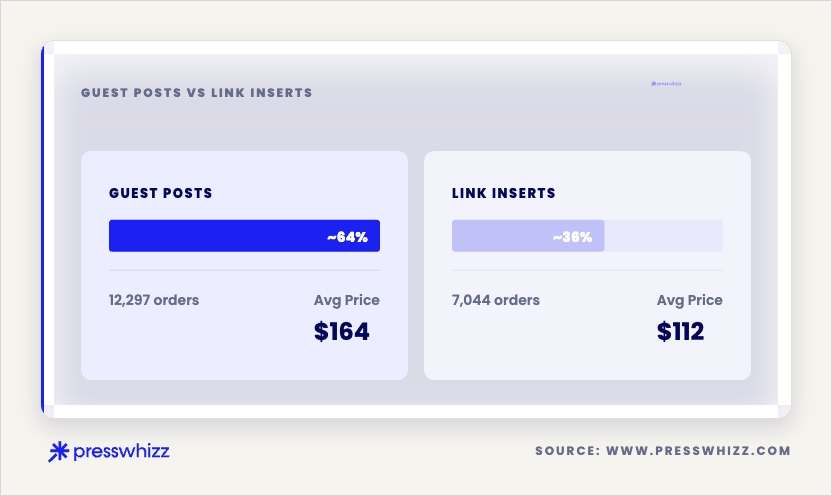
Four things account for the $52 price gap:
- Editorial control: With guest posts, you write the piece, choose the anchor text, and decide which page the link points to. A niche edit works within someone else’s existing article, so placement and context are constrained by what’s already on the page.
- Framing: A guest post is built around your topic and positions your business the way you want. SEOs and site owners love this.
- Inventory quality: This is the one that most affects the average. High-authority media sites sell guest posts but rarely sell insertions. Those expensive digital PR backlinks pull the guest post average upward, so part of the gap is the format and part is simply that better sites are available through it.
- Buyer expectations: Guest posts are what agencies package and what clients expect to receive, which sustains demand independent of measured performance.
That doesn’t mean niche edits are “bad”. They have SEO value, and there are many reasons to buy niche edits. Some of the benefits of niche edits include:
- Lower cost per placement
- Faster effect, since they go into pages that already rank and already pull traffic
Note on Guest Posts and AI Visibility
Guest posts still influence AI visibility, but not through the mechanism most people assume.
The link itself is very valuable, but the mention wrapped around it is the main factor in gaining a citation.
Ahrefs’ analysis of 75,000 brands found that brand web mentions correlate at 0.664 with AI citation rates, roughly three times stronger than backlinks at 0.218.
So, you are not just buying an anchor. You are buying your brand name placed in editorial context on a source the model already trusts, alongside category terms it associates with your space.
Backlinks function as a threshold condition rather than the main driver: they help clear the bar to be considered by a retrieval system, after which brand mentions, co-citations, and content structure determine whether you actually get cited. So the guest post is still valuable, just not in the way you think. Its return has shifted from link equity to entity reinforcement, and it happens to deliver both at once, which is why it holds up better in an AI search environment than niche edits do. This is why it’s so valuable to have an AI SEO company that actually understands how to do strategic link building for AI citations rather than just a traditional company that views it as “All the same. Just a different name”.
Closing Thoughts
The takeaway here is that buying guest posts costs far less than the figures circulating in blog posts and agency quotes.
The average placement in our dataset ran $164. Compare that to the $500 to $1,000 range you see across SEO, and it is shocking to say the very least.
Most published pricing comes from people selling links rather than from completed transactions, and a handful of premium placements distort every average built on top of them. Strip out the markup and the outliers, and you’ll see the real truth.
Guest posts and link building services are well within the budget of small businesses, startups, and affiliates. Don’t assume you are priced out just because some study says it costs $500 for a regular link.
We will leave you with this: The barrier to quality link building is very low when you buy directly from the source. Ignore what link building agencies tell you and trust the data instead.
– Dusan Novakovic