If you’ve landed on this local link building mega guide, then you either own a local business or are doing SEO for one. Either way, you want to rank yours or your client’s site higher in search engines like Google in a local market.
How do you do that?
Local link building.
…and that’s exactly what I’m going to teach you today: How to create a local link building campaign the right way so you dominate competitors while they’re busy submitting their NAP to 500 directories and getting nowhere.
I’ve been in the link building business for 17 years now (literally since I was 12 years old). In that time, I’ve ranked countless local businesses at the top of Google (including the Map Pack) in some of the toughest niches.
I can confidently say most local businesses or their SEO teams are doing SEO the wrong way. Local is no longer just about citations. Instead, it requires the right type of links that help you dominate hyper specific SERPs in your local area.
In this guide to local SEO link building, you’re going to learn some of my best secrets for building high quality, hyper relevant local links that scream to Google “trust me. I am in (insert city)”. I’ll cover the basics (like citations and directories), some of my favorite hacks, and some other lesser known link acquisition strategies I use to outrank the competition.
What is Local SEO Link Building?
Local SEO link building is the process of obtaining backlinks from websites, organizations, and businesses that are relevant to a specific geographic area or service location. Common examples of links you typically build during a local link building campaign include local newspapers, business associations, directories, or even other businesses in the same geographic area as yours.
These geo specific links help Google associate your business with a specific city, region, or community. Essentially, these links are proving to Google that you really are in the region you claim to be.
Local backlinks help improve:
- Google Map Pack rankings
- Local organic rankings
- Branded search visibility
- Trust signals for your business
- Referral traffic from actual local customers
To put it simply, building local authority with local backlinks brings local traffic. Makes sense, right?
But how does Google know which links are local?
When Google determines local search results, it not only looks at how many links point to your site but also where those links come from geographically.
By boosting your local authority (such as within a city or county), you can improve your rankings in location based search results and drive more local traffic to your pages.
Imagine you run a roofing company in Chico, CA. A backlink from a Chico news site, business directory, or contractor association sends much stronger local relevance signals than a random backlink from a marketing blog in another country.
Writing this down makes it seem so obvious…but you have no idea how many SEOs focus on Domain Rating (DR) and Domain Authority (DA) so hard that they miss incredible local link opportunities.
Google wants to see repeated evidence that your business is real and connected to a specific local area. Local SEO link building is how you do that (among other things).
How is Link Building for Local SEO Different?
Link building for local SEO is different from traditional SEO because it focuses on geographical relevance, citations, consistent NAP signals, and links to location-based pages. In a national or international SEO campaign, SEOs typically focus on domain authority, links to home pages, organic traffic, and number of referring domains. But with local SEO, a hyper relevant link from a local entity or a simple citation on YELP could bring as much ranking equity as a high DR editorial link.
It seems obvious, but for local rankings, your links should come from sources based in your target area (or that serve your target local audience). If you’re trying to rank a local plumbing company, dental office, law firm, or roofing business, Google is trying to figure out whether your business is trusted in that specific area. It wants to see connections between your business and your city, county, or service area. The way you demonstrate those connections to Google is… wait for it… local links. I’ve seen DR 20 local sites outperform DR 80 generic guest posts for local rankings.
Traditional link building, on the other hand, focuses on general relevance.
Say I were trying to rank a client of mine worldwide, I might start with a general press release on a high DR media site, then follow that up with niche edits on pages with a high number of referring domains and finish it off with guest posting on industry blogs with branded anchor text pointing to the home page. But with a local client, I’d go straight for local directories, associations, and blogs without paying too much attention to domain authority, traffic, and number of referring domains (though that could still help…it always depends).
TL;DR: Normal SEO link building is mostly about domain authority, number of referring domains, and general relevance. Local SEO link building is all about location and NAP consistency.
I also want to say that building local links isn’t all you have to do to win at local SEO. You also have to send supporting signals via local citations, Google Business Profile engagement, and positive Google Maps reviews (more on all that below).
But in my experience, links are the most important part of local SEO.
Ok, enough of my rambling. Let’s get to the local link building strategies.
The 13 Best Local Link Building Strategies
OK, now it’s time to get into my top local link building tactics. The best local link building strategies are:
- Get featured in local citations
- Reach out to local business associations
- Engage local media like bloggers & newspapers
- Get listed in local resource pages
- Claim and optimize your Google Business Profile
- Sponsor local events
- Donate to local charities and nonprofits
- Build local lead magnets
- Create local stats pages
- Reverse engineer competitor backlinks
- Exchange links with local businesses
- Reclaim unlinked mentions
- Publish local case studies
These are the best link building tactics to help you rank on local SERPs. You may not need all of them, because local link building is not about blasting thousands of backlinks at your website.
Start by choosing the strategies that are easiest for you to access (maybe you know a local blogger or reporter), and focus on building a smaller number of highly relevant local links from businesses, organizations, newspapers, associations, and directories.
Let’s get into the strategies now, starting with my favorite one…
Local Citations
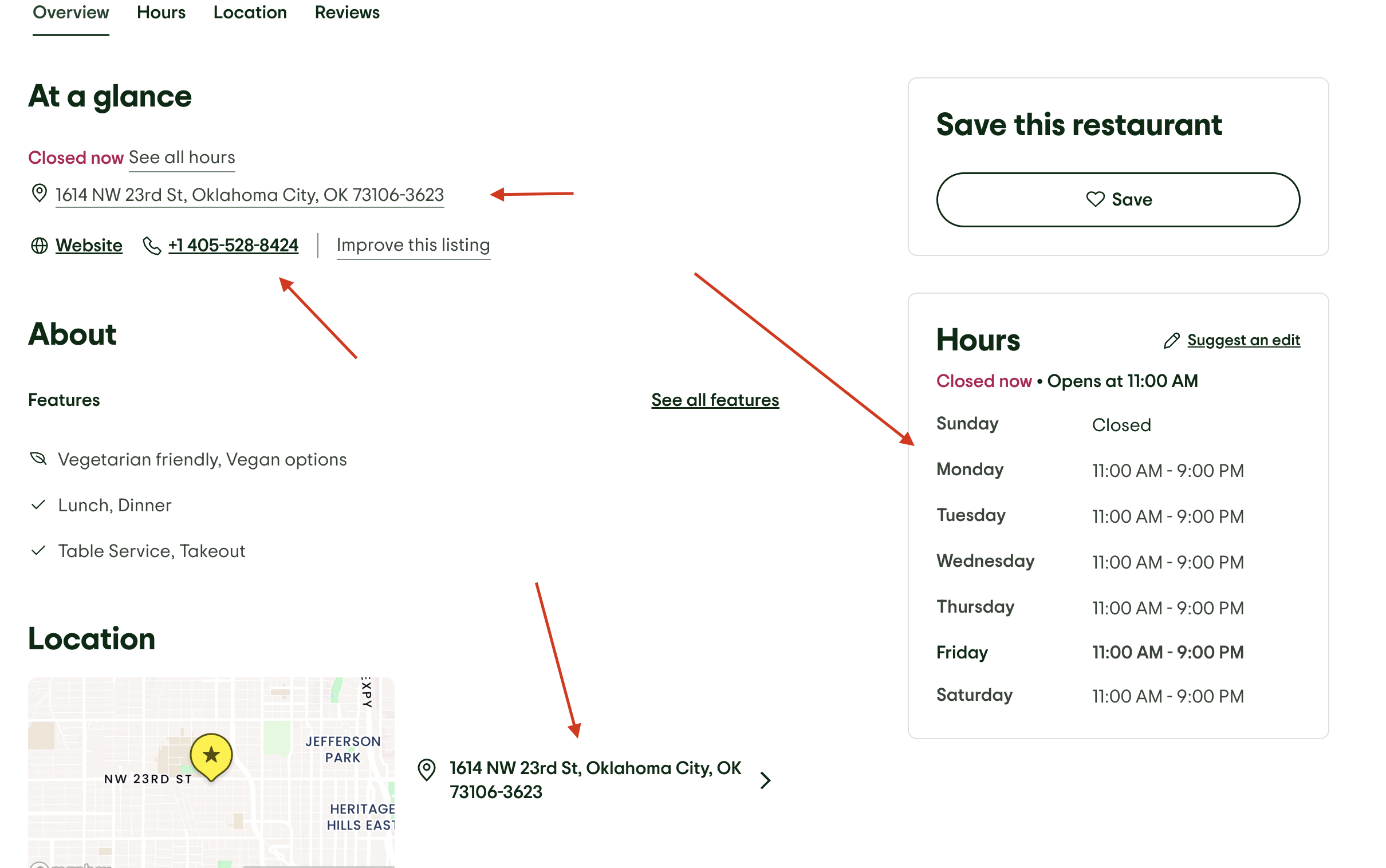
A local citation is a mention of your business’ NAP on another website, typically a directory, social media site, or local focused resource page. You know when you Google “best pad Thai in Oklahoma City?” and a business’ page on TripAdvisor pops up? That’s a local citation.
Sites like Yelp, Yellow Pages, local business directories, chambers of commerce, and industry associations all list citations. This is always the first type of link I build when trying to rank a new location based business.
Here’s a good example of a local citation at work:
If I were trying to rank a local business, I would start by building out the following local citations:
- Google Business Profile
- Yelp
- Apple Maps
- Facebook Business
- Better Business Bureau (BBB)
- Bing Places
- Yellow Pages
- Nextdoor
- TripAdvisor
- LinkedIn Business
But every area is different. Google your competitors and see where they’re listed. Some cities even have city specific directories that others don’t have. I did a quick search of a random Queens, New York plumbing service and found them listed on a number of little known directories:
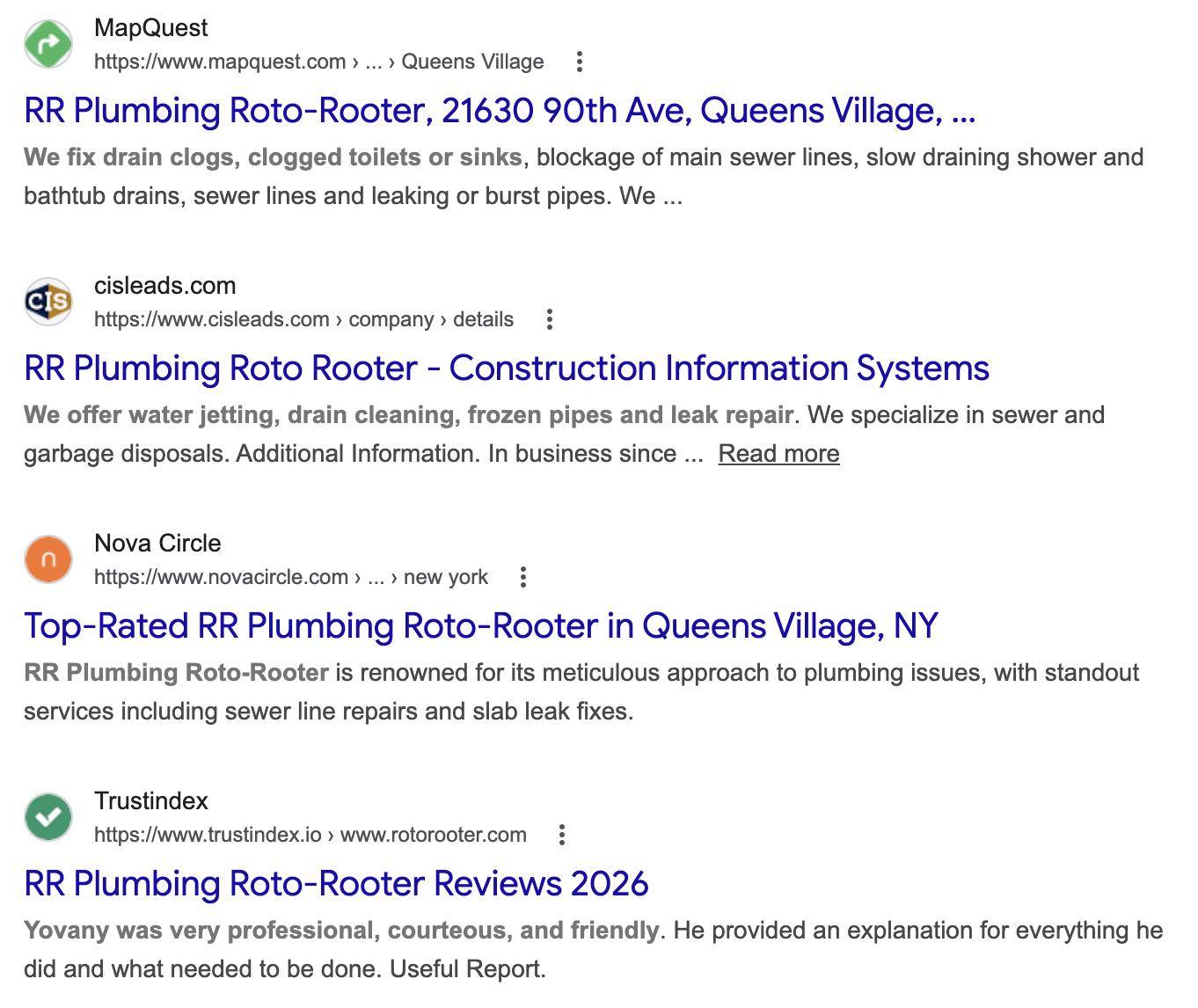
Pro Tip: Use the skyscraper technique for local citation building. Find everywhere your competitors are listed, then improve on them. Get listed in even more directories. The arms race is on!
Citations aren’t exciting, but they are the workhorse of local SEO rankings. They are what gets the job done.
Google loves seeing the same business information repeated consistently across trusted local websites. It’s basically Google double checking that your business is real and not some guy from Siberia pretending to be your friendly neighborhood plumber.
If dozens of local directory sites all list your information, and people keep reviewing you (and not reporting you), Google takes that as proof that you really are based in that location.
Citations often contain your business name, address, phone number, website, and sometimes your opening hours or services. Google uses all of this info to verify that your business is local and legit.
Let’s check out another example of a citation from Yelp. Since I love California, I’ll use Chico again:
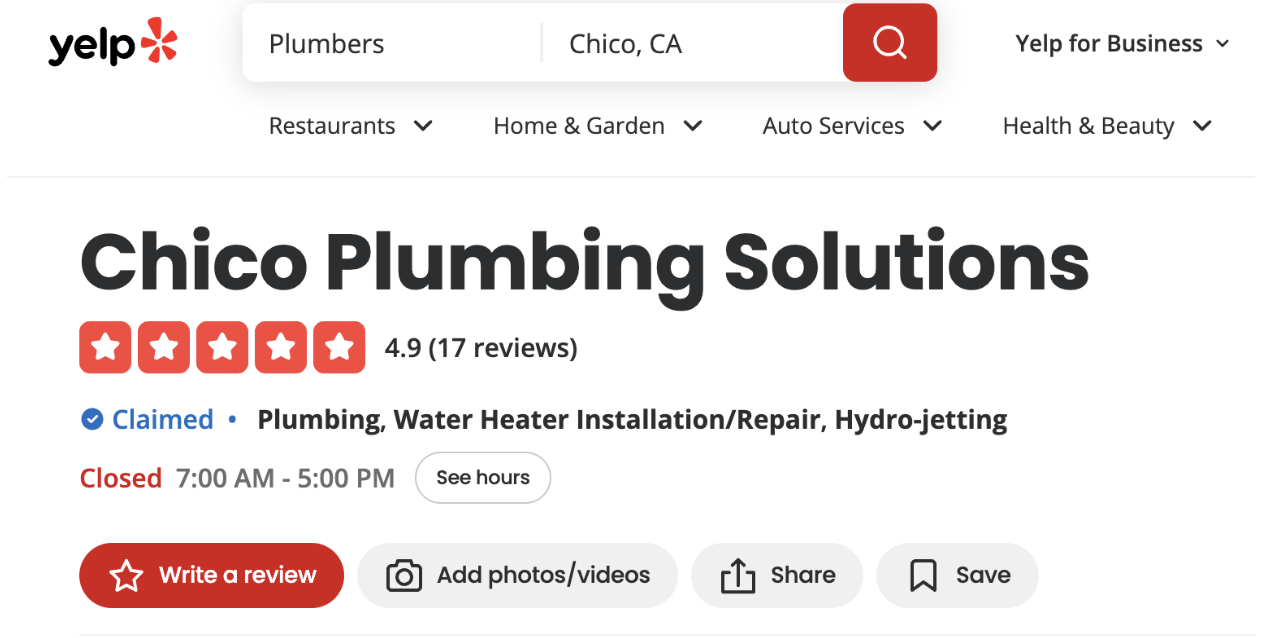
I recommend you start by going to Yelp, your Google Business Profile (R.I.P, GMB), Apple Maps, Bing Places, and Yellow Pages. If your business is already listed, claim the listing and update it with accurate info. If there isn’t a listing for your business, create one.
One more next level SEO tip for you while we’re on the topic of citations…
I recommend interlinking your local citations to reinforce your business’s local footprint. This is actually an incredibly important part of local SEO called entity stacking, something we specialize in here at PressWhizz.
If your Yelp profile links to your site, your site links to your Google Business Profile, and your directory listings all consistently reference the same business information, it forms an interconnected local entity stack around your business. This makes it much easier for Google to figure out that all of these profiles belong to the same company.
Local Business Associations
Local business associations are an easy local link opportunity that many companies completely ignore. And I still don’t know why. They’re probably the lowest hanging fruit in all of local SEO behind citations.
Local business association examples include:
- Chambers of commerce
- Contractor associations
- Tourism boards
- Small business groups
- Merchant associations
- Industry organizations (local chapters)
Here’s a great example of a local NYC plumber getting a solid link from a plumbing association website:
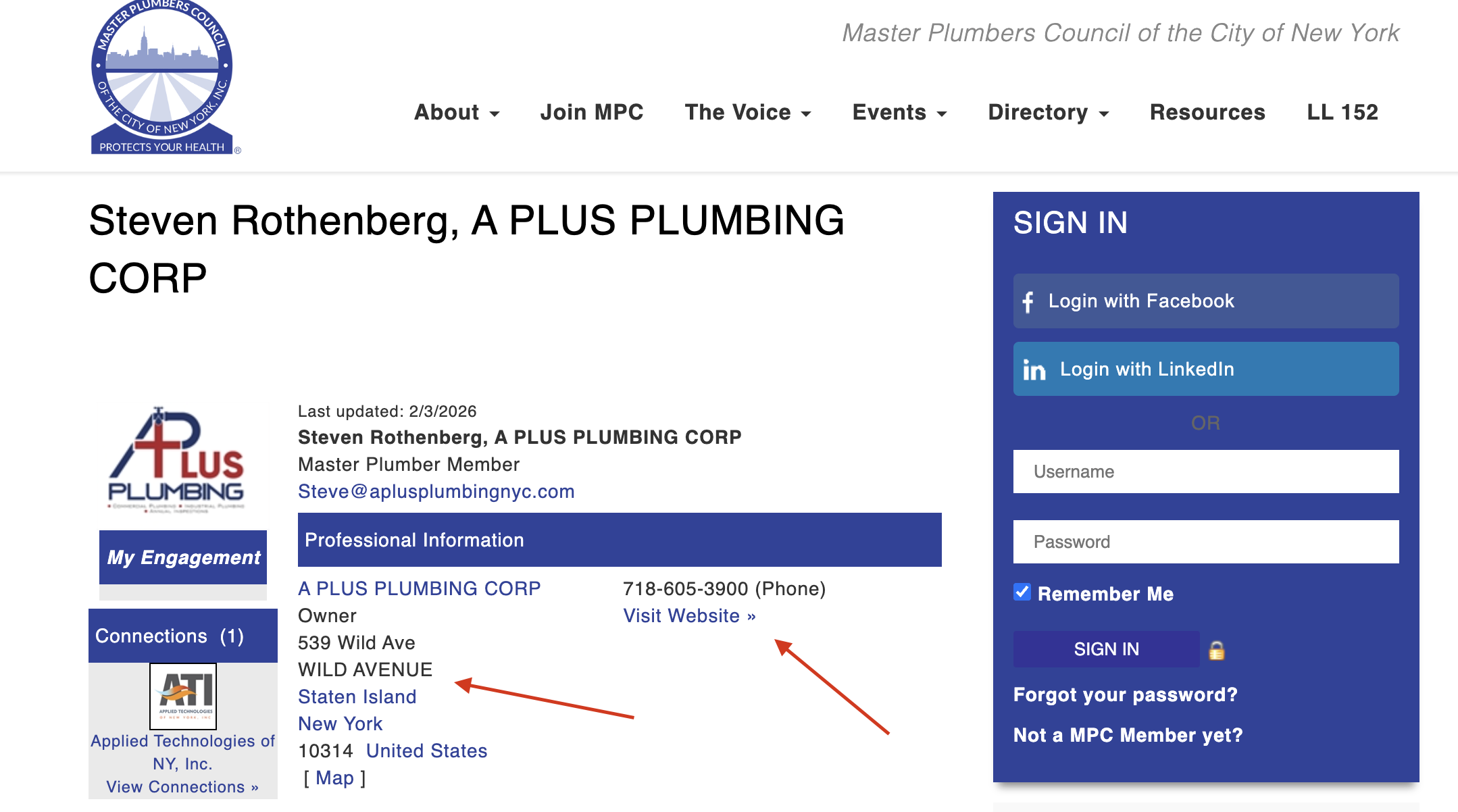
This “Master Plumbers Council” directory has his name, address, and phone number clearly visible plus a link to his website.
These links are great for local SEO because they check multiple boxes at once: relevance, trust, geographic proximity, and legitimacy.
These types of links prove to Google that you are a legit service provider in your area. Some random lead gen spammer isn’t going to spend $500 a year to get listed in a city directory (and probably wouldn’t even qualify for the license).
Many of these links are ridiculously easy to get.
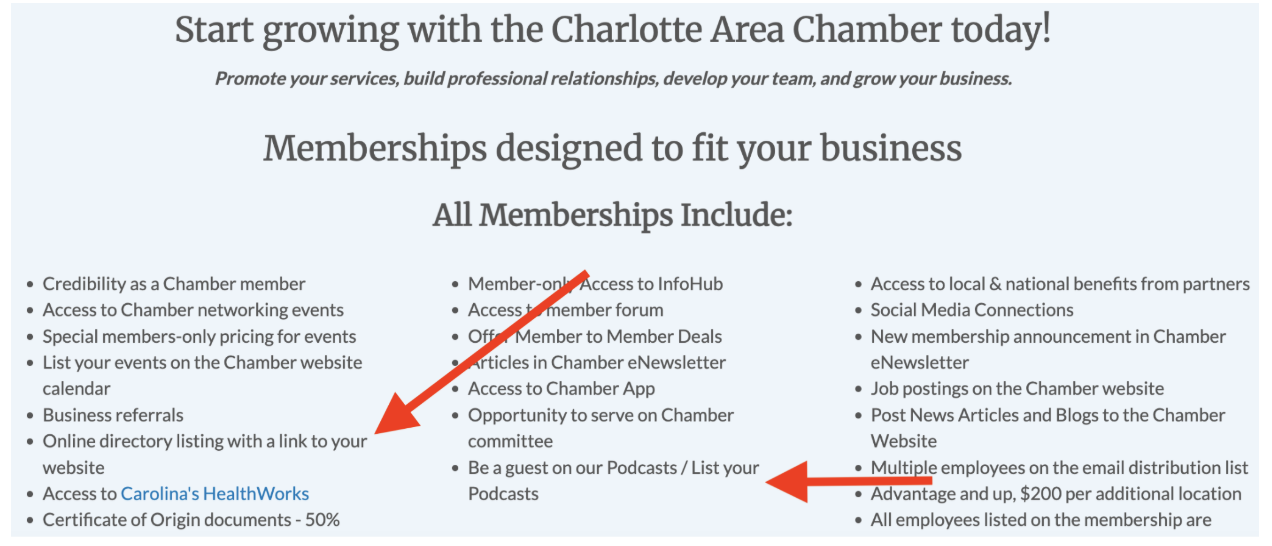
The Charlotte Area Chamber of Commerce (based in Charlotte, NC) advertises an “online directory listing with a link to your website” directly on their membership page. Looks like everyone knows the SEO link building game these days.
The cost? $350 a year. It’s hard to get a regular guest post on a DR 70 website for that price.
You get a bunch of other perks, too, such as appearing on the Chamber of Commerce podcast (that’s another link!).
I recommend starting your local link building journey first with citations, then move on to your local Chambers of Commerce and other associations. Once you’re in, you can use the CoC as a resource to connect with other local associations, media, businesses, and more.
Local Bloggers & Newspapers
Local news sites and bloggers are great places to get links and exposure in your local community. Links from local newspapers probably won’t be cheap (unless you have a great story or the right connections), but sometimes you can get good links from local bloggers for free.
In most cities, bloggers and reporters are constantly searching for stories. You’re literally doing them a favor by giving them something to write about other than the geese on the town green.
Whatever you do, don’t just reach out to them and ask for a link. Instead, pitch a story that their readers will care about.
Some angles you can pitch include:
- New business openings (yours)
- Community events (you have a booth at a local fair)
- Seasonal tips (how to keep pests out of your attic)
- Charity involvement (your business is sponsoring a food bank)
- Local statistics (uptick in termite infestations this year)
Local reporters and bloggers eat this stuff up because they need content every single day (there are only so many times a local newspaper can write about potholes). And one good local news mention can snowball into more links, branded searches, and referral traffic.
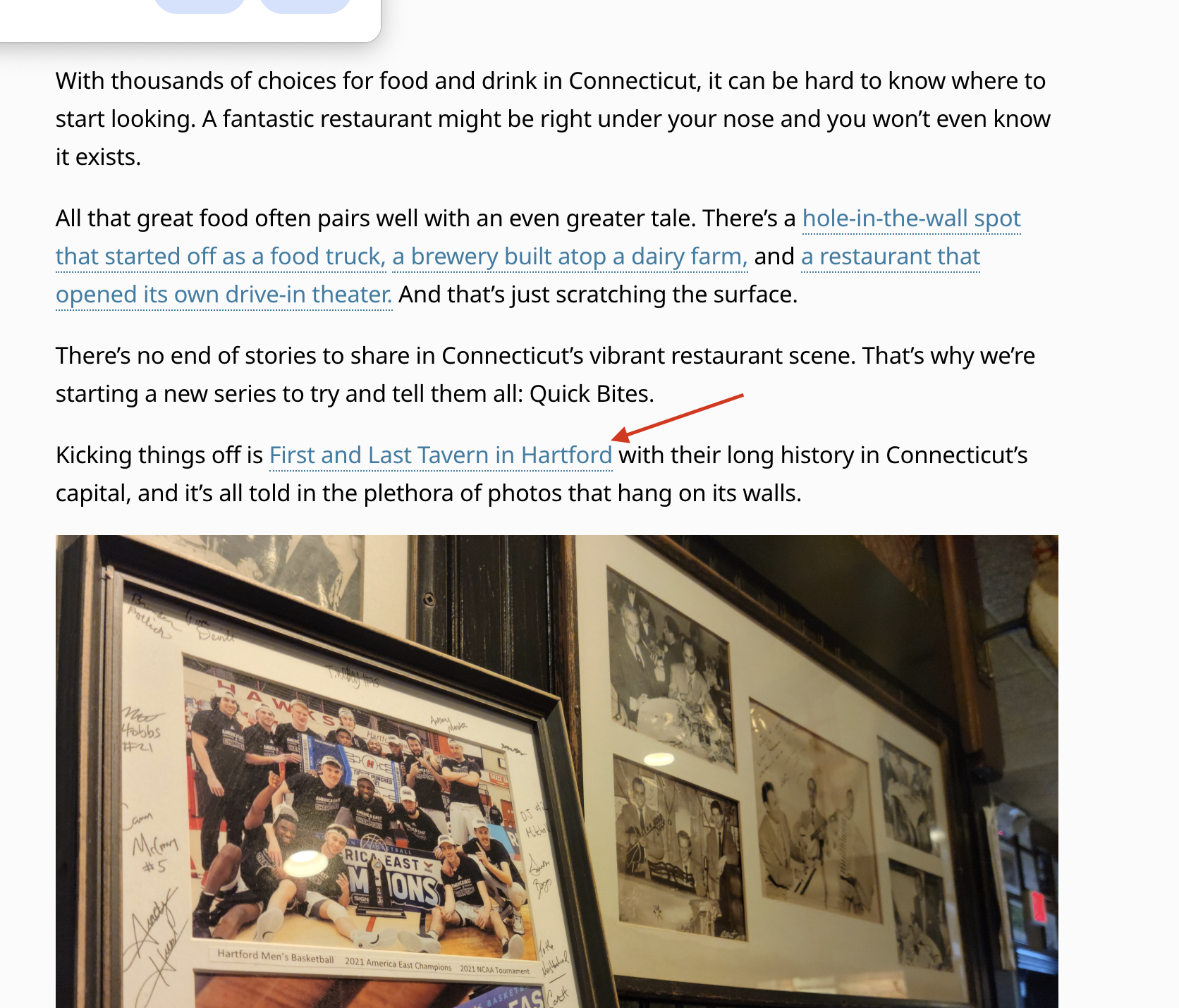
Here’s a great example of a local restaurant getting a DR 82 link from a local newspaper that a ran a story about the eatery’s history:
Local Resource Pages
Local resource pages are directories that connect local residents to services, like plumbers and pest control companies. They’re usually created by city governments, local organizations, schools, nonprofits, libraries, and chambers of commerce.
Community websites and local blogs might curate resource pages too.
Here are a few examples:
- A city website hosts a “local businesses” page
- A parenting blog recommends top local pediatric dentists
- A local nonprofit maintains a list of trusted contractors or sponsors
A simple example is Chico, California’s non-profit “Find a Business” page. It lists local businesses in alphabetical order and links to their websites.
By the way, I promise, I’m not obsessed with Chico, CA. I’m just using it as an example to show you how all of these local SEO link building strategies can stack within the same community.
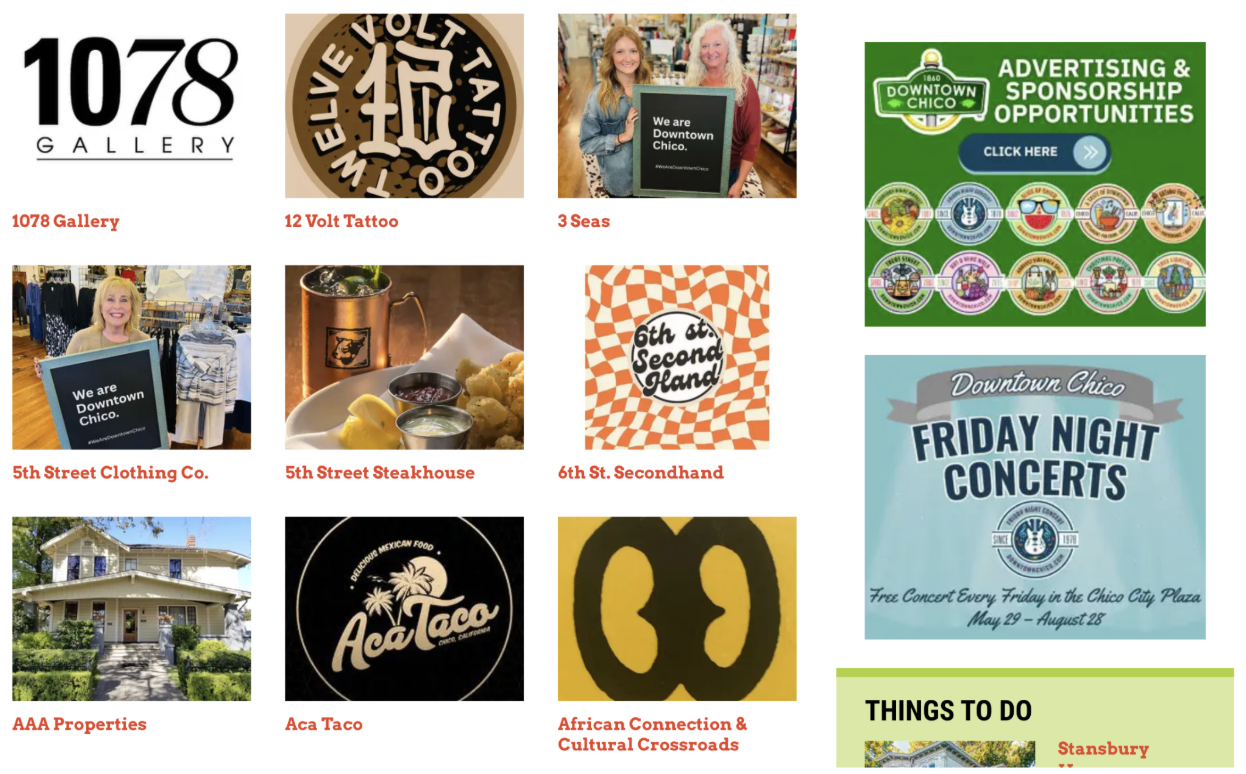
That’s a nice, clean local link that Google will love.
For Google, these links are highly geographically relevant. Locals trust them too, because they’re usually created by unbiased sources (like the public library or non-profits).
Don’t pass these links up. I’ve got loads of them, 100% for free. Most businesses never even look for them.
To find them, start with simple Google searches like:
- “[city] local resources”
- “[city] recommended businesses”
- “[city] business directory”
- site:.gov “[industry] resources”
Then, send a polite email introducing your business and explaining why your company would be useful for their audience.
Here’s another example of a food resource page from the City of Boston that links to local food program participants:
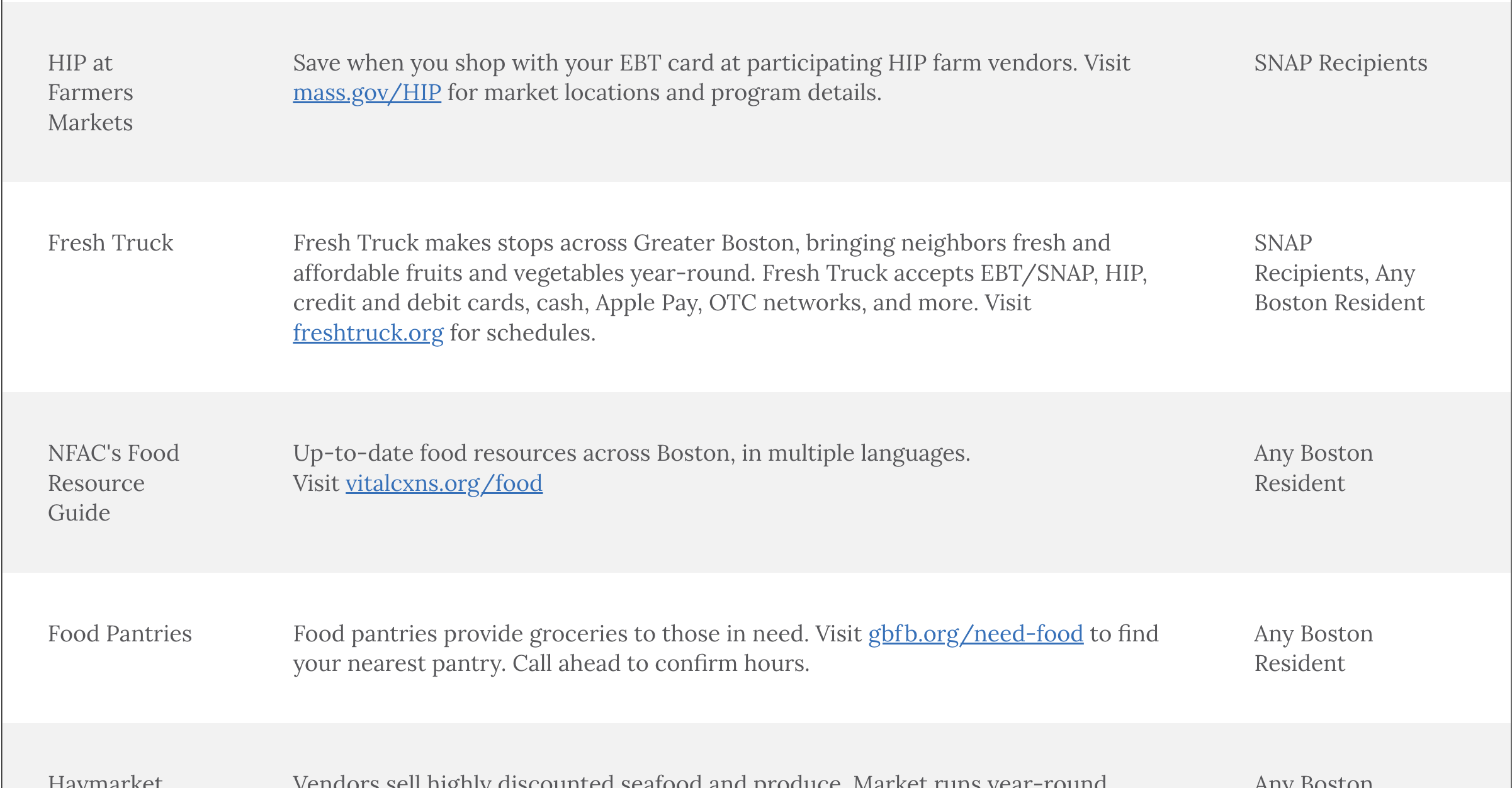
These types of links are everywhere and in every local niche imaginable.
Claim Your Google Business Profile
I know this sounds painfully obvious, but you’d be shocked at how many local businesses either never fully optimize their Google Business Profile (GBP) or barely touch it after setting it up.
Quick aside, Google Business Profile used to be called Google My Business, and many know it as GMB. I’ll fight the nostalgia and use the updated acronym, GBP, in this article.
Let’s get this out of the way first:
If you don’t have a GBP, visit business.google.com/create and enter your business’s name. If your business is listed, claim it. If it isn’t, create a new listing.
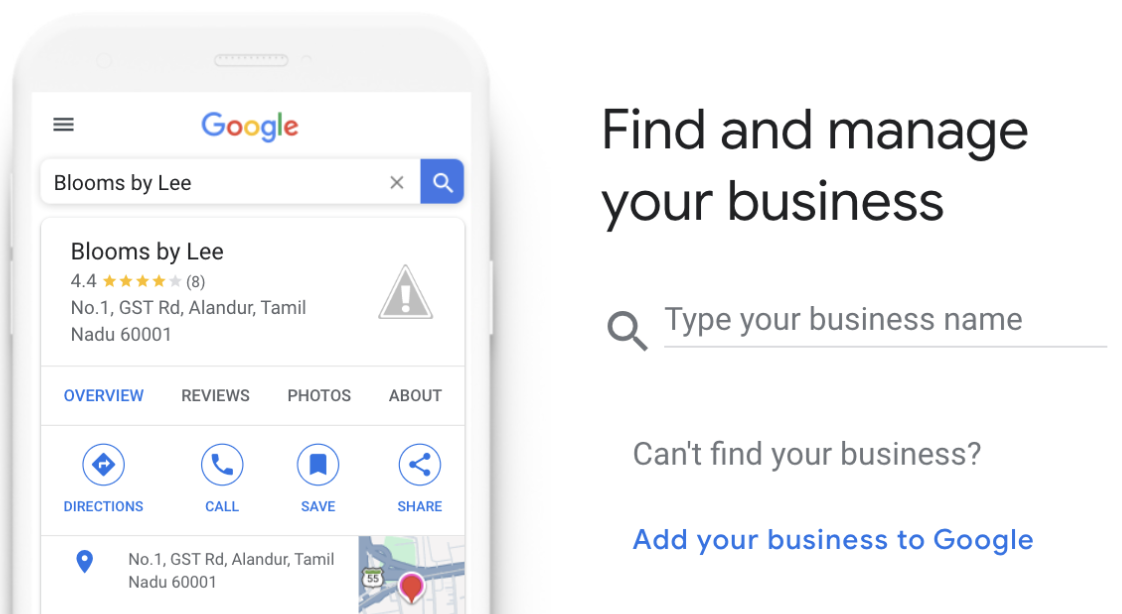
Your Google Business Profile is one of the strongest local trust signals you have. It ties together your reviews, location, services, citations, photos, business information, and local engagement signals all in one place.
And yes, I absolutely recommend linking to it from your website and major citation profiles where possible.
The info you put on your GBP is your official, real business information, according to Google. You need your GBP info to match your business info elsewhere (same business name, address formatting, phone number, etc.). Google is not nice to businesses that have inconsistent info scattered across the internet.
Another thing: Treat your GBP like a social media profile. It’s not Google’s profile. It’s YOURS. Fill out every relevant field, and remember that customers will see this information.
Monitor it like it’s your baby and use it to:
- Upload photos
- Add updates
- Respond to reviews
- Complete Q&As
- Post promotions
- List products and services
In my experience, businesses that actively maintain their profiles do much better in Maps, especially in competitive local niches.
Sponsor Local Events
Sponsoring local events in a next level local link building strategy that lands top quality links at affordable prices. There are loads of local events that need your money, and getting a link is often included in the cheapest pricing tiers.
Examples of local events you can sponsor include school events, competitions, fairs, sports teams, charity events, local festivals, business expos…and that’s just scratching the surface.
I absolutely love these links because they are often much more valuable than they look on paper. Sponsoring a university event or city-run festival could get you coveted .edu links or .gov links for a crazy low price. Those are some of the best types of backlinks you can possibly get in SEO.
I always aim for recurring (annual) events, because my links are more likely to stay live for years.
To find sponsorship opportunities, start by searching “[location] events seeking sponsors” (yes, it’s that easy).
I did this search using Chico, California as the location, and the top result was a page full of event sponsorship opportunities from the Chico Area Recreation & Park District (CARD). These will provide .gov link opportunities (hallelujah).
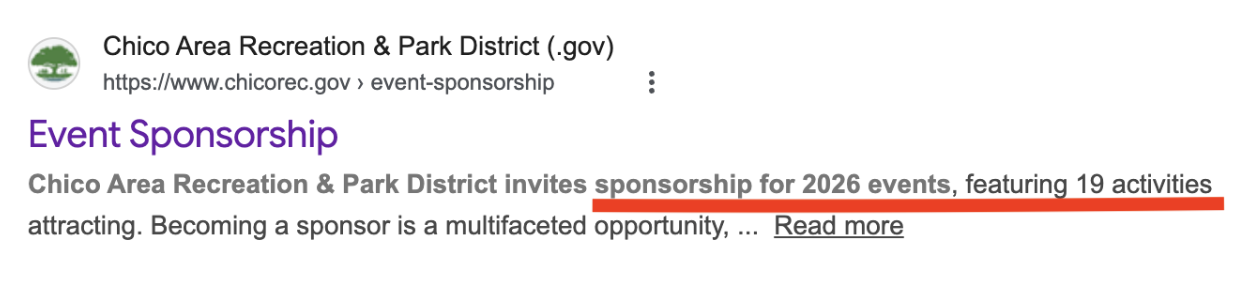
For just $1000, CARD offers a link on the event webpage PLUS your business name on marketing and social media content (good for brand awareness, local search volume, and in person sales too).
Here are the pricing details, just to show you how affordable this is:
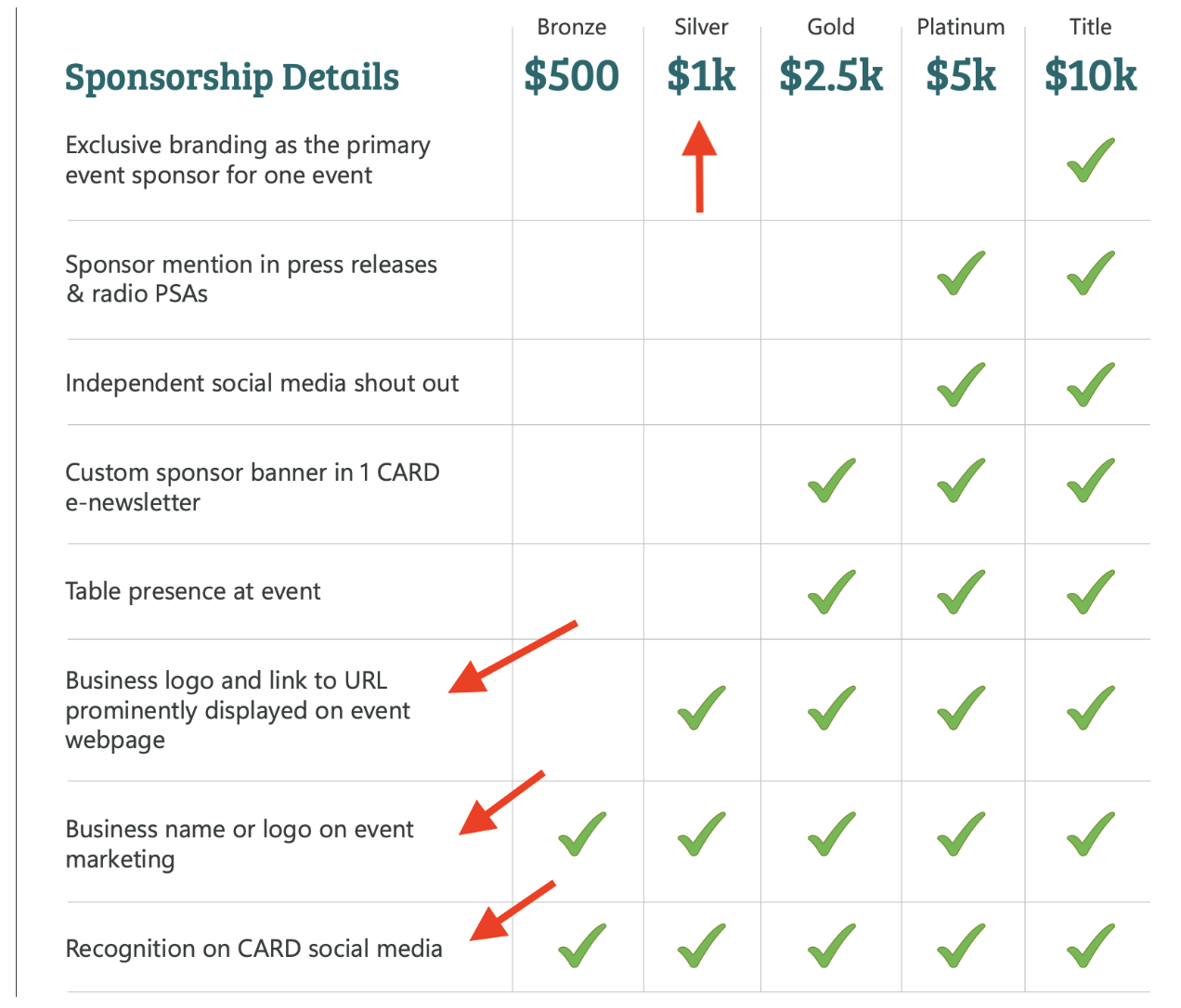
That would earn you a .gov link plus a bunch of trust signals. And, your money is actually going to a good cause (and not some greedy link building service…I mean…).
Donate to Charity
Donating to charity can help local SEO link building by earning you a link on the charity’s website. Usually, this involves regular giving, but it’s a great way to support your community and get something back in return.
This is very similar to sponsoring a local event. Start by searching terms like:
- Donate to charity [location]
- Charity sponsorship [location]
- Charity fundraising [location]
You could even just post on your company’s social channels asking for charity recommendations.
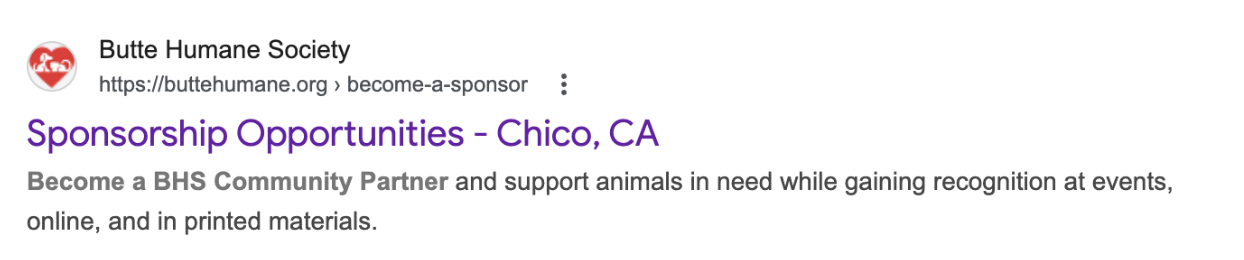
I searched “Charity sponsorship Chico, CA” and the Butte Humane Society was number 2 on the SERP.
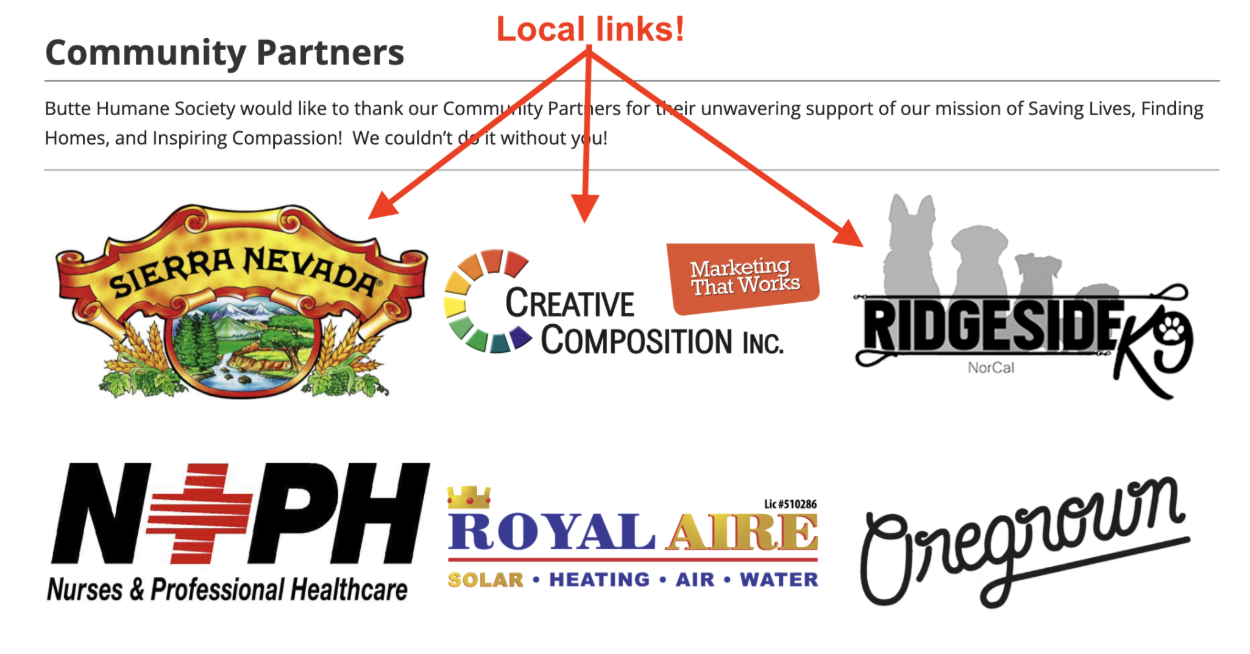
The BHS offers donors a nice big logo and link on the site’s Landing page and Community Partners page (plus social media mentions and more), as you can see in this screenshot:
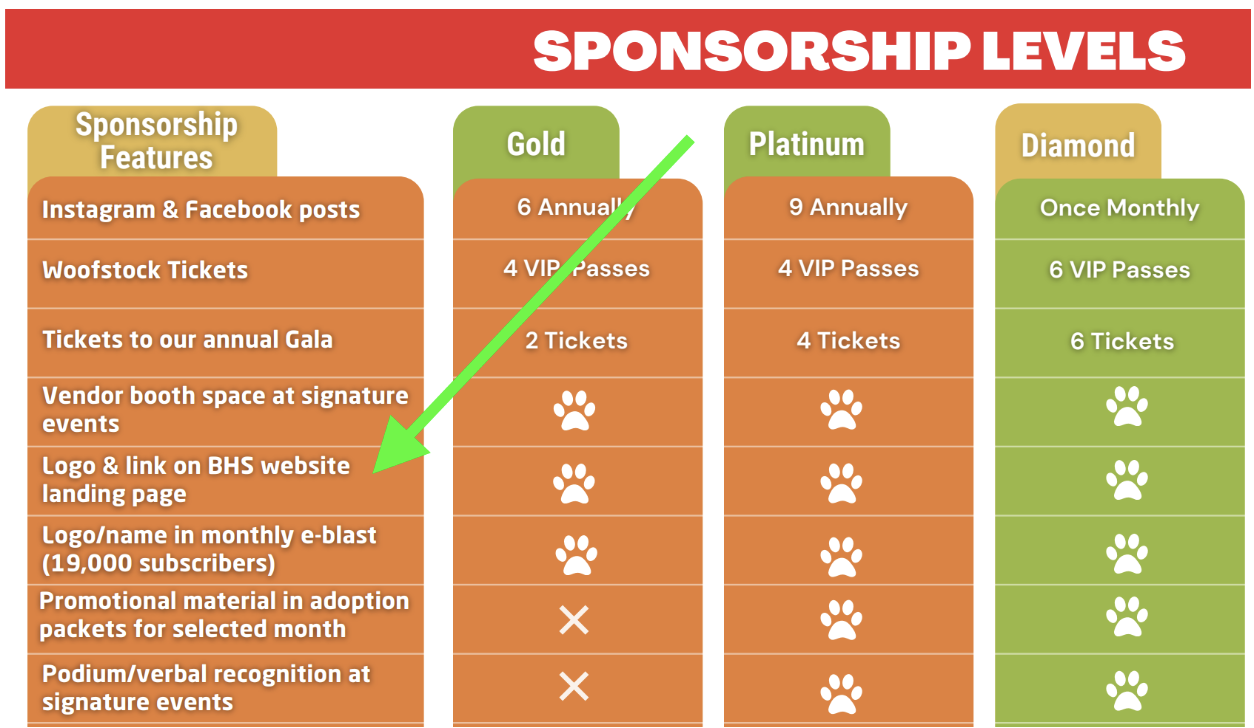
Sponsorship for this charity starts at $10k. Not super cheap, but who could say no to these rascals…

There are definitely cheaper opportunities out there, so browse around to find the right charity for your budget. I’ve landed high DR links in the past for as little as a $500 donation.
(I’m going to adopt a puppy now. brb.)
Build Local Link Magnets
Link magnets are when you create content that naturally attracts links. You may also hear this referred to as link baiting or creating linkable assets.
Examples of link bait content include local stats pages, free tools, guides, videos, or checklists.
When you create this type of content about the local area, local bloggers or websites (and even national sites) might link to it to improve their content or give their audience something interesting to read.
This takes more effort, but it can earn you loads of links (possibly for years to come) if you do it right.
You’re going for links from real local businesses and organizations, so you need to provide enough value that they want to link to your asset to help their customers.
Brainstorm some geo targeted resources that local people genuinely find useful. Things like:
- “[City] Small Business Toolkit”
- “[Industry] Safety Checklist for [City] Homeowners”
- “Best Dog Friendly Cafés in [City]”
- “[State] Moving Checklist”
- “The Complete Guide to Winterizing Homes in [City]”
If I were you, I’d search for these terms as well to ensure other businesses have created something similar. You could even throw your competitors into Ahrefs and check their backlink profile to see which of their posts have generated the most backlinks (keep it simple!).
Next, create an attractive ebook, webpage, or interactive tool that provides fast value.
For example, a landscaping company could create a guide on city specific watering regulations. That’s the type of resource local bloggers, businesses, and possibly the media would share.
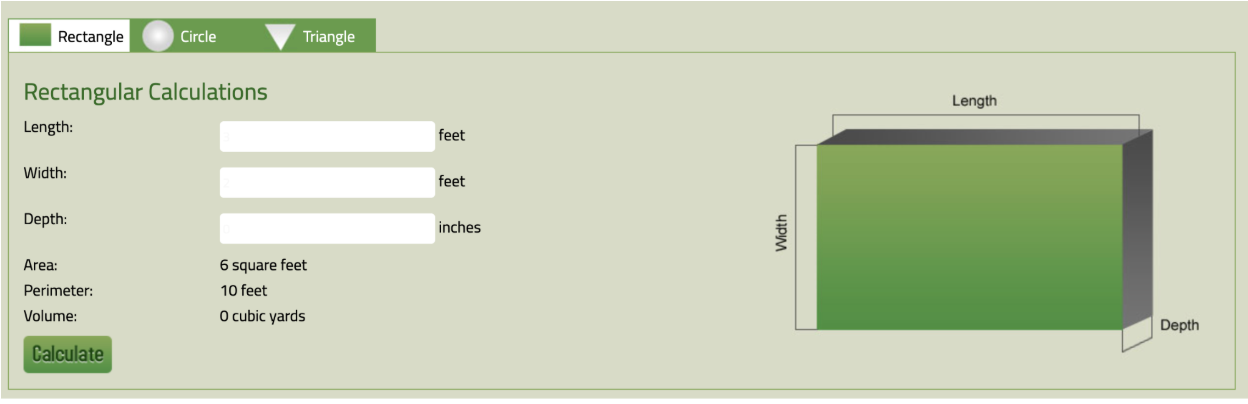
One landscaper in Chico did something similar. They created a calculator to help people understand how much rock, sand, or bark they would need to fill in a particular area:
Here’s another great example of a local tool built by a New York City real estate service that could generate some high DR local links:
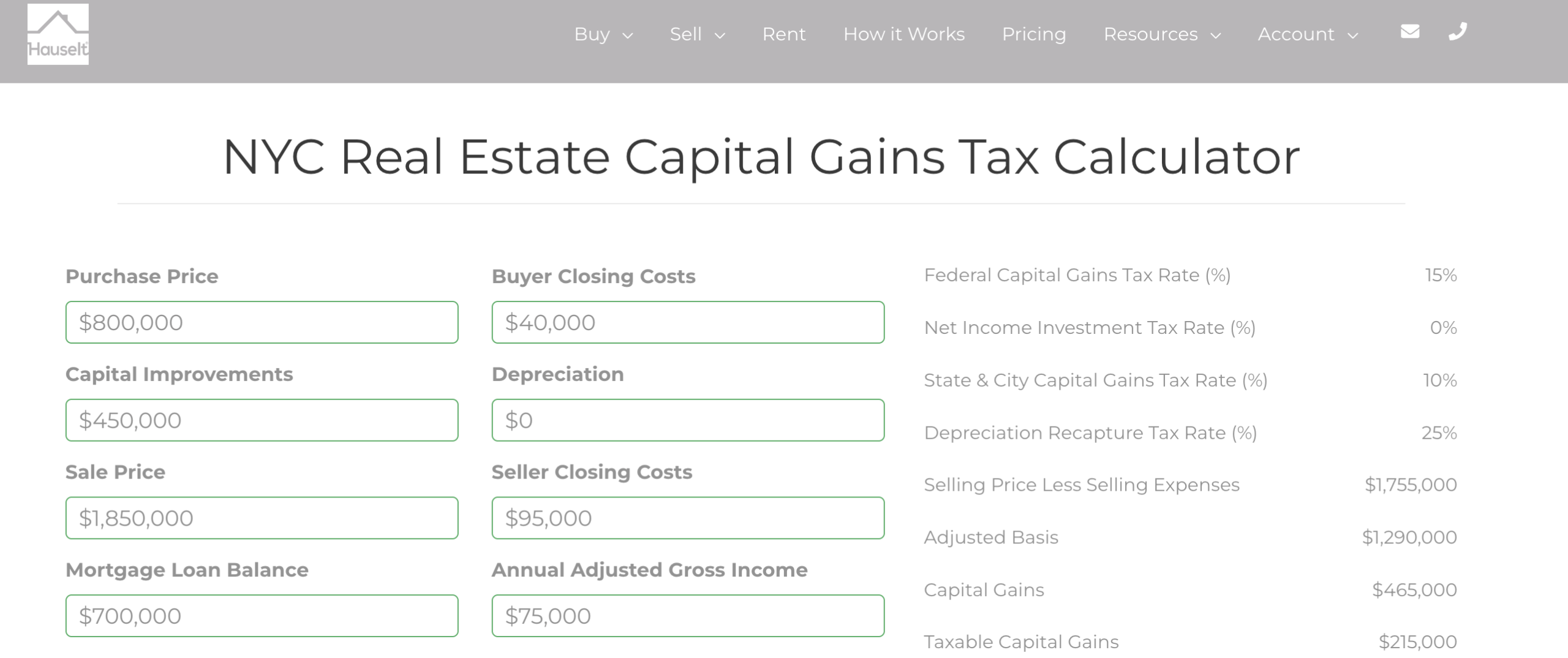
This is the sort of tool that’s easy to create and super useful. It doesn’t have to be fun or flashy. You can probably vibe code the thing yourself in a few hours with Claude Cowork.
Create Local Stats Pages
Stats pages are one of the best types of local link magnets. They’re so good that I’m going to give them their own entry on this list.
Just about everyone makes traditional stats pages that highlight key numbers from their industry. PressWhizz has one, 50+ Linkbuilding statistics for 2026, that was written by yours truly (and has earned us a ton of good links).
But most people don’t know that local stats pages can be effective too.
Journalists, bloggers, local newspapers, and other businesses constantly need statistics to reference in their content. Most of them don’t have time to collect the data themselves, so they just Google it and link to whatever page already did the work.
If that’s you, you’ll get a free local backlink.
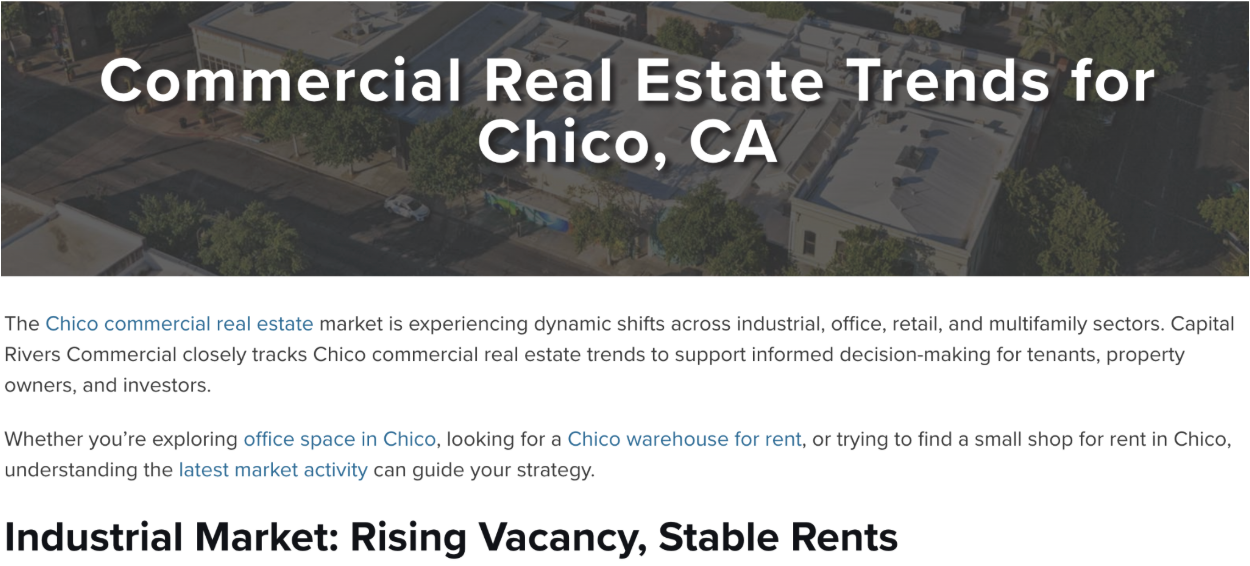
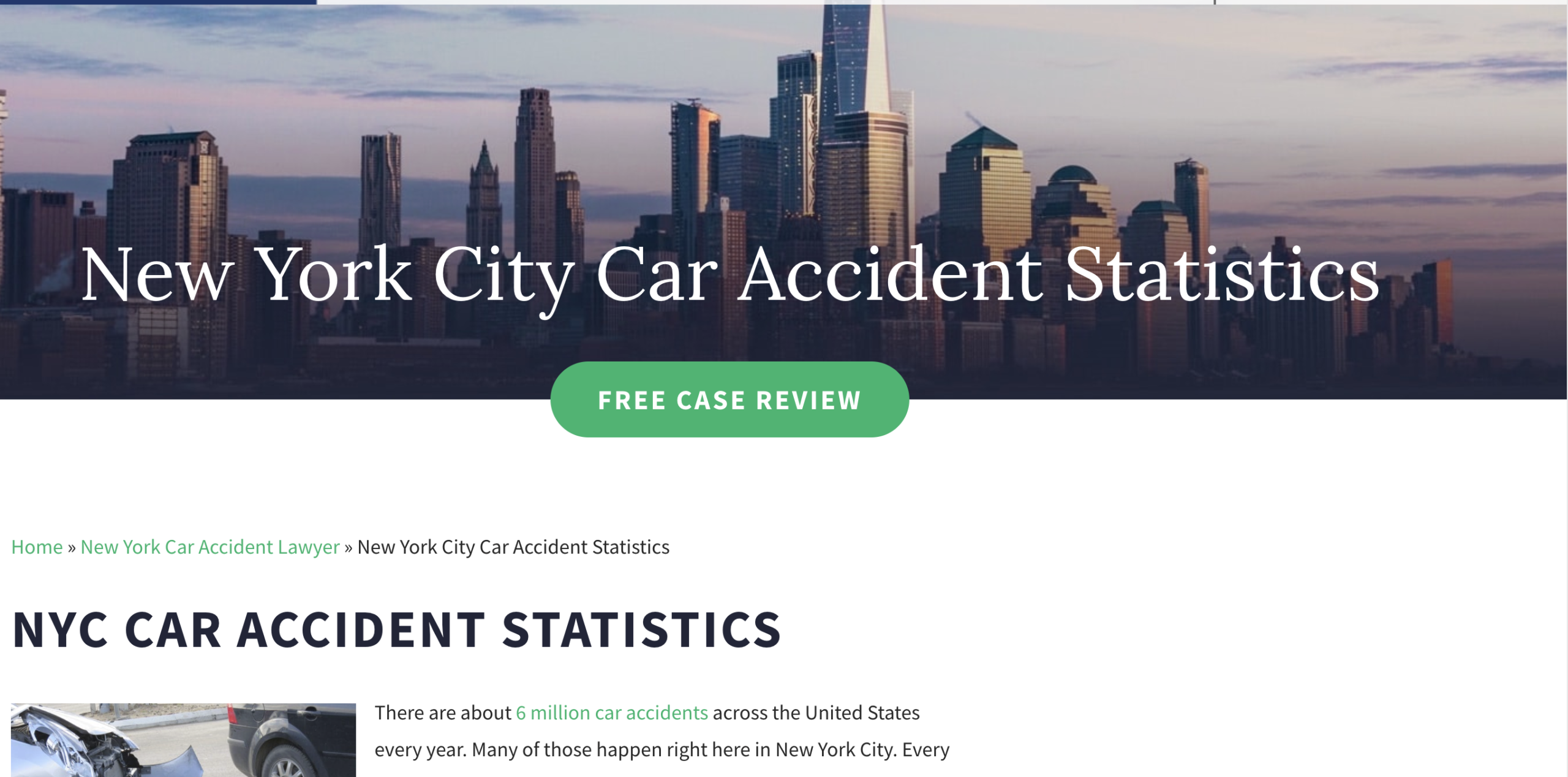
For this to work, you need to create a stats page that’s relevant to your business and the local community. For example, if you’re doing link building for lawyers, you could create a page on car accident statistics in their city. Or, a real estate business could track average home prices and rental costs.
Here’s one by a local Chico, CA real estate agency, Capital Rivers Commercial:
Here’s another example of a car accident stats page a local NYC lawyer published that generated 11 solid backlinks for them:
11 links might not sound like much, but when you dig deeper into the data, you see that a few of the links are from local New York City businesses, like this one:
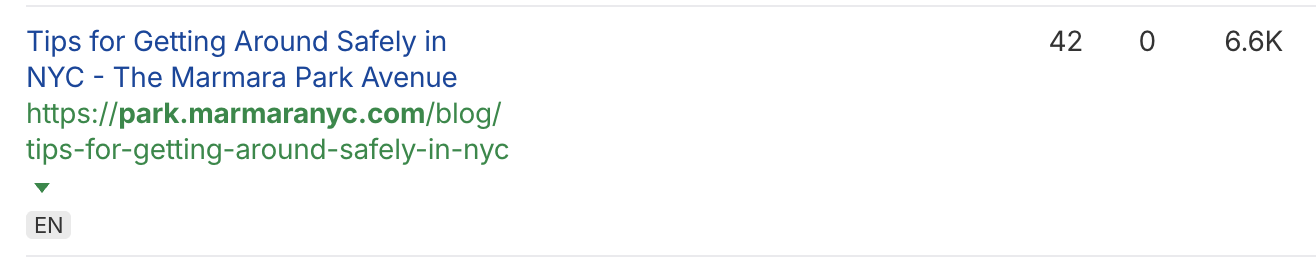
That’s huge for local SEO.
Buying 11 links might cost $2,000 or more. How much did it cost to write this local stats page? $5? $50? It’s nothing. By the way, you should still be buying backlinks. They’re part of every SEO campaign, local or international. Please read my guide on how to buy backlinks for a full breakdown on how to do this safely.
And it only takes a few hours to make a decent stats page. The data doesn’t even need to be yours (though it’s definitely better if you have some original stats). You just need to pull in some relevant industry stats from around the web and make them easier to skim. If you’re better at SEO than competitors, your copy of their stats might outrank them and get more links anyways (got to love Google).
Reverse Engineer Your Competitors
Another good way to start building high quality links in your local area is to search your local competitors and see who links to them. This is either called “reverse engineering” or “competitor link analysis”. I don’t care which one you use. Once you get this window into their link building strategy, you simply reach out to whoever linked to them and try to get a link yourself (or improve on what your competitor did and steal the link).
You can view a competitor’s backlink profile using backlink management tools like Ahrefs and Moz. Before we go on, if you aren’t familiar with link building tools, I suggest you familiarize yourself with them before your first SEO campaign.
Just plug in your top local competitors and filter for:
- Dofollow links
- Referring domains
- DR 15-70 sites (usually the sweet spot for local, though it can be higher in major cities)
- Filter for domain names, referring page URLs, and titles that contain the name of your city
I used Ahrefs’ Site Explorer to do some research on Chico Dental Arts, which is ranking #1 for the term “Chico CA dentist”:
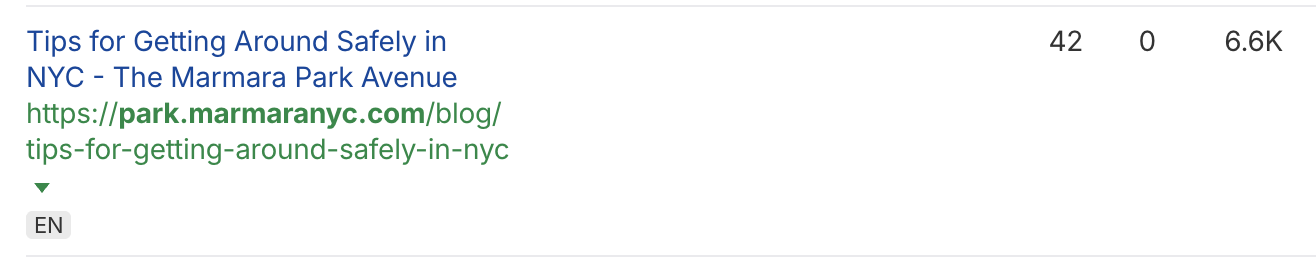
I found some potential backlinks, but most are directories. What I’m really looking for are local links. Let’s scroll for a few seconds, and…
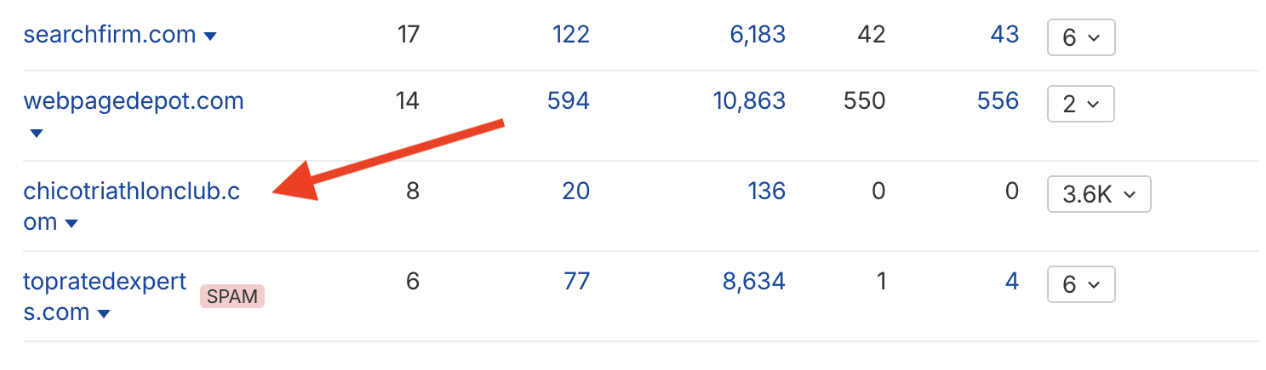
Bam. Found one! This is a local link from Chico, CA that I could easily hunt down.
I recommend that, when doing your research, look for local domains that appear repeatedly across competing businesses. These are surefire link building opportunities. You know they’re open for business and willing to let anyone get a link. Contact them ASAP.
Exchange links with local businesses
The nice thing about local SEO is you can build real relationships with other local business owners.
It’s not just endless dead internet and casino sites like general SEO (no offense, casino sites). If you’re a local roofer, why not offer a link to a local hardware store? If you scratch their back, they’ll scratch yours.
You don’t even have to frame it as a link exchange. Real businesses link to each other all the time without even thinking about SEO. They link to preferred vendors, recommended partners, contractors, suppliers, etc. While we’re on the topic, getting into a preferred vendors resource page is a great idea (I guess that falls under both the local resource page and link exchange categories).
Local connections can also bring in more business via word of mouth or affiliate deals. Always be thinking one step ahead.
Just make sure to swap links with businesses that are relevant to your industry. A handful of local link exchanges between trusted businesses looks natural. Building hundreds of exact match reciprocal links from random websites is playing with fire.
Unlinked mentions
Unlinked mentions are when someone mentions you, your business, or someone else related to your business, but doesn’t link back to you.
Google still registers those brand mentions to some extent (brand mentions are big for SEO now), but you’re leaving SEO value on the table if there’s no backlink attached.
This is some of the lowest hanging link fruit you can go after. Whoever mentioned you already knows who you are. You’re not some random internet stranger begging for a placement.
If you just ask them, they’ll almost always give you a backlink, if you can get a hold of them.
A quick email usually works. Here’s exactly what I would send in the email:
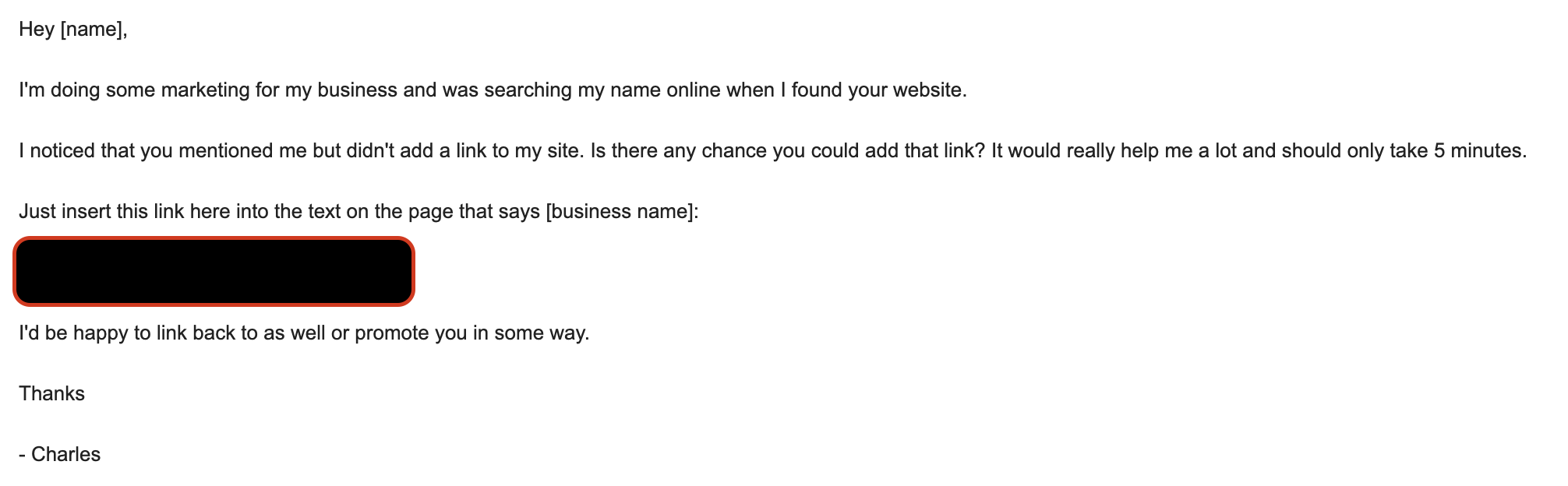
The easiest way to find unlinked mentions is with Ahrefs’ Content Explorer tool. Just search for your business name in quotes and exclude your own domain.
Here’s an example of searching for unlinked mentions of my brand, “PressWhizz.”
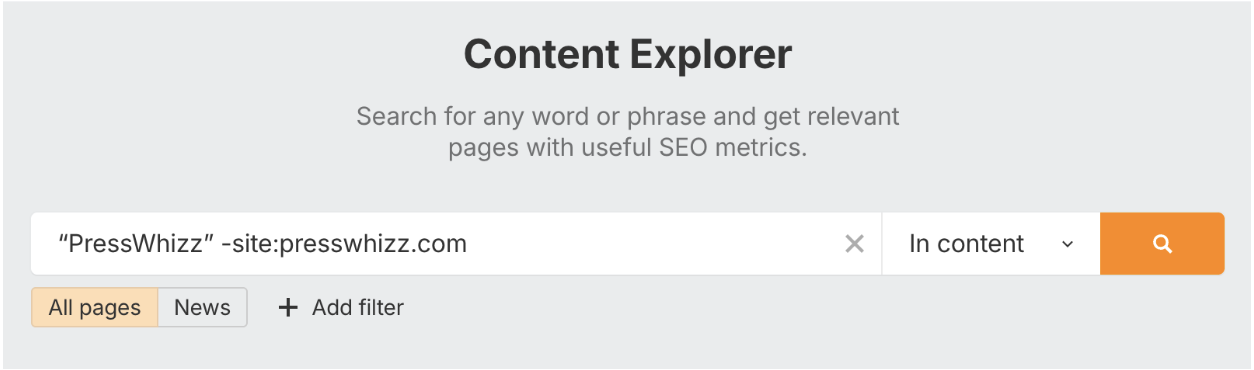
Then, use Ahrefs “Highlight unlinked domains” feature to filter for pages that mention your brand but don’t link to your website. Easy.
I also recommend doing a manual search every now and then, especially if you sponsor events, charities, or local organizations. Businesses get mentioned without links all the time on community pages, sponsor pages, and local news articles.
Case studies
Case studies are a type of high quality content that attracts backlinks naturally. They tell a story of how your business solved a problem and include hard data to back it up. They’re also an easy way to get local backlinks because happy customers are usually willing to do anything for you after you increase their bottom line.
For example, if you helped a local roofing company increase leads by 40%, that could be a case study.
To find case study content, look for past customers who had a particularly good experience with your company. Reach out to them to get their consent before starting the study (it seems obvious, but I’ve seen teams create 80% of a case study before reaching out to the customer for an interview and getting shut down).
Ideally, the customer should work closely with you on the study, because you need their testimony and their local backlink.
Next, build the study based around this simple idea: What was the problem and how did we solve it? Publish the case study on your own site and socials, and have your client do the same.
I recommend doing a case study at least once per year. If you work with multiple local clients across different cities or industries, you can build a strong local backlink profile over time this way.
Final Thoughts
Dominating local search rankings comes down to who’s best at local link building. Period.
Reviews are nice. Prominence is nice too. Even proximity matters for ranking in Google’s local pack.
But nothing is more important than building high quality backlinks. And that’s even more true as we’re creeping ever closer to an AI-first search world.
If there’s one thing I want you to take away from this article, it’s that the majority of your local SEO budget should be dedicated to building “REAL” local links via donations, sponsorships, news stories, local link magnets, and resource pages.
Once you build the foundations – citations, directories, and business associations – dedicate as much of your budget as possible to local media coverage, community sites, and government backlinks (via charities, city/county/state sites, or resource pages).
Whatever you do, don’t waste all of your budget on building hundreds and hundreds of citations and think that will be enough. It’s not.
And as we move closer to an AI dominated search world, those editorial links in local media coverage will matter even more.
I wish you luck.