

Guest post link building is the SEO practice of publishing an article on another website in order to acquire a contextual backlink to your site.
It’s one of the most common link building strategies in the search engine optimization industry. According to PressWhizz’s own link building statistics page, 74% of SEOs pay for links, and nearly 90% see a rankings lift from links within the first 6 months.
But building high-quality guest post backlinks is also one of the most difficult tasks in all of SEO. And, if you’re here, you probably have many difficult questions on your mind.
Do guest posts still work?
Is it safe to buy links in 2026?
How does guest posting even work? And why does it improve SEO rankings?
In this guide we will answer all of these questions and more with real first-hand experience from our guest post marketplace.
You’ll learn why guest posts are still effective, how to avoid Google penalties, how links affect SEO, and the basics of how to do guest post link building yourself.
Ready? Let’s begin.
Do Guest Post Links Still Work?
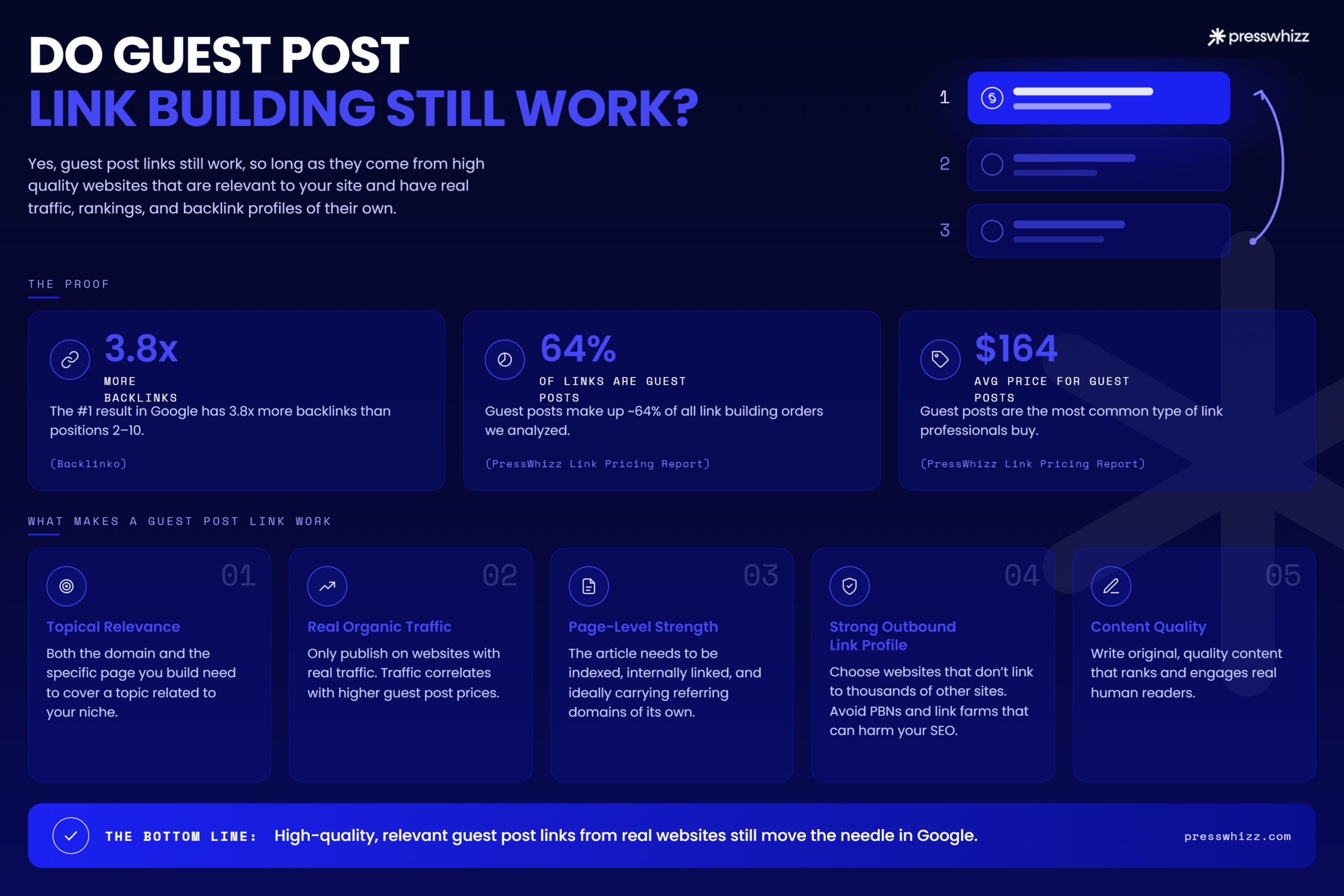
Yes, guest post links still work, so long as they come from high-quality websites that are relevant to your site and have real traffic, rankings, and backlink profiles of their own. The most important factors that determine guest post link quality are:
- Topical relevance: Both the domain and the specific page you build need to cover a topic related to your niche.
- Real organic traffic: Only publish on websites with real traffic. By the way, traffic correlates with higher guest post prices compared to Domain Rating.
- Page-level strength: The article needs to be indexed, internally linked, and ideally carrying referring domains of its own.
- Outbound link profile: Choose websites that don’t link to thousands of other sites. Google can easily identify low-quality PBNs and link farms now. These will only harm your SEO.
- Content quality: Spun AI articles don’t rank, and a page that doesn’t rank passes almost nothing. So, focus on writing original, quality content that human readers can actually engage with.
To understand why guest post backlinks still work for SEO, you need to understand how Google ranks websites.
Backlinks operate as votes of confidence between websites.
PageRank, Google’s foundational ranking algorithm, works off the quantity and quality of links pointing at a page. And Google’s patent, “Method for node ranking in a linked database“, states that a document’s rank is calculated from the ranks of the documents citing it.
DOJ antitrust testimony also confirmed links are still part of the core ranking system.
So, NO, link building is not dead, and anyone who says “links don’t matter as much as they used to” is either misinformed or lying.
The data backs this up.
According to Backlinko on their page “We Analyzed 11.8 Million Google Search Results. Here’s What We Learned About SEO,” the #1 result in Google has 3.8x more backlinks than the results sitting in positions 2 through 10.
We also know from our own link building pricing report that guest posts are the most common type of link SEOs build. Together, this shows that guest posting remains the preferred method for generating quality backlinks among the people doing this professionally.
So:
- Google’s algorithm uses links to determine rankings
- Their patents plainly say they use links to determine rankings
- DOJ testimony proves it
- Data proves it
- Our own industry data shows that professionals buy guest posts in large quantities
Translation: Yes, guest post links still work.
Note: AI has not devalued links. It has made links even more valuable. When anyone can publish 500 articles a month for pennies, high-quality links are one of the few authority signals left that are hard to scale artificially (it’s expensive and Google is scarily good at determining link quality).
Guest Post Case Studies
I want to prove the value of buying guest posts with real data, so here is the work we’ve done in three of the most competitive niches in SEO.
Guest posts made up the majority of links in all three campaigns, and none of these sites were penalized or suppressed.
Links still work!
Case Study 1: iGaming Crypto Casino (+176% organic traffic in 6 months)
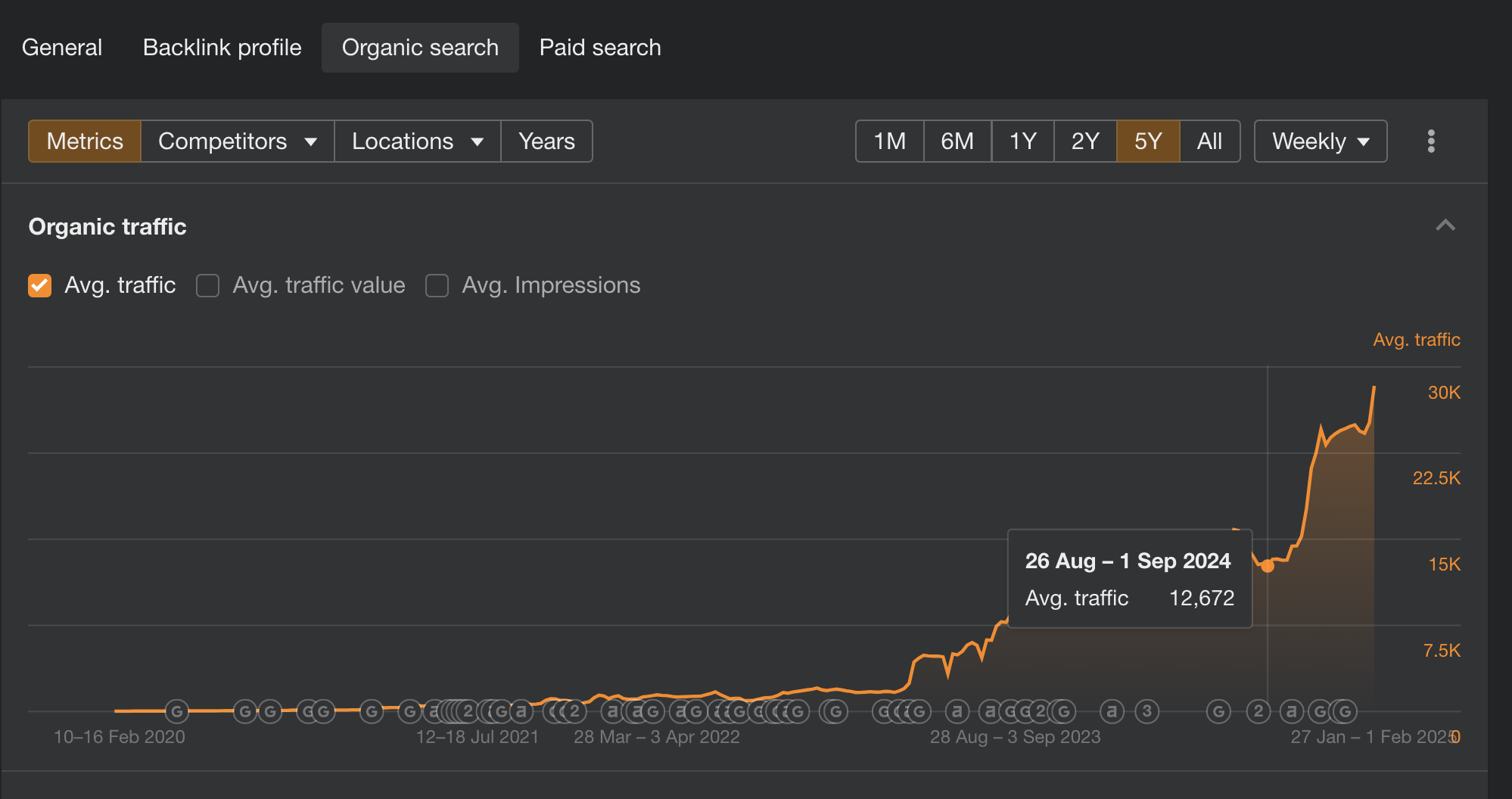
iGaming and crypto are two of the most competitive niches, and Google treats these niches as high-risk, so there’s heavy scrutiny on websites trying to rank for these insanely valuable key terms. We knew this wouldn’t be easy, but we wanted the challenge of building high-quality iGaming backlinks.
This client came to us with a small link profile in a niche where Google is openly hostile to thin, spammy sites. We built seventy handpicked links, and they returned $510,000 in organic revenue over 6 months on a $65,000 spend.
Here’s a summary:
- Links built: 70 new, unique referring domains over 6 months, with guest posts making up 65% of placements and niche edits the other 35%.
- Criteria: DR 40+ sites with real organic traffic in the gambling, finance, and crypto verticals only, restricted to tier-1 markets.
- Authority gain: DR 38 to DR 71. Domain Rating isn’t everything, but that’s very nice to see.
- Results: +13,000 monthly organic visitors, roughly 900 new monthly signups, and $85,000 in additional monthly organic revenue.
- Campaign cost: $65,000.
Without guest posts, this site never would have ranked in this niche or enjoyed anywhere near this level of success.
Case Study 2: eCommerce Brand (+201% organic traffic in 3 months)
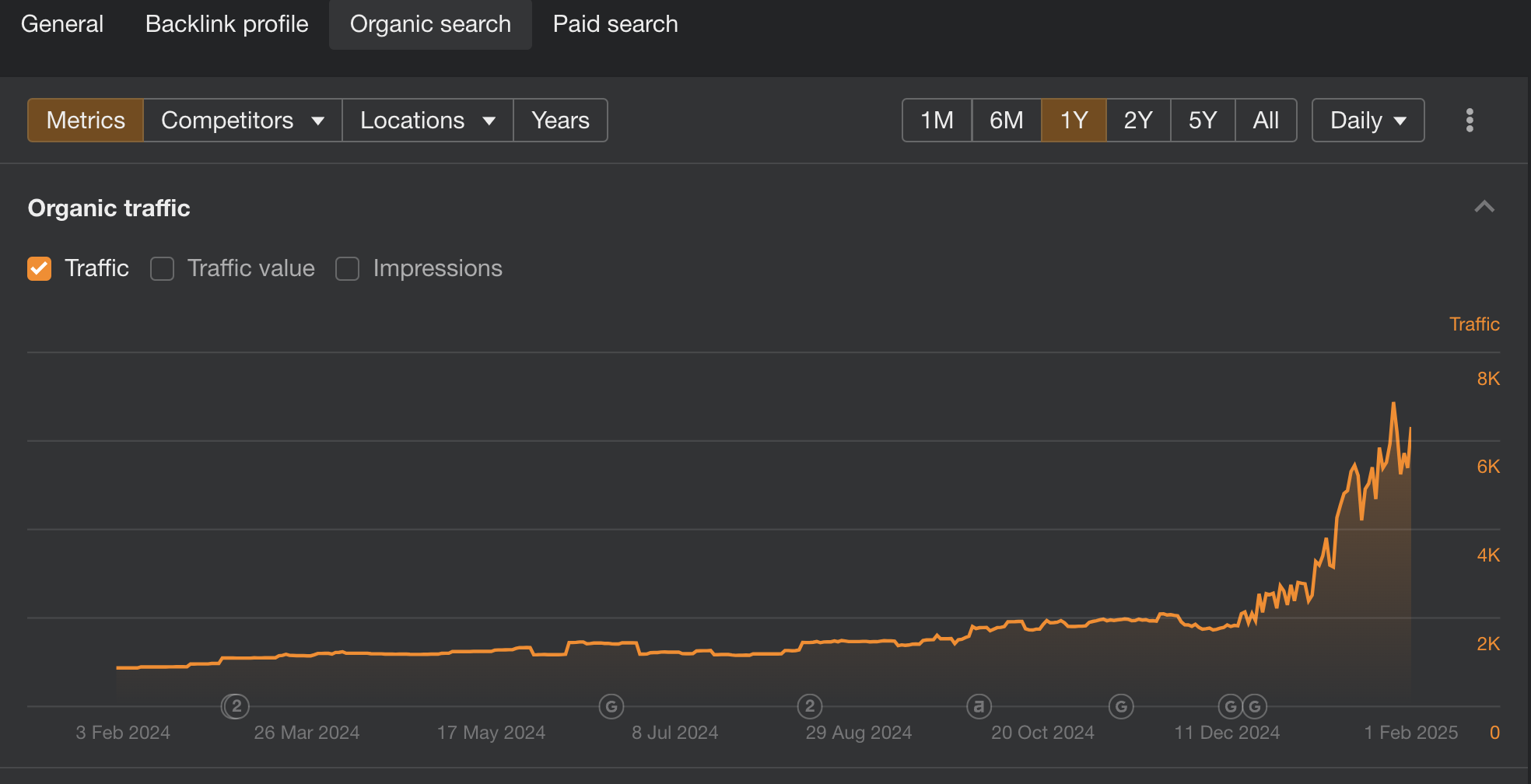
eCommerce link building is notoriously difficult. Anyone in the SEO industry knows that.
This was a family business that had already been burned by several agencies and freelancers who could not compete in a high-ticket niche. We matched their competitors’ authority in three months by pointing most of the links at blog content that had been sitting on the site unlinked for years.
Here’s what we did:
- Links built: Around 150 referring domains in three months, split 55% guest posts, 35% niche edits, and 10% niche-specific directories.
- Criteria: Dofollow, in-content placements from topically relevant sites, with a distributed rollout to keep link velocity natural.
- Example placement: A DR 72+ industry blog published a piece on the future of the client’s industry with a contextual dofollow link to their best-selling category page.
- Results: +4,000 monthly organic visitors, a 159.1% increase in monthly sales, and roughly $100,000 in additional monthly organic revenue.
- Campaign cost: $24,500.
Again, high-quality links (mostly guest posts) made a major difference here.
Case Study 3: Casino Affiliate (+284% organic traffic in 8 months)
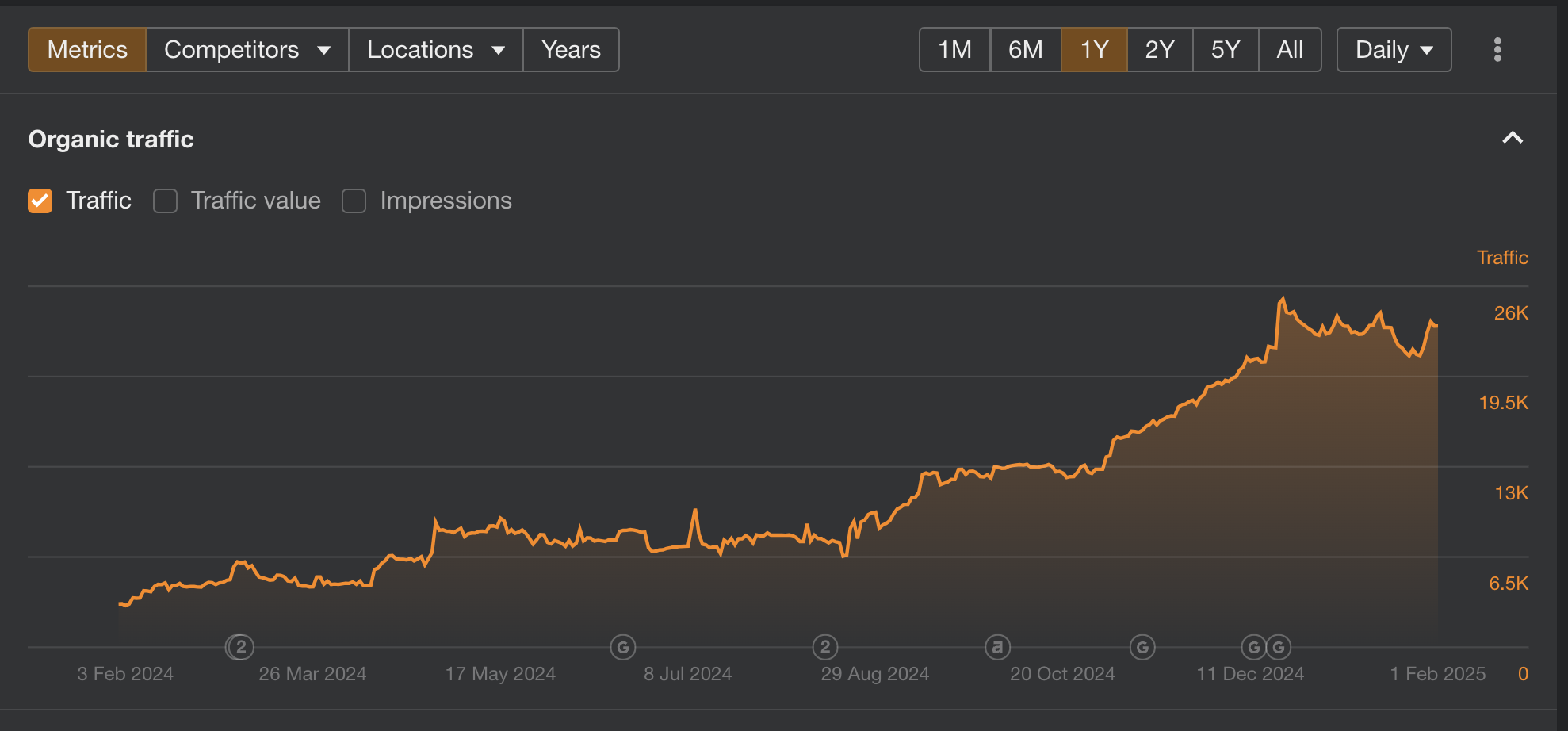
The content base was already strong here, so the entire campaign was pure link acquisition against affiliates with years of authority already built up.
Building relevancy match pages first is what unlocked publishers that no casino affiliate could pitch directly.
Here’s a quick summary:
- Links built: Around 300 referring domains over eight months from casino, gambling, and finance sites in tier-1 markets.
- Creative relevance: We had the client build new pages specifically to create relevancy matches for links they otherwise couldn’t earn, including food and lifestyle publishers with legitimate ties to licensed casino content.
- Results: +18,500 monthly organic visitors, roughly 2,500 new monthly organic commissions, and $50,000 in additional monthly affiliate revenue.
- Campaign cost: $115,000, and the campaign is still running.
No, link building is not dead. Businesses that embrace it and do it the right way are still vastly outperforming the competition.
OK, I think you believe me about the efficacy of guest blogging. Let’s cover why building links still works and how links affect SEO.
How Do Guest Posts Affect SEO?
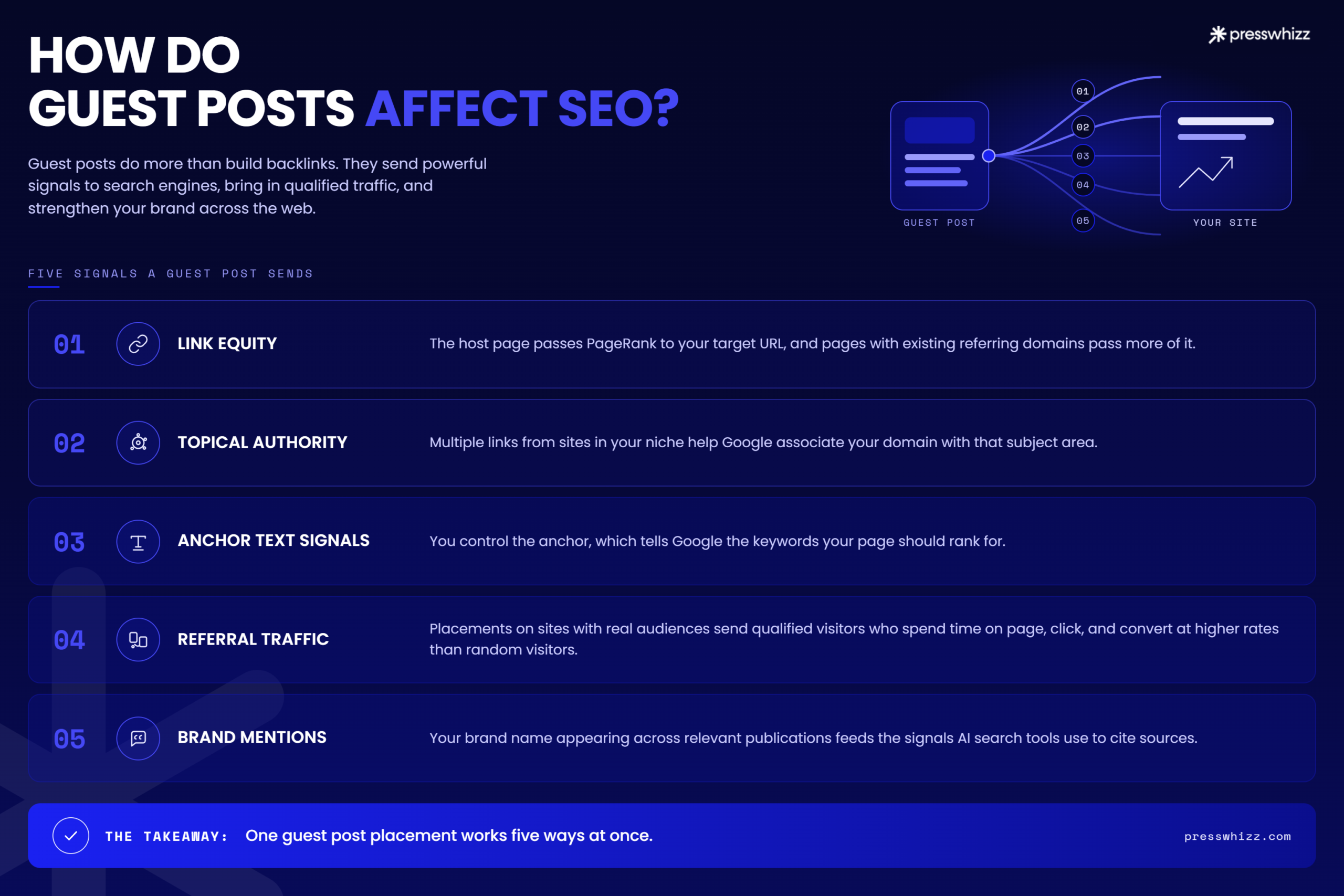
Guest posts affect SEO by passing authority from the host domain to your site, building topical relevance around your target pages, and adding referring domains to your backlink profile.
For example, a link on a high-authority site can transfer link juice, send relevant traffic, and reinforce your entity with Google.
Together, high-quality backlinks “transfer” authority from one site to yours, send targeted traffic, contribute to a natural link profile, and prove to Google that you are a real business.
Let me break down each effect in more detail.
- Link equity: The host page passes PageRank to your target URL, and pages with existing referring domains pass more of it.
- Topical authority: Multiple links from sites in your niche help Google associate your domain with that subject area.
- Anchor text signals: You control the anchor, which tells Google the relevant keywords your page should rank for.
- Referral traffic: Placements on sites with real audiences send qualified visitors who spend time on page, click, and convert at higher rates than random visitors.
- Brand mentions: Your brand name appearing across relevant publications feeds the signals AI search tools use to cite sources.
The last important topic we will cover now is whether or not it’s safe to buy guest blog posts. There is a lot of disinformation and bad advice out there about buying links, so I suggest you read the next section.
Is It Safe to Buy Guest Post Links?
Buying guest post links is safe as long as you do it the right way.
Doing it the wrong way does carry risk, because paying for links violates Google’s link spam policy.
The factors that affect whether your link building efforts will get flagged by Google are:
- Scaling low-quality links: Ordering 50 placements a month from a vendor selling DR 30 sites with no traffic.
- Link farms and PBNs: Networks of sites built for no reason other than selling links, which SpamBrain maps by their outbound patterns.
- Over optimized anchor text: Pointing 40 exact match anchors at the same money page in eight weeks.
- Unnatural velocity: A 6 month old site picking up 200 links from unrelated blogs.
We understand if you are worried about a Google penalty. They are adamant about buying and selling links being against their guidelines.
But the truth is that Google does not have the will, time, or resources to police the entire web for paid links. It would be far too complex and expensive for them to do so, and it would not have a substantial effect on search result quality.
Instead, what they do is devalue the lowest quality links and combine human monitoring with advanced machine learning algorithms to detect scaled abuse (for example, building hundreds of links quickly using AI or mass guest posting).
It’s a lot like the police setting speed traps for drivers going double the speed limit. The police can’t stop every car going 5 miles per hour over the speed limit, but they can sit by the side of the road and deter people from speeding while catching the worst offenders doing double the speed limit. That’s what Google does, too.
Just ignore what you see on social media and focus on what the results show you.
First off, a major study from Reporter Outreach titled “50+ statistics for 2026” found that 64% of SEOs spend at least $3,000 per month on links. And Search Engine Land claims that 92% of SEOs suspect their competition is buying links.
And look at the link building industry: publishers list prices openly, marketplaces operate in public, and link building services charge five figures a month for placements. We have thousands of customers buying links through PressWhizz who have never had a single issue.
If buying links were dangerous, none of these things would be true.
How to do Guest Post Link Building the Right Way
The best way to do guest post link building is by targeting relevant websites within your niche, creating high-quality content that provides value, and focusing on creating quality links over quantity. When building links, target real websites with real organic traffic, rankings, and editorial standards as well as a natural link profile.
A few important things you need to know about building quality SEO backlinks are:
- Sites that link out to thousands of other sites are typically devalued by Google (though this depends on many other factors)
- When you build multiple links with the same website, the links also tend to get devalued
- Links from sites with no traffic or organic rankings (link farms) provide no SEO value and can even hurt your rankings
- Google is more sophisticated than ever before. Prioritize relevance over just pure Domain Rating
We’ve written an entire guide on guest post outreach that details our proprietary methods for landing high-quality guest post opportunities, so we won’t go into major detail here. We just urge you not just reach out to any site that accepts guest posts. Qualify the sites first.
However, the best way to land more guest post opportunities is:
- Build a prospects list (use Google search operators, review page authority, find contact details, etc.)
- Personalize your outreach using AI automations
- Research helpful topics
- Write high-converting, personalized emails (according to the site’s guest post guidelines)
- Create valuable content for the website’s audience
- Follow up without being annoying
- Track everything and optimize
For more on this process, please read our full guide.
Final Thoughts
The one thing I want you to take away from this post is that guest blogging still works, so long as you do it the right way. It increases your authority, sends referral traffic, reinforces your entity, and enhances brand visibility. This is a proven fact, and Google has even stated (and DOJ testimony has confirmed) that links are vital to its search ranking algorithm.
Don’t waste your time on low-quality links, PBNs, or mass-generated posts on irrelevant sites. SEO has evolved, and Google is far too sophisticated for that these days.
Instead, focus on placements on relevant websites within your niche and prioritize websites with real traffic, search engine rankings, and link profiles.
You 100% MUST build links if you wish to succeed in SEO, especially in competitive or high-scrutiny niches like YMYL topics, iGaming, SaaS, and eCommerce.
As always, I wish you luck.
– Dusan Novakovic