Wikipedia backlinks are one of the best types of backlinks in SEO.
But you don’t need another article telling you “Wikipedia links are good” or “Wikipedia is a popular website”.
What you need is an article that:
- Shows you valuable ways to earn high quality backlinks from the world’s most popular website
- Goes into detail on pricing, including an industry survey on how much Wiki links cost
- Is full of tips, prompts, and lifehacks for improving your SEO
- Shows you which types of content earn Wikipedia links and get accepted by moderators
If that’s what you’re looking for, this guide is for you.
Wikipedia links are a controversial topic. The truth is that their value is NOT from directly passing PageRank. Instead, it’s from entity validation, reinforcing topical authority, enhancing trust signals, and secondary link acquisition. But there’s a reason that I make them part of every possible link campaign if the opportunity is there: they work.
By the end of this guide, you’ll know:
- My exact process for building Wikipedia links
- The SEO mechanism behind why they’re so important
- Some little known Wikis that list hundreds or even thousands of low-hanging fruit link opportunities
- A next-level link building hack for earning even more backlinks
- Which prompts, Google searches, and email templates I use to earn backlinks
- The average price for these links and how to approach buying them
- My step-by-step process for editing Wiki articles
How to Get Wikipedia Backlinks
The best ways to get Wikipedia backlinks are to replace dead citations, update out-of-date citations, and rewrite or improve existing pages that need work.
Wikipedia link building is nothing like typical SEO link building. Wikipedia has extremely rigorous standards, and if the mods get even a whiff that you’re plugging your own work (and it’s not up to par), the link will be gone. You’ll also get banned and may even end up on MediaWiki’s “blacklist” (ask me how I know…).
I don’t want to waste any more of your time. Let’s get into how to build high quality links from Wiki…
Broken or Dead Links
Finding dead links is the #1 tactic for earning Wiki backlinks. If you’re not sure where to begin, start here.
Dead backlinks are the easiest opportunities to find, and one of the few tactics that genuinely helps improve Wikipedia. If you’re familiar with link reclamation from your daily SEO grind, you’ll know what I’m talking about here.
Replacing dead links is a high-ROI white hat link building tactic because it helps Wikipedia solve a desperate need. Why wouldn’t they want a more relevant, up-to-date source instead of a broken link that ruins UX?
As long as your replacement source is equal to or better than the original, it should work (though mods are notoriously moody).
Before replacing a dead link, evaluate the opportunity carefully:
- Is the dead source closely related to your content?
- Does the article genuinely need the cited information?
- Can you recreate or improve on the original resource?
- Is the Wikipedia page relevant to your niche?
- Does the page receive meaningful traffic and visibility?
How to Find Dead Link Opportunities Using Google and AI
Ready to find some broken Wikipedia links? All you need is Google, an LLM, and the Wayback Machine.
Let’s start by using Google.
To find opportunities, search Google for:
site:wikipedia.org [keyword] “dead link”
Let’s do a simple example that I know will return an inhuman number of results: Site: Wikipedia.org [artificial intelligence] “dead link”:
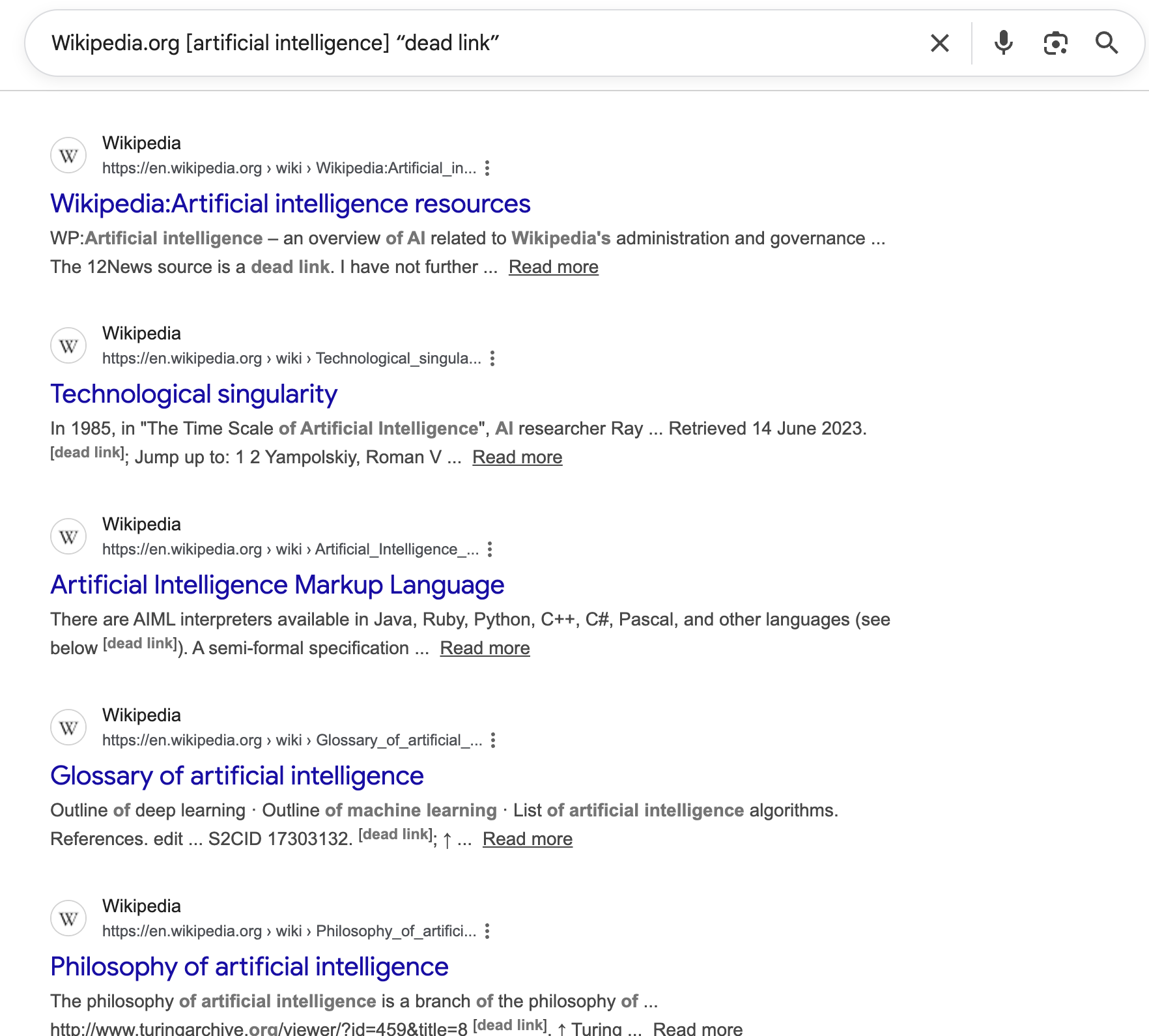
Bingo.
Now let’s go to each of these pages and use CTRL + F (or Command + F on a Mac) to search for “dead link”:
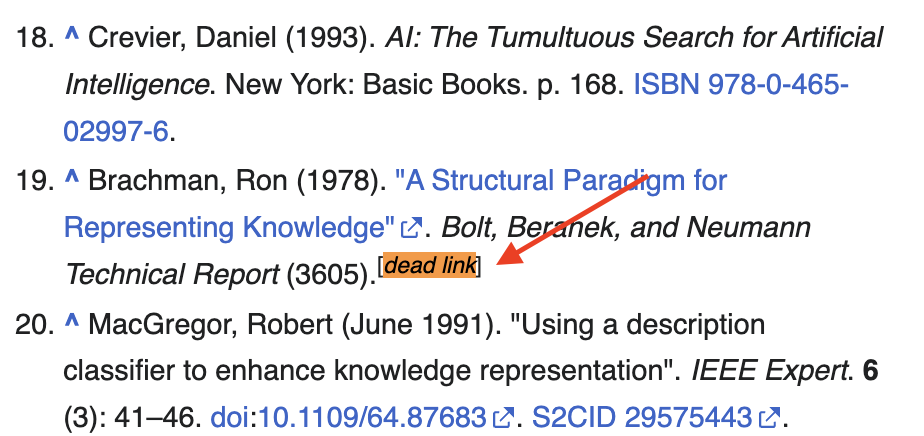
Got one.
So, what’s next?
Copy that URL there and throw it into the Wayback Machine. In case you aren’t familiar, this is an amazing SEO tool that shows you what pages used to look like.
Go to the Wayback Machine, enter the URL, and inspect the page:

When you evaluate a page, ask yourself the following questions:
- What exact claim is this supporting?
- What type of source was it?
- Can I recreate it?
- Can I improve it?
- Would my replacement be objectively useful?
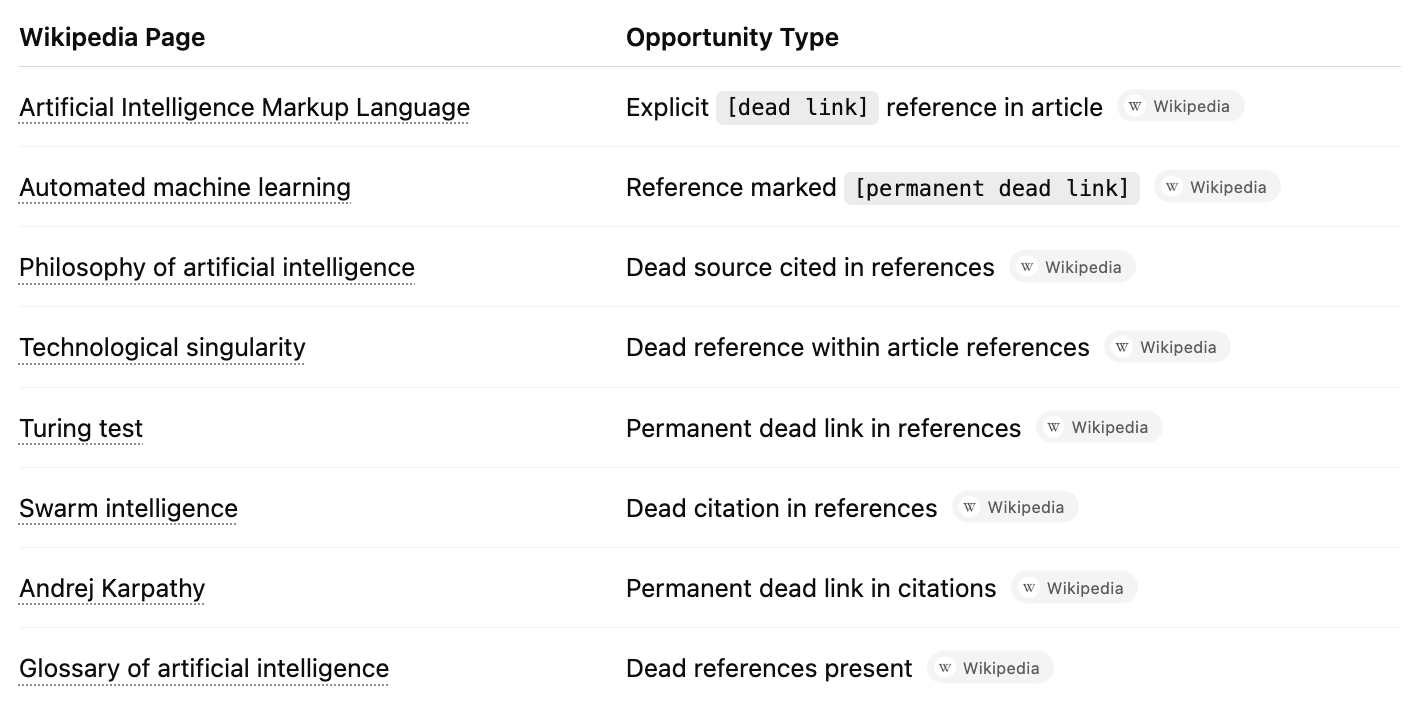
This is a great way to do things, but I prefer using AI. With AI, you can search for a group of keywords automatically, and it reliably surfaces pages that mark links as dead. This is one of my favorite AI link building techniques.
Here’s a screenshot of me using ChatGPT to find dead links related to AI:
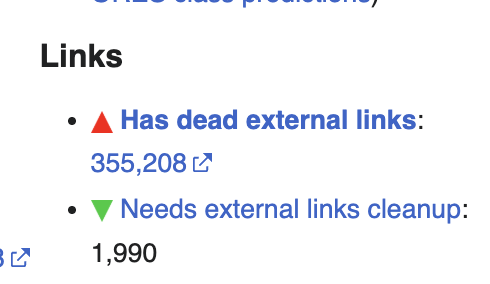
Lifehack: Wikipedia literally has a list of articles with dead links. Go to Wikipedia:Maintenance and click on the Has Dead External Links category:
Outdated Citations
Replacing outdated citations is another effective way to earn Wikipedia backlinks, particularly in fast-moving industries like AI, SEO, technology, and digital marketing.
Instead of looking for broken sources, you’re looking for citations that are still live but no longer represent the most current information available.
For example, in an industry like AI (or even SEO or SaaS), referencing statistics from 2021 might as well be referencing statistics from 1921. If you have newer research, statistics, or industry data, your source probably deserves to be cited.
We work with loads of clients who need SaaS links here, and we routinely get their linkable asset pages cited in Wikipedia.
Here’s an example of two citations that are WAY out of date:
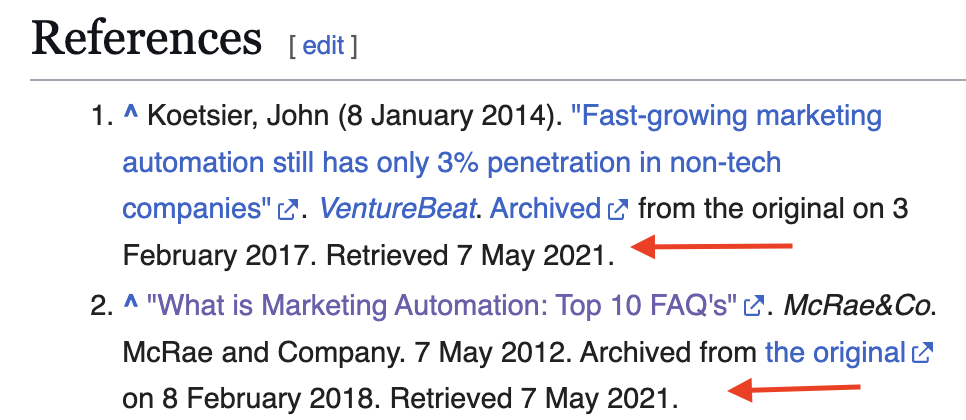
Marketing automations only have 3% penetration in non-tech companies? That’s an insane statistic.
This takes a bit more legwork than other techniques, but it’s very high ROI. I suggest you start by Googling your keywords along with modifiers to try to find stat or fact citations. Here are a few to get you started:
- site:wikipedia.org “[KEYWORD]” “market size”
- site:wikipedia.org “[KEYWORD]” “statistics”
- site:wikipedia.org “[KEYWORD]” “forecast”
Rewrite/Edit Existing Pages
Many Wikipedia articles need rewriting, editing, updating, or other forms of maintenance. If you’ve got the time, doing some cleanup is a great way to build high quality backlinks organically.
There are literally hundreds of thousands of pages that need work (maybe more), and all you need is your own Wikipedia account to do it.
Start by creating your own account and going to one of the following pages:
- https://en.wikipedia.org/wiki/Category:All_articles_needing_additional_references
- https://en.wikipedia.org/wiki/Category:All_articles_with_unsourced_statements
- https://en.wikipedia.org/wiki/Category:Wikipedia_articles_in_need_of_updating
- https://en.wikipedia.org/wiki/Category:Wikipedia_articles_that_may_need_to_be_rewritten
- https://en.wikipedia.org/wiki/Category:Articles_needing_multiple_maintenance_issues
- https://en.wikipedia.org/wiki/Wikipedia:Stub
You can also do niche specific Wikis. If I were in software or AI, I’d check out Wiki Projects like:
- https://en.wikipedia.org/wiki/Wikipedia:WikiProject_Software
- https://en.wikipedia.org/wiki/Wikipedia:WikiProject_Computing
- https://en.wikipedia.org/wiki/Wikipedia:WikiProject_Internet
- https://en.wikipedia.org/wiki/Wikipedia:WikiProject_Artificial_intelligence
- https://en.wikipedia.org/wiki/Wikipedia:WikiProject_Software/Article_alerts
- https://en.wikipedia.org/wiki/Wikipedia:WikiProject_Computing/Article_alerts
- https://en.wikipedia.org/wiki/Wikipedia:WikiProject_Internet/Article_alerts
- https://en.wikipedia.org/wiki/Wikipedia:WikiProject_Artificial_intelligence/Article_alerts
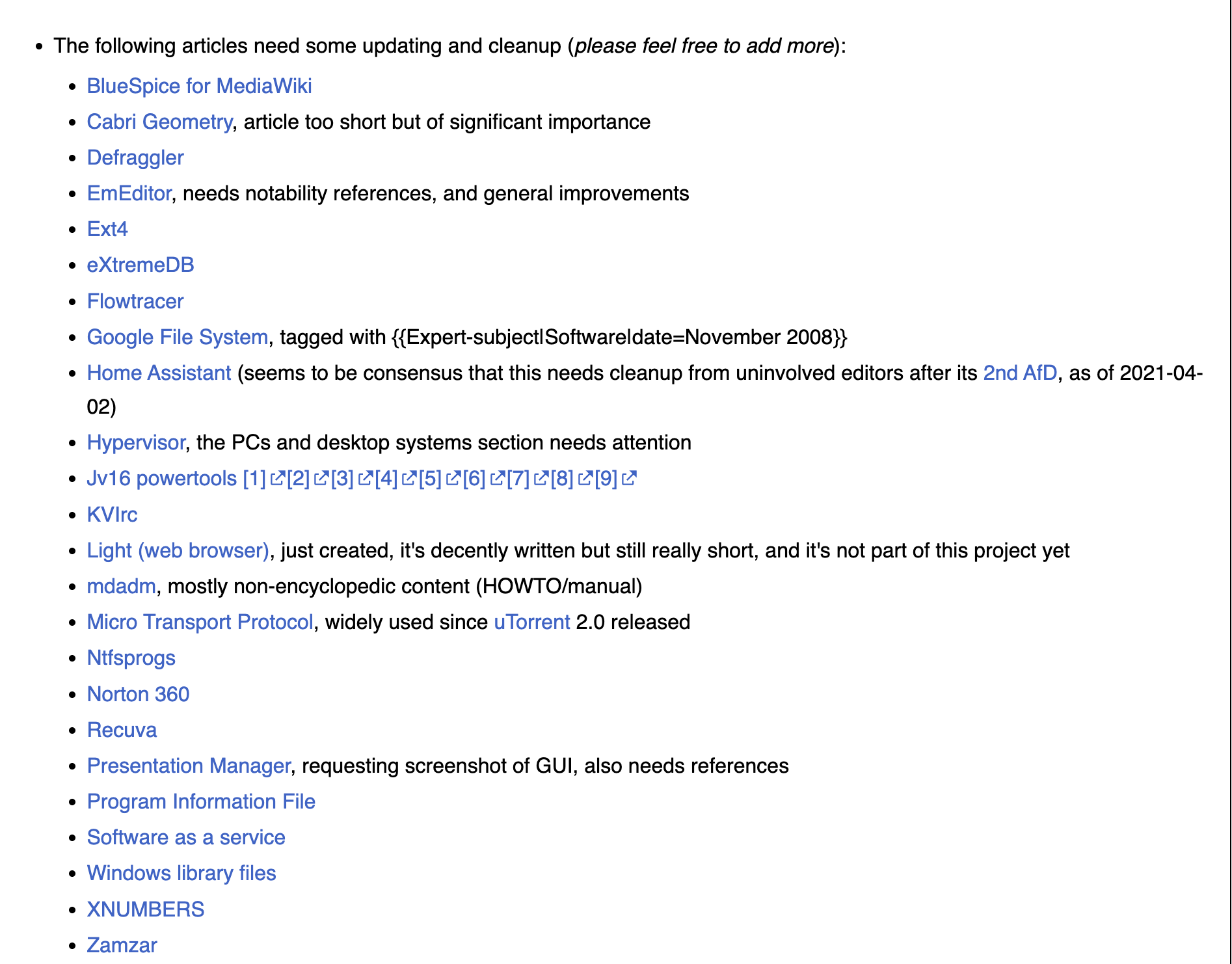
The cool thing about these projects is they show you articles that need updating within that specific niche, which makes it way more likely you’ll find niche-relevant opportunities:
Pro Tip: Don’t start spamming links to your sites. You’ll get banned. Instead, assign one of your team members to this job and have them edit Wikipedia all day. If there’s a natural place for your (or your client’s) link, great. Add it. But focus on editing articles for genuine quality, or you’ll get banned (again, ask me how I know).
Create Valuable Content
I hate when anyone says “just create good content” because that’s what Google always defaults to. But when it comes to Wikipedia links, it’s mostly true. Creating valuable, citable content does naturally attract Wikipedia citations IF you are a decent sized brand.
Let me explain how this works so you get the idea.
Wikipedia editors cite sources, obviously. When you publish original research, first-party surveys, or industry data that doesn’t exist anywhere else, you give editors something they can reference when backing up a claim.
That’s the only way you earn these links without manually editing the page yourself. You won’t get the links instantly, but you’ll drastically increase your chances of getting them.
Here’s an example of a stats page from 2014 that got cited and is STILL live somehow:
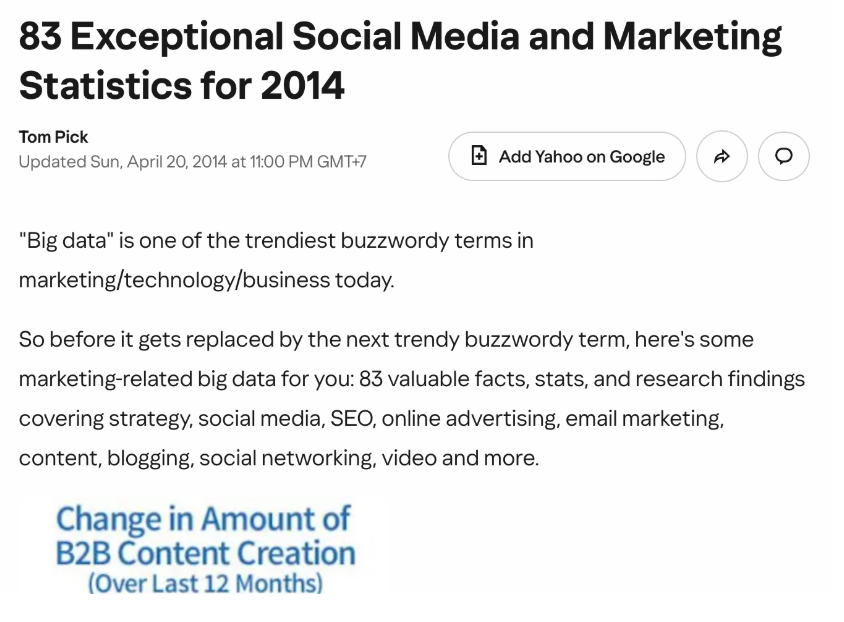
If this guy’s social media stats page from 2014 can earn a Wikipedia citation, so can yours.
Content types that consistently earn Wikipedia citations:
- Original research and surveys: First-party data editors can cite when no other source exists.
- Industry statistics reports: Proprietary numbers Wikipedia can’t source elsewhere.
- Definitive guides and reference pages: Resources editors use to explain a concept to readers.
Getting organic Wikipedia citations comes down to being citable and findable. Editors source references the same way everyone else does: they Google them. That means you need well-written, SEO-optimized content that ranks for your topic, or content that gets enough social traction that editors encounter it naturally.
How to Earn Even More Links
Here’s a next level SEO link building hack that I use on all my clients’ sites to earn organic links.
Every site linking to that same dead URL is a broken link building prospect for you. Sometimes, you can build 10+ or even dozens of new backlinks simply by reaching out to the sites that also link to that broken Wiki citation. By the way, this is a 100% white hat link building strategy, so it’s Google safe.
If Wikipedia links to a broken page, other sites across the web almost certainly link to it too. Find the dead link once, and you’ve found every site that needs a replacement.
Here’s an example of an article about pop up ads (the worst) with 66 organic links pointing at it:
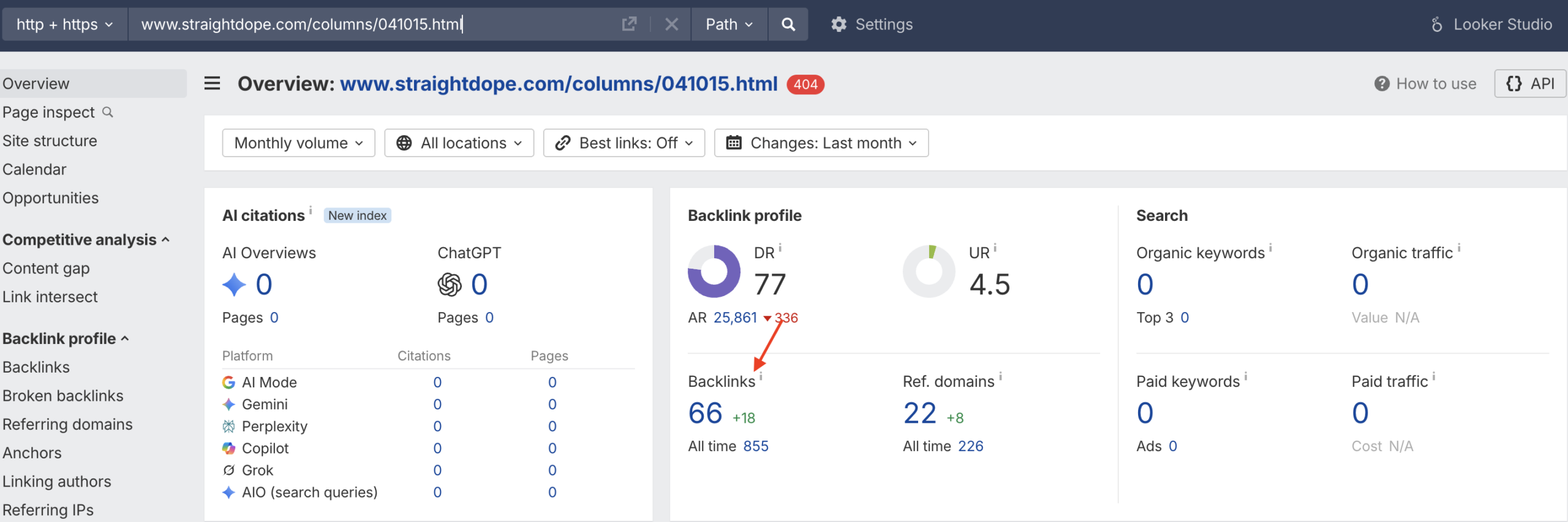
That’s 66 broken link opportunities! And some of them are within the SEO niche, which would be a great opportunity for us to build a niche-relevant backlink:

Here’s my process for finding these links:
- Find the broken link: Use WikiGrabber to find relevant Wikipedia articles with dead citations relevant to your niche, or use the same Google search strategies I gave you before.
- Pull every site linking to it: Drop the broken URL into Ahrefs’ Site Explorer and export the full referring domain list.
- Create your replacement content: Check what the dead page covered using the Wayback Machine, then build something that covers it more thoroughly. I recommend adding original data and updated statistics.
- Pitch your replacement: Once your content is live, email each site to tell them the link is broken and point them to your content as the fix.
Here’s an outreach email template that gets a high response rate (in my experience):
Hi [Name], I was reading your article on [Topic] and noticed you’re linking to [Dead URL].
That page is returning a 404, which means anyone clicking it hits a dead end. Broken links hurt user experience and can drag down your page’s SEO, so I wanted to flag it.
I recently published a resource covering the same topic: [Your URL]. It goes deeper than the original by [one specific reason it’s better, e.g., ‘includes 2026 data’, ‘covers X angle the original missed’, ‘twice the depth on Y subtopic’], so it should work as a solid replacement.
Happy to answer any questions if you want to check it out first. [Your Name].
Why Are Wikipedia Backlinks Good for SEO?
Wikipedia backlinks are high quality links for SEO because they reinforce your trust with Google, increase your search engine rankings indirectly, send referral traffic, and generate secondary links from journalists who use Wikipedia to find their own citations.
There’s a ton of debate around Wiki links. But there’s a reason why everyone wants them.
While they are nofollow links and don’t pass traditional PageRank, they can still provide indirect SEO value. We know from Google patents, Knowledge Graph seeding, and the algorithm leak that Google uses entities, relationships, seed sets, and trusted sources to help shape the SERPs.
Knowing that Google uses those things to help determine rankings, we can reasonably infer that links from the world’s most trusted website with 4 BILLION+ organic traffic will benefit your SEO.
Also, unique links from sites like this help give your site a natural looking backlink profile. OK, enough rambling.
Let’s break down the reasons one by one.
Entity Reinforcement
An entity is any well-defined, unique concept that a search engine can recognize as a distinct person, place, organization, event, or thing. And it’s extremely important for SEO. The more Google recognizes you, the better.
For example, I am an entity:
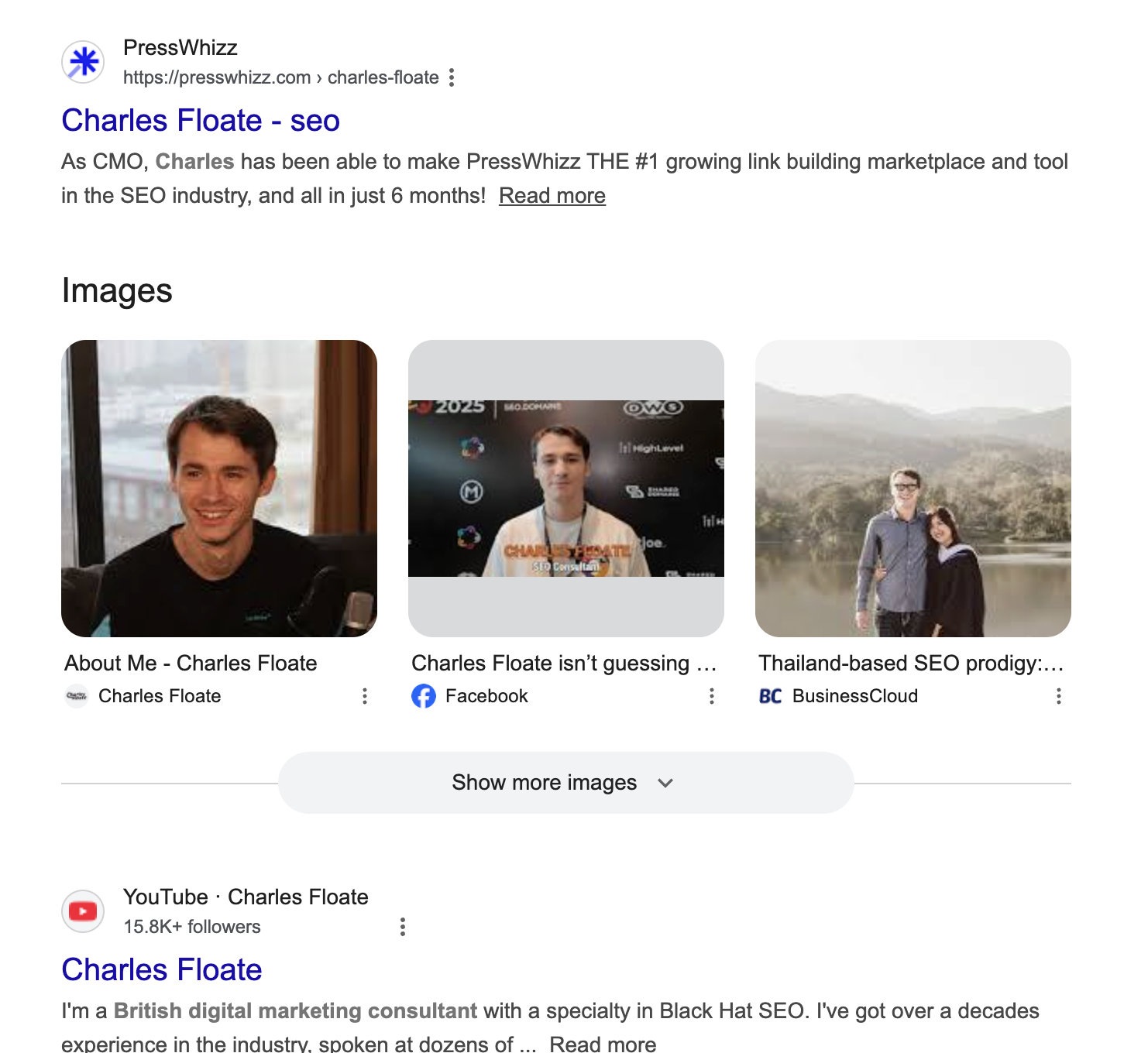
Wikipedia is one of the largest and most trusted sources of entity data on the web, and the moderators actually care about the integrity of the brand (which is rare on the internet!).
So, even if you don’t get any link juice from the citation, it still helps show Google that you are real and well known, which in turn boosts your website’s search engine rankings.
Increased Rankings
Wikipedia backlinks are unlikely to improve rankings directly, but they can contribute to a broader authority-building strategy. The more authority and entity recognition you have, the more likely Google is to rank you for keywords related to your industry.
Any Wiki link you build improves topical relevance, entity reinforcement, and increased brand recognition, which can all contribute to stronger SEO signals over time. Better brand awareness also improves branded search queries and traffic to your website, which we know are invaluable for SEO from several sources, such as Google patents, the algo leak, and anecdotal evidence.
And no, I’m not saying “Wiki links boost rankings immediately.” I’m just saying they’re part of a holistic SEO strategy.
Secondary Links
Journalists and bloggers use Wikipedia all the time to find sources for their posts. So even though you get nofollow links from Wiki (which don’t increase your site’s authority), you might get secondary dofollow links from authoritative sites.
AI & LLM Visibility
Wikipedia citations can be valuable for AI and LLM visibility because modern AI systems frequently reference and cite external sources when generating answers.
In fact, according to a study by Peec.ai entitled “Top domains cited by AI search: Analysis based on 30M sources,” Wikipedia is the 4th most cited AI source by LLMs.
So, I hope you see the value here. When an AI model decides which sources to display, it typically favors content that appears authoritative, trustworthy, and well-cited across the web. Wiki citations will help with that.
Should You Buy Wikipedia Backlinks?
Yes, you should buy Wikipedia backlinks or Wikipedia page creation services, so long as the service is reliable and you get good value for money.
The official word is that you should not buy links because they violate Wikipedia’s guidelines. But as we all know, SEO is about doing what works and NOT what the official mouthpieces tell us.
So, should you buy Wiki links? The answer is that it depends.
There are several questions you need to ask before purchasing Wiki citations:
- How much are they?
- Do you have an editor connection, or will the service you choose handle dead link outreach for you?
- What type of page will the link appear on? Is it relevant to you?
- What if the link gets taken down? Will you get a replacement link?
- Is the Wiki link service just building a citation, or are you getting a full page?
- Do you already have link worthy content? If not, is it included in the price?
For example, if some random service I’d never heard of wanted $500 for a single link on Wikipedia, I’d almost certainly say no. But if someone I’d heard of wanted $150 for a link on a relevant page pointing at an important post of mine, I’d probably say yes.
Also, Wikipedia page creation is an extremely valuable service provided it’s done properly and part of a wider entity stacking strategy.
So, TL;DR: If a link is priced fairly and placed on a relevant page with a guaranteed replacement (if the link gets replaced), then buy it. If it’s expensive with no guarantees, move on. By the way, if you don’t know how to buy backlinks, I suggest you read my guide so you don’t waste money on links that don’t provide value.
Speaking of pricing…
How Much Do Wikipedia Links Cost (Study)
For this article, we conducted a small study on roughly 20 Wikipedia backlink service providers. We separated them into tiers, analyzed their prices, and calculated the average costs to give you a rough estimate.
Prices vary tremendously. Some were on the low end, like these Upwork freelancers:
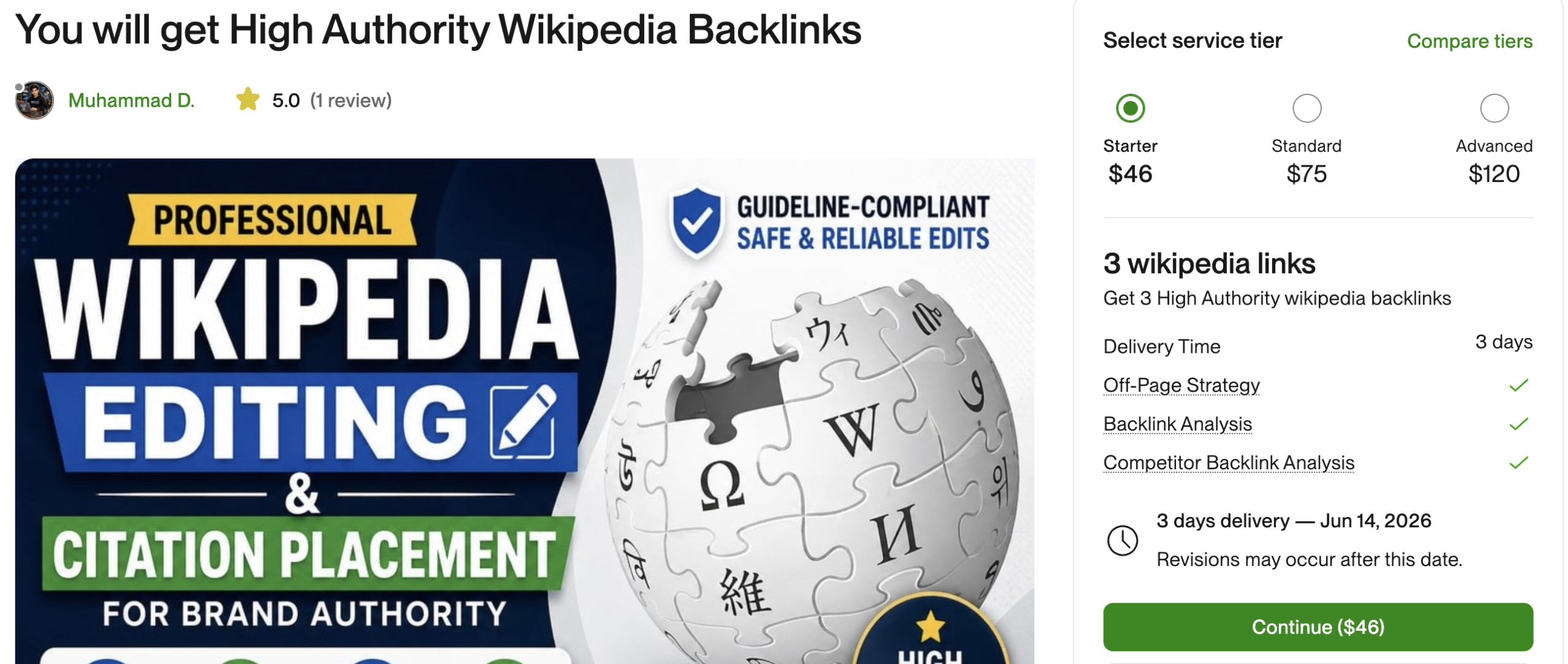
Others were ludicrously priced, like Wikipedia Page Creation Service, which wanted $300 for a consultation and $4,000 for a Wiki page ALONE.
Here are the results of our Wikipedia backlink pricing study:
| Provider | Price |
| Provider 1 | $25 |
| Provider 2 | $40 |
| Provider 3 | $40 |
| Provider 4 | $100 |
| Provider 5 | $100-$125 |
| Provider 6 | $99-$160 |
| Provider 7 | $150 |
| Provider 8 | $149-$499 |
Wikipedia Backlink Pricing Summary
| Metric | Value |
| Lowest Price Found | $25 |
| Highest Price Found | $499 |
| Most Common Price Range | $90-$150 |
| Estimated Median Price | ~$100 |
| Estimated Average Price | ~$110-$120 |
Pricing by Service Type
| Service Type | Typical Price |
| Budget Providers | $25-$75 |
| Standard Providers | $90-$150 |
| Premium Providers | $150-$500 |
| Wikipedia Article Creation | $300-$4,000+ |
TL;DR: I’d be wary of cheap citations, and avoid anyone charging hundreds of dollars for a link. Page creation is very valuable, but only when part of a broader strategy. Try testing out cheaper, reputable services first and see the results. If it’s only $40, give it a go. What do you have to lose?
What Type of URLs Do Wiki Moderators Accept?
Just for quick reference, I’d like to walk you through the different types of articles that mods tend to accept and ones that get taken down quickly or replaced.
Keep these types of content in mind when pitching your content or creating new linkbait posts.
Commonly Accepted for Citation
These tend to survive the longest:
- Original research
- Industry surveys
- Statistics pages
- Market reports
- Government data
- Academic papers
- Educational resources
- Technical documentation
Commonly Rejected for Citation
I’d avoid linking to these except in very rare circumstances.
- Product pages
- Service pages
- Home pages
- Sales pages
- Landing pages
- eCommerce pages
- Affiliate articles
- Lead generation pages
- Promotional content
- Press releases
How to Create Content That Wiki Editors Accept
There’s no “right way” to create content that gets cited. That’s just not how it works.
However, based on my experience in the SEO industry, several types of content and/or strategies get you cited more frequently by Wiki editors (and don’t get removed by moody mods).
Just to show you how random articles can generate citations, here’s a great example where HubSpot wrote a news story about their former office building that ended up generating a Wiki mention:
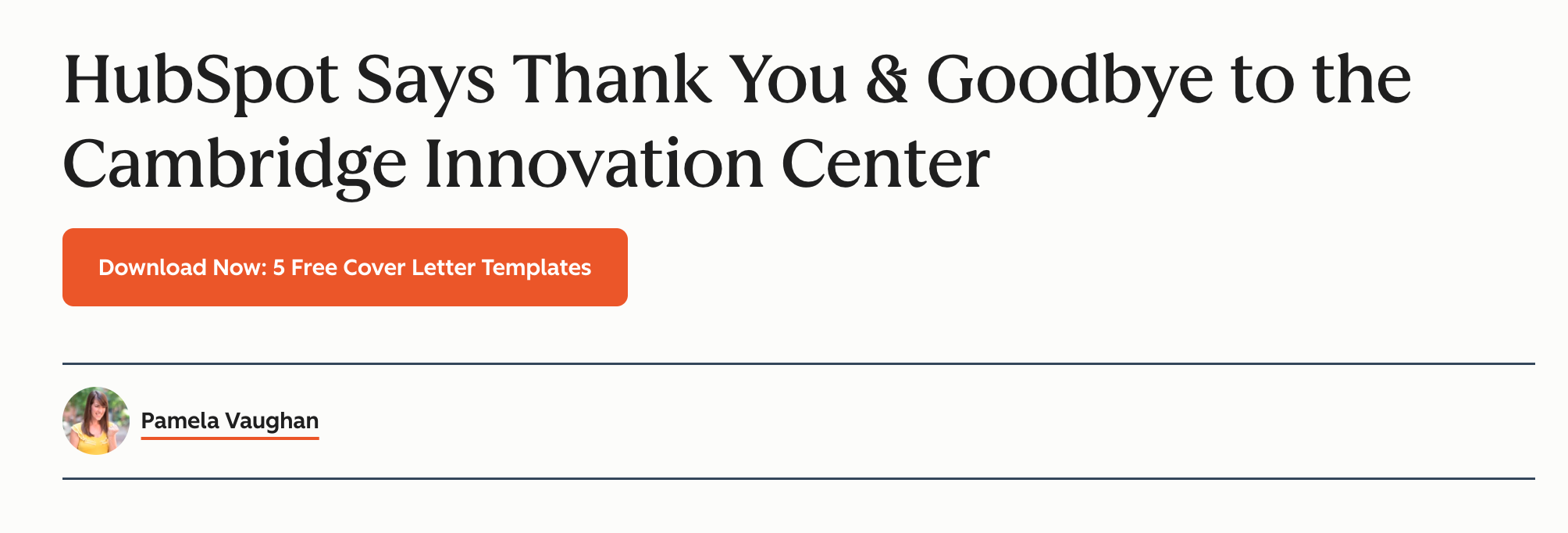
And here it is on the CIC’s page:
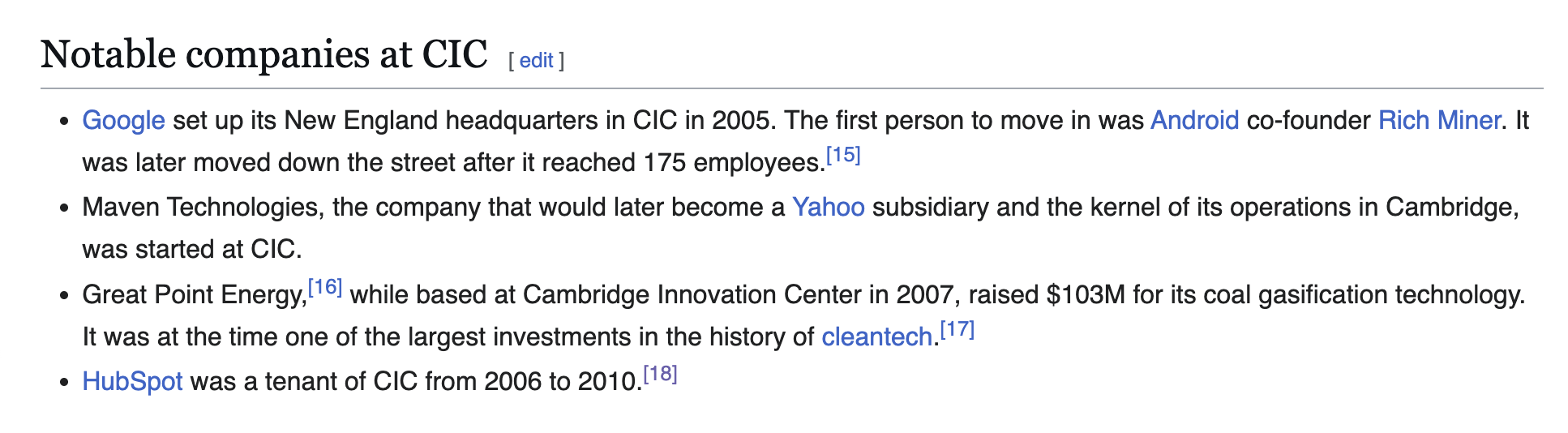
Pretty wild!
The most common types of posts cited on Wikipedia are news, studies, and books. There’s no definitive data on this, but I just know from doing this for nearly 20 years. In general, content that’s good for editorial links is also good for Wikipedia.
Here are the best types of sources Wikipedia actually accepts:
- News: News articles may be the most common type of citation. The world moves fast these days. Keep your blog up to date and write about things happening in your industry, famous people, or even well known landmarks in your city (see the HubSpot link above…).
- Original Statistics: These are prime candidates for a citation. If you don’t believe me, scroll up and take a look at the social media stats page from 2014 that’s still live.
- Industry Reports: Look at any B2B, SaaS, AI, or basically any other business related Wiki article, and you’ll see the citations list littered with industry reports. Don’t believe me? Google this: wikipedia.org “Gartner Magic Quadrant” citation. Now, look how many times they’ve been cited.
- Digital PR: Digital PR backlinks work on two fronts: One, it earns you widespread recognition, which is enough to help you get your own page. And two, it increases the chances of you getting cited. Wiki editors love major publications almost as much as Google does.
How to Add Your Links to Wikipedia
You know how to find link opportunities, and you know which types of content you need to create. If you’ve read this entire article closely, you’ll also know whether or not you want to buy links or not.
Now, let me walk you through how to add links to Wikipedia step by step. Don’t worry, it’s really easy.
Create Your Wiki Account
Start by creating a free Wikipedia account.
You can technically edit without one, but using an account helps you build editing history and looks less spammy.
Go to Create Account in the top right corner:
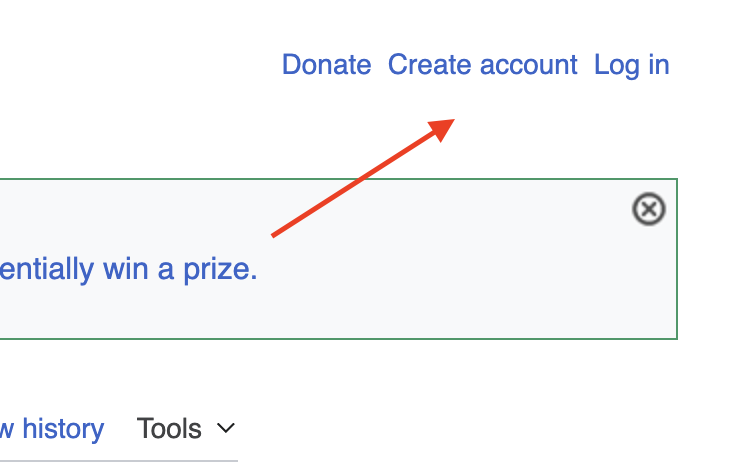
Pro Tip: Before adding any links, make a few basic edits first, like fixing typos or adding neutral sources. Only add your sources after “warming up” your account.
How to Edit an Article
Go to the Wikipedia article you want to update and click Edit or Edit source. Here’s what it looks like:
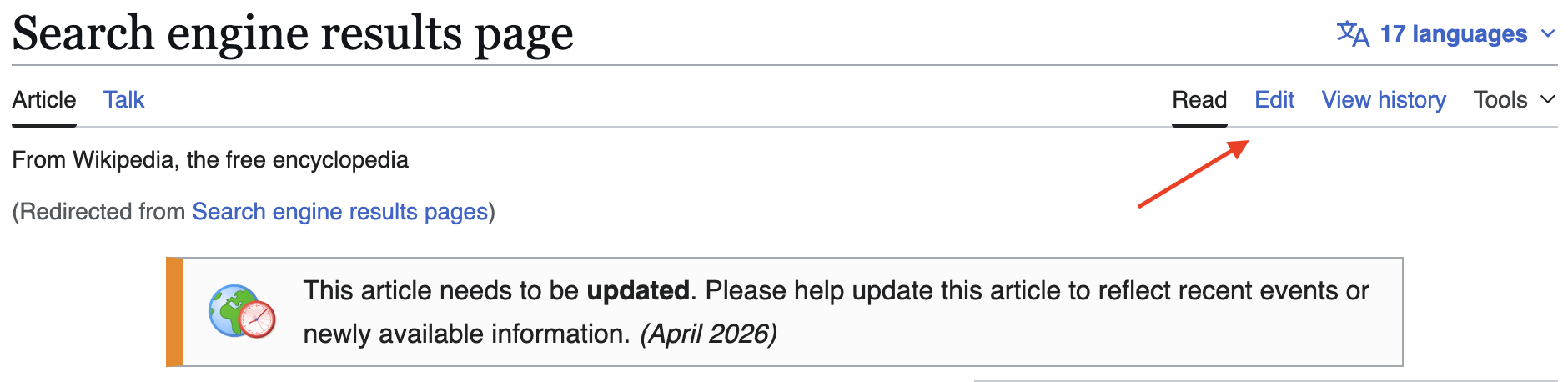
Just use the visual editor. It’s way easier.
Find the exact sentence or claim your source supports. Don’t add your link randomly. The citation should directly verify the statement being made. Here’s how to do that…
Add Your Citation
To add your citation, click the citation tool, paste your URL, and let Wikipedia generate the reference.
You can find statements that need a citation by using the visual editor. It looks like this:
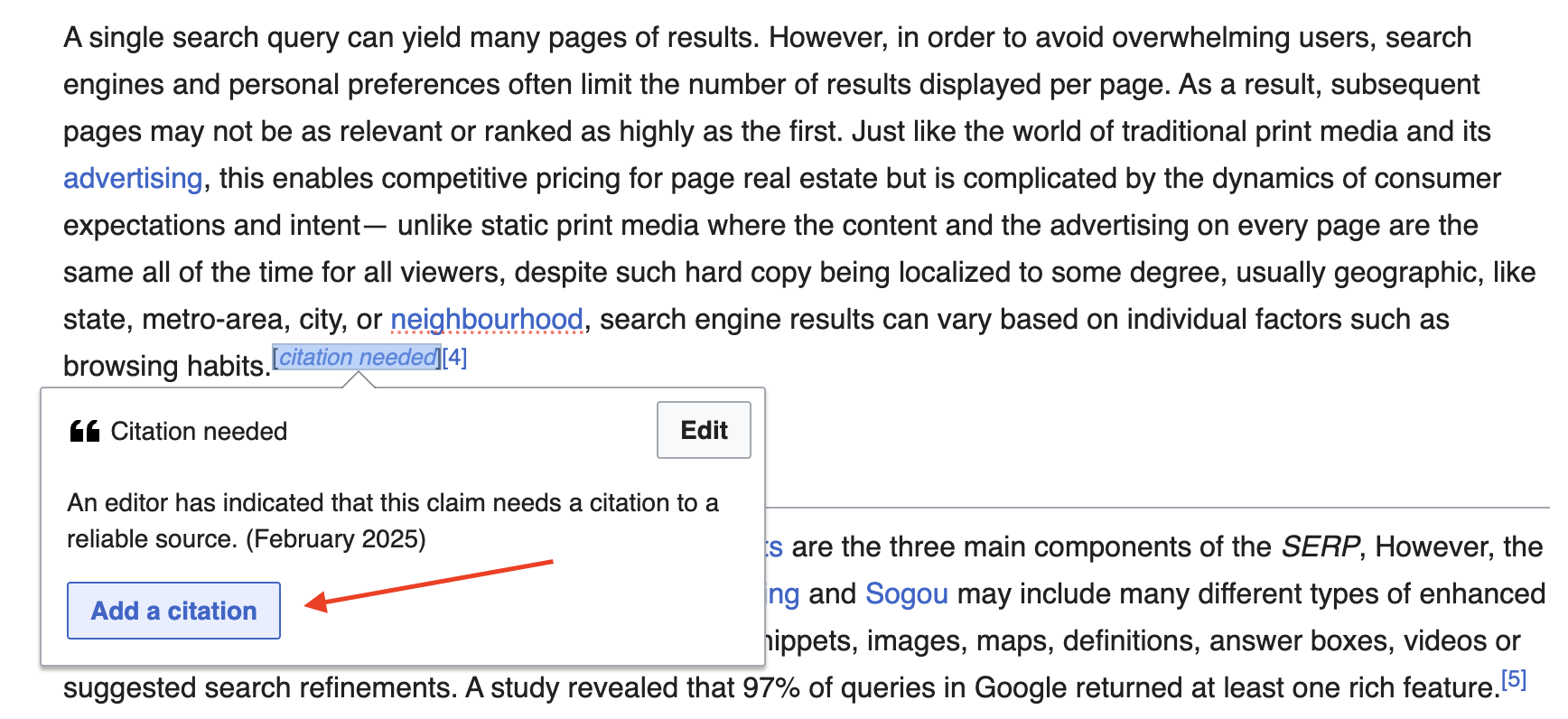
Check that the title, publisher, date, and author are correct. Your source should be informational, neutral, and relevant: not a product page, sales page, or thin blog post.
Double Check Your Link
Before publishing, reread the section and ask whether your link genuinely improves the article. Then add a short edit summary explaining what you changed, such as “updated citation with newer industry data.” After publishing, monitor the page to see whether the edit sticks.
Final Thoughts
I’ll leave you with something I tell every client who asks me about Wikipedia backlinks: they’re extremely valuable, but only when part of a broader link building and entity validation strategy.
Is a single Wiki citation valuable? Yes, in many ways it is. But is it worth spending weeks chasing one or thousands of dollars for a single citation? Probably not.
I’ve seen a single high authority PR link to a home page bring more value than a Wiki citation.
I’ll leave you with this…
If you have genuinely useful research, statistics, or educational content that improves a relevant article, go after it. A well-placed Wikipedia citation can strengthen your brand, reinforce topical authority, and expose your content to others who may link to it later.
But don’t obsess over getting a single link. You’re better off spending the money on PR placements or other forms of editorial links.
At the end of the day, Google rewards authority, relevance, and trust. Wikipedia can absolutely play a role in that strategy, but so can high-quality niche edits, guest posts, digital PR campaigns, and other types of links.
As always, I urge you to think about the bigger picture instead of looking for a magic link that will solve your SEO problems.
Good luck.