Managing your backlinks properly is the #1 competitive advantage in SEO today.
In 2026, you can buy backlinks for a reasonable price very quickly on marketplaces like PressWhizz. And there’s no shortage of link farms or “professional link builder” spammers, either. Anyone in SEO knows that.
Buying high quality, safe links that improve SEO rankings has never been easier. Now, the game isn’t about how many links you have. It’s who manages their links the best. That means:
- Who gets the most value for their money
- Who builds the best quality links
- Who builds backlinks most efficiently
- Who keeps their site the healthiest and minimizes risk
That’s why I’ve created this complete guide to managing your backlink profile. We are going deeper than “just buy high DR links.” Today, we’re going to cover everything about your link profile in painstaking detail.
I’m going to walk you through the basics of backlink management, then we’ll move on to how to audit your site, how to build new links, and how to monitor your site long term. And finally, we’ll wrap up with some of my top tools for link building.
What is Backlink Management?
Backlink management is the process of tracking, analyzing, and maintaining the links pointing to your site from other websites. The reason SEOs do this is because it enhances their search engine rankings, improves ROI, and reduces risk.
Essentially, you’re keeping tabs on the links you have, where they came from, how much traffic they are bringing in (and at what cost), and whether they’re helping or hurting your rankings. As an SEO, you need to manage your link profile for a number of reasons, such as:
- Bad links can hurt your rankings
- Broken links could be hurting you, too (or at the very least are low hanging fruit)
- To keep up with competitors
- To manage the overall health of your website
- To avoid penalties
- To optimize your link building campaigns
Every SEO knows that backlinks are basically a full-time job.
You’re constantly building new ones, auditing the ones you already have, chasing down broken links, and disavowing toxic links.
There’s a lot that goes into this SEO discipline.
Here’s what falls under the backlink management umbrella:
- Building new backlinks through outreach, content, and partnerships
- Monitoring your profile for new links (good and bad)
- Identifying and disavowing toxic or spammy links
- Reclaiming lost or broken backlinks
- Tracking competitor backlink profiles
- Managing anchor text distribution
- Auditing existing links for relevance and authority
- Responding to negative SEO attacks
- Keeping records of your link building campaigns and outreach
And yes, you’re going to need tools to help you with this. My team and I at PressWhizz use Ahrefs and a few other niche specific tools. I’ll cover all that toward the end.
Why is Backlink Management Important?
Backlink management is important because links are still one of the top three ranking factors in Google’s algorithm. They always have been, and that’s not changing anytime soon (despite what Google and white hat fanboys say). Backlinks from trustworthy, relevant sites pass “link juice” to yours and act as votes of confidence to Google that boost you up in the search results.
Most SEOs remember when Gary Illyes, an analyst at Google, blatantly lied about how Google sees backlinks. According to SearchEngineJournal.com, he said, “We need very few links to rank pages… Over the years, we’ve made links less important.”
This was tweeted by Patrick Stox back in 2024.
White hats ate it up, but anyone who actually works in search engine optimization for a living knew it was a blatant lie.
Backlinks are important for SEO. VERY important. Mission critical.
But here’s the thing: Getting links has never been easier. All you need to do is go to a link marketplace (I know a really good one…) and you can get all the links that money can buy.
Imagine that you’re a hiking website that wants to buy backlinks. All you’d have to do is go to PressWhizz, add your keyword, filter by location, and set a minimum domain rating (a website’s authority with Google), and you’d get hundreds of easy backlink opportunities:
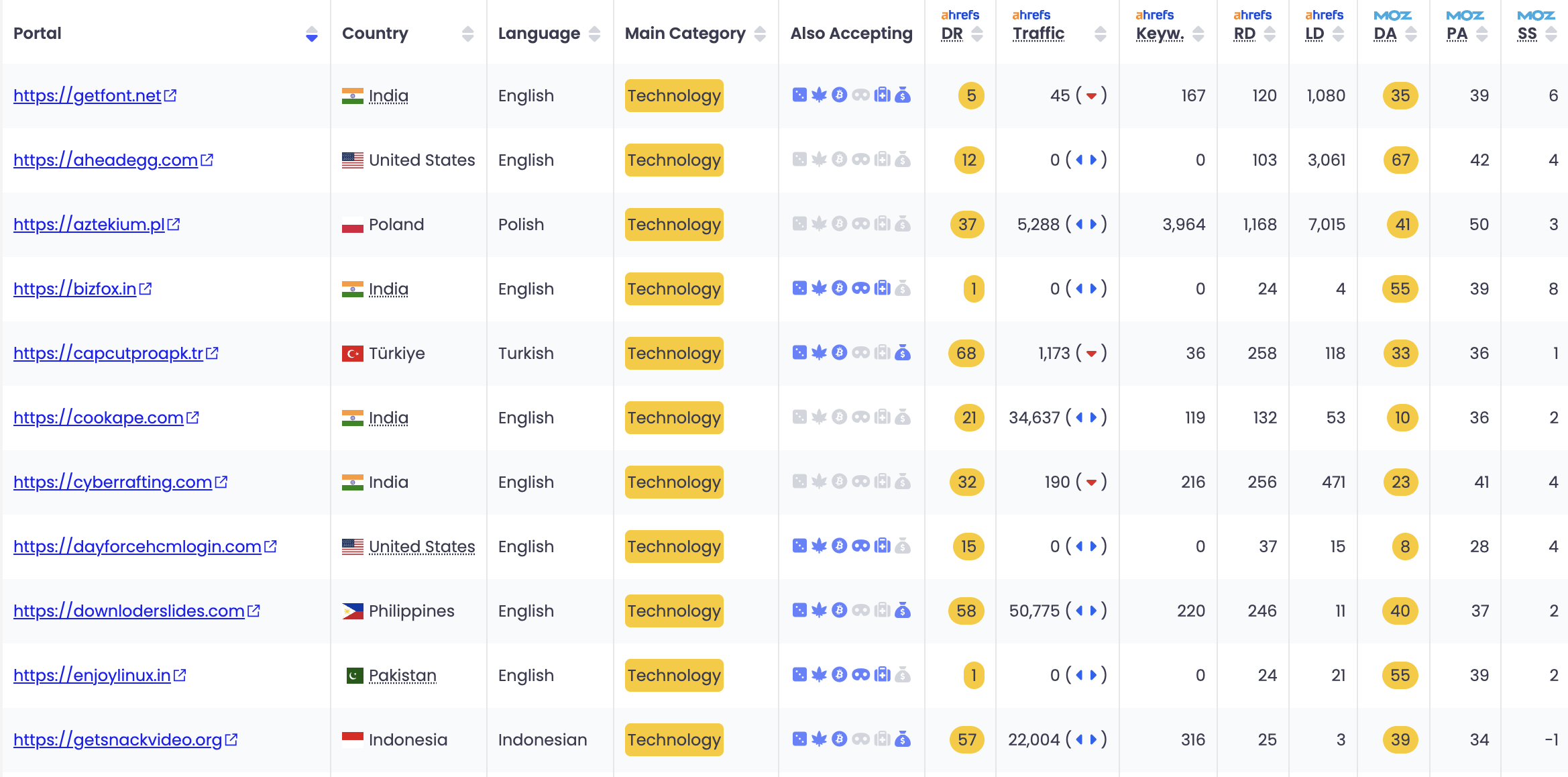
It’s ludicrously easy to buy links now. The real advantage isn’t just acquiring them anymore; it’s managing them better than your competition.
Think about it this way…
If your competitors are building new links, improving the quality of their existing profile, and cleaning out anything that could hurt them, they’re going to outrank you. Plain and simple.
Another issue here is that some sites have tens of thousands, if not hundreds of thousands or millions of backlinks. Here’s a screenshot of Backlinko’s backlink profile:
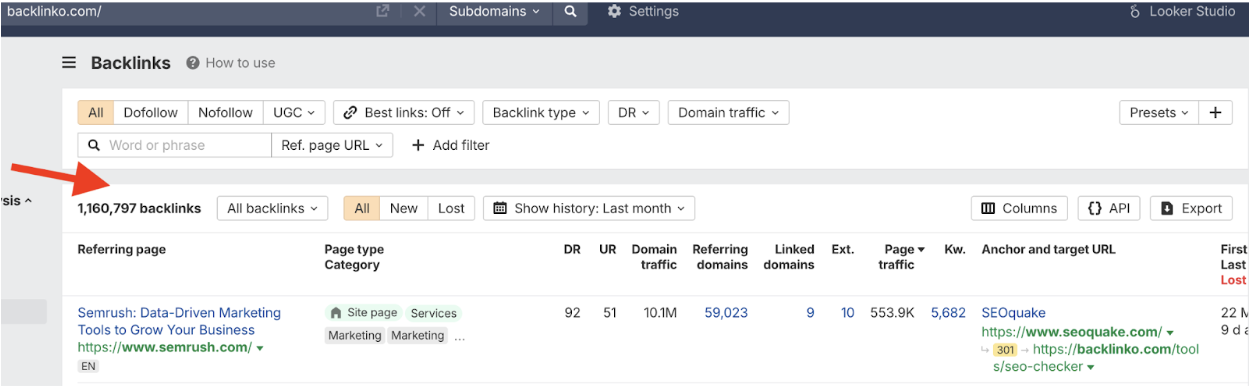
1.1 million links. With that many links, some will inevitably get broken, others might get lost, some might need to be disavowed, etc. If nobody is watching, the site might even lose rankings.
Link Building Management Key Terms
Before we go any further, let me define a few key terms that might be new to you:
- Toxic Links: Links from spammy, irrelevant, or low quality sites that can hurt your rankings. They include links from link farms, adult sites, or anything that looks manipulative to Google or other search engines.
- Disavow: Google’s way of letting you say “ignore this link.” You upload a disavow file through Google Search Console, and Google stops counting those links against you. There is debate on whether or not this is still a necessary SEO strategy, but it’s worth doing for now.
- Link Juice: SEO slang for the ranking power a link passes from one site to another. A link from the New York Times passes a lot more of it than a link from a random blog with zero traffic.
- PageRank: Google’s original algorithm for measuring a page’s authority based on how many links point to it.
- Domain Rating (DR): This is Ahrefs’ metric for measuring the strength of a site’s backlink profile on a scale of 0-100. It’s not a Google metric, but most SEOs use it as a quick gut check on link quality.
- Referring Domains: The number of unique websites linking to you. One site linking to you 100 times counts as one referring domain.
- Anchor Text: The clickable text used in a hyperlink. Over optimizing this (like using “best SEO agency” as your anchor 50 times) is a red flag to Google. I have a complete guide on anchor text that I think you should read, by the way.
13 Tips For Managing Your Backlink Profile
OK, now that you know the basics, let’s get into some tips on how to manage your backlink profile. For simplicity’s sake, I’ve divided these tips into 3 categories: managing links, acquiring new links, and some long term strategies I think everyone should know.
Managing Your Current Links
First up, we’re going to talk about managing the links you already have. I like to start here because most SEOs skip straight to building new links when their existing profile needs attention first. I’ve seen sites get serious ranking jumps just from cleaning up and optimizing what they already had…no new links needed.
#1) Run an Audit
First things first, you need to run an audit on your current link profile. There are two things I recommend doing here.
One, you can manually audit criteria like link “spaminess” by entering your domain in Ahrefs and looking to the left under Backlink Profile.
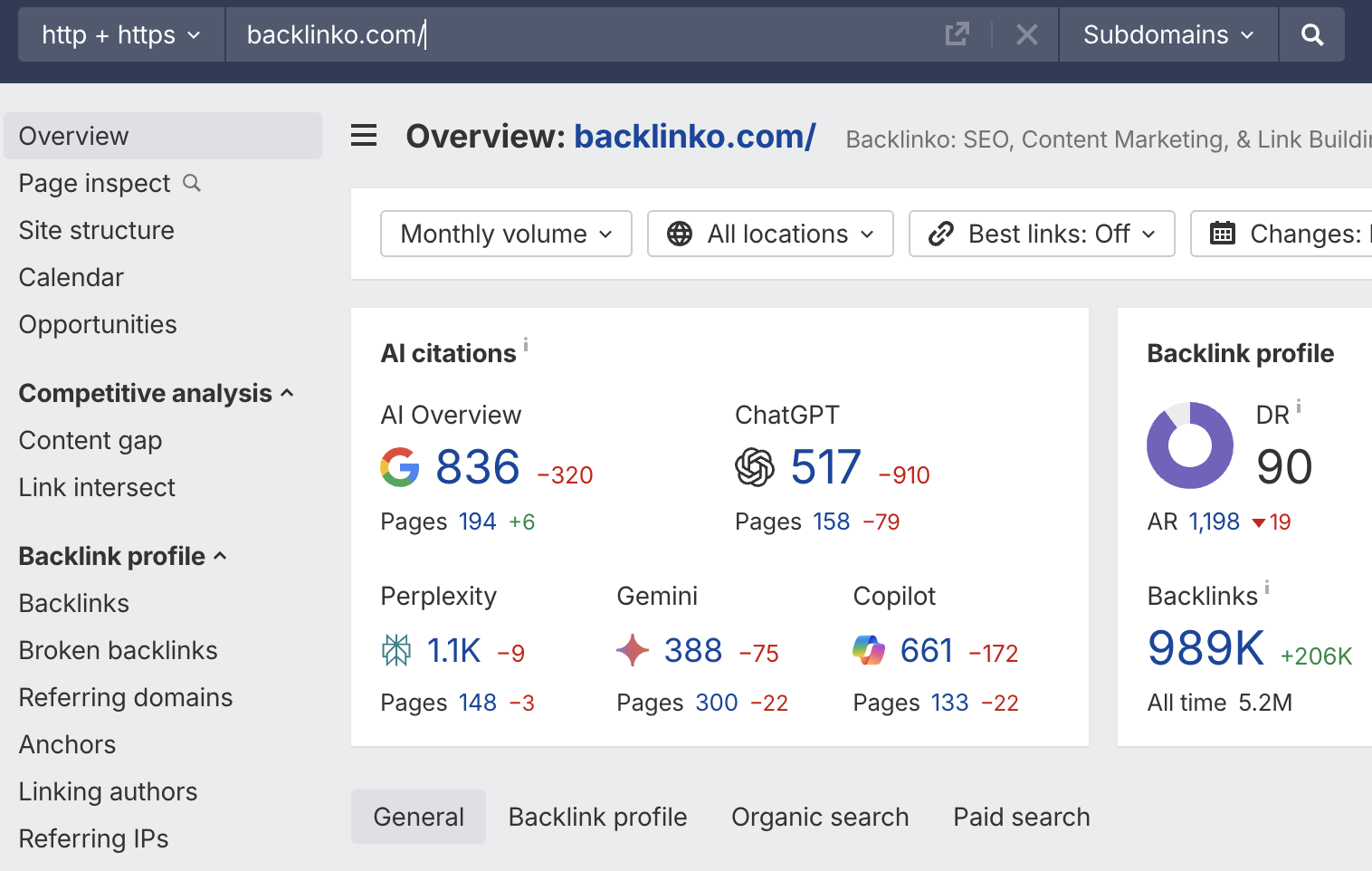
I hope Brian Dean doesn’t care that I’m using his site (thanks, Brian).
We’ll come back to this later. Here’s the other thing I want you to do…
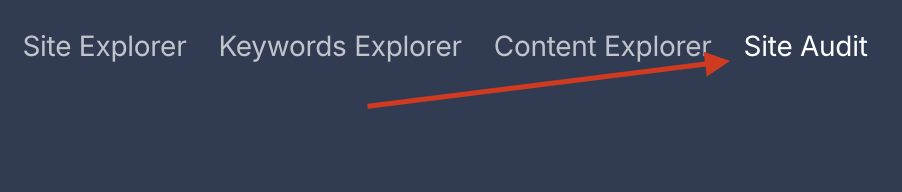
Go to Ahrefs and click Site Audit in the top right corner.
Then click New Project.
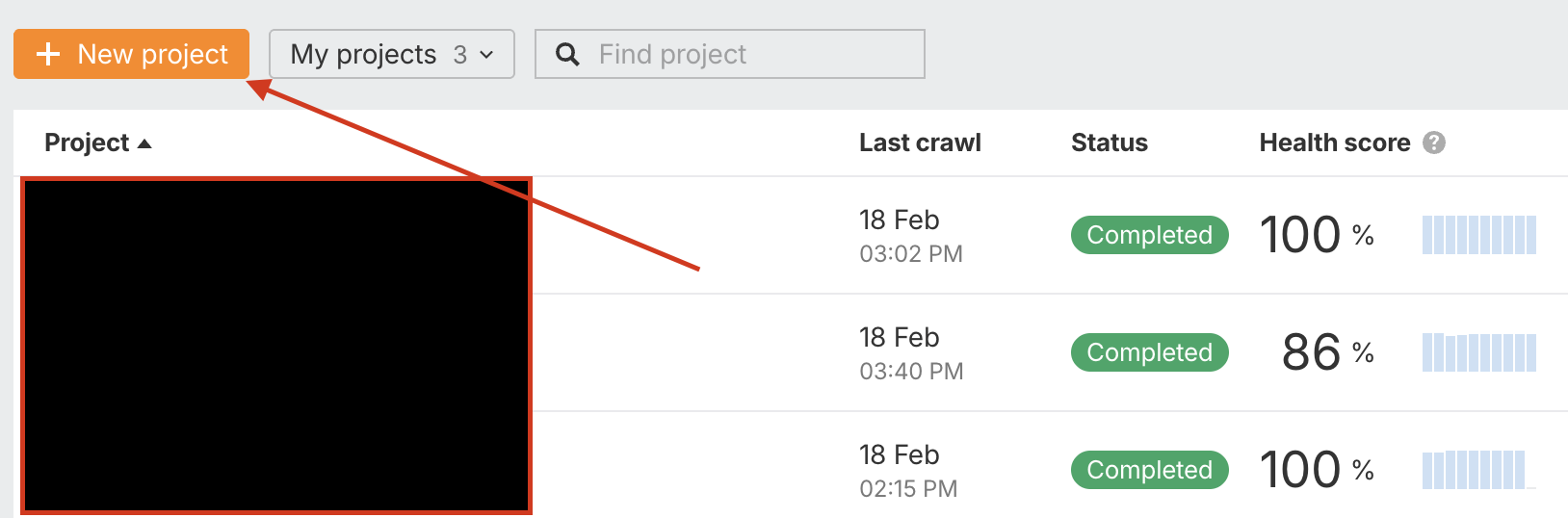
From there, you just enter your website and verify ownership in Google Search Console, and you’re ready to audit.
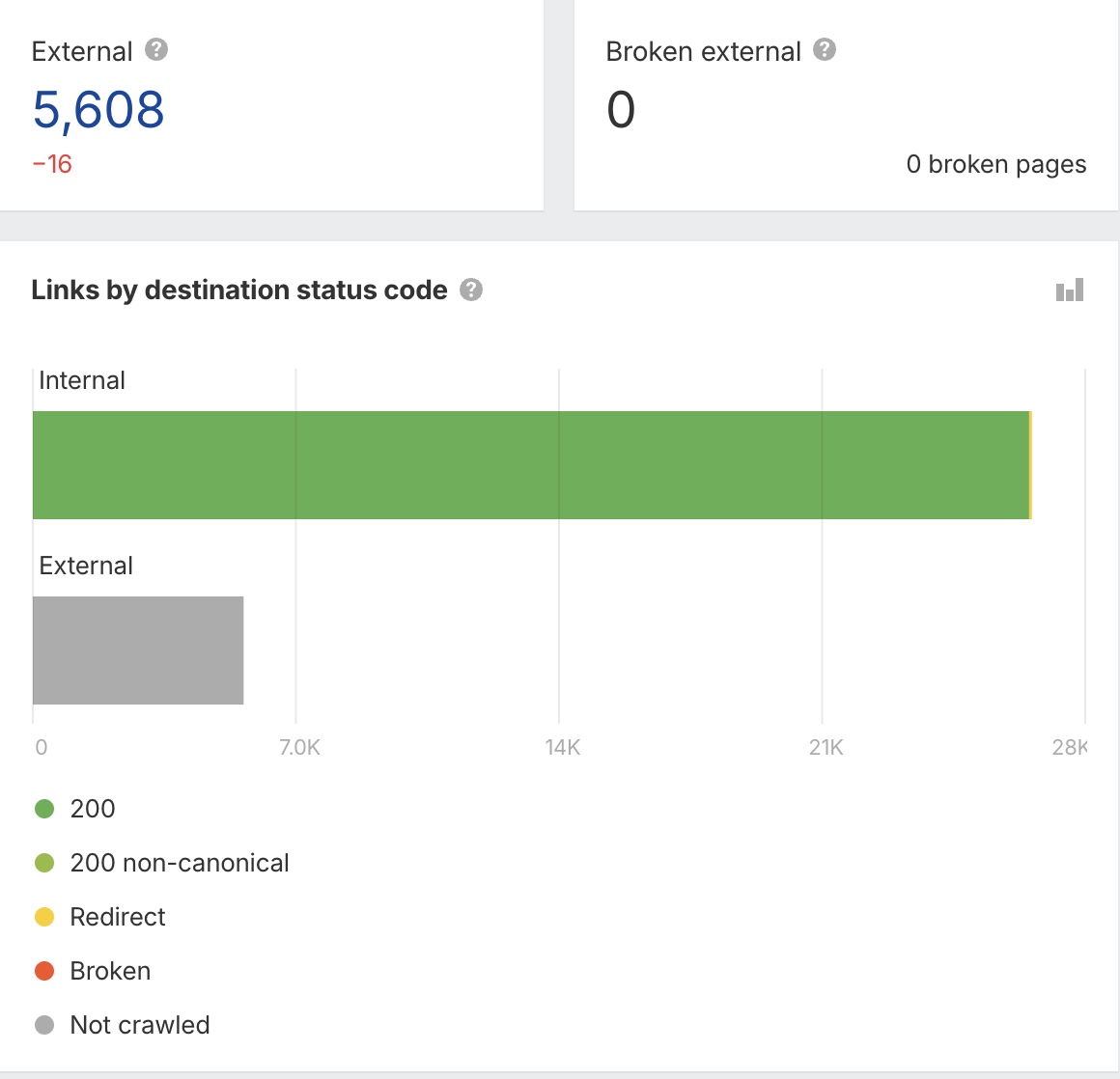
Once this is ready, you can see a ton of helpful data right from the Ahrefs Links report:
OK, now that you’ve run the audit, let’s cover the things you need to check to manage your backlinks properly.
#2) Check Referring Traffic
The first thing I recommend you do is to check referral traffic from current links.
Here’s why.
Links from other sites naturally pass traffic to yours. People arrive at that site, see your link, click it, and come to your site. That’s pretty straightforward.
But this has a major added SEO benefit. When people click links from other sites and arrive at your site, that signals to Google that you are a relevant, high quality site.
We know this because the Google algo leak back in March 2024 confirmed that site relevance matters for links. So, as an indirect factor, traffic from these relevant sites is great for your search engine optimization.
I recommend you go to Reports > Acquisition > Traffic in Google Analytics and search for “referral” or change the primary dimension to “Session source/medium” to see specific domains.
Why Do This?
- See which link partnerships bring the most traffic
- See underperforming links and stop buying them
- Acquire more external links from high leverage partners
- Stop wasting money on useless links
#3) No Follow vs. Do Follow Ratio
Next, we’re going to look at your do follow vs. no follow links ratio.
Do follow links are the main type of link you should be after. They pass link juice from one site to yours and are a direct ranking signal to Google.
No follow links don’t pass that same authority, but they still matter. They drive referral traffic, build brand visibility, and, most importantly, they make your profile look natural.
A site with 100% do follow links is a red flag to Google, because it looks like someone engineered it from a spreadsheet. Which is kind of true. A “real” link profile would be a natural mix of do follows and no follows. If you have all do follow links, it looks like an SEO built it that way.
We recommend shooting for a 3:1 or maybe 4:1 ratio here. That’s the range where most healthy, naturally built profiles land.
To check yours in Ahrefs, go to Site Explorer, enter your domain, and open the Overview report. Then click Backlink Profile:
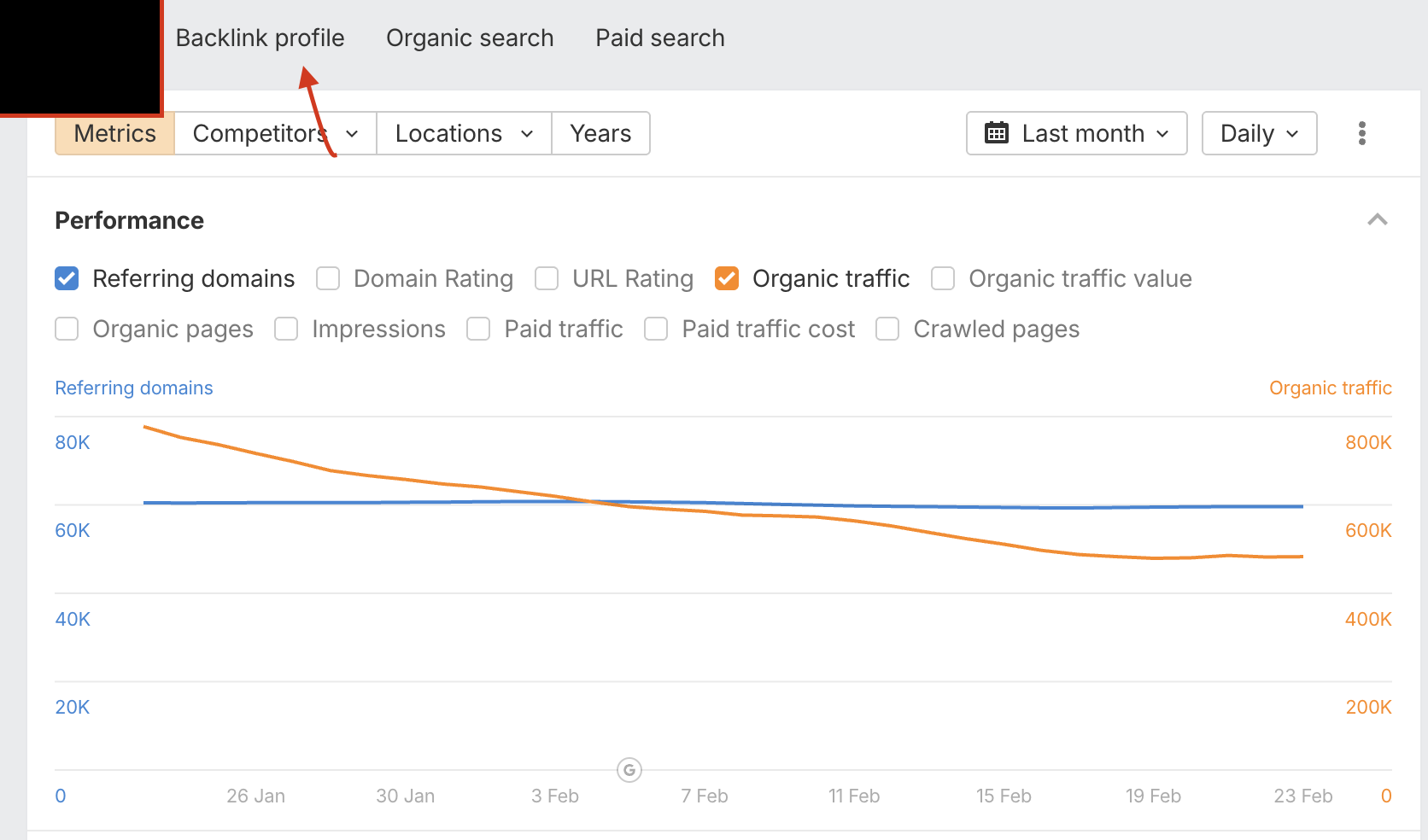
Then, on the right hand side, you’ll see the ratio of do follow vs no follow.
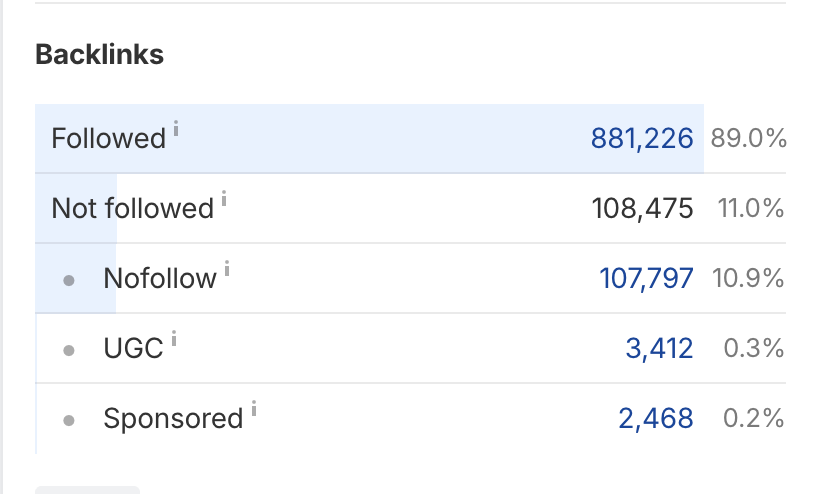
This is about 9:1, which is INSANE to me. But when you’re a DR 90 megasite, you can do whatever you want, apparently.
Here’s a smaller site with a more natural ratio (taken from the site audit feature):
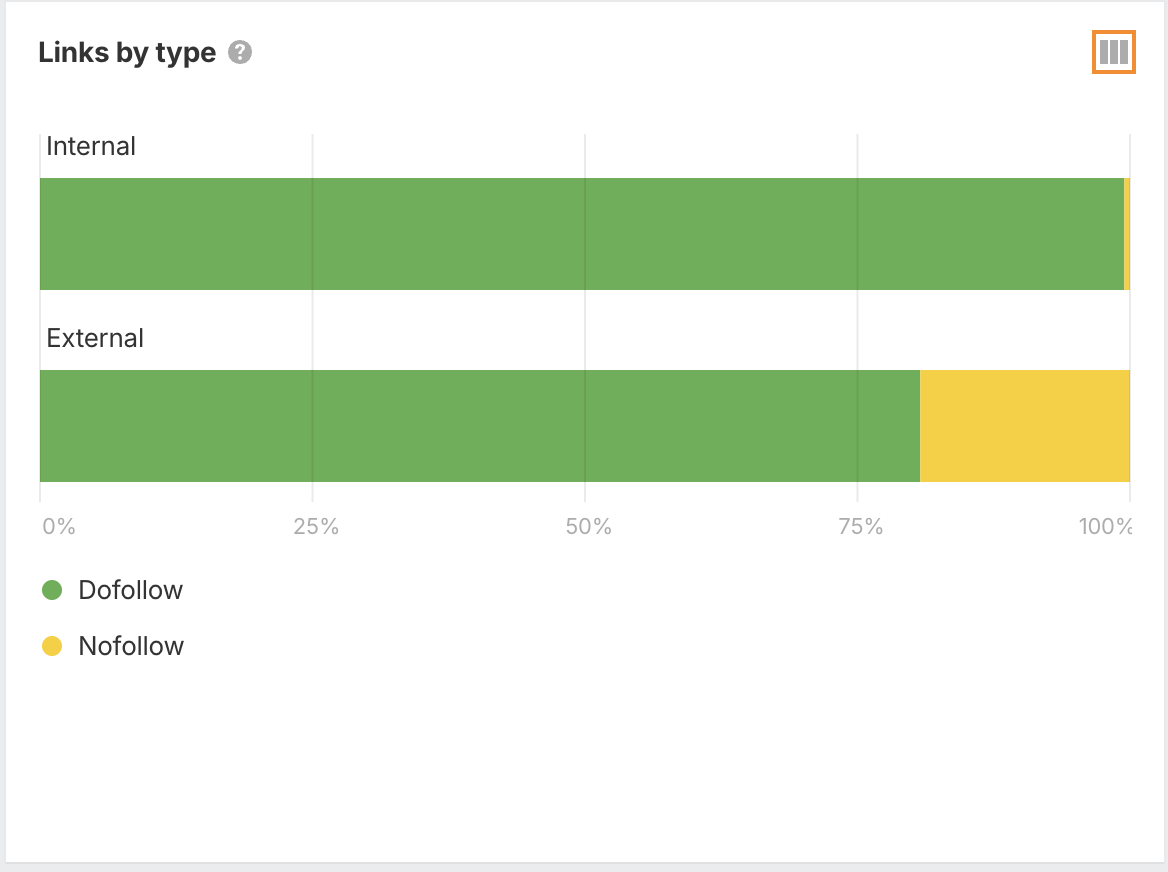
This is in that 4:1 range. If you’re a normal site and not Brian Dean, we recommend this.
#4) Check Link Velocity
This one is pretty simple. I recommend you check it to make sure you’re steadily building links naturally. In theory, a good website will steadily receive more links and organic traffic simply because it’s a good website (“just write helpful content, bro,” as Google says).
We know that in reality, this isn’t always the case. But still, you want to get a steady stream of links from reputable sites. An influx of spammy links or a sudden spike in links won’t help rankings and could result in a penalty.
Go to your site’s overview in Ahrefs and look at the number of links you’ve built divided by the number of months to get your link velocity:
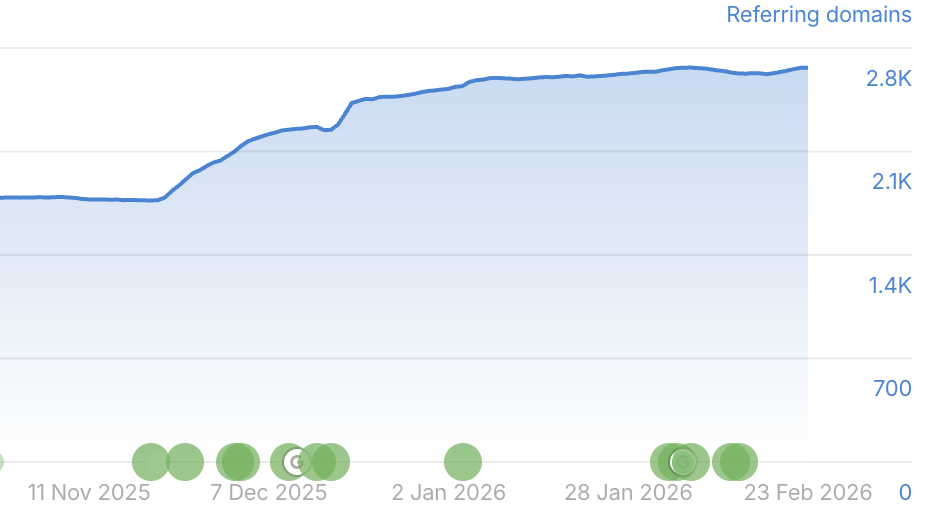
Here’s a site we’re working on that’s gained about 900 links over the past 6 months, or roughly 150 links per month. To be fair, it’s a huge site, so this might look aggressive, but it’s really not for a site of this size.
Pro Tip: Checking your link velocity is a great opportunity to benchmark yourself against competitors. If you’re building 10 links per month, that’s great. But if your competitors are all building 30, have fun on Page 2.
#5) Analyze Competitor Gaps (Link Intersect)
This one is a next level SEO hack that I love. It’s one of the best ways to identify high probability backlinking opportunities.
Instead of just checking “how many inbound links do I have vs. how many do my competitors have,” you plug your site into the Ahrefs Link Intersect tool and plug in 2-3 competitors, too.
Let’s do an example using Backlinko again. I’m going to find a small website that publishes similar content to Backlinko and plug it into Ahrefs, along with another large competitor, ProBlogger:
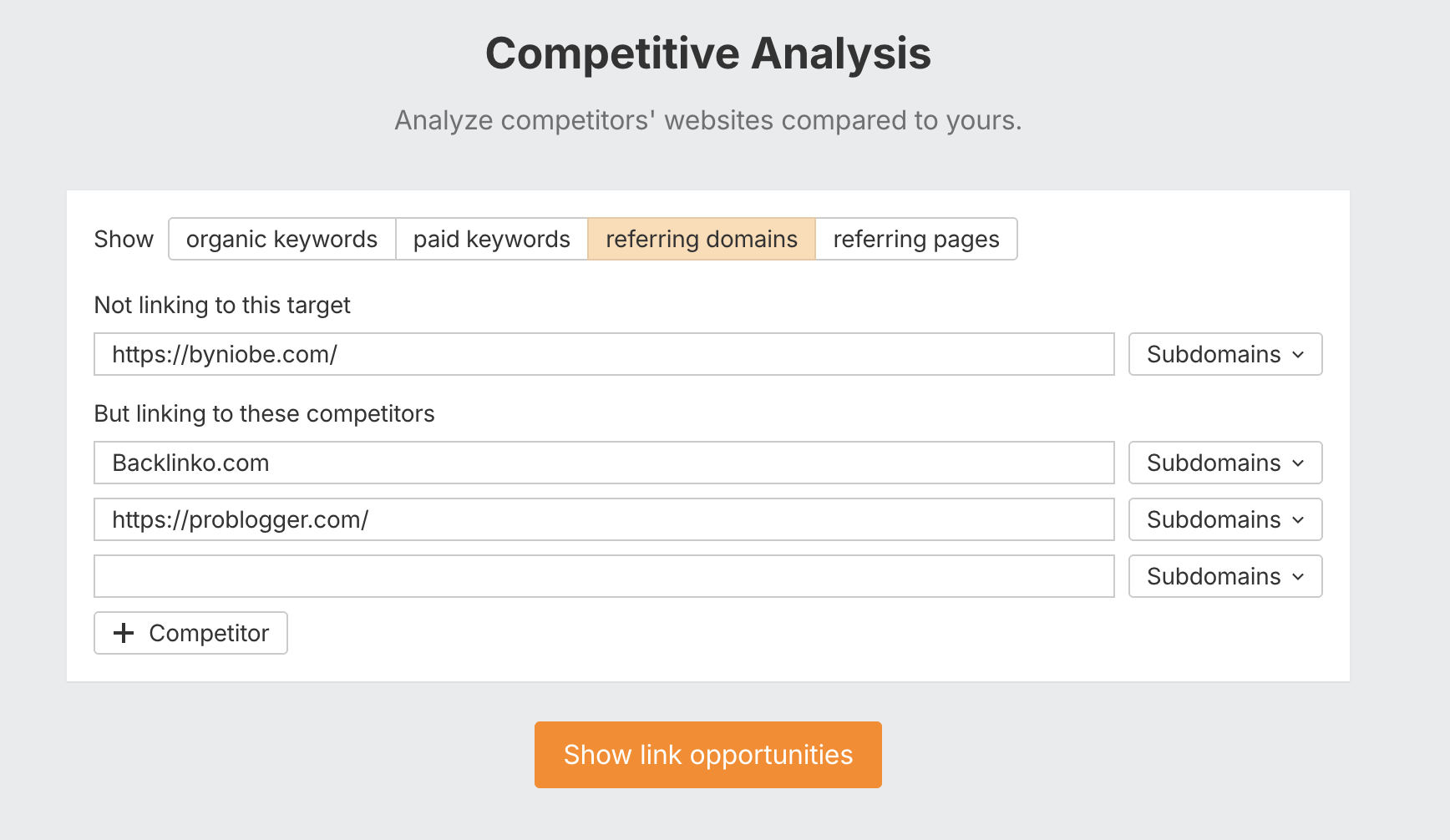
Then, filter by Not linking to target and Links to all competitors.
You’ll see a list of everyone who links to both of your competitors but not to you:
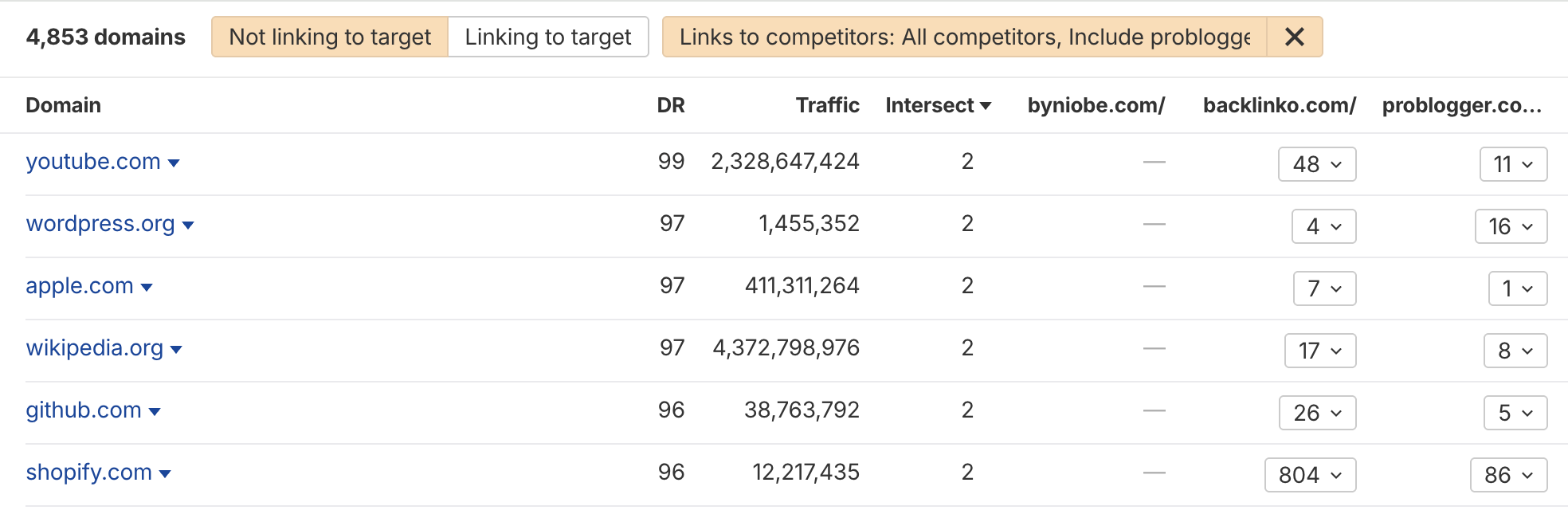
God speed, Byniobe.
Jokes aside, this is a great chance for Byniobe to see what we call “warm link opportunities.” If a site has linked to multiple other competitors in your niche, there’s a good chance they’re open for business.
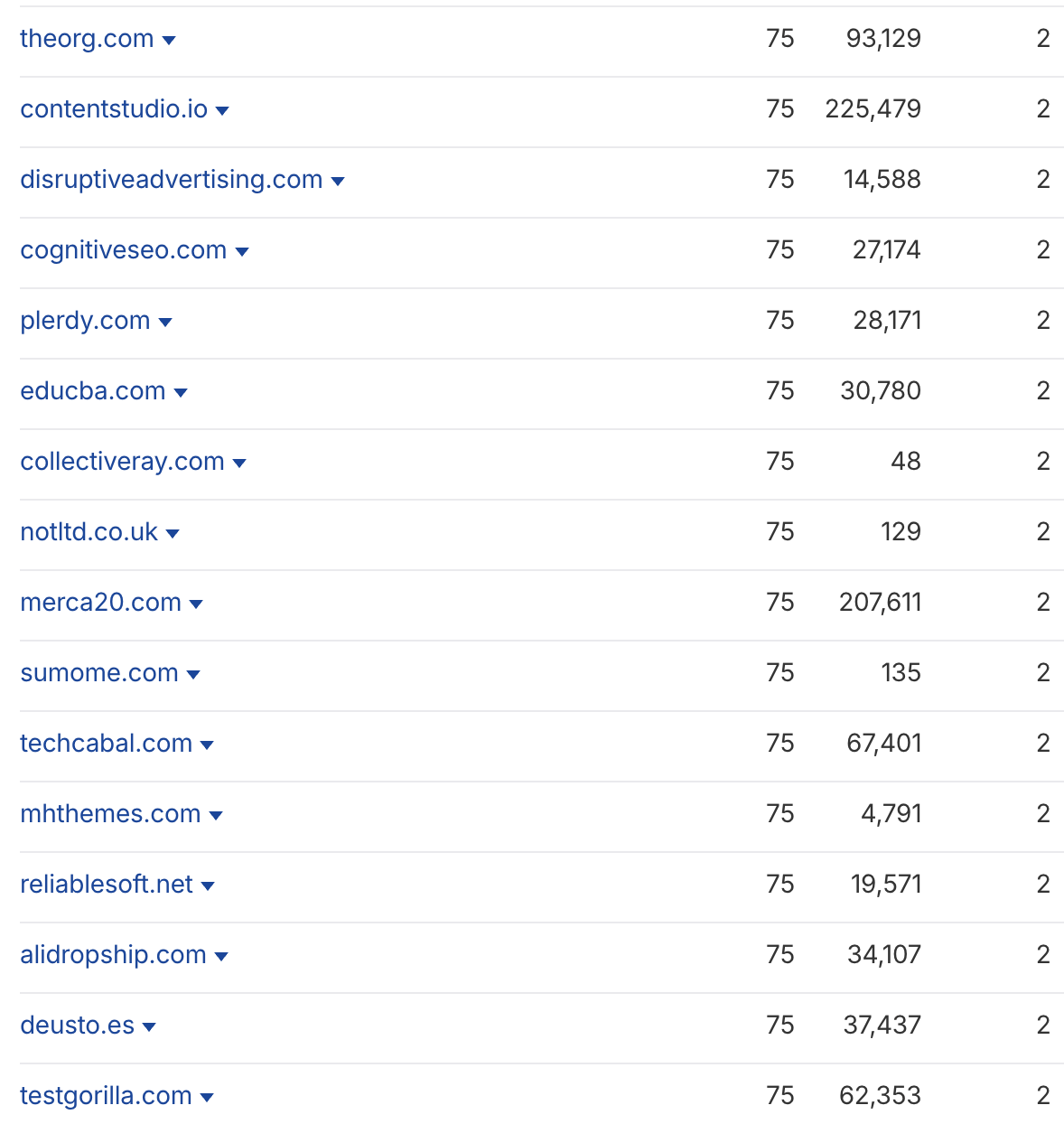
If I were the owner of this site, I’d look through the data and find some realistic targets in the DR 70 range with good organic traffic. That’s a good mix of not too expensive and still good enough to make a difference.
#6) Check for Broken Links
If you’ve been in SEO long enough, I don’t need to tell you what a broken link is. But just in case, it’s a hyperlink that points to a page that does not exist.
When running your audit, check for links (both internal and to other sites) that lead to nowhere. Dead links kill your UX, and a large number of them will send negative signals to Google.
This is one of the easiest wins in SEO. I don’t know why so many people don’t do it.
Here’s what to do…
Go back into Ahrefs’ Site Audit feature and click Links under Reports:
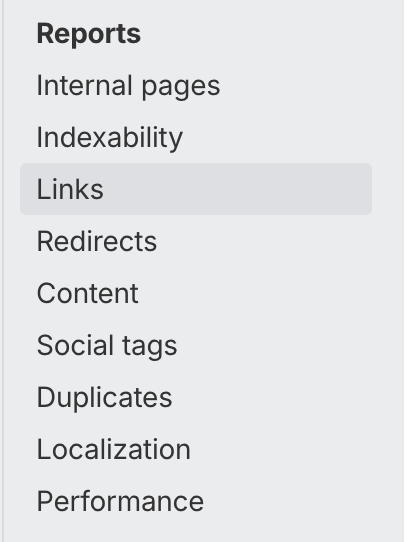
Then, Ahrefs will show you how many broken links you have and which ones to fix:

In about 15-20 minutes of work, you could drastically improve your user experience and maybe your rankings. It’s not that hard at all.
#7) Verify Your Anchor Text is the Right Ratio
Anchor text is the clickable words in a hyperlink. When a site links to you with the words “best SEO agency,” those three words are the anchor text.
Here’s an example…
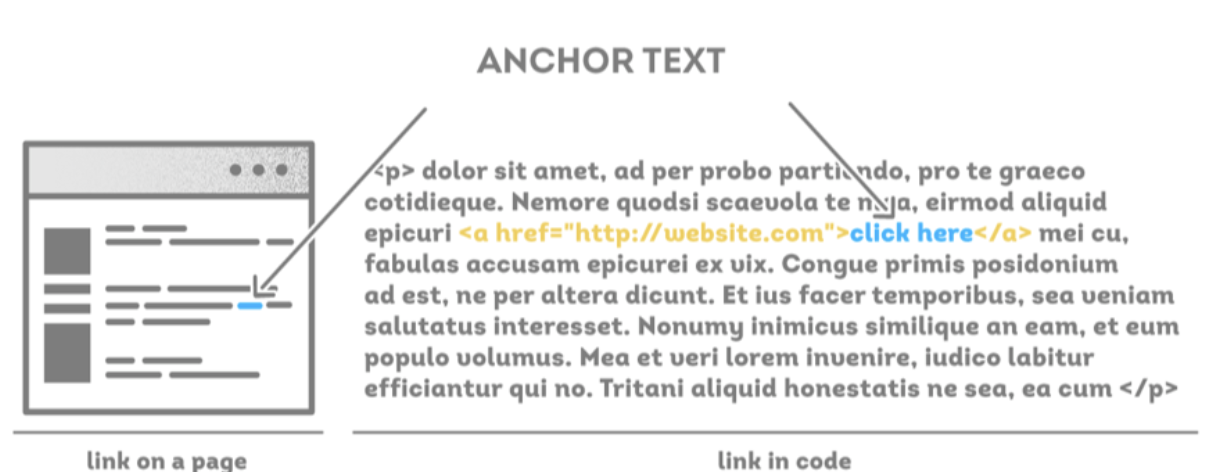
That blue text that says “click here” is the anchor text.
There are different types of anchor text, such as:
- Naked URL: The raw link itself is the anchor, like “www.yoursite.com” with no surrounding text.
- Branded: Uses your brand name as the anchor, like “PressWhizz” or “Nike.”
- Exact Match: The anchor is the exact keyword you’re trying to rank for, like “link building services.”
- Partial Match: A variation of your target keyword mixed with other words, like “affordable link building services for agencies.”
- Compound: Combines your brand with a keyword, like “PressWhizz link building.”
- Contextual: The anchor fits naturally into a sentence, like “according to this guide on effective backlink management”—it’s less about the keyword and more about how it reads in context.
Your goal is to build a natural looking anchor text profile that combines all of these different types of anchors.
In backlink management, anchor text ratio is the ratio of how much you use one type of anchor vs. another.
Now for some bad news…
There is no “ideal ratio” for anchor text. Every niche and every SERP is different. What works for a plumber in a small city won’t work for a large SaaS website with 500,000 visitors.
I can’t go into all of the science in just 200 words here, so I urge you to read my guide on anchor text, where I explain everything. Long story short, your anchor text should appear naturally varied. NOT like an SEO trying to manipulate rankings.
Bonus – Improve Your Internal Linking
Quick bonus here. Internal links matter for SEO, too. I once had a DR70+ client whose rankings were much worse than they should have been, and it was because dozens and dozens of pages on their site were orphan pages (pages that didn’t link to other pages on the site).
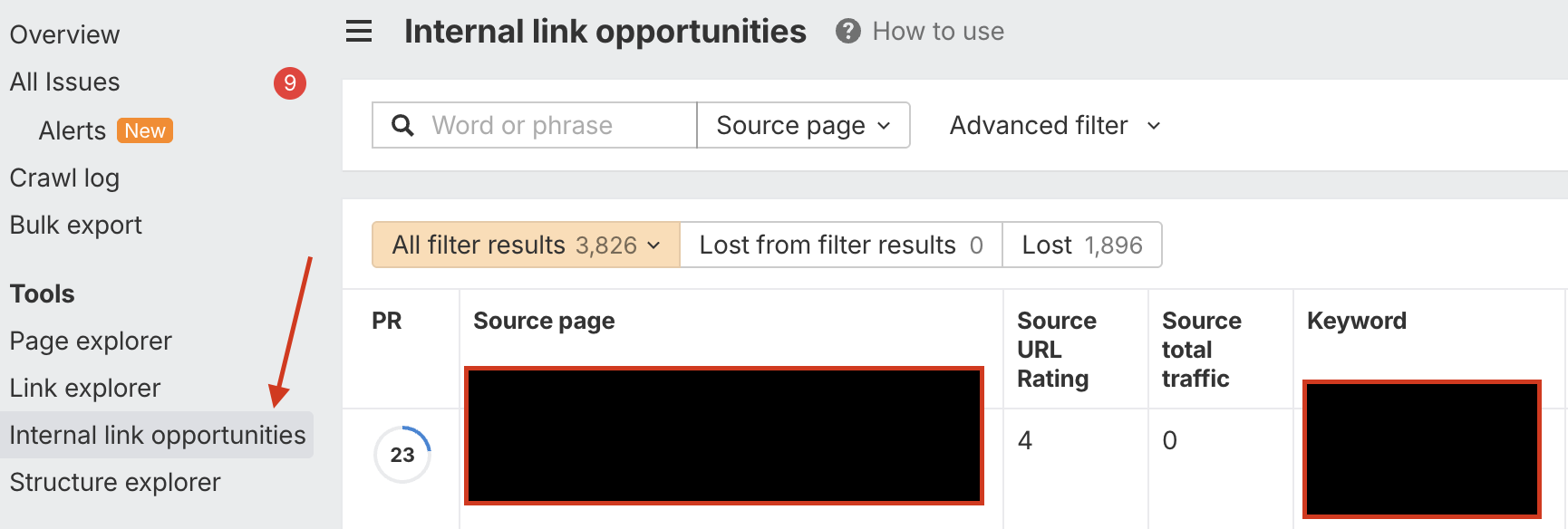
Once we fixed the internal linking, rankings climbed steadily in the coming weeks. If you did this yourself, it’d cost $0.Go to Ahrefs Site Audit again, click Internal Link Opportunities, and you’ll see a ton of helpful suggestions to pass more link juice around your site:
Acquiring New Links
Now that you’ve gotten control over your existing links, it’s time to start bringing in some new link juice.
Let’s build some links.
#8) Reacquire Lost Links
Lost links are backlinks that used to point to your site but have since disappeared. Don’t worry, it happens to everyone. Even massive sites like Backlinko have tons of lost links. This is one of the more annoying bits of link building.
Editors remove links during content updates, sites go through redesigns that break old URLs, or someone decides to swap your link out for a competitor’s without telling you. This is infuriating when you’ve paid for a link or done a swap.
But the good news is that getting them back is one of the easiest ways to “build new links.”
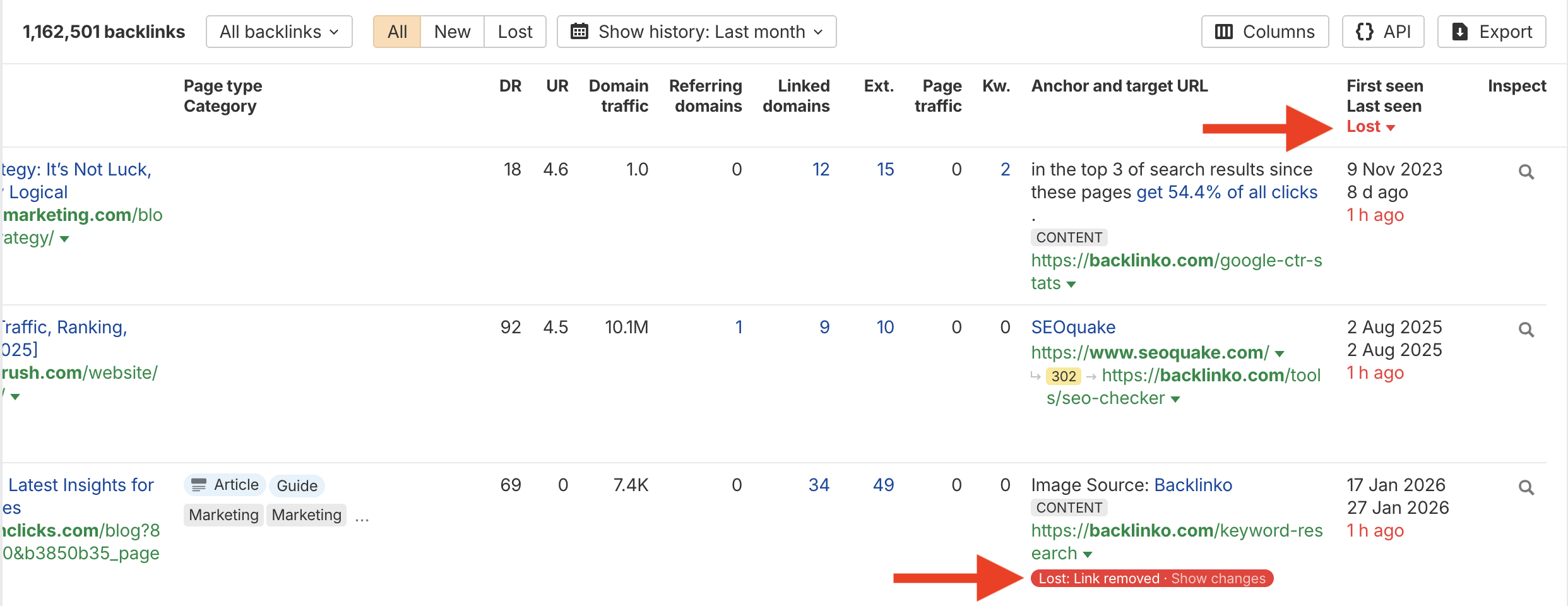
Open Ahrefs, go to Site Explorer, enter your domain, and click on the Backlinks report. Filter by Lost at the top. You’ll see every link that’s dropped off and when it happened. From there, reach out to the site owner and ask them to restore it.
#9) Claim Unlinked Mentions
Brand mentions are, believe it or not, when someone mentions your brand (wow). I suggest you reach out to sites that have mentioned you and ask them to link if they haven’t already. Here’s an example of a branded mention with a link:

It really doesn’t get any easier than this. The website has already mentioned you. All you need to do is use an SEO tool to find them, reach out politely, and ask them to link to you.
Warning: SEOs and site owners are greedier than ever before, so expect them to ask for something in return (certainly not payment – wink – that’s against Google’s rules).
Depending on the price, they’re worth it.
I know that many SEOs are saying, “mentions are the new backlinks.” While it’s true that mentions are super important for your search rankings, nothing beats a backlink to your site with branded anchor text. This is huge for EEAT, brand recognition, and trust with Google.
You can do this with the Ahrefs Content Explorer tool (I swear Ahrefs is NOT sponsoring this blog). Just search for your name (exclude your own domain), and filter by “highlight unlinked.”
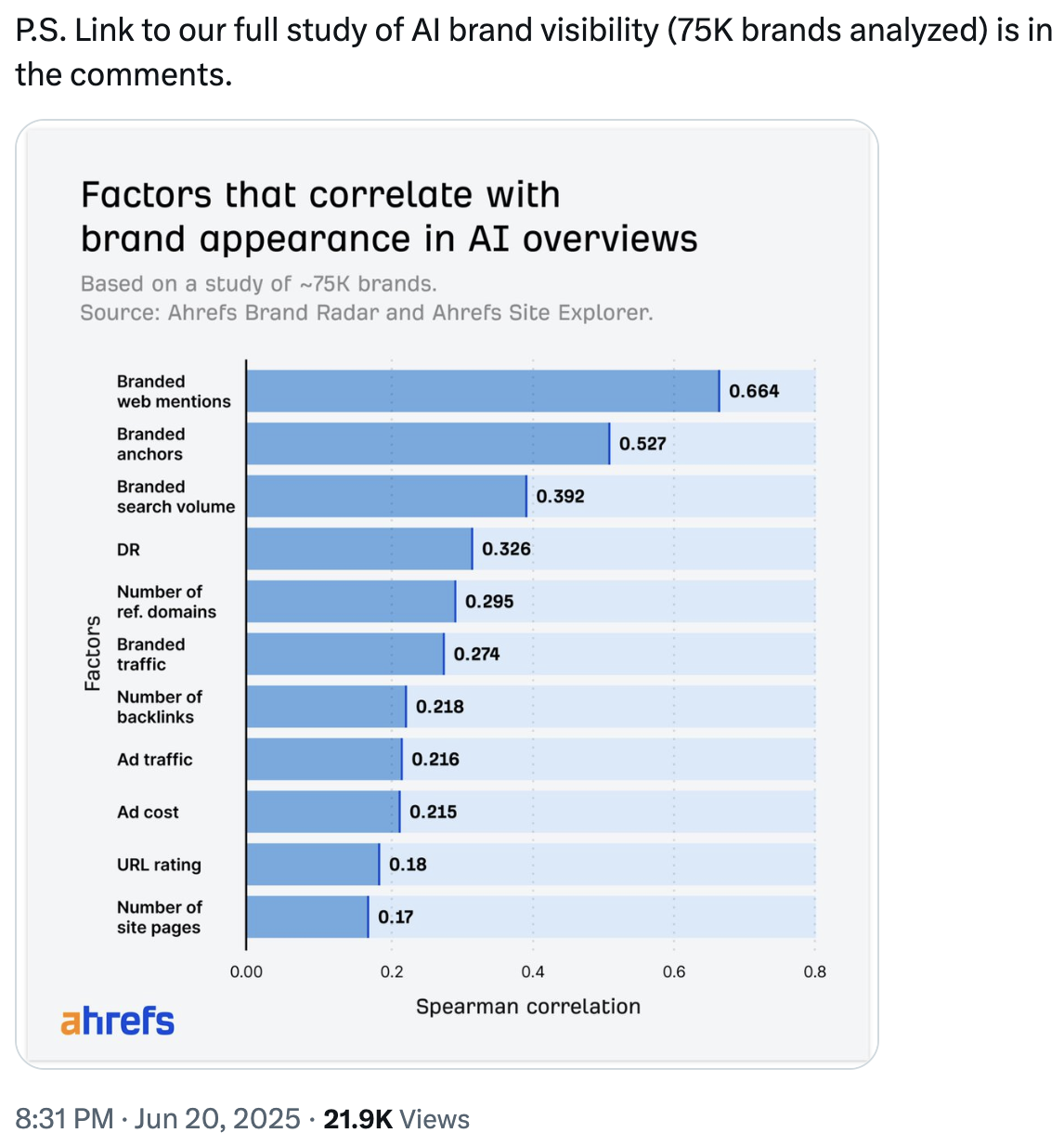
NOTE: Brand mentions are also super important for AI visibility these days, in case you’re interested. Here is a fascinating tweet from Mr. Ahrefs himself, Tim Suolo, on the importance of brand mentions for AI visibility.
#10) Begin Link Outreach
OK, you’ve got your current links under control and built/reclaimed the lowest hanging fruit.
Now, it’s time to start reaching out to high probability link leads.
Before you start blasting outreach emails for link acquisition, take a step back and look at what’s already working.
Go into Ahrefs and pull up your best performing pages by backlinks. Those are the types of new backlinks you should be building.
From there, I recommend crossing that with your competitor analysis. You already know which sites are linking to them, but not you.
That’s a great place to start. Use AI to make a list of all the possible link opportunities you have and start reaching out. You 100% should outsource this to a VA.
Here’s a good example of a link outreach email that’s worked for us:
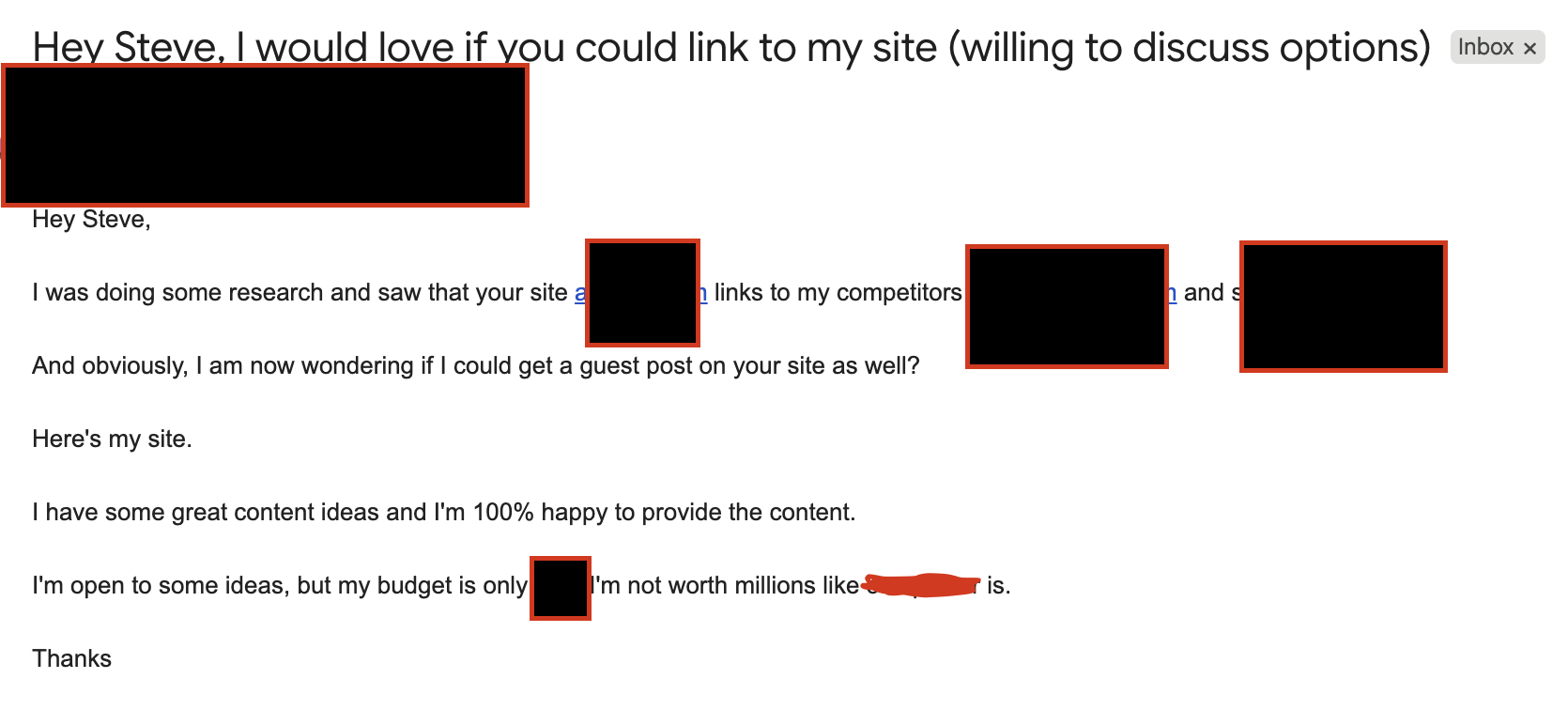
Don’t be cheeky or try any of those “hey, I was just browsing the internet and happened to see you” or “your name came up over coffee!” cringe methods, please. They’re beaten like a dead horse. Just be normal and direct.
#11) Start Building New Links – Our Top Link Building Strategies
By this point, you’re ready to build some new links to your site. I don’t know why, but I find this super exciting.
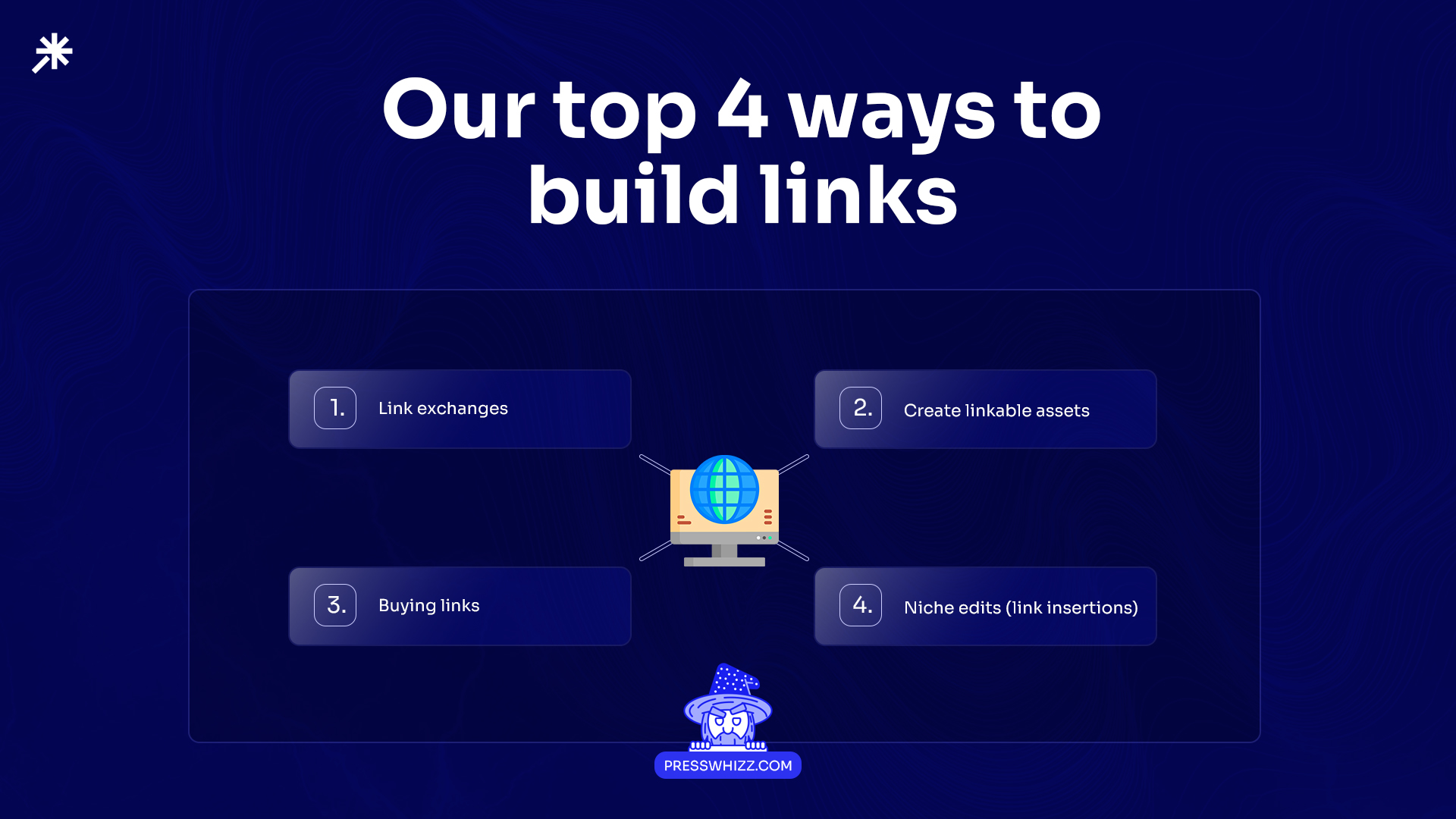
Here are my top methods:
Link exchange
A link exchange is when two sites agree to link to each other. Site A links to Site B, Site B links back to Site A. Simple as that.
It’s a quick and easy way to get a link, usually for free. You get a link. The other site gets a link too. Everyone’s happy.
You could either reach out to sites of similar authority or join an exchange community.
Say you run a project management tool, and you find a time tracking software company with a similar audience but no overlap in keywords. You reach out, suggest linking to each other’s tools in a relevant blog post, and both of you walk away with a quality link from a site Google actually sees as relevant and can send relevant, high converting traffic to you.
When to do this: Often, especially when you’re a new website just starting to build links or if you have a low budget. Link exchanges are a great way to get the ball rolling, but it gets harder as you move up to a higher DR.
Linkable assets
Old Faithful. Creating linkable assets is one of the most reliable ways you can attract links without doing much outreach.
A well researched stats post, an original survey, or a free tool in your niche can pull in dozens of links on its own. Think about it: Every time a blogger or journalist needs to cite a statistic, they need somewhere to link to. They’re most likely just going to Google their key terms and see which assets pop up.
If your page is there, you’re getting that link.
When to do this: I recommend having someone on your team creating these assets regularly and reaching out to potential link partners regularly as well.
Buying links
Let’s just get this out of the way. Buying links is the fastest and easiest way from A to B. You don’t have to do any outreach, and you’re guaranteed to get a high quality, vetted link from a real website…if you do it right.
I’m not saying you should go buy 100 links from Fiverr. But if you use marketplaces like PressWhizz, you gain access to thousands of trustworthy links. In the past year alone, we’ve built tens of thousands of links for our clients, and our database has 37,000+ curated websites. You don’t have to buy backlinks from me, though. You can read my ranking of the best places to buy backlinks and find anyone you want.
Link Insertions
Niche edits, also called link insertions, are when you pay to have your link inserted into an existing article that’s already live, indexed, and in many cases, already ranking on Google.
They’re generally cheaper than guest posts and faster to go live, with most placements happening within a few days of purchase.
The main advantage is that you’re building on a foundation (I hate this cliché) that already exists. The page is already ranking in Google, so you’re not starting from zero the way you would with a brand new piece of content. Instead, you’re plugging into authority that’s already been established.
BONUS…Guest Posting…
Yes, guest blogging still works these days.
Finding guest posting sites and writing blogs for them is still one of the most reliable ways to build high quality backlinks. The key is being selective. Target sites with real traffic and genuine audiences in your niche instead of just high DR scores. Once you find a viable partner, write something actually useful and place your link naturally in context. That’s all you need to do. This is another thing that PressWhizz makes simple and painless, by the way.
Long Term Backlink Monitoring
I hope you’re still with me. This has been a LONG article on link management. You’re almost in the clear. I know you’re probably excited that you’ve built a ton of valuable, new links. But there’s still one more step: setting up long term monitoring.
Let’s cover that in more detail:
#12) Set Up Link Monitoring
Set this up first. Don’t complain. Just do it.
Link monitoring is when you have a system that tells you when something changes in your backlink profile. Setting up link monitoring takes just a few minutes, and it shows you when new links come in or when you lose one (or when one gets broken).
Again, I just use Ahrefs.
Go into Site Explorer, set up email alerts for your domain, and it’ll ping you whenever you gain or lose a backlink. I run mine on daily alerts for any site I’m actively building. It takes two minutes to set up.
#13) Invest in Link Management Tools
Please tell me you aren’t running your entire link operation through spreadsheets. You need real link building tools to keep track of what’s coming in, what’s falling off, and what’s hurting you.
My team and I use Ahrefs, Google Search Console, and some other tools (depending on our needs) when we want a second opinion on link quality.
Link management tools help you:
- See your full backlink profile at any time
- Get alerts when you gain or lose links
- Catch spammy or toxic links before they become a problem
- Track competitor backlinks in one dashboard
- Analyze your anchor text distribution
- See how your profile has grown over time
What Are Backlink Management Tools?
Backlink management tools are software platforms that let you monitor, analyze, and manage the links pointing to your site. Instead of manually checking who’s linking to you, these tools pull all of that data together in one place and update it automatically. Ahrefs, Moz, Majestic, and Google Search Console are the most widely used ones.
Let’s cover some of my favorite link management software for SEO that I think your company should invest in before we finish up.
Bonus – Your Backlink Management Sheet
Even if you’re using backlink management tools, you should still be tracking everything in a spreadsheet. It doesn’t have to be fancy. Here’s a sample backlink management sheet you can use based on our internal sheets. It’s got everything you need ready to go.
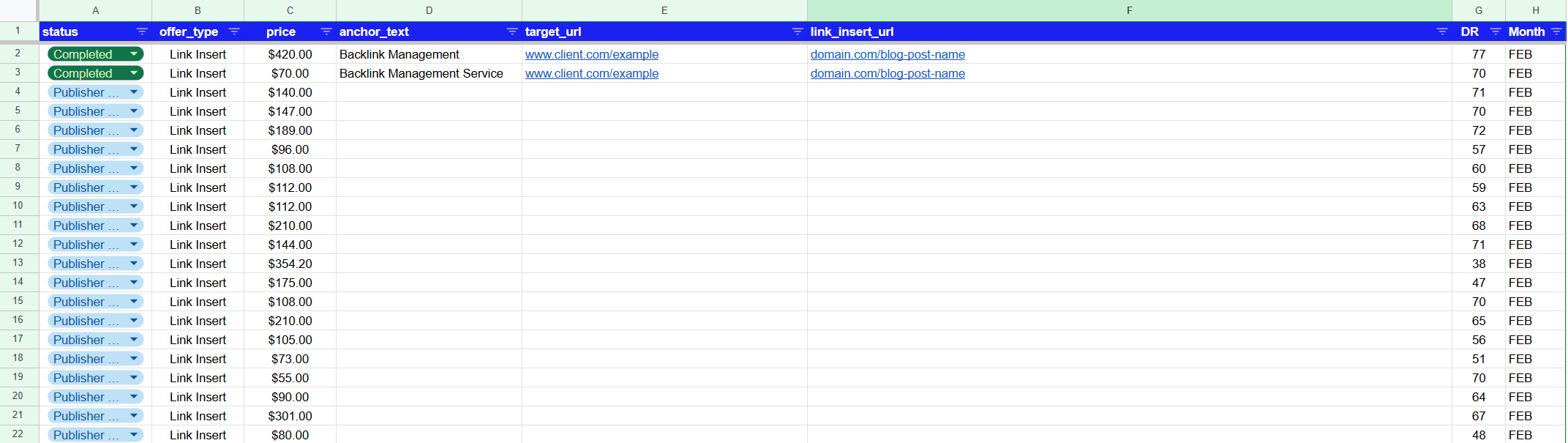
Join our newsletter to access the download.
Top 5 Link Management Tools
The best link management tools for SEO are PressWhizz, Ahrefs or SEMrush, BuzzStream, SEOJet, and Open Link Profiler. Let me elaborate more on each of them before we wrap up:
#1) PressWhizz – Buy High Quality Links Fast
Welcome to SEO in 2026, where everyone just ranks themselves #1 in their own product roundups.
Jokes aside, I’ve poured my heart and soul into PressWhizz over the last year or so. And personally, I’ve overseen thousands of link placements that have gotten great results for my customers. If you want to build high quality backlinks quickly and easily (it usually takes 18 hours or less for a link to go live), this is the marketplace for you.
PressWhizz is a link buying marketplace that gives you access to 37,000+ curated websites. You can filter by keyword, domain rating, and niche. You can even reverse engineer your competitors’ strategies and reach out to sites that link to them.
#2) Ahrefs

You don’t need me to tell you what Ahrefs is. It’s the godfather of all SEO tools. My team and I use it to monitor links, spy on competitors, and fix broken link issues. It’s not cheap, but for link management, it’s the best in the biz.
#3) Buzzstream
BuzzStream is an outreach tool that lets you build email lists fast, send emails at scale, track inbox activity, and measure the performance of outreach campaigns. If you’re doing mass outreach, this is the tool for you.
#4) OpenLinkProfiler
OpenLinkProfiler.org is a free backlink analysis tool you can use if you’re on a budget.
It’s limited, but you can use it to see where a site’s links are coming from, what anchor text they’re using, and which industries are doing the linking. It also lets you pull competitor backlink data, so you can see exactly who’s linking to them and figure out if those same sites are worth targeting for your own campaign.
#5) SEOJet
SEOJet is backlink management software with some pretty cool features like anchor text customization, competitor analysis, and potential link partners ranked for you. It’s also a great long term monitoring tool because it stays on top of your link profile for you. For example, if a link is no longer live, it’ll notify you.
The best thing about it? You get unlimited users, which is great for agencies. If anyone from your team needs to log in, they can, and you won’t jeopardize your subscription (looking at you, Ahrefs…).
Final Thoughts
I cannot stress to you enough how important it is to manage your link profile properly. Just think about all of the amazing SEO benefits of doing things the right way:
- More high quality links pointing to your site
- Higher ROI and lower wasted spend
- Less effort spent on getting links, because you find the right prospects to reach out to (or just focus on high ROI current vendors)
- Lower risk of penalties
In other words, more profit, better rankings, less waste, and lower risk of penalties. Who in SEO wouldn’t want that?
I’ll leave you with this advice…
Focus on gaining control of your current link profile first, and then move on to building new, high quality links from relevant sources. Once you’ve done that, set up monitoring and continuously track, evaluate, and tinker with your strategies.
It’s not enough to “just buy links” anymore in 2026. You need to step your game up. Those that do will get rewarded with high converting traffic from Google. Those who don’t will get left behind. Choose wisely.