Domain Rating (DR) and Domain Authority (DA) are third-party metrics that estimate a website’s backlink profile and authority. DR is Ahrefs’ measure of the strength of your backlink profile, whereas DA is Moz’s metric that estimates your site’s overall likelihood of ranking in Google.
They both run on a 0–100 scale, and you can’t have a conversation about SEO strategy without someone mentioning one of them within 60 seconds.
Let me clear up some confusion first…DR and DA aren’t Google metrics. They are ranking factors developed by Ahrefs (DR) and Moz (DA) respectively. But they still influence how most SEOs make decisions, especially when it comes to link building (where it’s grossly over relied on).
I want to say two things about DR and DA that might seem contradictory at first:
- DR and DA are massively overestimated by most SEOs, to the point where they ignore real ranking factors. Making decisions solely based on DR and DA is a bad idea.
- On the other hand, domain rating and domain authority are useful directional indicators, and they can make link prospecting much easier. I would never buy a link without checking both of these metrics.
It comes down to this: If you know what DR and DA measure and how to use them, they are incredibly helpful. If you base your SEO and link building decisions on “big number good, small number bad,” you’re going to overpay for links, miss high-impact opportunities, and build a backlink profile that looks impressive but does nothing for your rankings.
In this guide, I’m going to give you the truth about these two metrics based on my 17 years in the SEO business. The real truth – NOT what Google, white hat SEOs, or link scammers say. I’ll cover the difference between domain rating and domain authority, how each one is calculated, and how I use them when evaluating links and competitors.
What is Domain Rating?
Domain Rating is a 0-100 score for evaluating the strength of a website’s backlink profile that was developed by the SEO platform Ahrefs. It estimates your site’s ability to rank on Google search engine results pages (SERPs) based on the external links pointing to your site.
DR is NOT a Google metric. It is Ahrefs’ own metric.
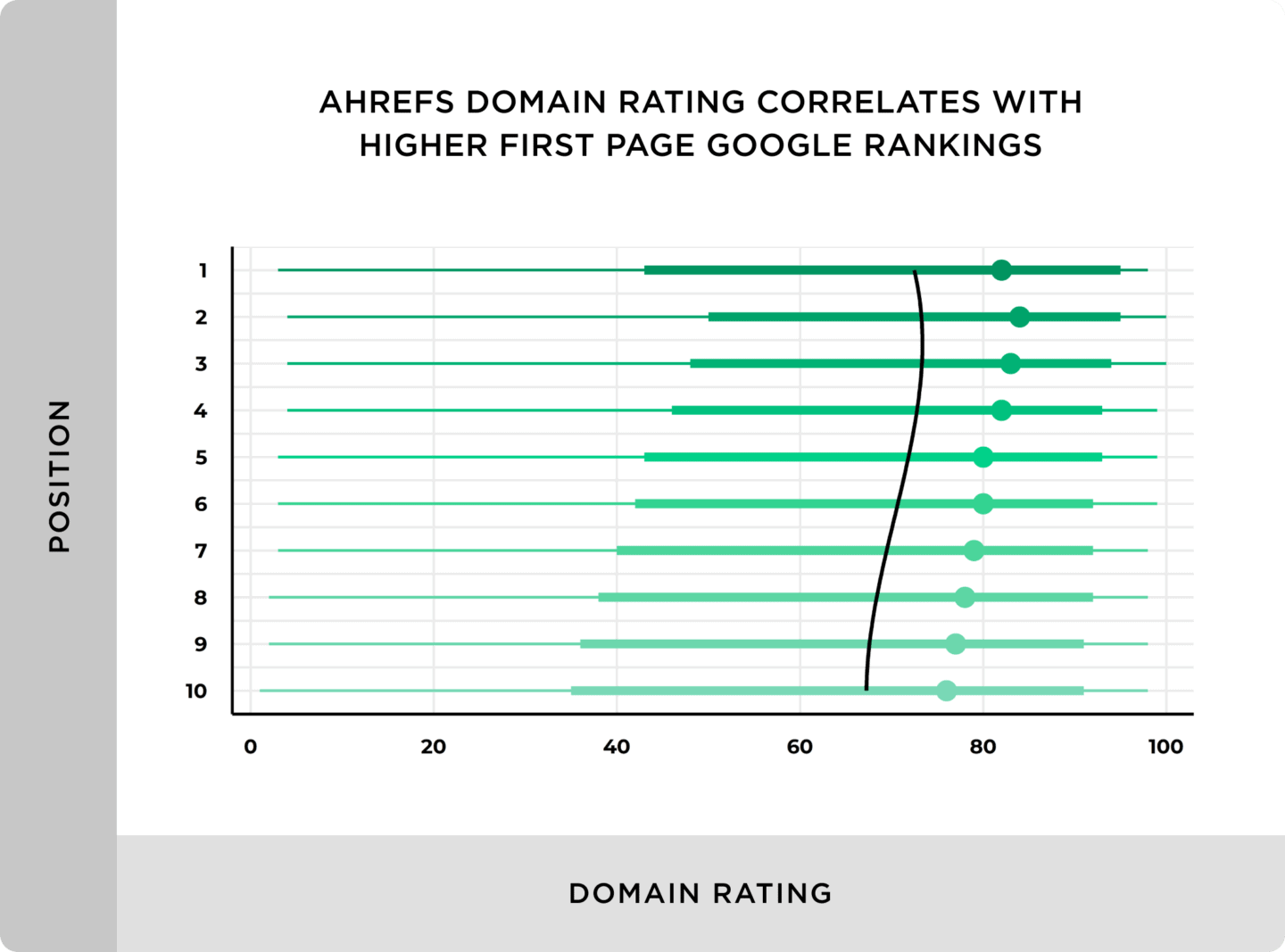
However, in my experience, it is highly correlated with rankings. In general, the higher your site’s DR, the more likely you are to rank higher in Google’s results.
In fact, a study by the search engine optimization blog, Backlinko.com, titled We Analyzed 11.8 Million Google Search Results. Here’s What We Learned About SEO, found that “a site’s overall link authority (as measured by Ahrefs Domain Rating) strongly correlates with higher rankings.”
The important thing to understand right away is that DR is entirely based on links. It’s calculated using the following data:
- How many unique referring domains point to a site
- The DR of those domains
- The number of sites those domains link to
It doesn’t factor in anything else, such as traffic, content quality, or how well pages actually rank.
Generally, higher numbers indicate a stronger link profile (but that’s not always true…). And because a strong backlink profile is associated with better rankings, DR is a useful directional metric for estimating a site’s ranking potential and authority.
We know this is true because even for low competition keywords like “pens that can write upside down,” the results are usually dominated by high DR sites.
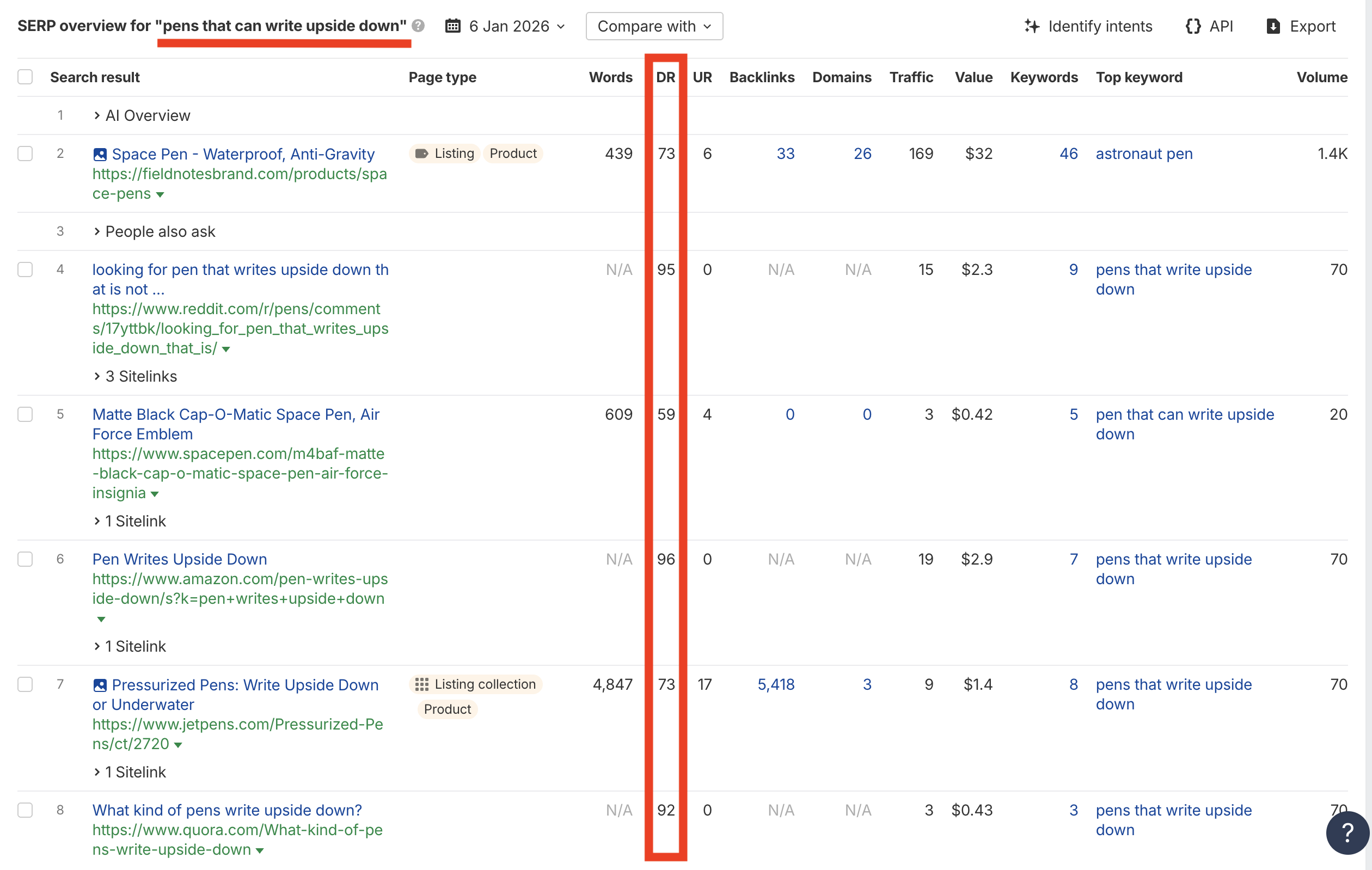
That doesn’t mean smaller sites can’t rank, but it does show that higher DR sites are the ones you usually see on page 1.
That also means that super high DR sites can usually rank for more keywords, more easily (obviously, this doesn’t apply to DR inflated spam…more on that later). They have more authority, so Google trusts them and typically ranks them without question.
Just look at massive media conglomerates like Forbes and The New York Times that rank for millions of keywords. They are all DR 90+ because they have massive, high authority SEO backlink profiles.
On the other end of the spectrum are the low DR sites in the 5-30 range. These are your small blogs, PBNs, new websites, or small online businesses who have done minimal amounts of link building and maybe have only a handful of high quality backlinks.
Most established websites fall somewhere in the middle. A solid niche site or well known blog is often in the DR 40 to 70 range, although that varies quite a bit depending on the industry and how competitive it is.
Here are a few examples:
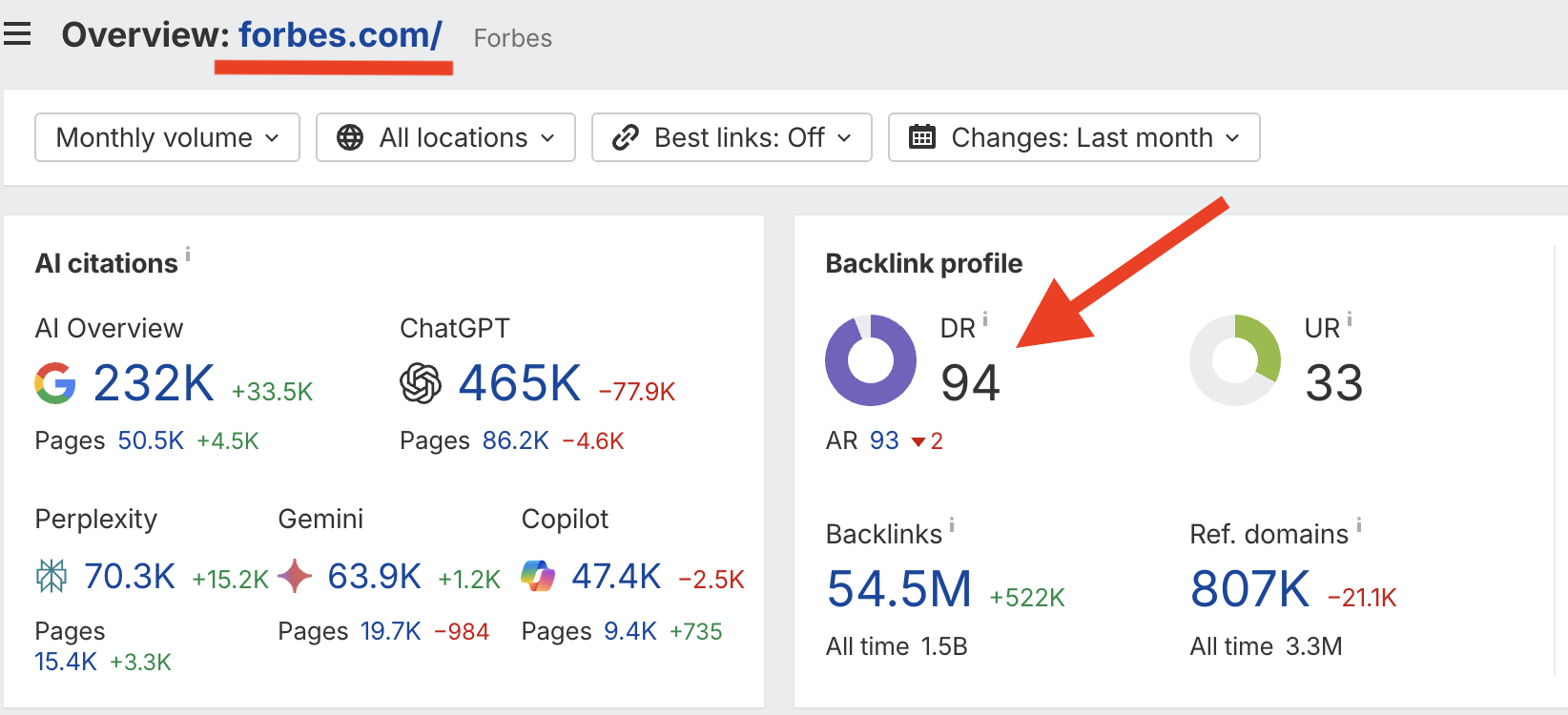
Forbes has a DR of 94 thanks to its nearly 55 million backlinks (it’s almost farcical at this point…55 MILLION):
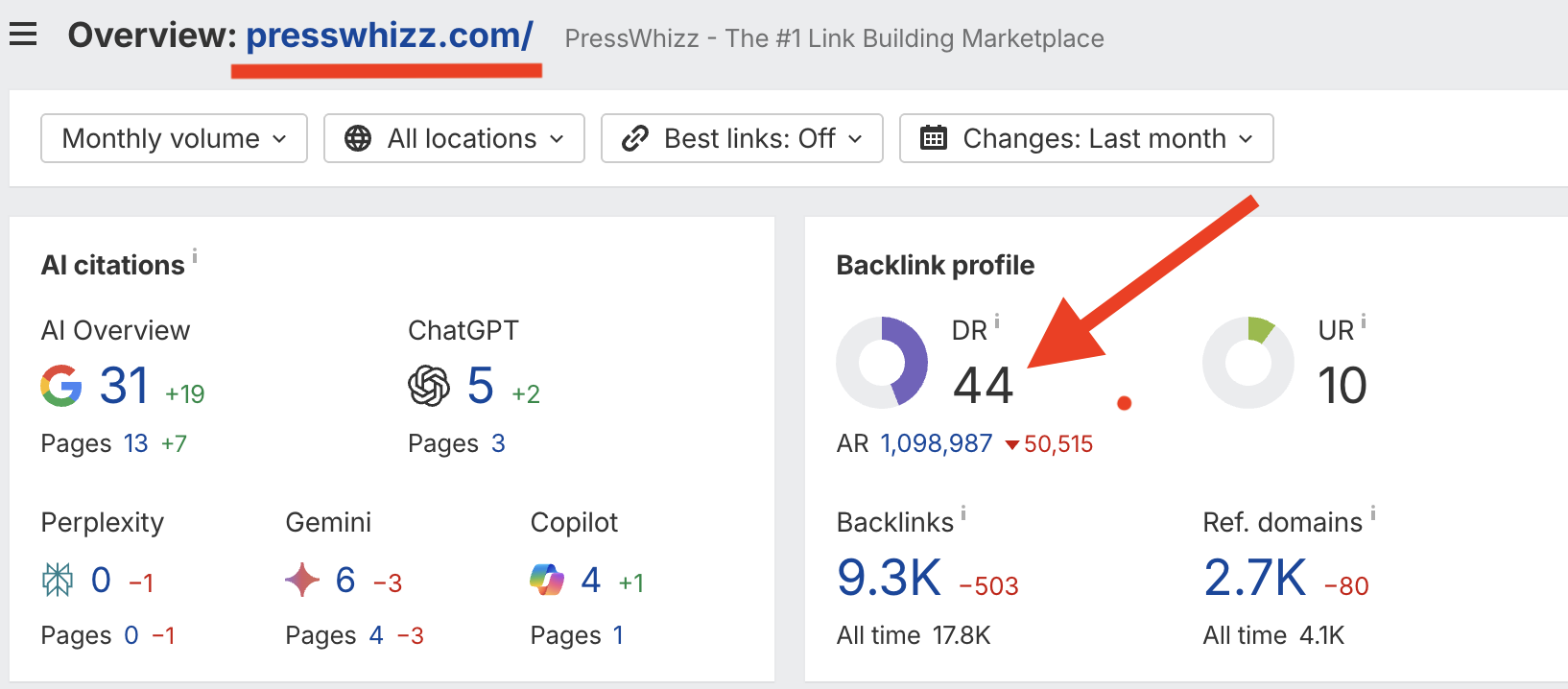
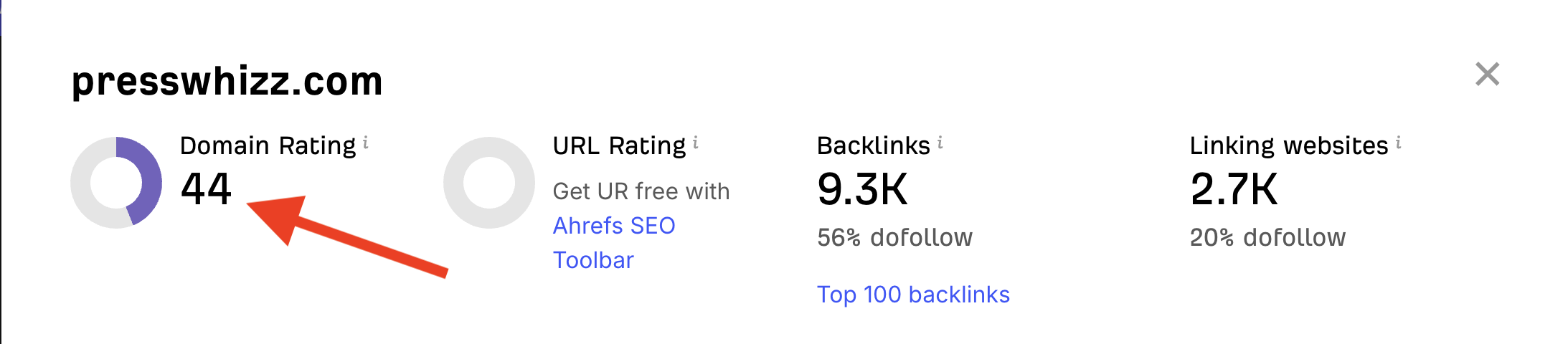
Yours truly and his team here at PressWhizz have a DR of 44. Not too shabby, considering we’re not a news outlet with an infinite budget trying to rank for everything under the sun. Also, Google literally watches my every move due to my history in the SEO industry (a much deserved reputation).
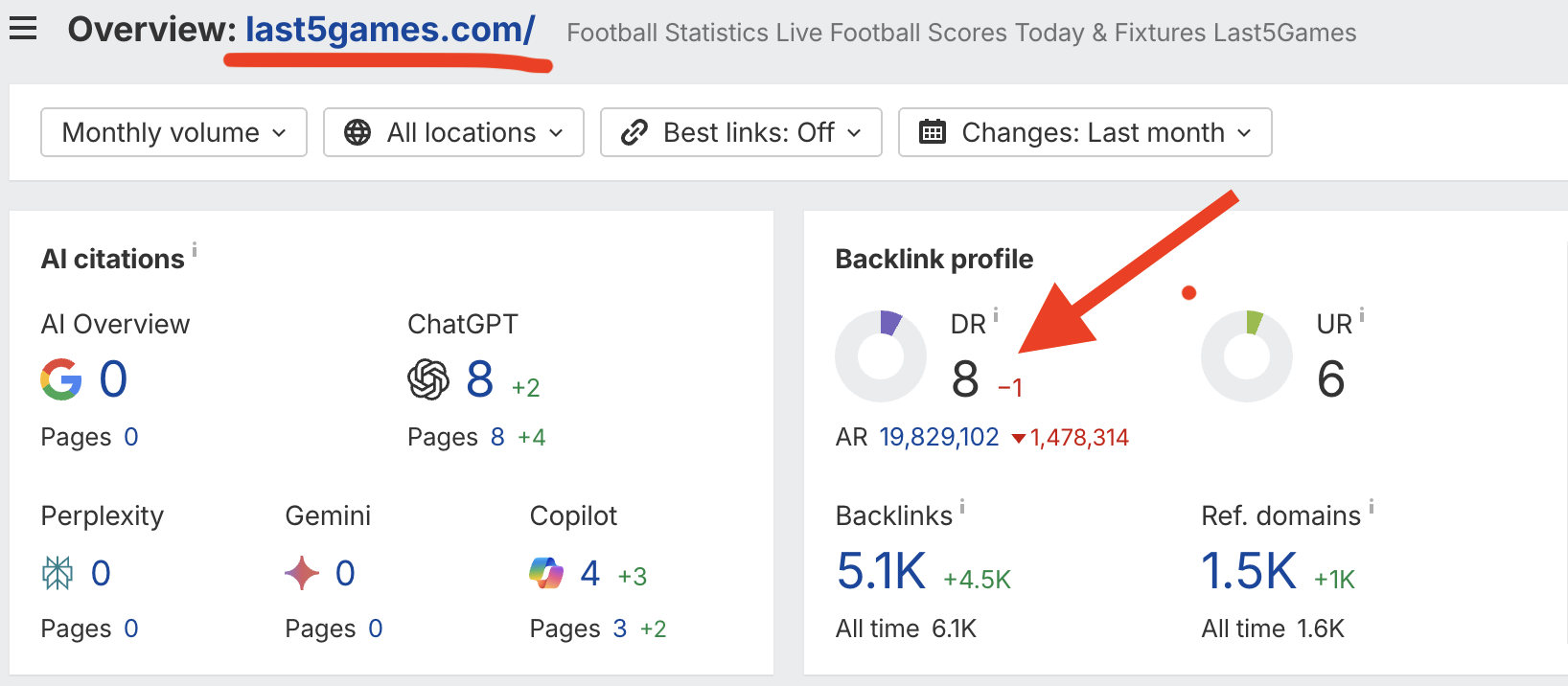
On the low end of the totem poll is this new DR 8 sports stats blog. That’s not necessarily a bad thing, considering new domains start at 0. By the way, if you’re a new domain, we have a complete guide on link building strategies for new websites.
Note: Google, to their credit, is much better at understanding relevance now than ever before. So, smaller DR sites like PressWhizz can outrank mega evil conglomerates like Forbes for SEO related keywords like “what are backlinks” or “how to buy backlinks.” Still, domain rating is overall a very important metric for your site’s SEO performance.
How is Domain Rating Calculated?
DR is calculated using a mix of different backlink quality factors, such as the quantity of unique referring domains, the authority of those domains, and how many other websites those domains link to. In simpler terms, it’s based on how many unique websites link to you, how strong those websites are, and how much of their “authority” they pass on (aka link juice).
Here’s an easy way to think about it:
Every website linking to you is casting a vote, but not all votes are equal. A link from a high DR site like Forbes carries more weight than a link from a small or low authority site. At the same time, that “vote” gets diluted depending on how many other sites that domain is linking out to.
So, when calculating DR, Ahrefs looks at all the domains that link to you with dofollow links. Then it evaluates how authoritative those domains are (using their DR) and how many other sites they link to. Based on that, it creates a 0–100 score.
The exact calculation is Ahrefs’ secret, but we know which factors it takes into account.
There are a few more important aspects of DR you should know:
- DR is driven by unique referring domains rather than total backlinks. Getting 100 links from one website won’t move your DR nearly as much as getting links from 10 different websites.
- Nofollow links do not contribute to DR at all.
- DR operates on a logarithmic scale. That means it gets progressively harder to increase as you move up. Going from DR 10 to 20 is quite easy. Going from 70 to 75 is an absolute slog.
The good news is that the goal isn’t necessarily to reach a DR of 100 (I’ve honestly never seen a DR 100 in the wild in my two decades in the game). A healthy domain rating depends on your niche and competition. Shooting for a higher DR should never make you lose sight of rankings and traffic.
Does Domain Rating Matter?
Yes, domain rating 100%, without a doubt, matters for your search rankings. Go check any SERP, and you’ll see a general trend hold true: The higher the DR, the better you rank. But keep in mind, this is in general. Of course, it always depends on that specific key term, your site’s authority, your site’s relevance, and dozens of other factors. So, DR definitely matters, but it isn’t a god tier metric for identifying quality backlinks like some SEOs think it is.
A website’s domain rating used to be a better indicator of ranking potential, but Google is much better now at filtering out low quality or manipulative links. And it is very good at determining relevance as well, both the relevance of your site to a keyword and of a link to your specific industry.
Here’s a good example where PressWhizz.com outranks much higher DR competitors for a core key term:
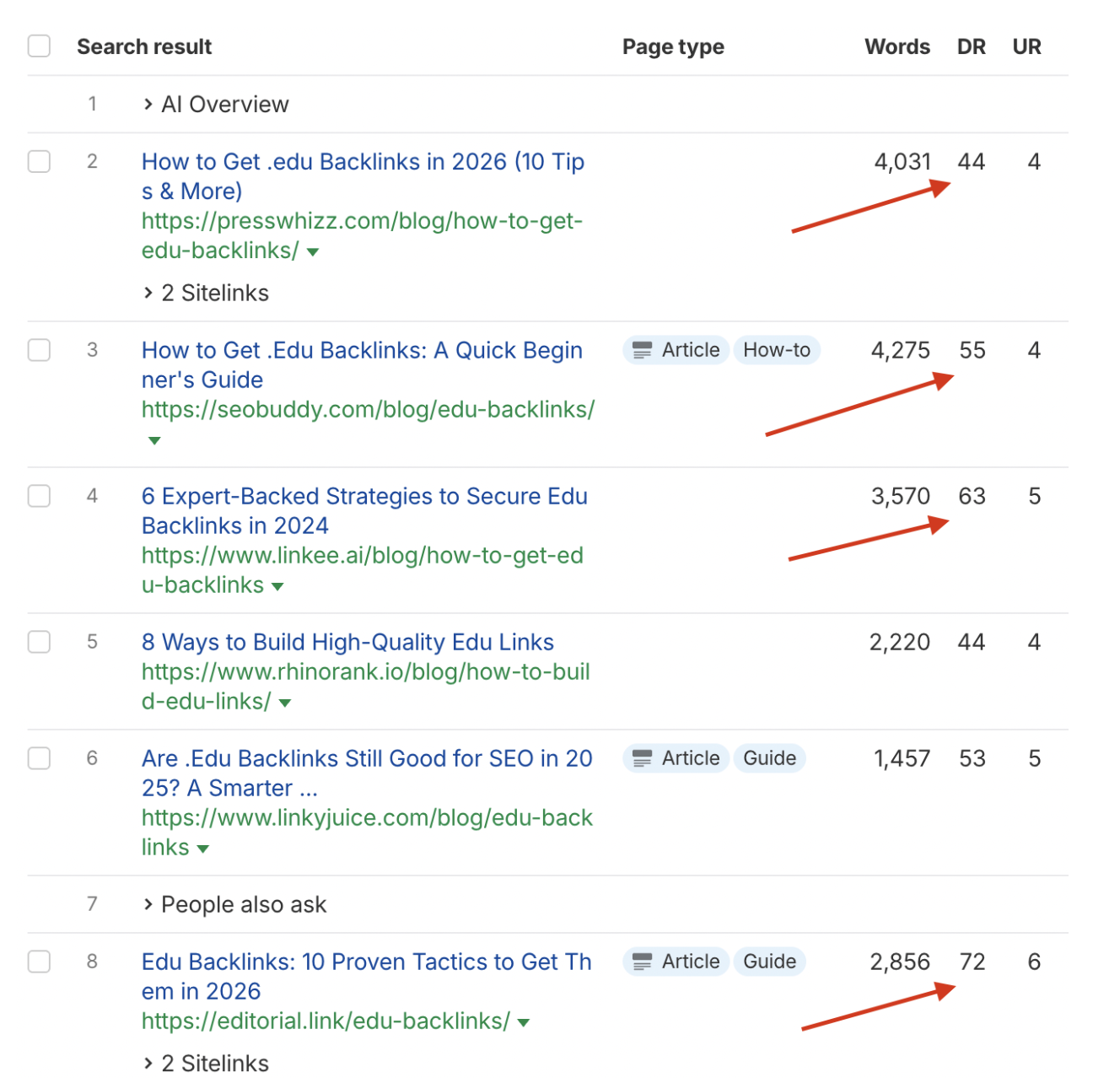
We can outrank the competition here for a number of reasons.
For one, our SEO is much better overall, and our content is grade A, top notch stuff written by a real link building expert. But Google is also much better at determining how relevant our link profile is to the topic, as well as dozens of other little factors like user engagement, brand mentions, and others.
That brings up an important point: DR is easy to manipulate. Any decent black hat SEO can use link rentals, PBNs, and other low quality links to boost DR, and Ahrefs won’t know the difference.
But Google will, which means you can inflate your DR without improving your rankings. You might even get flagged as spam.
Just look how easy it is to buy high DR links on Fiverr (pro tip: do not buy these).
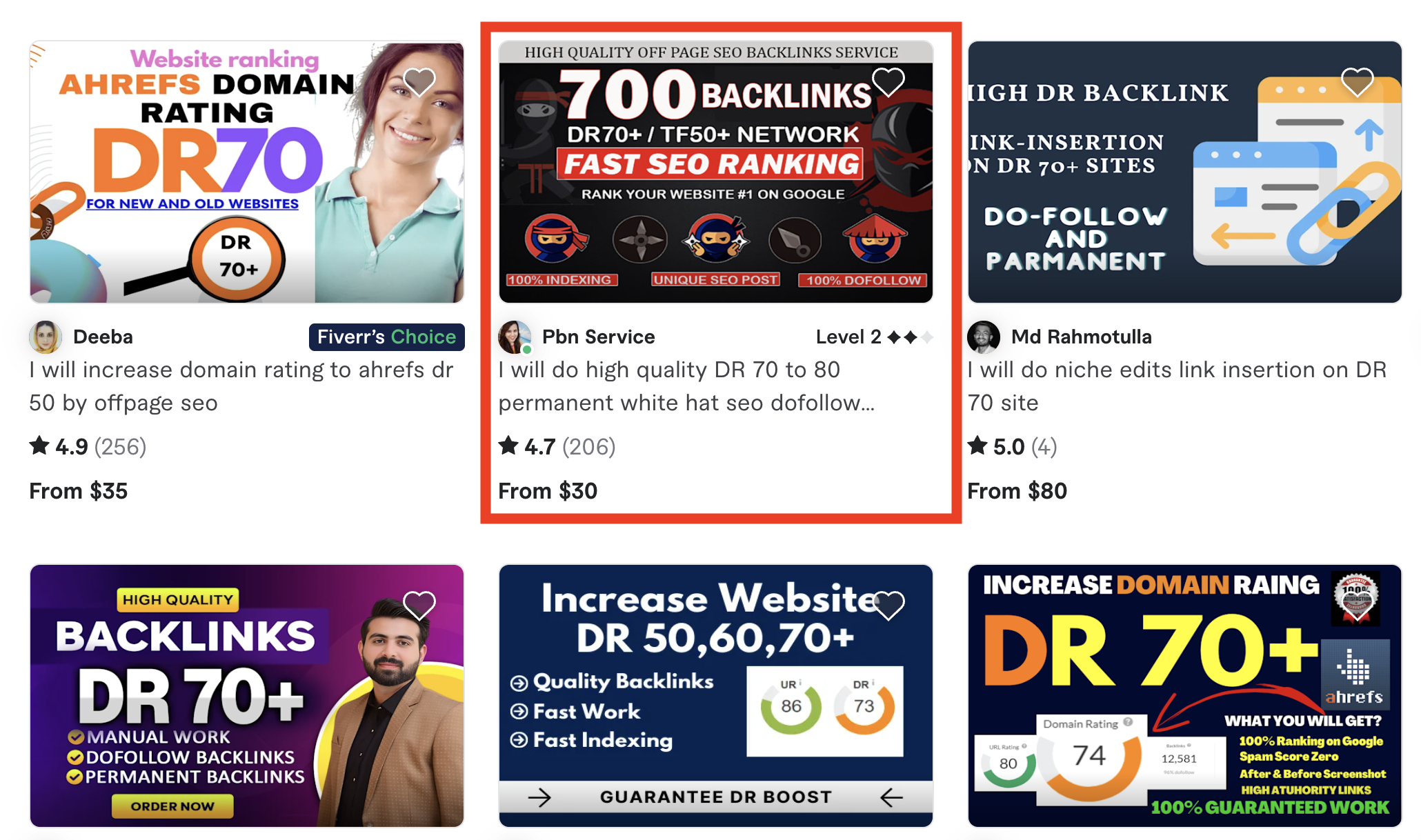
Wow, 700 DR 70+ links for $30? How could this go wrong? TAKE MY MONEY!
At the same time, you shouldn’t ignore DR. Higher DR sites do tend to rank better on average. DR is an indicator of the quality of a site’s backlink profile, and links are still one of the core signals Google uses to evaluate websites (in my opinion, they are the #1 ranking factor).
Here’s a quick example:
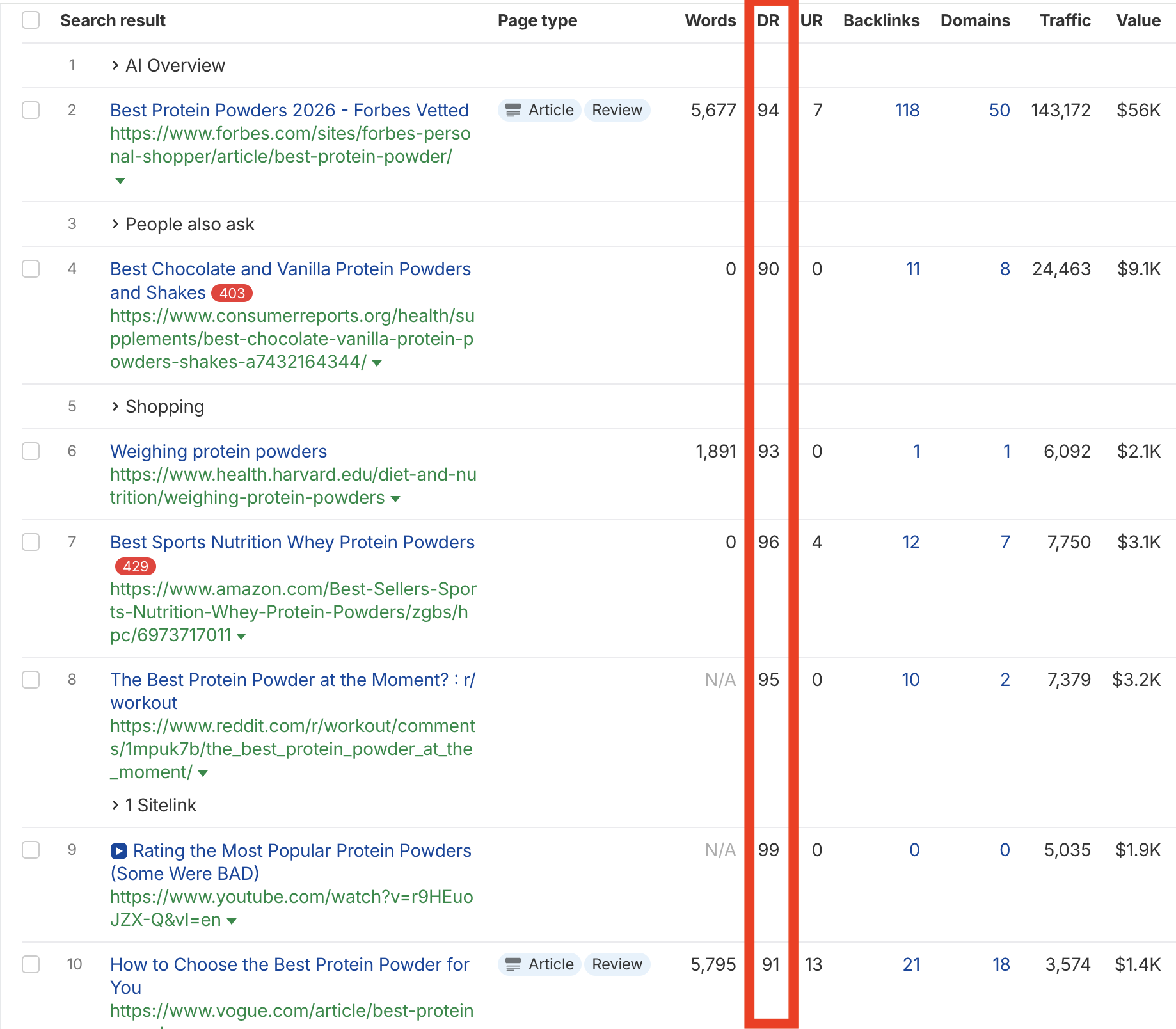
If you look at a competitive keyword like “best protein powder,” almost every site on the first page has a super high DR.
Just look at the mega authority sites dominating this SERP:
I think most search engine optimization professionals go wrong when they start treating DR as the final decision-making factor.
In practice, I use it as a quick “blink test” when I’m evaluating link opportunities (especially when I’m browsing thousands of domains at a time).
If a site has extremely low DR, it’s usually not worth even checking. But once a site passes that initial DR test, I care much more about things like relevance, organic traffic, and whether the page itself actually gets visibility.
I’ve seen plenty of high DR sites that offer zero value because the page is irrelevant or gets no traffic. High authority sites also sometimes rank for a handful of keywords that drive all their traffic, which is essentially a house of cards that could fall apart at any time. I’ve also found lower DR gems that are highly relevant and well positioned within their niche.
TL;DR: It’s SEO. It depends.
So yes, domain rating still matters. Just don’t rely on it alone for ranking or link building.
How to Check Your DR on Ahrefs
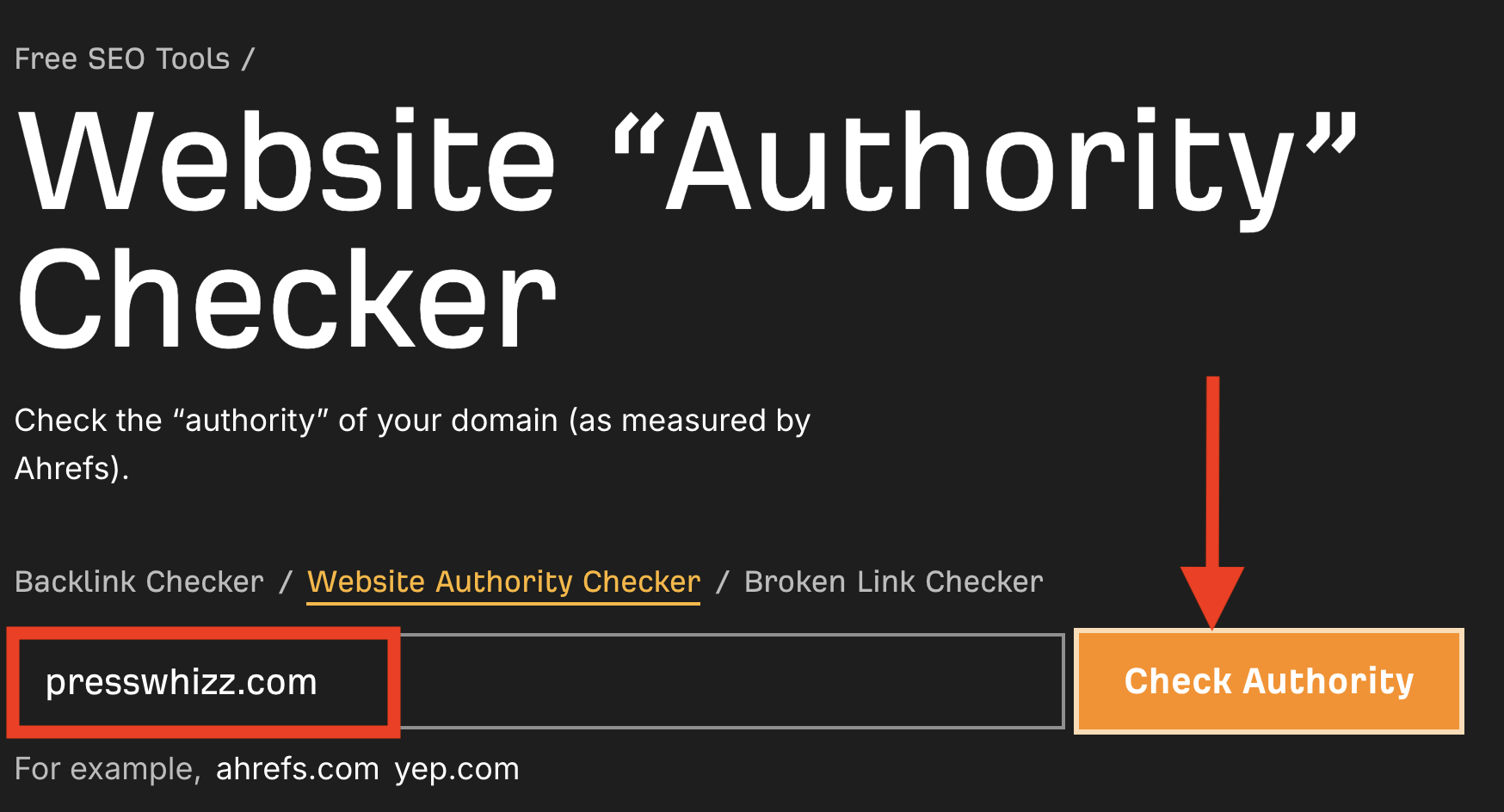
The easiest way to check your site’s domain rating is to use Ahrefs’ website authority checker. Don’t worry, it’s free. You don’t even need an account to use it.
Just add your domain and click Check Authority.
The free tool generates a basic snapshot of your DR and backlink profile.
If you’re serious about ranking or link building, I highly recommend signing up for an Ahrefs account. That way, you can use the Site Explorer tool to check any site’s domain rating, analyze its backlink profile, identify the exact links helping it rank, and much more. It’s about 1000x more useful than the free tool.
To use it, just log in, click Site Explorer in the nav bar, and enter a domain in the search bar.
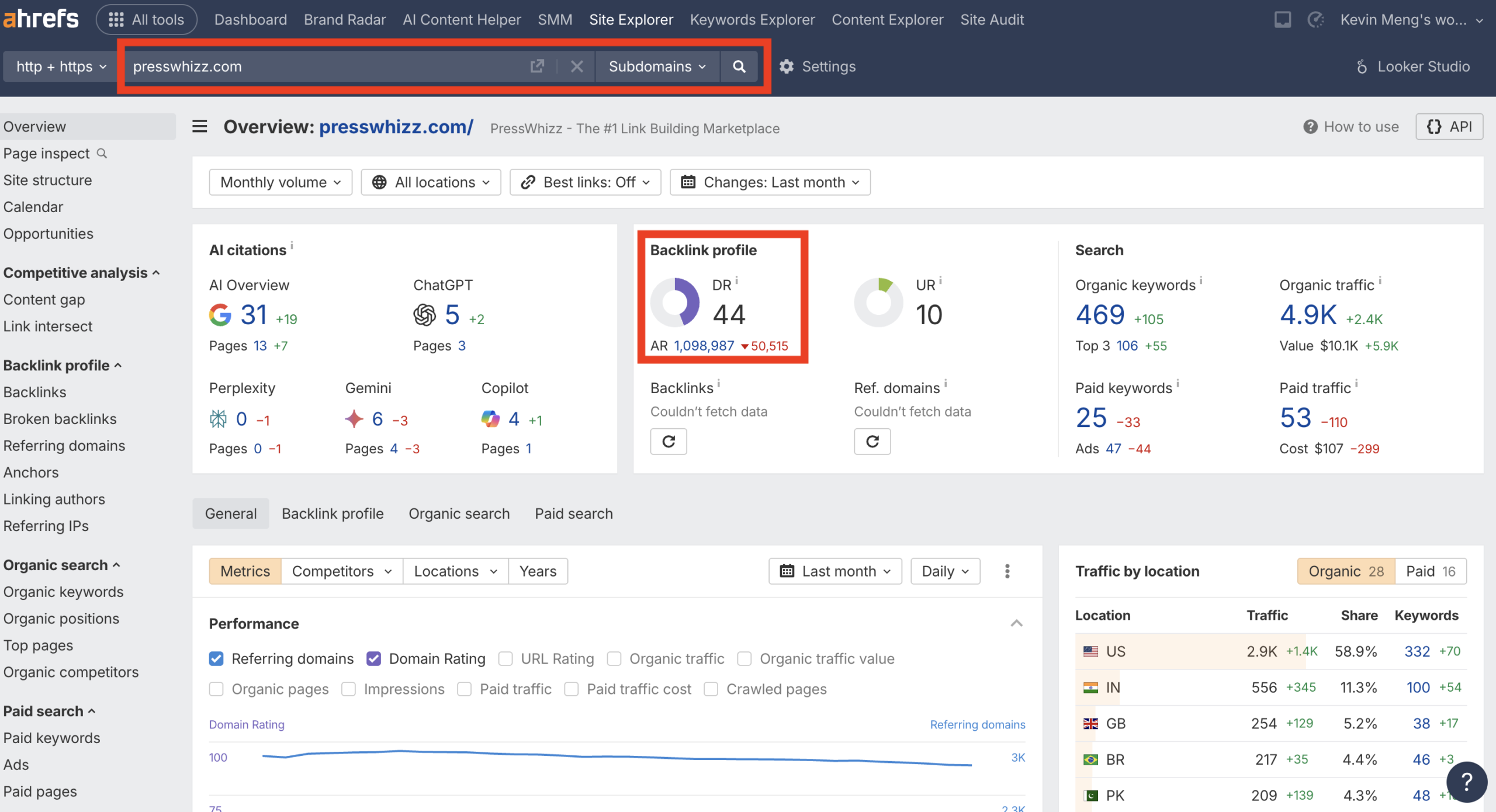
That’s a lot of data, and it’s just the tip of the iceberg.
If you want to go a step further, I recommend checking a few related signals while you’re there:
- How many referring domains the site has
- Whether it gets real organic traffic
- Which pages attract the most links
- What the anchor text profile looks like
There’s loads more data to dig into in Site Explorer results. But for understanding DR, start with the suggestions above. They’ll tell you if the site is as strong as its DR suggests (or stronger).
What is Domain Authority?
Domain Authority (DA) is Moz’s version of an authority score, and it’s a metric that quantifies a site’s overall ability to rank in search engines like Google. Like DR, it runs on a 0–100 scale and is designed to give you a quick sense of how strong a website is.
The biggest difference between DA and DR is that DA doesn’t measure links alone. It combines several factors to give you an idea of how likely a domain is to rank in search results overall.
We know that DA still relies heavily on backlink data, but it also takes into account other factors, such as:
- Spam Score
- Traffic volume
- Social media signals
- Domain age
Taking more factors into account should make it a better metric than DR, right? Not necessarily.
In my experience, DA is harder to connect with real world results precisely because it takes loads of unknown data into account.
DR is more transparent. We know exactly what factors it measures (links). When it changes, we can typically trace the cause and take action. When DA changes, it’s harder to pinpoint why, because any number of hidden factors could be the cause.
That explains how it’s possible to get very different DA and DR scores for the same URL.
Remember how PressWhizz got a DR of 44 from Ahrefs? Take a look at our Moz DA:
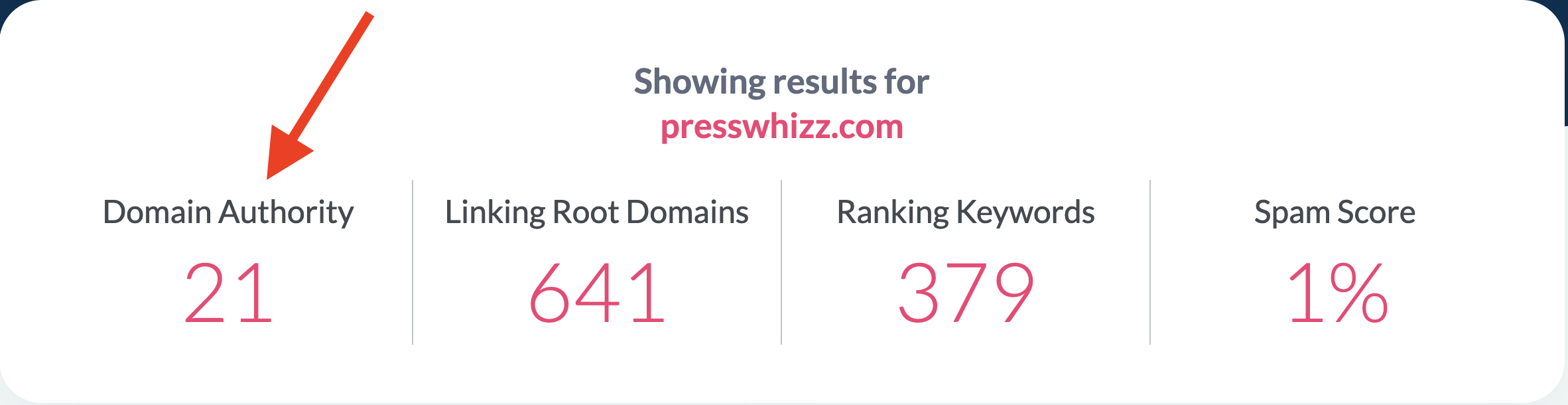
Not exactly close…
I should also mention that, like DR, DA can be inflated artificially. Though it’s not quite as easy to game Moz’s rating as it is Ahrefs’.
But overall, DA is still valuable for basic profiling and link prospecting. I use it daily along with DR to evaluate sites and link opportunities. We even display DA for our customers to view right on our link marketplace. Together, they give you a decent, high level snapshot of a site’s authority.
By the way… You can view both DR and DA for every site on PressWhizz’s marketplace, so you don’t need to sign up for Moz and Ahrefs to check and compare domain authority.
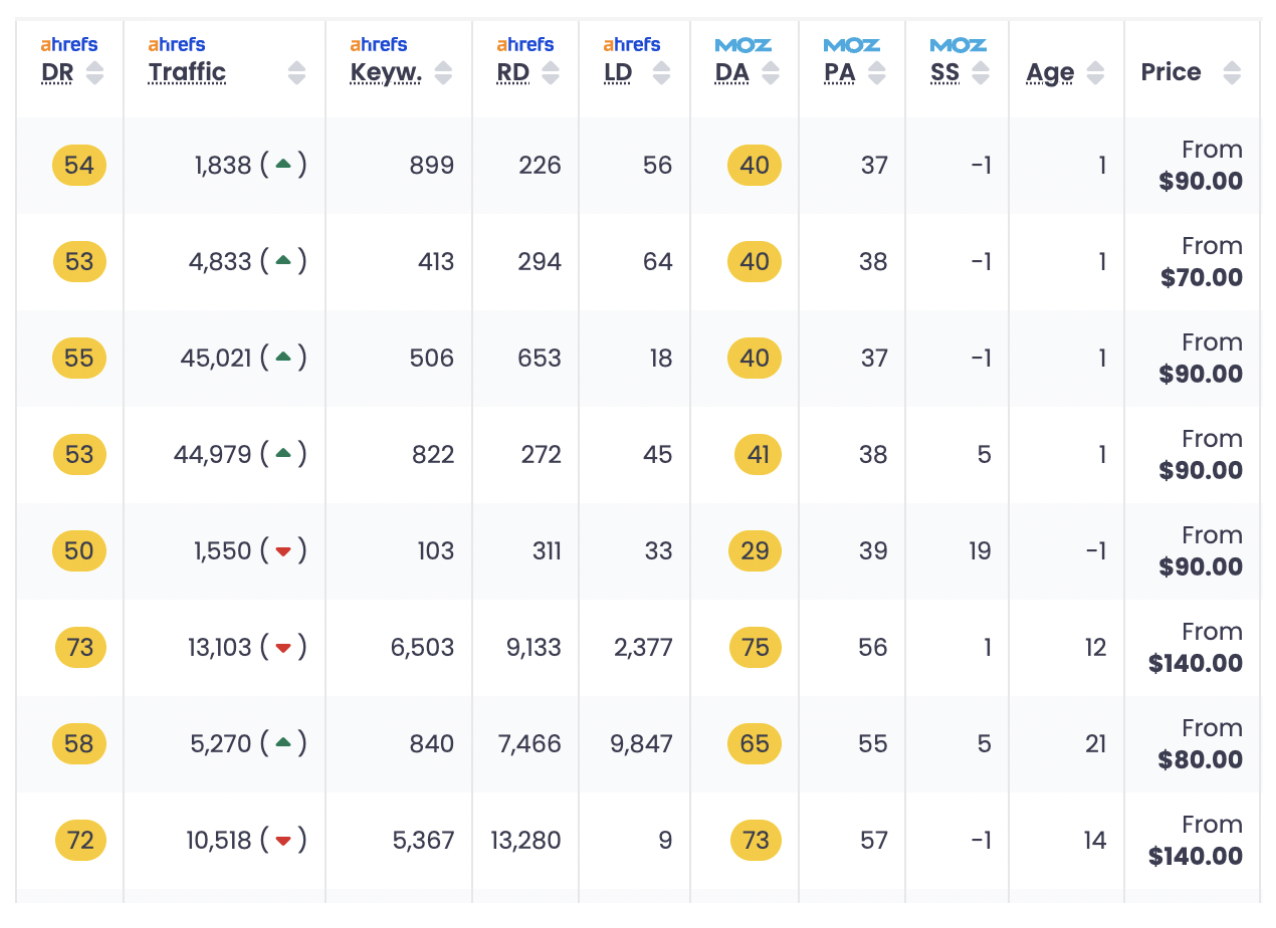
How is Domain Authority Calculated?
Domain authority is calculated using several factors, including a site’s backlink profile, link quality, Spam Score, traffic, and more. It’s a bit harder to explain than DR, because Moz doesn’t publish a clean, step-by-step formula the way Ahrefs does.
But we know from Moz that DA is calculated primarily using backlink data (similar to DR). It also takes into account dozens of other factors. Moz doesn’t reveal most of those, but there are some clues.
A while ago, Moz founder Rand Fishkin said that “DA is just the Page Authority (PA) model at the root domain level” (PA is another Moz SEO metric). And Moz has revealed a bunch of PA factors, like linking URLs, linking root domains, linking subdomains, and anchor text distribution.
So, we can safely assume that the following (along with backlink data) go into calculating DA:
- Nofollow links
- Link anchor text distribution
- 301 and 302 status
- New vs. old links
- Top level domains (TLDs)
- Domain names
- Branded mentions
- Spam Score
All of that data is fed into machine learning models trained on real SERPs, and the result is a score from 0-100. The higher the score, the higher a site’s potential to rank.
Like DR, DA is also logarithmic. That means moving from DA 20 to 30 is cake for any decent SEO, but going from 70 to 80 is like summiting Everest (trust me, we’ve worked with a lot of clients, and getting them to DA 70+ takes a lot of work).
Does Domain Authority Matter?
Yes, domain authority matters. But like DR, it isn’t as important as it used to be. And many SEOs (especially white hats) grossly overestimate its importance.
Again, like DR, DA is a third-party metric. It is not one of the direct Google ranking factors.
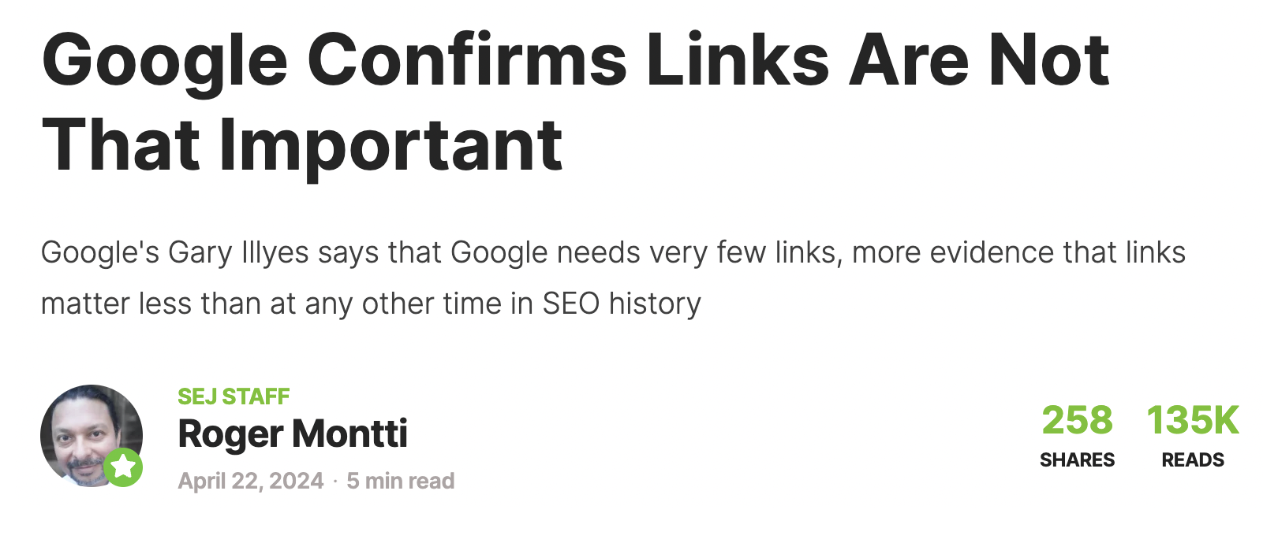
I find that, even in 2026, many SEOs think DA and DR are Google’s own rating system. They’re 100% not. Google Search Advocate John Mueller stated that Google does not evaluate a site’s authority or assign authority-based scores. And Google never lies… (wink). Like, it was 100% true when Gary Illyes said links were not that important:
However, it’s clear that many factors that go into calculating DA overlap with Google ranking factors. The most obvious being links, but also brand mentions, for example.
In a study, A Comprehensive Analysis of the New Domain Authority, published on Moz.com, Moz shows that DA has a strong correlation to SERP rankings. And DA is a tougher score to manipulate than DR, I’ll admit.
I use DA almost as often as I use DR. If I’m looking at a SERP and most of the sites ranking are sitting in a similar DA range, that tells me roughly what I’m up against. It’s not precise, but it’s a helpful benchmark when you’re sizing up a keyword or niche. And if you’re buying links or trying to build them naturally, DA is a good 10,000-foot metric to sort a list of link opportunities.
But keep in mind that you should be checking multiple SEO factors before buying links. For example, relevance is far more important now than ever, so you need to be checking that too as well as organic traffic. Ideally, you want a high DA AND a highly relevant link rather than just a high DA link.
I always use it (as well as DR) when filtering backlink opportunities. If you want to learn how I do it, you can read my guide on how to buy backlinks and pick the right sites. Long story short, a high domain authority score is a great thing to have, but it’s not a guarantee that you’ll rank (or that a link is a good link to buy).
How to Check Your DA With Moz
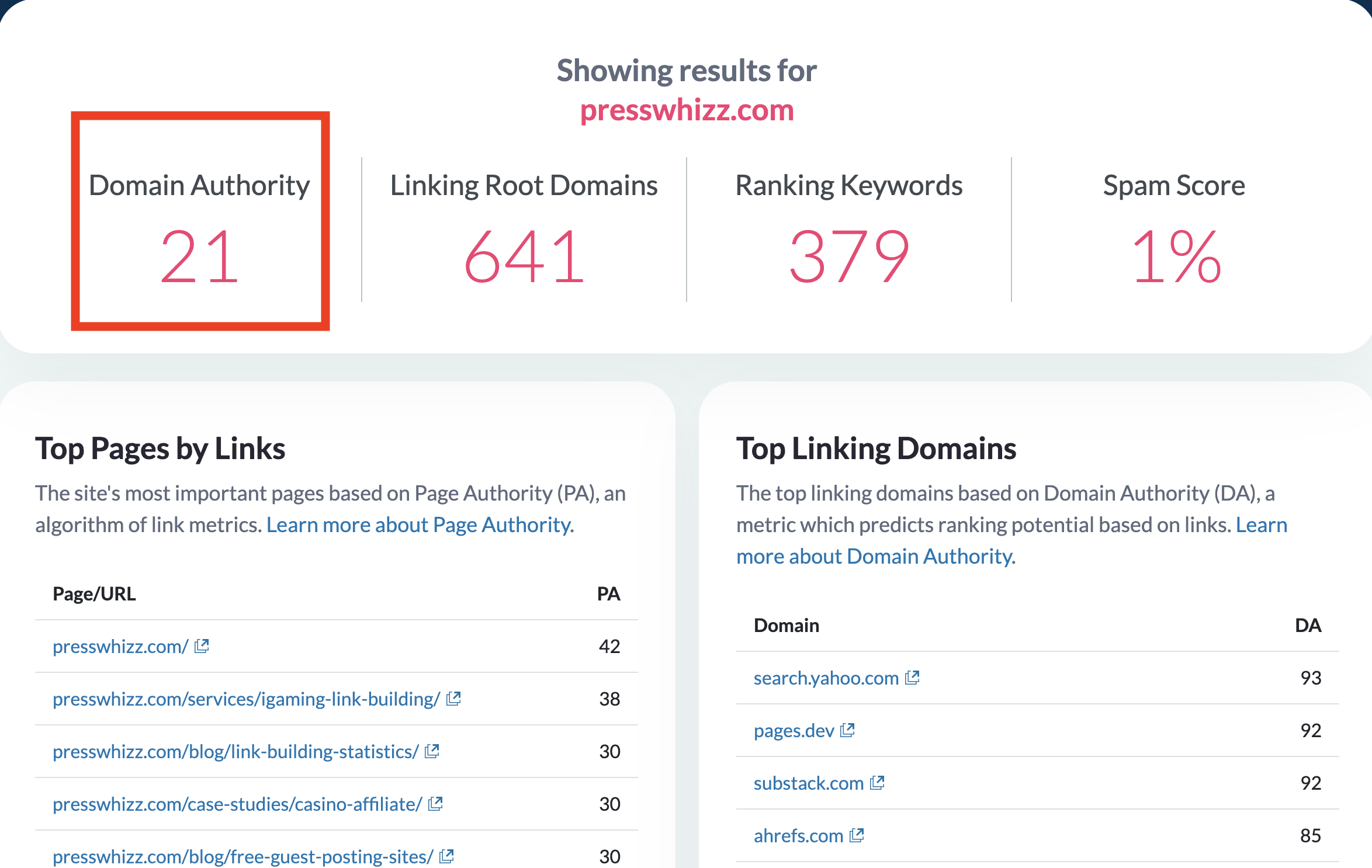
To check your DA with Moz, use Moz’s free domain authority checker. Just input your domain and click Check DA.
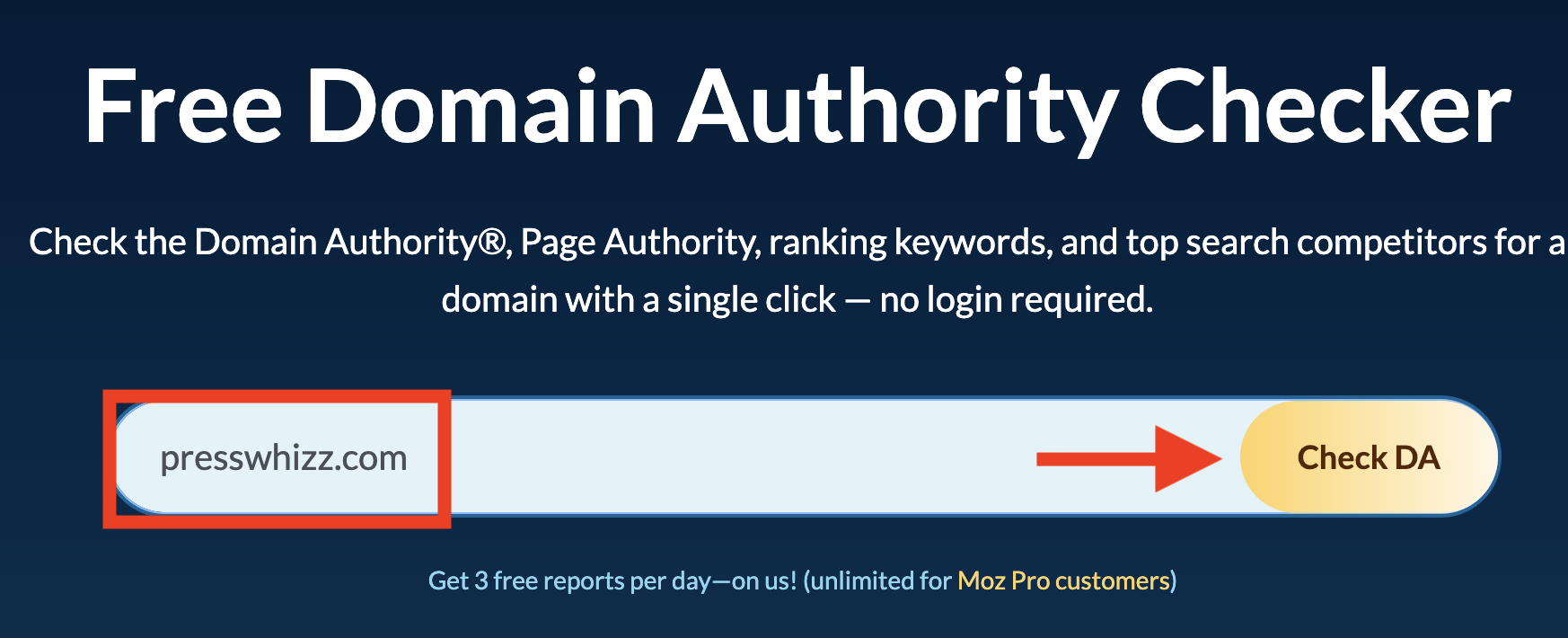
You only get three reports per day, but you get a lot more information than Ahrefs provides for free, including:
- Top linking domains
- Keywords by CTR
- Top ranking keywords
- Top competitors
- Top questions
- And more
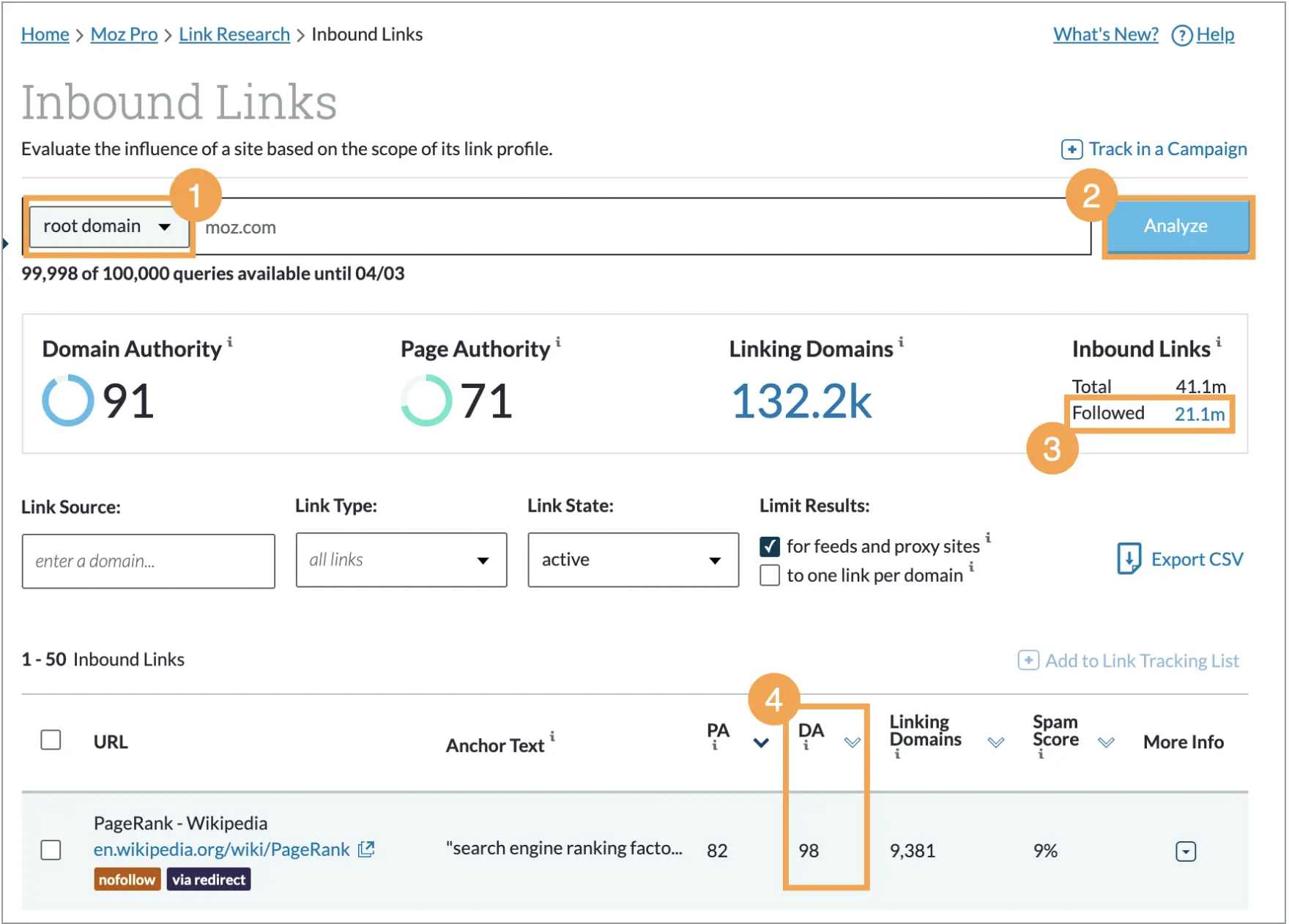
For more detailed data, sign up for a paid Moz Pro account and perform a search using the Link Explorer tool. Input any domain for in-depth data on:
- Inbound links
- Linking domains
- Anchor text
- Top pages
- Lost links
- Spam Score
- Link intersect
- And more
Here’s a helpful screenshot from Moz of their Link Explorer tool:
What is a Good Domain Authority?
It’s hard to say what a good domain authority is. There are far too many factors at play.
Generally, a high DA is good, but it all depends on the context. DA is a comparative metric, which means a “good” domain authority is relative to your niche, your competition, and who’s ranking in the SERPs.
Generally, I’d recommend aiming for a baseline DA of 30 to 40.
If you’re in a highly competitive space like finance, SaaS, or health, you’ll often see sites in the 60 to 90+ range dominating the SERPs. In less competitive niches, you might see sites ranking well with much lower scores. Again, it all depends.
At PressWhizz, we currently have a DA of 21 because we’re a relatively new site. I don’t lose sleep over it because I know that DA is not a ranking factor. We’re crushing for all of our core keywords right now, and our traffic keeps going up and up because we’re great at link building, content, and technical SEO. So, I’d focus more on your overall SEO rather than just your DA.
I’ve been doing this for almost my entire life (literally since I was 12), and I know what’s really important:
- Consistently earning (or buying) links from relevant sites
- Publishing content that targets real search demand
- Avoiding a backlink profile that looks artificial
If you can keep this up, a good DA will follow (and you probably won’t care at that point, because you’ll be ranking anyway).
How Does Authority Score Impact SEO?
High website authority, as indicated by a strong backlink profile, is directly related to rankings.
Regardless of what Google says, links are still the #1 ranking factor. In our blog on link building statistics, I wrote that pages ranking in the top 10 have an average of 3.8x more backlinks than lower ranking competitors.
Backlinks equal authority. There is no question.
But third party authority scores are not the same as building real authority. Third party metrics like DA and DR have zero direct impact on rankings.
They are merely tools that help estimate a website’s authority. Getting a high DR or DA doesn’t matter at all to Google.
But if you achieve a high DR or DA, it means you’re probably doing something right. Google relies heavily on signals that these tools attempt to approximate (aka LINKS). A 2023 study titled “Reliability of domain authority scores calculated by Moz, Semrush, and Ahrefs” published by repositori.upf.edu found that sites with high DR and DA scores are more likely to rank, and that higher scores typically indicate better rankings.
So, while you shouldn’t focus on these scores when improving your SEO, they are helpful pieces of data to consider, and they are great for judging websites at a glance.
Domain Rating vs. Domain Authority: Key Differences
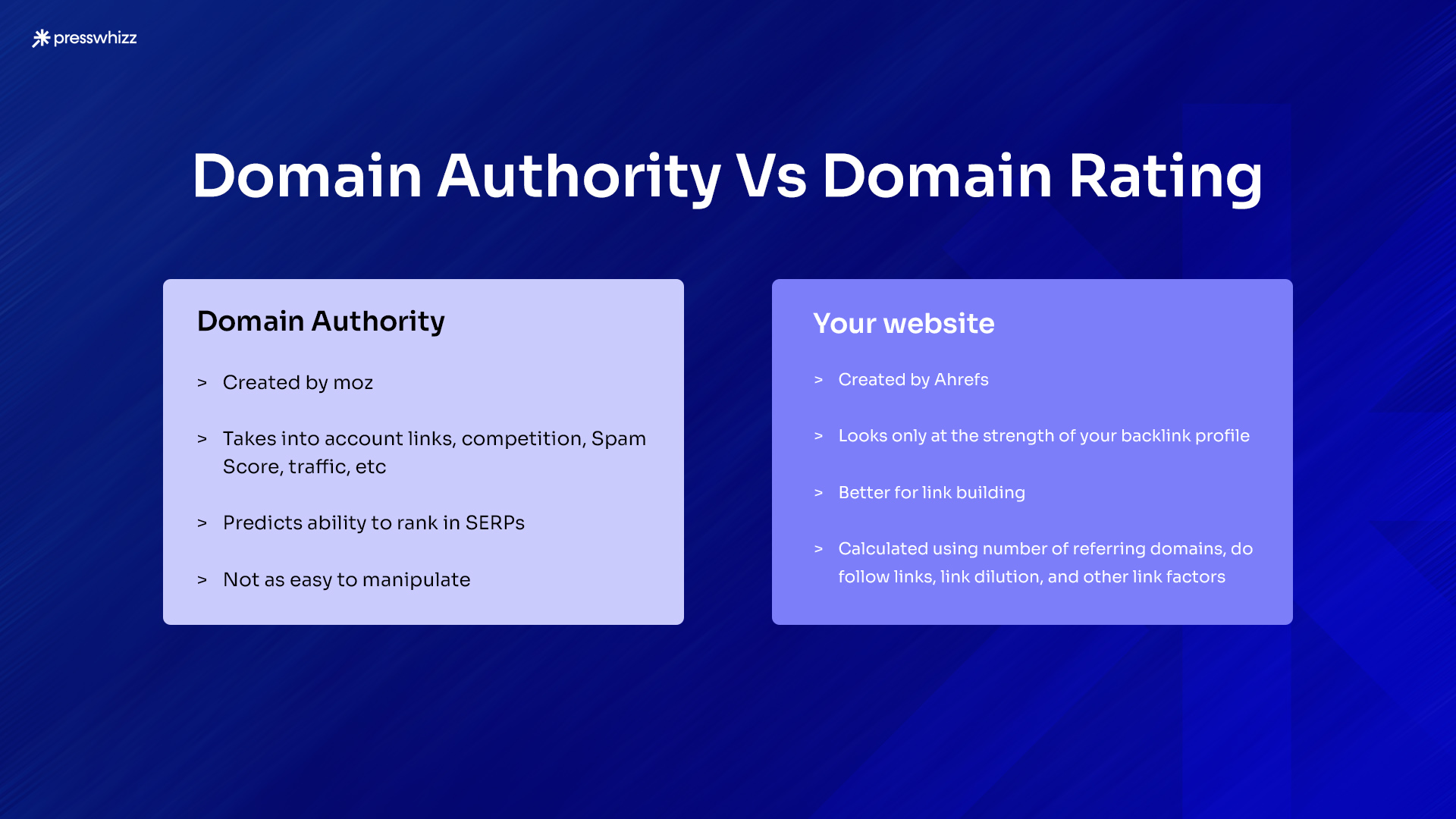
The primary difference between Domain Rating and Domain Authority is how each metric defines and calculates authority. DR focuses on the strength of a site’s backlink profile, and DA incorporates 40+ factors to estimate a domain’s overall ability to rank.
PressWhizz is living proof that these scores are not the same. Our DR (44) is more than double our DA (21). While both metrics focus heavily on backlinks, they weigh and interpret those links differently. DR looks more directly at link popularity, while DA factors in more signals tied to overall ranking potential.
Here’s a snapshot of their key differences:
| Domain Rating (DR) | Domain Authority (DA) | |
| Provider | Ahrefs | Moz |
| What it
measures |
Strength of a domain’s backlink profile | Likelihood that a domain can rank |
| Core inputs | Referring domains, authority of linking domains, dilution via outlinking, followed links. | Backlink data, Spam Score, traffic, brand signals, nofollow links |
| How it works | Logarithmic, link graph based | Logarithmic, machine learning |
| Biggest issue | Easy to manipulate with link spam, PBNs, etc. | Can lag behind real SERP activity |
| Best use case | Quick link prospecting filter | Competitive benchmarking and
“rankability” comparisons |
DR is Ahrefs and DA is Moz
Domain Rating is a metric created by Ahrefs, and Domain Authority is Moz’s version of an authority score. They’re built on different data sets, crawlers, and algorithms, which is why you’ll often see the same site with very different DR and DA scores.
It’s also worth noting that they are competitors. Both are for-profit businesses with loyal SEO fanboys (and girls). Don’t listen to them. Data, not marketing, tells the truth. It’s a lot like Google: Don’t listen to what they say. Reverse engineer the SERPs and see what’s actually true.
DR Measures Backlink Strength and DA Estimates Overall Ranking Potential
DR and DA measure different things. DR is a measure of backlink strength. It tells you how much authority is flowing into a site based on links.
DA estimates how likely a site is to rank. It still leans heavily on links, but it’s built to model overall performance rather than just a link profile.
In practice, that makes DR more useful when you’re evaluating links. You don’t have to worry about the waters getting muddied by hidden data. But I’ll admit, it also makes DR easier to manipulate.
DA is more useful when you’re comparing domains in search results. Its comparative algorithm is highly accurate, but the added complexity makes it harder to answer the question, “Why does this site have a high/low score?”
Calculation Approach
Ahrefs and Moz calculate their scores differently. DR is based on a fairly straightforward link graph model. It looks at referring domains, their authority, and how link equity flows between sites. Pretty simple.
DA also uses link data, but it feeds multiple signals into a machine learning model trained on real SERPs. Think of it as a Matrix-style simulation of real SERP activity (I’ve got to rewatch that movie soon…). Instead of just measuring links, DA predicts how likely a domain is to rank when compared to its competitors.
That’s why DA can sometimes feel a bit less predictable, even though it is still valuable.
Verdict: My Thoughts on DR and DA
I generally prefer to use Ahrefs’ DR over Moz’s DA (I still use both). That’s because I do a lot of link building (that’s putting it lightly), and DR is a better indicator of the strength of a domain’s backlink network. I also just prefer Ahrefs as a tool to Moz.
DR gives a straightforward answer on how strong a site’s link profile is. DA tries to solve a broader prediction problem around rankings, which results in less actionable data.
In my experience, higher DR sites (unless they’re total spam or completely unrelated to your niche) pass link juice more predictably.
This is less predictable using DA.
Because DA is trying to model overall ranking ability, it doesn’t translate as cleanly into how much authority a link will pass.
I often see high DA sites with weak or diluted link profiles, pages on high DA domains with zero traffic or rankings, and pages with lower DA but healthy traffic and backlink profiles (ahem…PressWhizz).
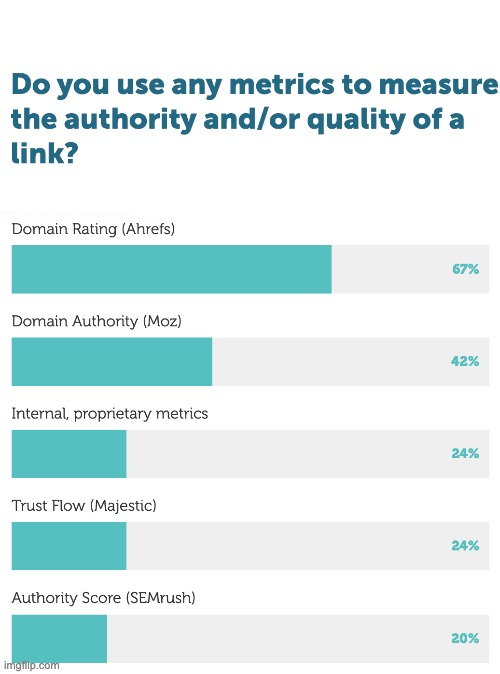
And in my defense, I’m not the only SEO that thinks this. In its 2022 “State of Link Building Report,” the digital marketing firm Aira found that 64% of SEO professionals trust Ahrefs’ link data over its competitors. It also found that 67% of digital marketers look to DR when evaluating backlinks (compared to 42% for DA).
Is DR perfect? No, but it’s transparent and reliable.
How to Increase DR and DA
The last thing I want to do here is leave you with a few tips for increasing your DR and DA (black hat, grey hat, white hat…whatever works). The best way to increase your DR and DA is by earning links from relevant, authoritative websites (aka link building). Both DR and DA evaluate your backlink profile above all else.
Here are a few practical ways to get high quality links and raise your DR and DA numbers:
- Earn links from new referring domains: Both DR and DA are heavily influenced by the number of unique sites linking to you. Getting links from new domains will benefit your authority far more than getting dozens of links from the same site.
- Focus on relevance, not just authority: Google prioritizes relevance now more than ever. That means a link from a lower DR site in your niche may pass more juice than a link from a random high DR site. Now, I’m not telling you to turn down a free DR 90 link just because it’s not highly relevant. But if you ignore relevance and focus solely on DR and DA, you’re going to waste your money.
- Create linkable assets: One of the best ways to earn free, natural links is to build tools, templates, data studies, and original research. Otherwise known as “quality content,” these assets are link magnets. I wrote a simple stats blog post, “50+ Link Building Statistics,” which requires little maintenance and has earned dozens of backlinks.
- Use digital PR and outreach: Getting mentioned in articles, news sites, or industry blogs is still one of the most reliable ways to build high quality links. You don’t need to be a PR pro to use services like HARO and get media links. HARO isn’t as good as it used to be, but there are plenty of HARO alternatives for building high authority links.
- Strengthen your internal linking: Internal links won’t increase DR directly, but they help distribute authority across your site and improve the performance of key pages.
- Avoid manipulative link tactics: Spammy link building might increase your DR or DA in the short term, but Google will come for you. The G is very good at filtering toxic backlinks these days. Trust me, I know more than anyone how tempting it is to try and outsmart Google, but getting relevant, high authority links with real traffic is better than any short-term manipulation.
I know I’m biased, but I highly suggest you buy backlinks. At the very least, you should have a mixed strategy of high authority editorial links (links earned naturally), purchased links, and brand mentions or quotes in high authority publications.
If all you’re doing is publishing content and sending hundreds of outreach emails, you’re going to get crushed. You can’t listen to Google and just wait for 1,000 links to appear. Everyone is buying links, and Google 100% does not care. If your competitors are buying 50 links a month while you’re building 1 the right way, it’s going to be hard to compete.
You simply cannot compete in the SERPs without a multifaceted link building strategy, which includes buying links.
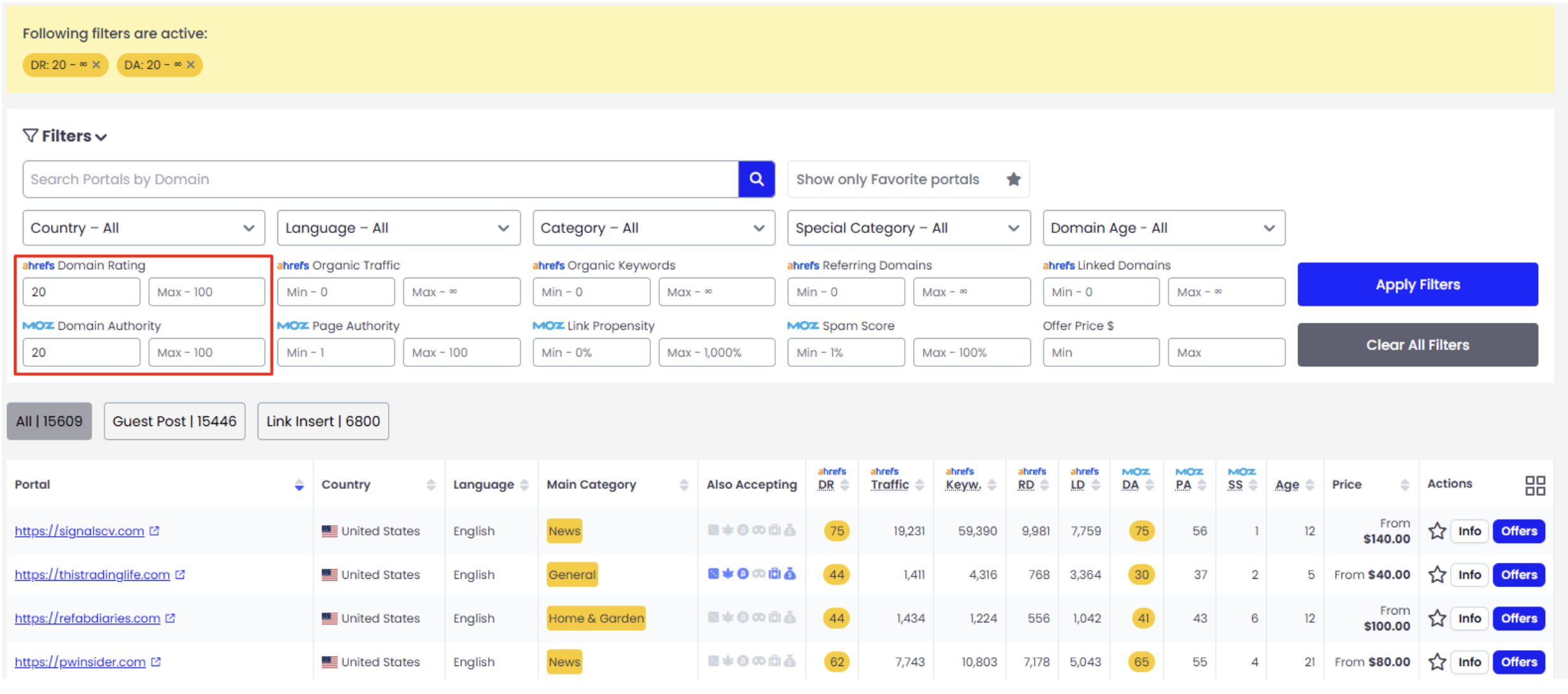
With PressWhizz, you can browse real sites, see their DA and DR metrics upfront, and get high quality links that boost your site’s authority in the long term. You can even filter your results to see DA and DR links within a specific range. It replaces the need for multiple SEO tools (at least for determining link quality).
That’s how easy it is to get relevant, high authority links on PressWhizz’s marketplace.
Domain Authority and Domain Rating in Link Building: What You Need to Know
Ok, I just rambled for ages on domain rating and domain authority. Let’s simplify everything into what you absolutely need to know about DR and DA. This is one of the most common questions I get from customers who are buying links from us. And it’s also one of the biggest mistakes I see SEOs make (that is, they focus on these top level metrics too much).
Here’s how DR and DA play into your link building strategy:
- DR and DA are useful, but they’re NOT Google metrics: They’re third party estimates based largely on link data. Use them as directional metrics but not as ranking factors.
- They’re best used as a top-level filter: When I’m looking at a list of sites, DR and DA help me quickly sort through opportunities. It’s a fast way to narrow things down, especially when you’re scrolling through thousands of domains. Just remember not to make decisions based on DR or DA alone.
- Higher DR and DA usually correlate with better rankings: Ranking domains have higher DR and DA scores most of the time, especially in competitive niches. But it’s not a guarantee.
- Relevance and traffic matter more than DR and DA scores: A DR 70 link on an irrelevant page with no traffic won’t pass much link juice. Google may even ignore it (yes, even if you paid a lot for it). A lower DR or DA link on a relevant, ranking page full of relevant keywords can be far more valuable.
- These metrics can be manipulated: If someone tries to sell you 500 DR 70 links for $20, remember that it’s relatively easy to inflate DR and DA. Spammers can build networks of low quality sites, pass links between them, and artificially boost authority metrics. When you buy these links, you’re not getting real Google-approved authority. You get spam using DA and DR as a disguise.
- Page-level signals often matter more than domain-level metrics: Google ranks pages, not domains. The strength and relevance of the specific page you’re getting a link from is often more important than the site’s overall score. Ahrefs plainly states on its SERP checker page that URL Rating (UR) correlates more strongly with rankings than domain rating (DR).
- I prefer DR (and so do most SEOs): Domain rating is more transparent and predictable than DA overall. It’s directly tied to backlinks, which are Google’s #1 ranking factor. That makes it easier to correlate with real data.
Final Thoughts
If you take one thing away, it’s this:
DR and DA are individual data points. They are small parts of a big picture that includes topical relevance, organic traffic, content quality, internal linking, and much more.
Are they important? Yes. Are they useful? Very. But treating them like the ultimate, Google-approved, god tier rank factors is flat out wrong.
If your end goal is to achieve a high DA or DR, you might end up neglecting these much more important (and real) ranking factors. If your goal is ONLY to get high DA and DR backlinks, you’re going to waste loads of money.
DR and DA are useful for quickly understanding a site, comparing link opportunities, and getting a bird’s eye view of your competitors. I use them every day when I’m building links.
But having a strong backlink profile matters much more than DR and DA. What really moves rankings are links that are relevant, placed on real pages with traffic, and make sense within the content.
If you focus on that, third-party metrics like DR and DA will usually take care of themselves.