

Broken Link Building Isn’t Dead — Your Workflow Is
Here’s the uncomfortable truth most SEOs won’t admit:
Broken link building still works, but only for people who stopped doing it like SEOs.
What died was:
-
Scrape-first workflows
-
One-to-one content swaps
-
“Your link is broken” outreach
What still works is editorial replacement engineering, rebuilding missing infrastructure on the web and inserting assets that should have existed all along.
If your broken link process starts with:
Ahrefs → Broken Backlinks → Mass outreach
You’re already late, already ignored, and already competing with 200 identical pitches.
The operators winning in 2026 don’t hunt broken links. They hunt link intent decay inside live content clusters and rebuild assets editors actually want to keep live.
Why Broken Link Building Still Works
Strip away the fluff and broken link building works for one simple reason:
Websites decay faster than publishers maintain them.
Teams change. CMS migrations quietly break URLs. Old resources disappear or get redirected into oblivion. But the citations pointing to them? They linger, often for years.
Every dead outbound link left live creates an opportunity to win:
-
A placement that already passed editorial checks
-
An anchor embedded naturally inside content the publisher chose to cite
-
A contextual insertion that doesn’t require selling “why your link deserves to be here”
Broken link building isn’t outreach.
It’s editorial maintenance you’re exploiting before the publisher fixes it themselves.
But it only works if you run an analysis-first workflow, not a scrape-and-pray operation.
7 Pain Points With Broken Link Building
Most guides skip this, but operators know these pain points:
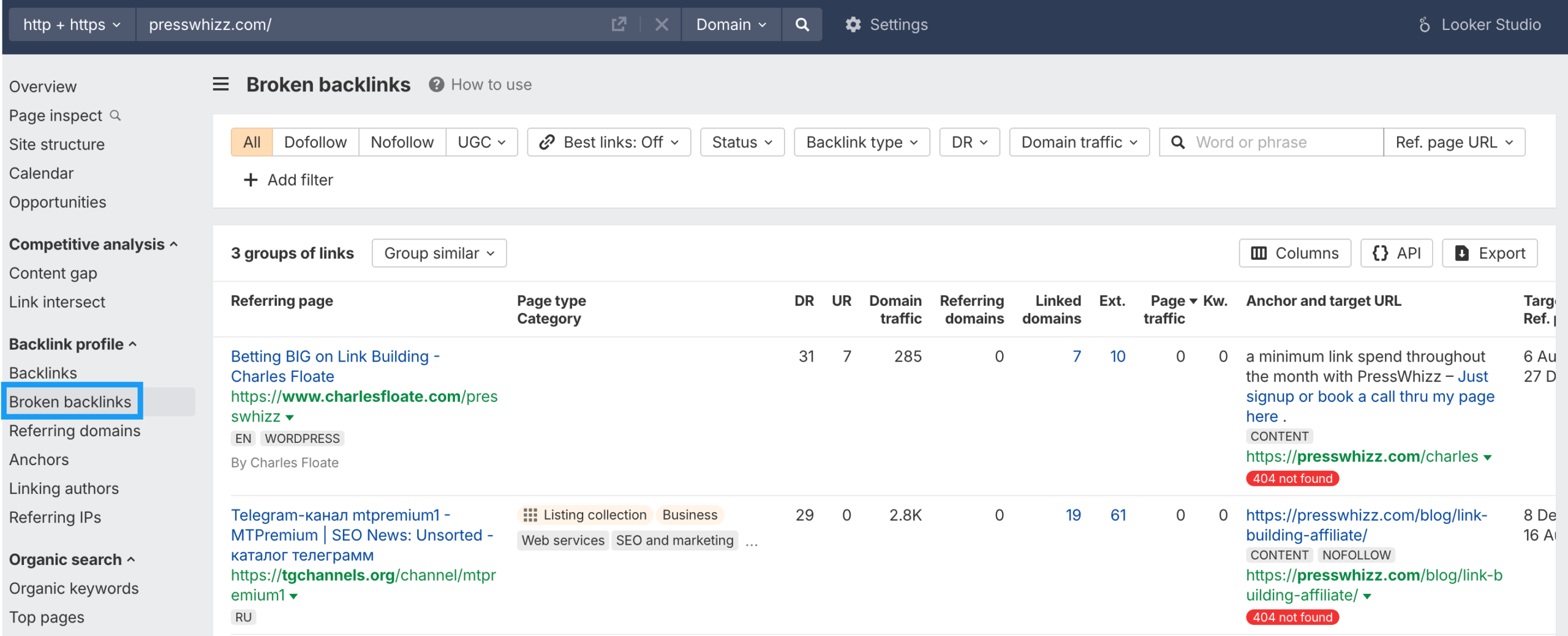
1. You’re Competing on Public Data
Ahrefs’ Broken Backlinks report is useful and completely public.
The second a high-DR resource dies, it lights up every SEO dashboard on the planet. Hundreds of operators chase the same URL, pitch the same angle, and flood editors with cloned outreach.
The graveyard isn’t the issue.
The crowd around it is.
If your workflow begins and ends with “open Ahrefs → filter broken backlinks,” you’re fighting over scraps with agencies, vendors, and junior link builders running identical SOPs.
2. Editors Auto-Delete SEO Language
“Your link is broken” emails are burned out.
Editors have seen them thousands of times. Templated pitches, weak replacement assets, and thinly disguised attempts to turn a 404 into a favour.
The moment an email reads like SEO outreach, it’s mentally discarded. Editors don’t want noise. They want clarity, context, and a fix that improves their content without extra effort.
3. If You Miss Anchor Intent, You’re Done
A lot of decayed URLs weren’t strong assets to begin with.
Thin listicles. Outdated PDFs. Legacy stat pages that ranked because they existed early.
Recreating that level of content won’t win a replacement. Editors aren’t looking for a like-for-like swap, they’re looking for something better than what died.
A blog rewrite won’t cut it.
Your replacement has to be editorial-grade: structured, citable, data-backed, and strong enough that an editor is comfortable putting their name behind it.
4. The Content Lift Is Always Underestimated
“Can’t we just repurpose an existing post?” is the fastest way to kill a broken link campaign.
Unless you’re happy with single-digit placement rates and long stretches of silence.
Editors aren’t replacing citations with lightly reworked blog content. They expect updated data, clean structure, proper sourcing, and a clear improvement over the original asset.
The content lift isn’t optional.
It is the strategy.
5. Dead Links Live Inside Old Content Clusters
Most broken resources aren’t isolated pages. They’re remnants of outdated topic hubs that haven’t been touched in years.
Dropping a single standalone article rarely fits contextually. Editors want replacements that belong inside the topic’s ecosystem – not orphaned posts floating on unrelated sites.
This is why lone blog posts fail.
Topical assets win.
6. Miss the Anchor Intent and You’re Done
If the original link supported a data point and you pitch a how-to guide, the conversation dies immediately.
Editors don’t want “something similar.” They want a replacement that supports the exact claim, angle, and intent behind the original anchor.
When alignment is perfect, links land with minimal friction.
When it isn’t, threads go cold.
7. Tracking ROI gets messy
Broken link building isn’t linear.
You’re not just counting links, you’re tracking replacement wins, cluster reinforcement, topical authority lift, and how assets compound over time.
When done properly, results become predictable and repeatable.
When tracked poorly, it looks random.
Advanced Broken Link Building Workflow
Broken link building is three pipelines feeding each other:
- Discovery
- Content Production
- Outreach
For the purpose of this article, we’ve gone with Ahrefs as our tool of choice because we’re operators, not hobbyists.
1. Discovery: Building a Data-Driven Dead-Link Pipeline
Most SEOs run discovery backwards. They start with broken URLs instead of broken opportunities.
You’re looking for topics where publishers already showed linking intent.
Step 1: Pull Broken Backlinks on Competitors
Ahrefs → Site Explorer → Backlinks → Broken
Filters:
- DR 50+
- Traffic > 1,000
- Dofollow
- English

Export everything.
This reveals topics that already earned links.
Step 2: Identify “Link Magnet” Patterns
For each dead URL, label:
- Content Type
- Link Intent
- Cluster
- Anchor use
If you don’t understand why people linked to the original asset, you can’t recreate the value.
Step 3: Use “Best by Links” to Find Soft Deletes
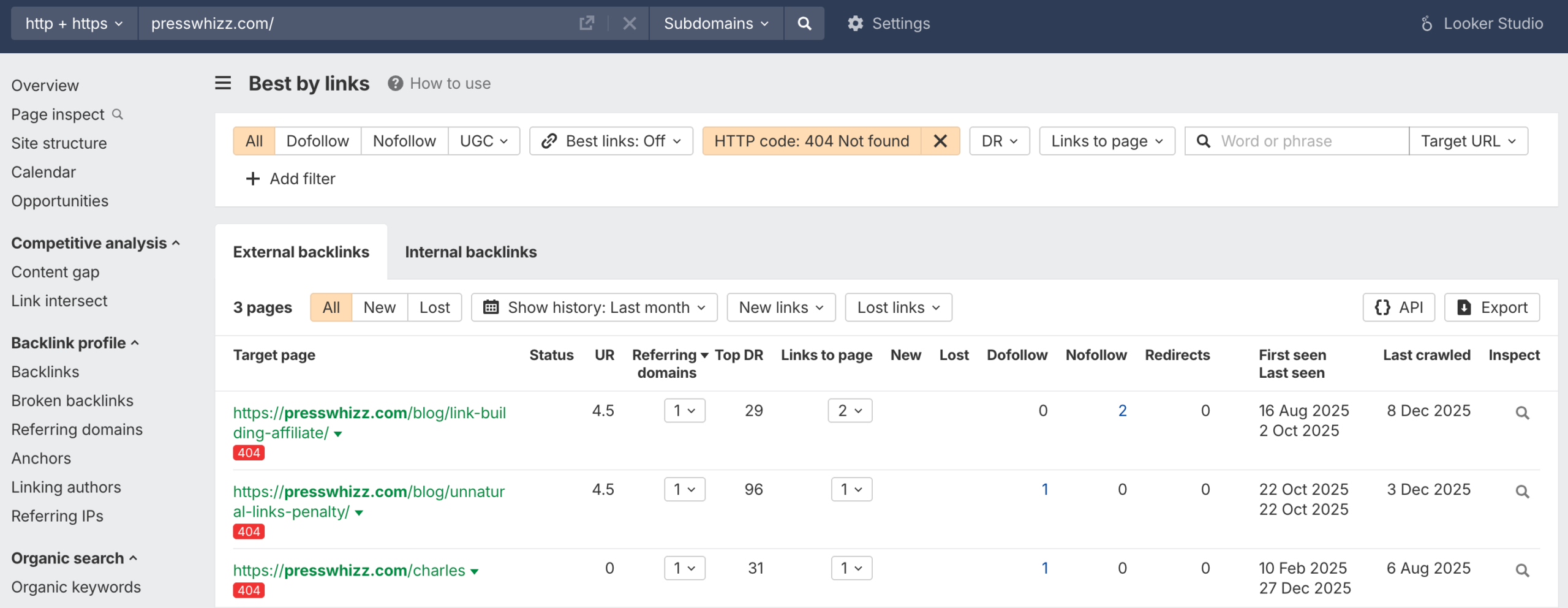
Ahrefs → Best by Links → 404 or 301
These pages are decaying silently and represent low-competition opportunities.
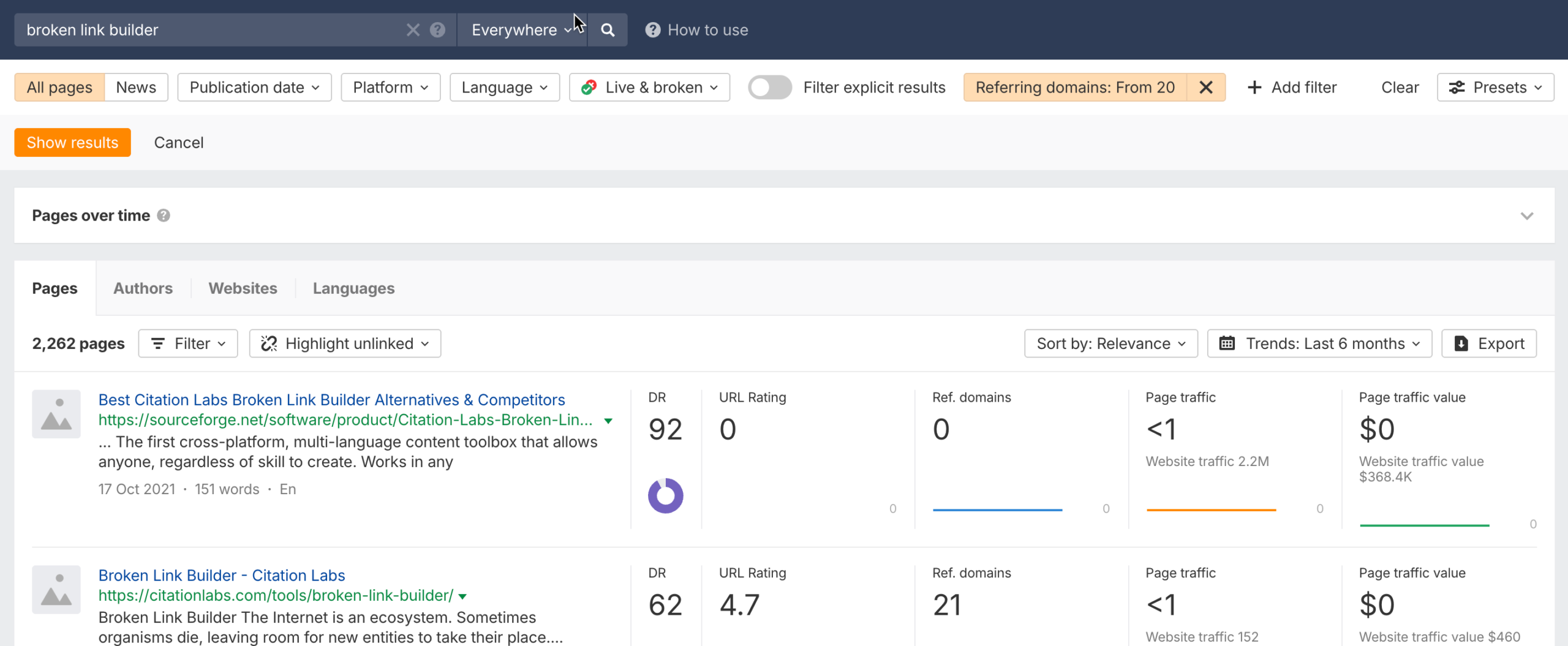
Step 4: Deep Crawl with Content Explorer
Use queries like:
status:404 AND “VPN statistics”
language:english
referring domains:>20
This surfaces dead resources nobody else is pitching.
Step 5: Build a Priority Score
Authority + RD + SERP relevance + difficulty.
This gives you a high-confidence target list and avoids wasted outreach.
2. Content Production: Assets That Actually Win Links
Broken link building isn’t “publish a blog post.” You need to take things one step further – you’re recreating something editors relied on. If your replacement asset can’t survive being cited by a DR80 editor with their name on the byline, it’s not a replacement, it’s filler.
Rule #1: Mirror the Original Intent Exactly
Data page → Data page
Statistics hub → Statistics hub
PDF → HTML resource
Template → Downloadable template
Match these or lose.
Rule #2: Build “Link-First” Assets
Your replacement must have:
- Citable facts
- Scannable headers
- Clear narrative
- Real sources
- Charts or structured data
This isn’t SEO content. This is editorial reference material.
Rule #3: Make the Asset Evergreen
Every replacement should be:
- Updateable
- Citable
- Evergreen
- Cluster-linked
Broken link building works best when assets compound.
3. Outreach: Editorial-First, Not SEO-First
Most broken link emails sound like “Hey stranger, please do something for me.”
Editors don’t respond to that.
You need editorial context, clarity, and authority.
These templates exist because editors already trust the structure, not because they’re clever.
Rule #1: Don’t Lead With “Your Link Is Broken”
You lead with value, not diagnosis.
Rule #2: Personalize by Section, Not Name
Editors don’t care if you know their name. They care if you understand their content.
Rule #3: Follow a 4-Touch Cadence
- Day 0 – Correction
- Day 6 – Updated version
- Day 13 – Alternatives
- Day 23 – Close-out
Subtle, professional, zero pushiness.
4. Scaling Broken Link Building Without Turning Into Spam
Scaling broken link building isn’t about blasting 5,000 emails. It’s about asset leverage – building resources that win replacements repeatedly, slot cleanly into multiple contexts, and compound every time you uncover a new dead citation. The operators who scale aren’t sending more emails; they’re deploying better assets, tighter topical clusters, and have an outreach pipeline that makes every pitch feel editorially necessary rather than opportunistic.
Scaling Method #1: Build Link Libraries
Stats hubs, glossaries, and directories aren’t just content pieces – they’re infrastructure.
When you build a library of evergreen, citation-friendly assets, every broken link opportunity becomes plug-and-play.
Instead of creating a new resource for every dead URL you find, you simply map the anchor to the most relevant item in your library. It’s how operators scale without bloating their production pipeline.
A strong link library turns one piece of content into a long-term asset that collects placements for years, not weeks, and gives you coverage across every angle, definition, stat, and concept in your niche.
Scaling Method #2: Use Ahrefs Alerts
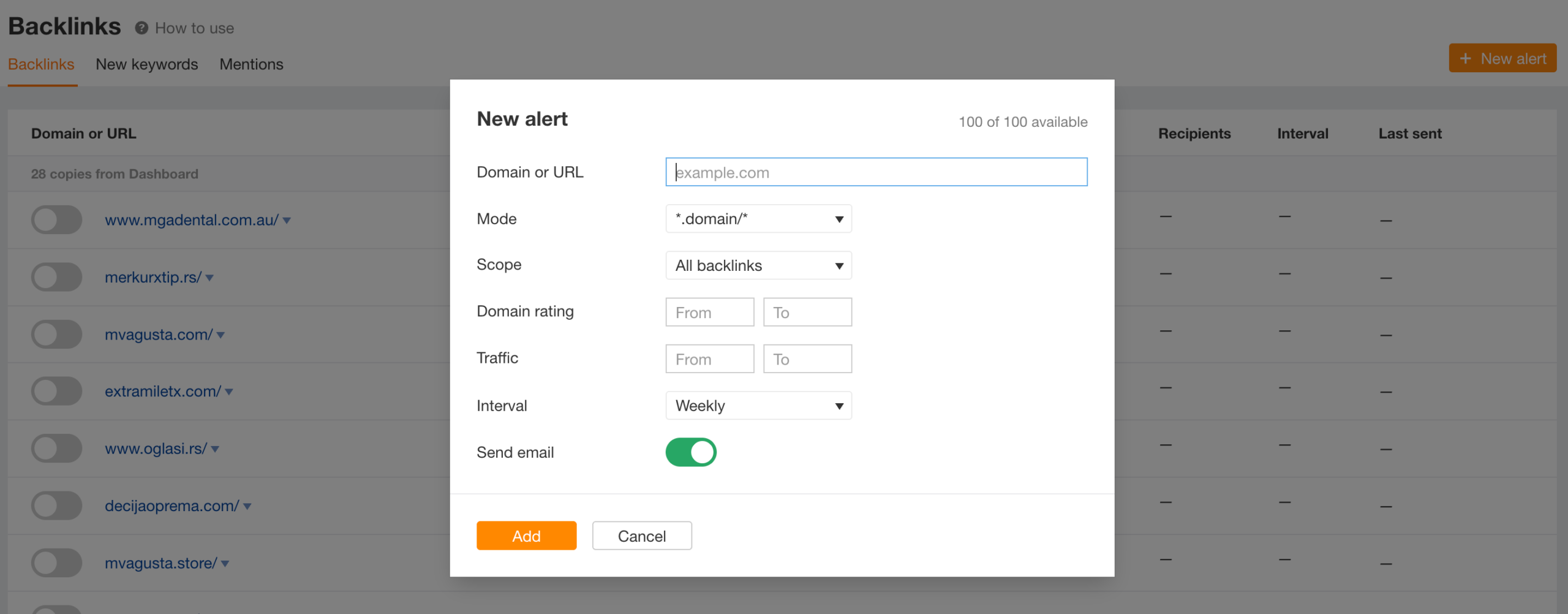
Ahrefs Alerts are your early-warning system. While other SEOs are scraping the same stale 404s, you’re getting notified the moment a high-value page dies, a redirect chain breaks, or a competitor’s asset collapses.
That timing advantage is everything. Editors see your email first, before their inbox fills with templated “your link is broken” spam.
Being early in the inbox increases conversion rates, reduces competition, and often lands placements simply because you solved a problem before anyone else knew it existed.
Speed wins, and Alerts give you that speed.
Scaling Method #3: Publisher-Direct Relationships
Broken link building becomes exponentially easier once you have direct lines to the people who control the pages. Editors remember operators who make their lives easier – the ones who send clean replacements, correct outdated sources, or flag broken public resources without expecting anything in return.
Over time, those small moments build trust. And trust is leverage. Suddenly, your emails skip the queue. Your replacements get reviewed faster. Your assets become the default choice when they need updated citations in your niche.
This is how you turn broken link building from cold outreach into editorial collaboration.
Scaling Method #4: Multi-Option Pitches
Nothing kills a replacement faster than making an editor think. If you send one asset and it doesn’t perfectly match the anchor, the conversation is over. But when you give editors two or three clean, contextually-fitting alternatives, you eliminate friction entirely.
They’re not evaluating you – they’re choosing between upgrade options that already align with their content. Multi-option pitching is simple psychology: reduce decision effort and acceptance rates spike. It’s one of the fastest ways to scale without increasing outreach volume.
Scaling Method #5: Build Clusters for Relevance Matching
Google’s link systems heavily reward topical cohesion, and so do editors. A broken link replacement performs significantly better when the asset sits inside a strong cluster with supporting content, internal anchors, and clear topical depth.
Editors can see it. Google can understand it. And your outreach becomes more credible because the asset isn’t a standalone page – it’s part of a structured, authoritative body of work. When your content ecosystem mirrors the topic in breadth and hierarchy, your replacements don’t just land more often; they deliver more ranking power.
5. Advanced Tactics Only Experienced Operators Use
These are the moves you won’t hear on panels or in webinars. They come out in operator circles — the people who care about ranking, not optics.
Tactic #1: Resurrected Data Pages
Build out-of-print statistical resources with current data.
Tactic #2: Rebuild the Entire Link Trail
Use Ahrefs → Broken → Linked Domains. Find everyone who linked to the same resource and contact them.
Tactic #3: Rebuild Dead PDFs as HTML Upgrades
This not only has a clear SEO advantage – it’s also a case of editorial preference.
Tactic #4: Acquire the Dead Asset (When Possible)
Rebuild it, redirect it, and you’ve just plugged pure authority straight into your site.
Tactic #5: Internal Anchor Sculpting
Push your replacement asset via internal cluster authority.
6. Measuring ROI the Right Way
When you’re measuring broken link building, track what actually moves the needle, not vanity numbers. Prioritise the metrics that show authority gained, relevance secured, and cluster strength improving.
That means monitoring the links you’ve won, the DR and topical alignment of those placements, the anchors used, and how the asset performs inside its cluster. Secondary signals like traffic uplift, organic impressions, and supporting page movement help you understand the wider ripple effect.
Long term, the real proof is in how often the asset earns new links organically, how easily it plugs into future outreach, and how reliably it strengthens your topical footprint. In short, track what matters, and ignore the noise.
Primary
- Links
- DR
- Anchor relevance
- Topical match
Secondary
- Traffic increase
- Cluster uplift
- Additional earned links
Long-Term
- Editorial relationships
- Reusable assets
- Compound link velocity
Broken link building is asset infrastructure, not a one-off trick.
7. When Broken Link Building Beats Digital PR
Broken link building wins in the places Digital PR can’t reach. When you need precise relevance, predictable authority, and placements that feed directly into a topical cluster, this tactic outperforms big-splash campaigns every time.
It’s not about headlines or virality- it’s about securing citations where they matter, in niches where PR angles fall flat and editors prioritise accuracy over newsworthiness. This is where broken link building becomes the smarter, cleaner, ROI-first move.
Broken link building wins for:
- Relevance
- Predictability
- Mid-tier DR
- “Unsexy” industries
Digital PR wins for:
- DR90+
- National press
- Brand visibility
Smart SEOs run both in parallel.
8. The Future of Broken Link Building
Google’s shift toward entity relevance and topical authority actually makes broken link building more powerful, if done with editorial integrity.
Publishers want:
- Current data
- Clean citations
- Non-spam assets
- Easy replacements
You give them that, you win.
9. Outreach Email Templates (Operator-Grade Examples)
These outreach templates speak the language of operators: clear, authoritative, and laser-focused. Forget the “Hi {Name} 😊” Fiverr nonsense — this is newsroom-calibre communication that wins links.
Email Template 1 — The Editorial Correction (Primary Email)
Subject: Quick correction on your {topic} page
Hi team,
Flagging a small correction on this page:
{URL}
You’re referencing {resource name}, which has been offline since {month/year}. It left a dead link in the {specific section or anchor} area.
I rebuilt the equivalent resource with updated {data/year/methodology}:
{Your URL}
If you’re updating the article, this version matches the original intent and provides the current figures editors usually cite.
Let me know if you want alternative sources too – happy to send options.
Best,
{Name}
Why this works:
It treats the editor as a peer, not a prospect. No fluff. No pressure. Just helping them fix their page.
Email Template 2 — The Value-Add Follow-Up (Day 6)
Subject: Updated version if you’re reviewing xyz citation
Hi team,
Following up in case you’re reviewing the outbound links on your {topic} article.
Along with the updated resource I sent earlier, here’s a cut-down version with the core stats editors usually want:
{URL or anchor jump link}
It mirrors the original source but includes:
- Updated {year} numbers
- Verified citations
- A cleaner breakdown section for quick referencing
Use whichever fits your editorial style best.
Cheers,
{Name}
Email Template 3 — The Multi-Option Pitch (Day 13)
Subject: Alternative sources (in case helpful)
Hi team,
If the replacement I shared earlier isn’t the angle you prefer, here are two alternative citations that fit the same topic cluster:
- {Asset #1 — short clause about intent}
- {Asset #2 — short clause about data}
Either would work as a clean replacement for the dead link pointing to the old {resource name}.
Whichever version matches your editorial direction, feel free to use.
Best,
{Name}
Why this works:
You remove decision friction. Editors like options.
Email Template 4 — The Final Soft Close (Day 23)
Subject: Closing the loop on the dead link flag
Hi team,
Closing the loop here in case you missed my earlier notes.
The link to {dead resource} in your {specific page/section} is still returning a 404.
If you’re updating that citation, this is the closest like-for-like replacement:
{Primary asset URL}
No need to reply – just flagging it so the page stays fully functional.
Thanks for keeping the article live, it’s still one of the best in the niche.
Cheers,
{Name}
Why this works:
Professional, unobtrusive, and confident.
Editors often link after this email because it’s purely helpful.
Email Template 5 — For High-Authority / Enterprise Publishers
Subject: Updated source for your {topic} coverage
Hi {if known},
I’m reaching out regarding a citation in your {page title} article:
{URL}
The source you used ({original resource}) is no longer accessible, which breaks the reference in the section discussing {specific insight}.
We’ve rebuilt the dataset using 2026 figures and industry-verified benchmarks:
{Your URL}
It’s structured so your team can pull top-line numbers quickly:
- {Stat #1}
- {Stat #2}
- {Stat #3}
If you’d prefer raw data or a more neutral version, just let me know, it’ll be easy to provide.
Appreciate the work your team does on this beat.
— {Name}
Email Template 6 — “Data Upgrade” Approach
Subject: You’re citing outdated data — here’s the current version
Hi team,
Noticed you referenced {data point} from {year} in this article:
{URL}
That dataset is no longer available (404), and the figures have shifted meaningfully since then.
Here’s the updated version with the latest numbers and sources:
{Your asset}
If useful, I can also send a CSV export or year-on-year comparison table – whichever your editors prefer.
Best,
{Name}
Email Template 7 — Replacement for a PDF Dead Link
Subject: HTML replacement for your PDF citation
Hi team,
The PDF you’re linking to in the {section name} portion of this page is returning a 404:
{URL}
I rebuilt it as an HTML version so your users don’t hit dead ends and can access the updated material:
{Your URL}
This includes the same definitions/data as the original PDF, plus updated {year} references and a cleaner visual layout.
Hope it’s helpful.
— {Name}
Email Template 8 — When You Need to Pitch Harder, But Still Classy
Subject: Cleaner replacement for your broken citation
Hi team,
Your article on {topic} still links out to {dead resource}, which has been offline since {date}.
Here’s a like-for-like replacement with updated data and a clearer structure:
{URL}
The asset covers:
- Same definitions
- Same angle
- Updated figures
- Fresh sources
- A properly formatted HTML layout
If you want a neutral, non-branded version, I can send that across too.
Cheers,
{Name}
Final Thoughts
Broken link building is simple – but not easy. The mechanics are straightforward, but the execution separates operators from amateurs. Anyone can find a 404; very few can turn that dead citation into a clean, editorially earned placement that reinforces topical authority and compounds over time.
The workflow is where the real leverage sits: a tight discovery process, assets built with citation intent in mind, and outreach that reads like an editorial correction rather than a cold pitch. When each step is executed properly, broken link building becomes one of the most predictable, relevance-first link acquisition systems in your entire SEO arsenal.
- Find the right dead resources using Ahrefs.
- Rebuild assets that deserve citations.
- Pitch editors with editorial purpose, not SEO desperation.
- Scale with topical clusters, libraries, and compounding systems.
- Track ROI based on authority and SERP lift, not vanity counts.
Do this right and broken link building becomes:
- A ranking engine
- A topical relevance builder
- An editorial relationship starter
- A compounding authority generator
Most SEOs treat broken link building like scavenging. Operators treat it like rebuilding the missing pieces of the internet – and editors reward them for it.