
If you’re here looking for HARO alternatives, then you know that HARO was taken out behind the shed by Cision some time in late 2024 only to be revived recently under new ownership.
Even though it’s back, I still don’t think it’s the best media platform for landing high authority white hat links.
Most SEOs, PR operators, and founders use other platforms to land:
- DR80+ media backlinks
- E-E-A-T power-ups
- Brand mentions
- Trust signals
- Top-tier digital press
HARO is too crowded. Too spammy. Too broad. Building a high DR, niche relevant link on HARO is literally like finding a needle in a haystack (I hate cliches, but this one is accurate here). You’re competing against massive SEO PR teams with AI pitch generators and journalists who are either too overwhelmed by pitch volume or too lazy to read their inbox. It’s a warzone.
Thankfully, while HARO was gone, a number of far better alternatives took over its place at the top of the food chain, and they are so much better (and way less competitive).
If you move now, before SEO Twitter wakes up from its nap, you can dominate the landscape while everyone else is waiting for HARO to either get its act together or for it to shut down again.
I’ve put together a list of the 7 best HARO alternatives that SEOs and PR teams are using these days. And they all provide REAL WINS, like:
- Niche or geo-specific platforms with 10x less competition
- Pitches journalists actually read
- Tools that filter the noise instead of amplifying it
- Systems that reward relevance instead of volume
So let’s cut through the sentimentality (let HARO die) and find you a HARO alternative that’s even better than the original.
Below are the 7 best HARO alternatives in 2026, ranked by their link quality, user experience, pricing, and conversion rate.
1. Source of Sources

What is Source of Sources?
Source of Sources is a media matching and public relations platform that feels very much like the original HARO service from back in the day. And that’s because it is HARO.
It is the successor to HARO and even has the same founder, Peter Shankman. SoS is a mailing list service that connects journalists looking for expert quotes or interviews with authoritative sources on the topic.
If you’re used to using the old school version of HARO, you’ll be comfortable with SoS.
Why Source of Sources is a great HARO Alternative
Source of Sources is the best HARO alternative because it’s free, easy, and effective for building high authority backlinks. If you’re an expert in a niche (or have a client who is), it’s dead easy to get relevant, high DR, and safe backlinks that improve search engine rankings from SoS.
SoS is basically what HARO was when it first started: Free to use, small, and relatively spam-free. Peter wants this platform to connect journalists to real experts with real media opportunities. No spam. No SEOs gaming the system (me? I’d never!). No nothing. If he finds you spamming a reporter, you’re out.
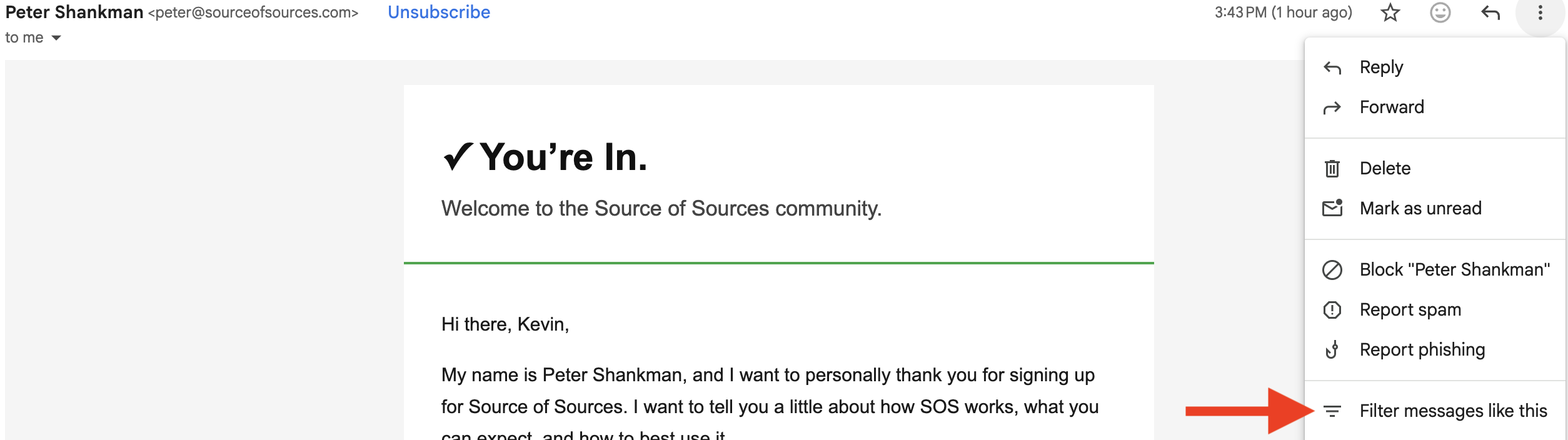
I personally love how much it feels like HARO. Up to 3 times per day, you’ll receive an email with opportunities, like this:

I love the old school lo-fi link building vibe here. As far as websites like HARO, nothing comes closer.
How to Use Source of Sources Successfully
HARO (formerly Connectively) has gained a reputation as a SPAM playground (deservedly so). Black hat SEOs basically overwhelmed the platform with AI generated spam (…no idea who was behind that…).
SoS, under Peter’s guidance, is taking it back to its roots and combating spam through a hands on approach.
Peter says, roughly, “If I hear that you are spamming reporters, you are out.”
So here’s what I recommend.
First, filter emails from SoS, because many will have totally unrelated journalist requests:
Add keywords related to your niche:
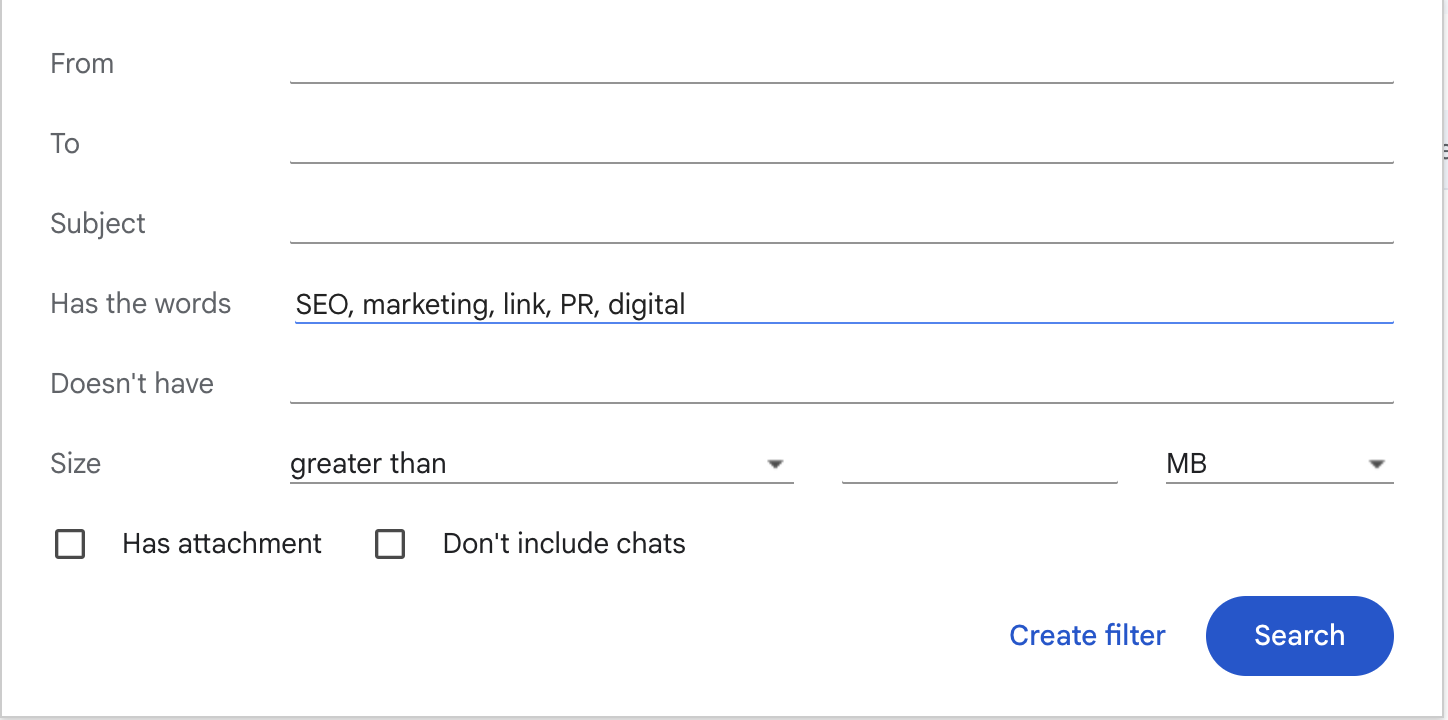
That’s it. You’ll now see emails only with opportunities related to your niche. Obviously, if you have SEO clients in different niches, be sure to add all related key terms here. You don’t want to miss anything.
Please, again, only give relevant responses. You will be banned if you try to game the system.
Who is SoS For?
SoS is a great entry level way to build links and gain media coverage. It’s perfect for small link building budgets, new websites, or supporting a more intense link building campaign. Just keep in mind that this is a free, low volume service that lacks the ultra high authority links (or search features) of other services.
If you need higher volume, better quality, or even enterprise features, skip down to #2 or #7.
Pros and Cons
Pros
- Free
- Legit high authority link opportunities
- Familiar for HARO users
- Proven to work
Cons
- Not as many link opportunities
- Hard to scale
- No interface and no integrations
- No metrics, so you need to research DR and traffic on your own
SoS Pricing
Free!
2. Featured.com

What is Featured.com?
Featured.com is a paid digital PR platform that connects journalists and other media members with subject matter experts who can add expertise to their pieces in exchange for a mention or a link. It’s a much more modern, curated version of HARO that feels more polished and professional. There is a free plan, but you’re limited to 3 answers per month, and that’s not even close to enough.
Featured.com’s dashboard is curated to your niche and expertise. That’s a big upgrade from a low tech mailing list like HARO. Everything feels much more high tech, especially how the dashboard shows only questions relevant to your expertise.
Why Featured.com is a great HARO Alternative
If you like the idea of connecting with publishers like Forbes, INC, and Fortune, and you want to do it from within an enterprise dashboard with alerts, pipelines, and curated questions specifically for you, Featured.com is the HARO alternative for you.
Unlike Help a Reporter Out, Featured.com is a paid service that feels more like an SEO link building tool than a platform for connecting industry experts with journalists. Once you sign up and create a profile, you’ll gain access to dozens or even hundreds of media outlets looking for experts to answer questions in exchange for links.
It has a much more professional feel than HARO, and everything is customized to your particular expertise. More on that in a bit.
How to Use Featured.com
Sign up, and you’ll be brought to a dashboard that looks like this:
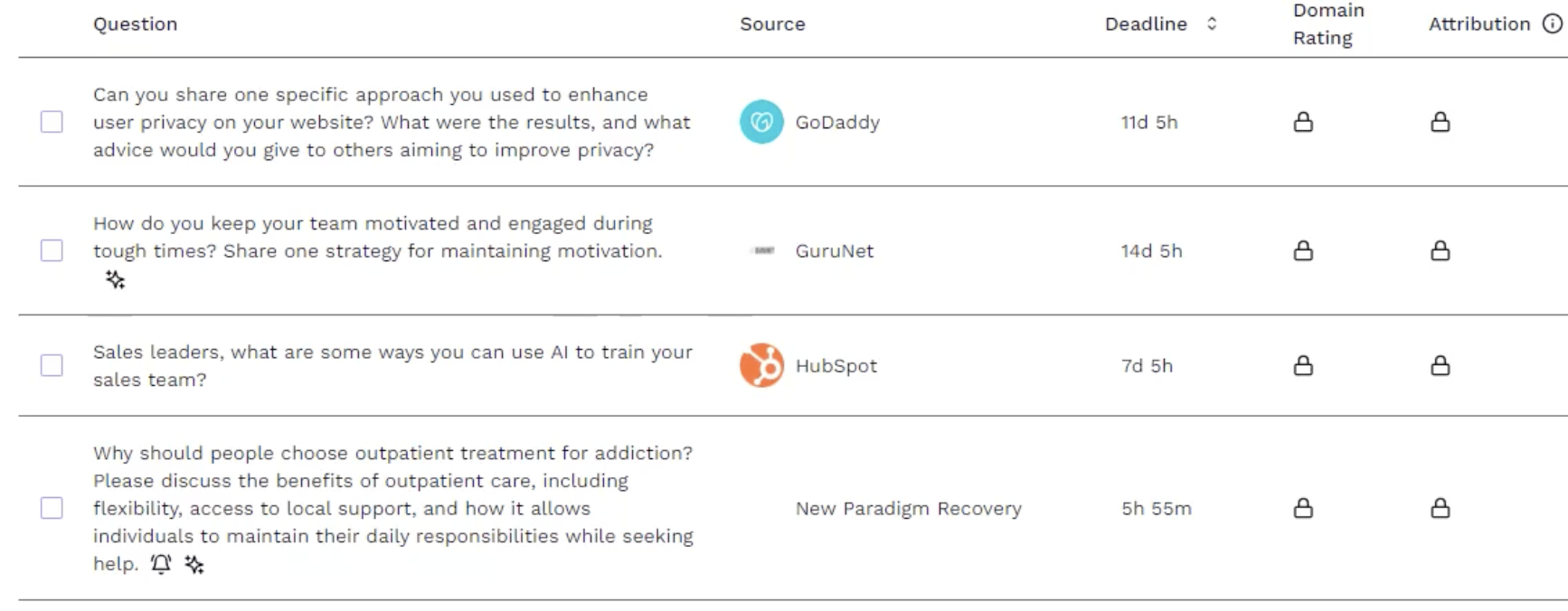
As you can see, authors on established websites use Featured.com to connect with experts and get industry insights for their content.
One of the best things about Featured, in comparison to HARO link building, is that your dash is curated specifically to you. It’s not just a hodgepodge of different reporters looking for quotes.
You can filter the results to fit your expertise, then click on Answer:
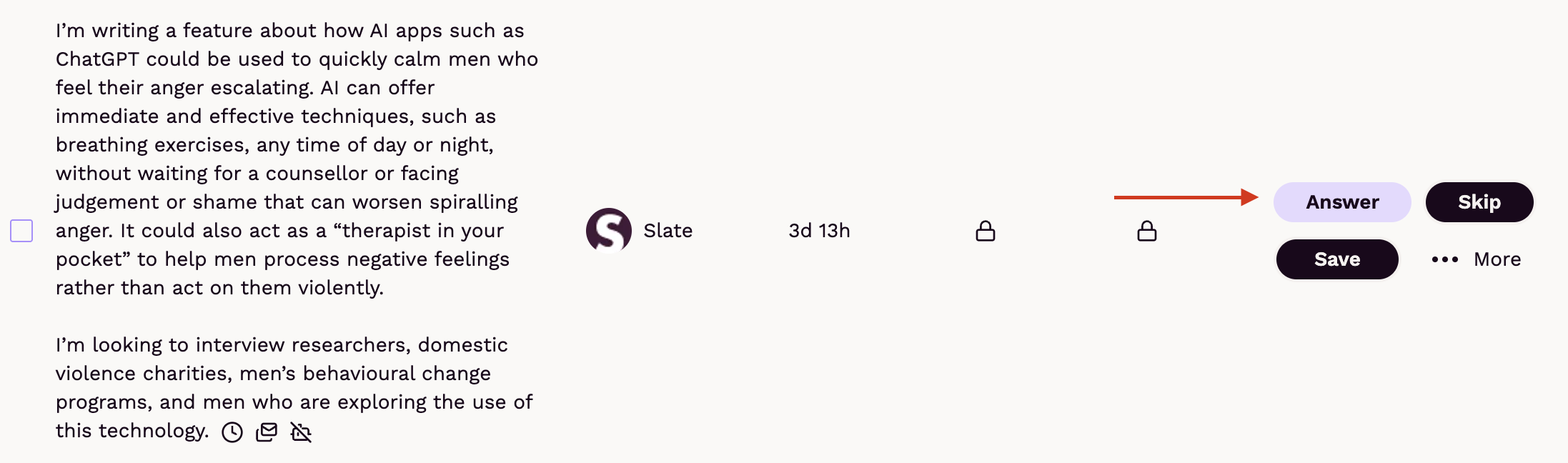
Anger management. That seems like a good topic for me.
Whatever you do, do not just provide an AI slop answer. People are too good at identifying it these days.
Long story short, if you’re a real subject matter expert, Featured.com is basically free editorial links on semi autopilot. It’s not that much work, and you can probably get a VA to do most of it.
Who is Featured.com for?
I recommend Featured.com for high authority, high volume, and enterprise level digital PR and link building. If you’re an SEO working in a tough niche and need high authority, relevant links or media mentions from top tier publications, Featured.com is the best and fastest way to get them. Here’s a good way to think of it: Instead of waiting around to see if a DR 40 niche blog needs a link, Featured connects you directly to DR 70+ media sites so you can build 100% white hat editorial links.
Pros and Cons
Pros
- Access to high authority publishers like Forbes, INC, and Fortune
- Curated dashboard showing only relevant questions
- High volume link building opportunities
- More professional and polished experience than HARO
Cons
- The free plan is useless, and you’ll probably need the $49 plan to get results
- Can feel more like an SEO tool than a real journalist-expert connection
- Relies on you (or a VA) consistently answering questions to see results
Pricing
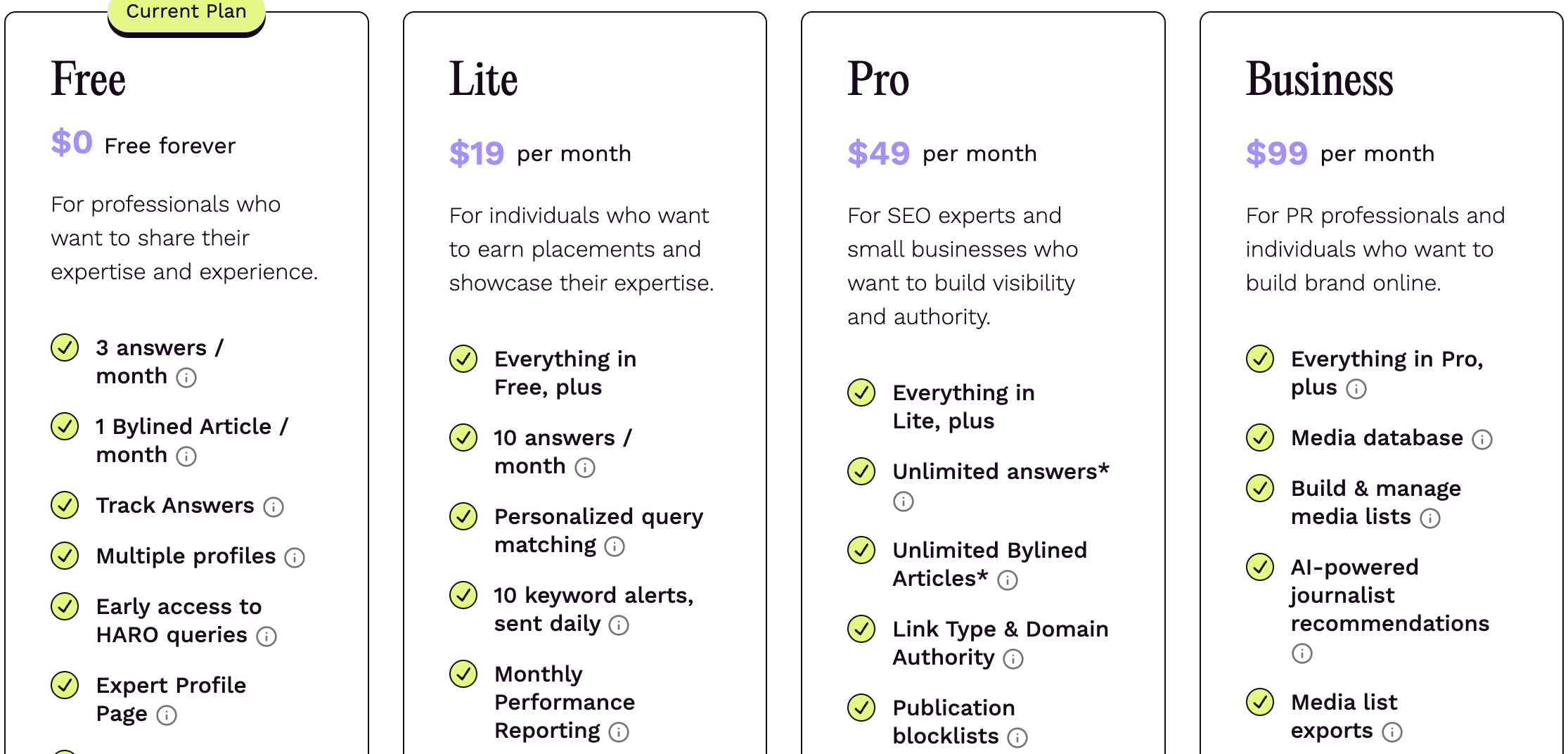
Featured.com’s pricing is fair and also very gradual. It goes from free to $19 to $49, rather than from free to $100+ like some other platforms do. I won’t name names, but it’s QWOTED, and it’s next on this list.
In my experience, you’ll need the $49 plan to see any real results. You need unlimited pitches (answers in this case) to build links. If you’re limited to 10 or fewer answers per month, you’ll build 1-2 links maximum per month…if you’re lucky.
3. QWOTED

What is QWOTED?
QWOTED is a platform that connects subject matter experts with journalists, reporters, and websites to help them gain media exposure. Then, it gives them a powerful suite of tools for pitching and building relationships. Think of it like your PR toolkit. Some examples of those tools include built in messaging, pitch intelligence, and real time keyword alerts. It makes finding opportunities AND sealing the deal much easier (and produces much higher ROI).
What Makes it a Great HARO Alternative
QWOTED is the HARO alternative I recommend if you are a top tier PR specialist in need of curated links in specialized niches like finance, business, and tech. Everything is done from a centralized dashboard that comes with some next level pitching features. And the quality of journalists, sites, and link opportunities is much higher than HARO (hence the high price).
This looks and feels like a high end service. Here are some of its features that you can’t get with HARO:
- A media request dashboard
- Real time alerts and targeting
- Pitch intelligence (that shows competition levels)
- Built in messaging and tracking
- Media database and search
On enterprise pricing plans, you get features for team activity reporting and an admin dashboard. It’s a very bespoke service.
How to Use QWOTED
I, of course, only use PressWhizz for links. But there was a time when I used other platforms for link building.
If I were still using these platforms, here’s how I would use QWOTED to land high authority links.
I’d head over to the dashboard (which looks amazing, by the way):
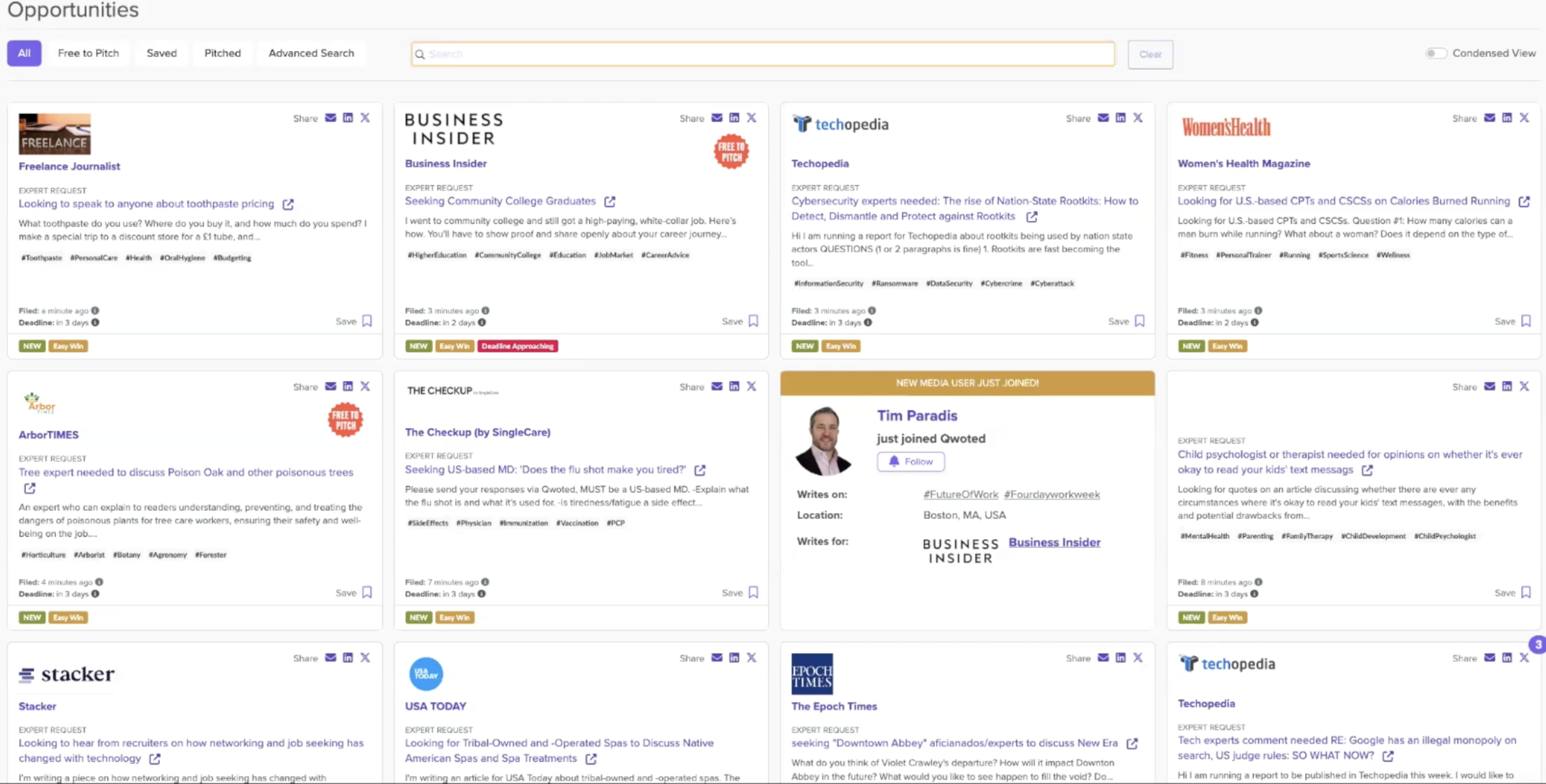
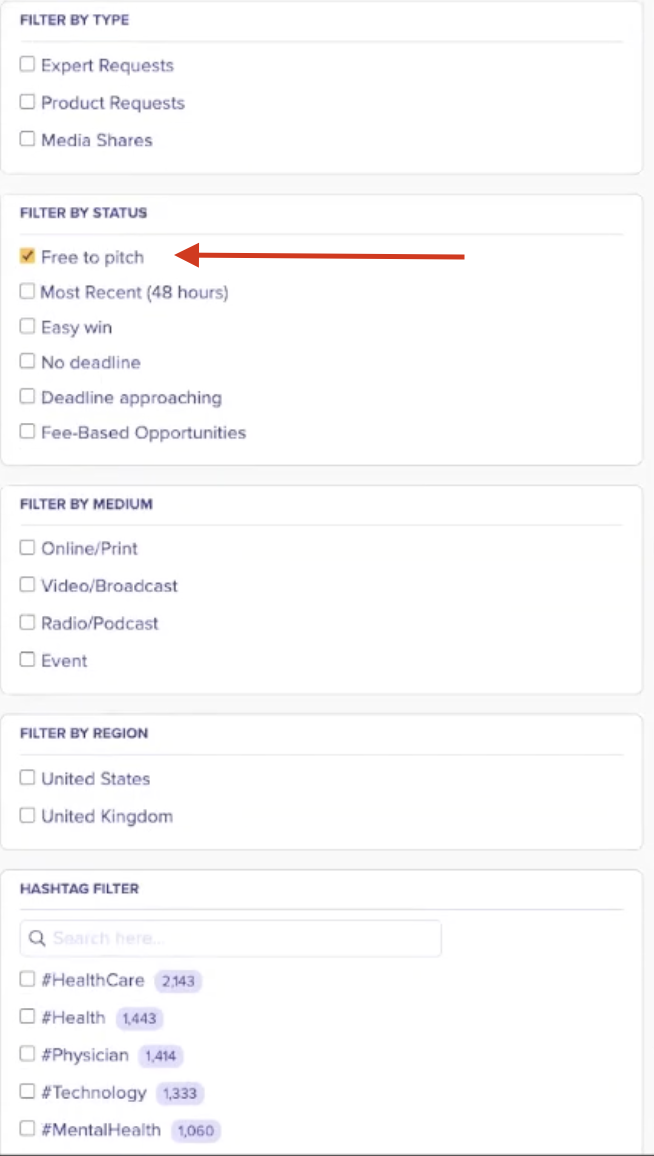
Then click on Advanced Search in the top left, and filter by Free to Pitch:
Then, I’d find something relevant and use Pitch Intelligence to see the level of competition:
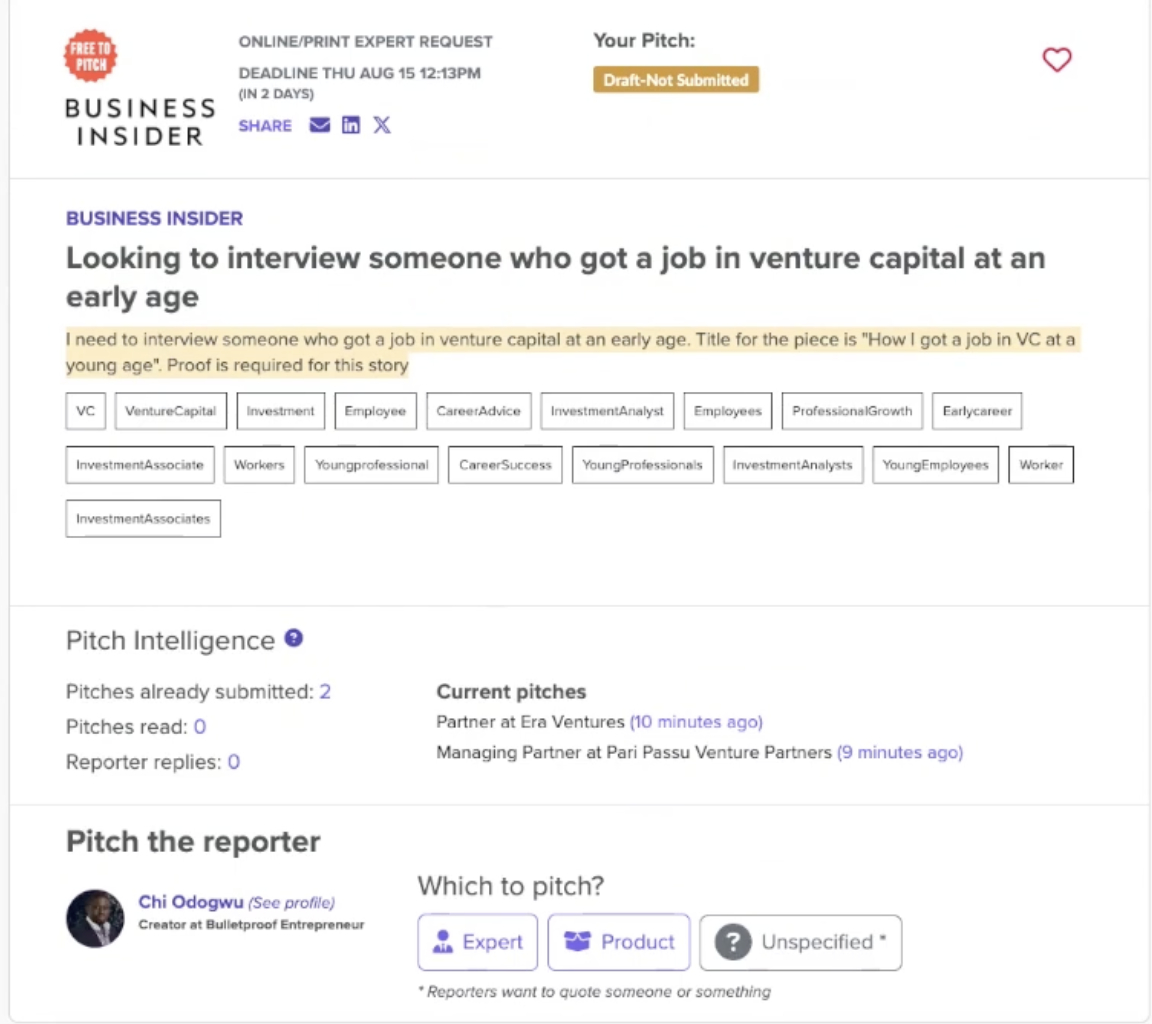
My advice? Be urgent. Get your pitches in early, be contrarian, and have a unique angle on something.
Who is QWOTED for?
I recommend QWOTED for high end digital PR and super niche link building needs. You can niche down using granular filters to find the perfect pitch opportunity, then use its built in tools to build better pitches and land more opportunities.
Pros and Cons
Pros
- Centralized dashboard with advanced pitching tools like built in messaging, tracking, and pitch intelligence
- Higher average quality of journalists, sites, and link opportunities compared to HARO
- Granular filters
- Enterprise features like team activity reporting
Cons
- Expensive pricing puts it out of reach for smaller budgets or solopreneurs
- The free plan is extremely limited and practically unusable
- Overkill if you just need a few casual editorial links here and there
- Steep learning curve
Pricing
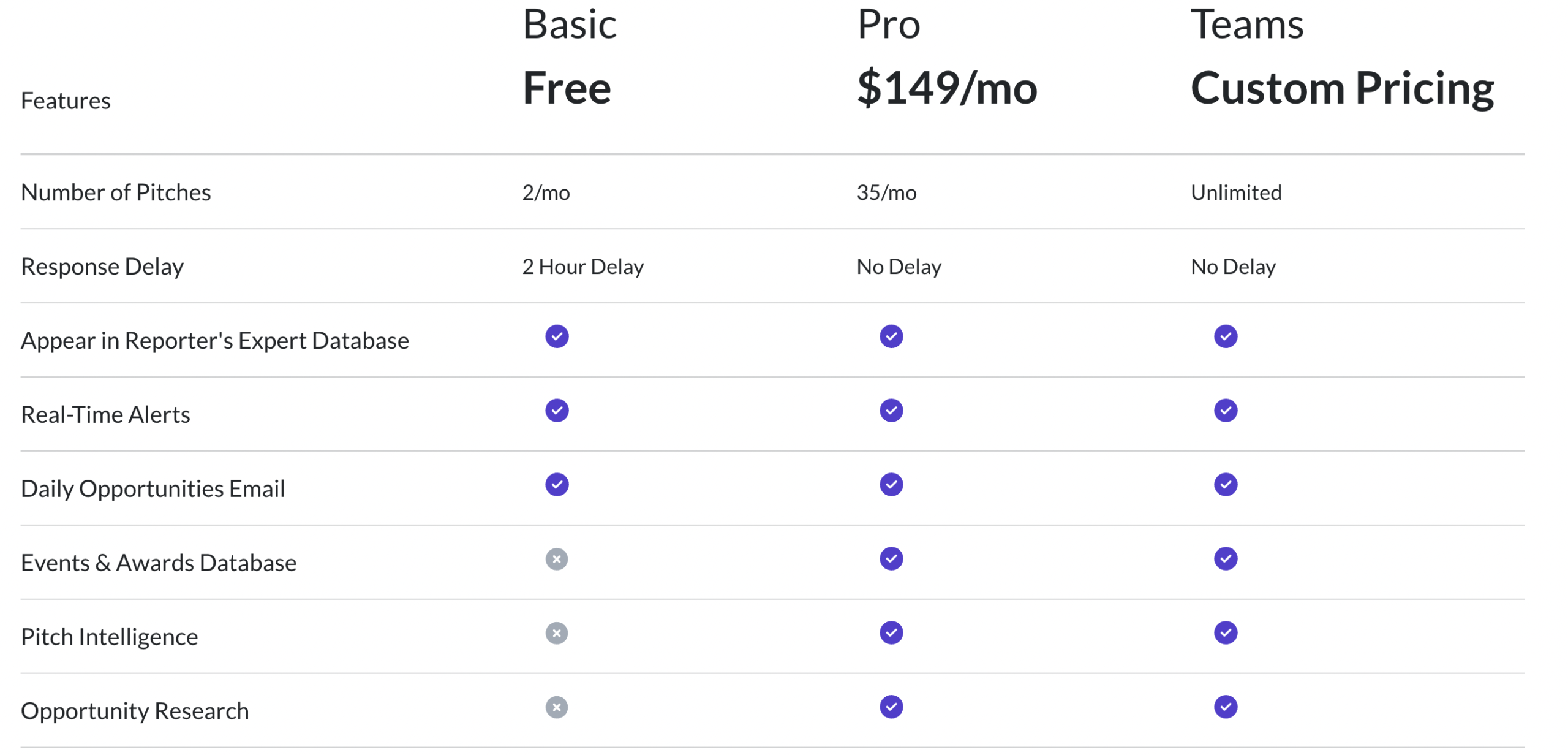
QWOTED ain’t cheap, but considering the value it provides, it shouldn’t be. You get access to top quality publications, pitch intelligence, and built in messaging. One high quality link is worth hundreds or even thousands of dollars. So $149 per month is nothing.
4. Social Media (X, Bluesky, LinkedIn)
What is Social Media Link Building?
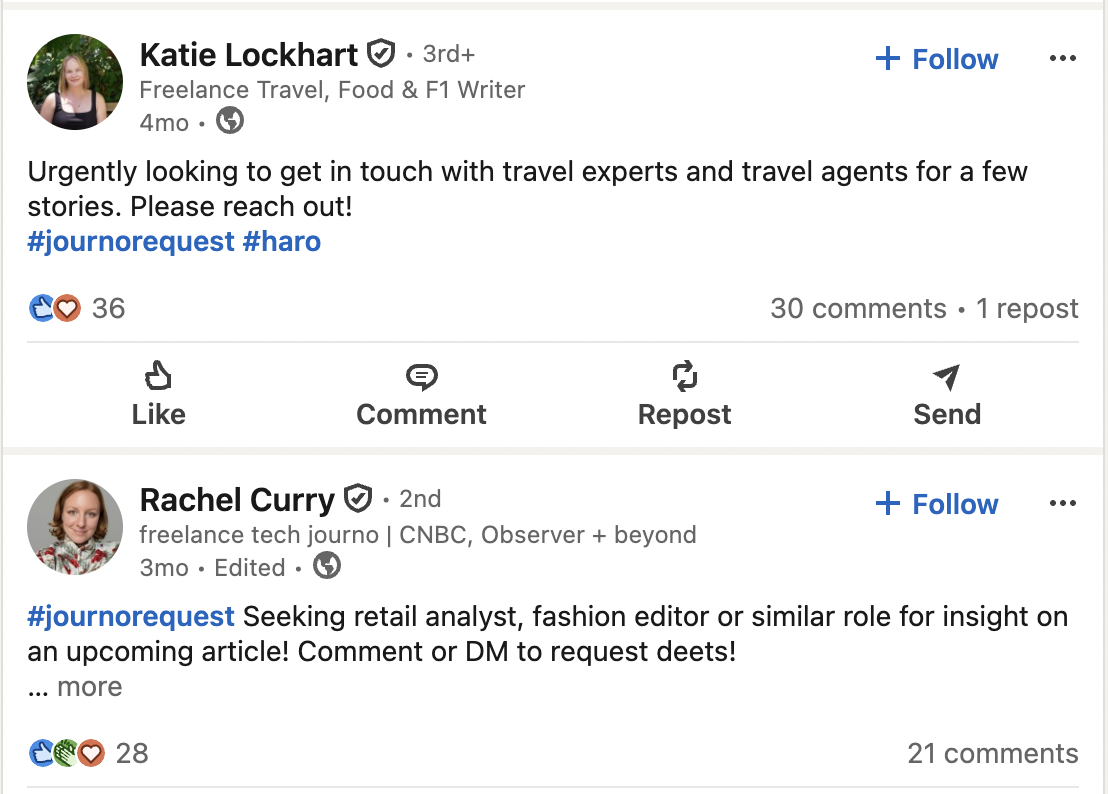
You know what social media is, so I won’t waste your time. But you might not be familiar with building editorial links via social media. You’d be surprised at how often SEOs don’t even know they can get free high authority backlinks for SEO from journalists on X or LinkedIn. I mean, they probably spend half their day on X and LinkedIn anyway.
Journalists use social platforms to connect with subject matter experts every day. They put out a request, you DM them, and if they choose your pitch, you get mentioned.
I hope that all makes sense.
What Makes Social Media a Good HARO Alternative?
Did you know that journalists frequently use social media platforms like X and Bluesky to find subject matter experts to quote (or even interview) in massive numbers? Like thousands and thousands of requests.
Don’t believe me? Just use the hashtag “#journorequest “ on X and see what pops up.
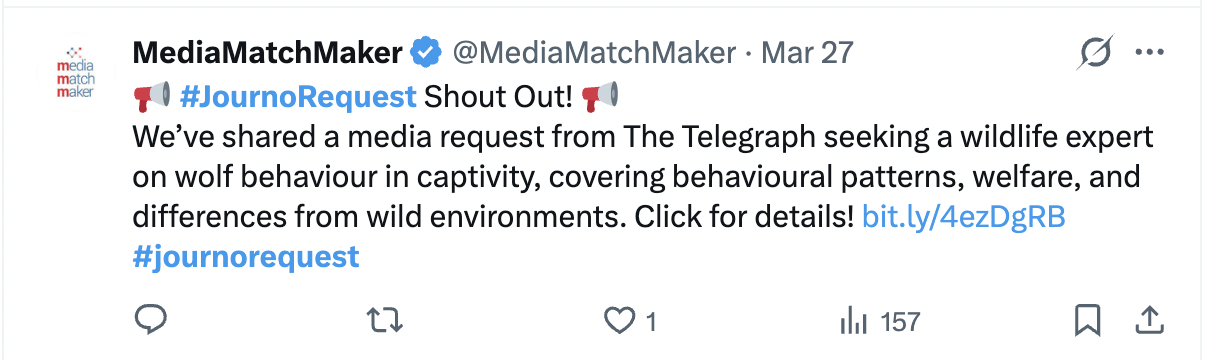
…Just in case you’re a wolf expert looking for a high authority backlink…
I recommend tracking hashtags and monitoring journalist activity on platforms like:
- X (Twitter)
- Bluesky
- Facebook (get in local groups and monitor community trends to connect with community newspaper employees)
My favorite thing about using social media as an alternative to the typical Help a Reporter Out system is that you are in total control. No waiting. No begging. No checking emails every day for a newsletter. Your team monitors socials, a request comes up that fits your speciality, and you DM the journalist.
I especially recommend this for influencers, consultants, and anyone with a decent social following in their industry. When a journalist sees you have a huge following and some clout, you have a much better opportunity to score a link.
How to Use Social Media as a HARO Alternative
The best ways to use social media sites as a HARO alternative are to actively search for editorial link opportunities, set up hashtag monitoring, and join local groups on Facebook.
The best and easiest way to get started is to manually search Twitter…errr…X…for the following most popular hashtags:
- #journorequest
- #PRrequest
- #Mediarequest
- #bloggerrequest
- #FindASrc
Here’s a great opportunity for any UK based SEOs with clients in the parenting or mommy blogger niche:
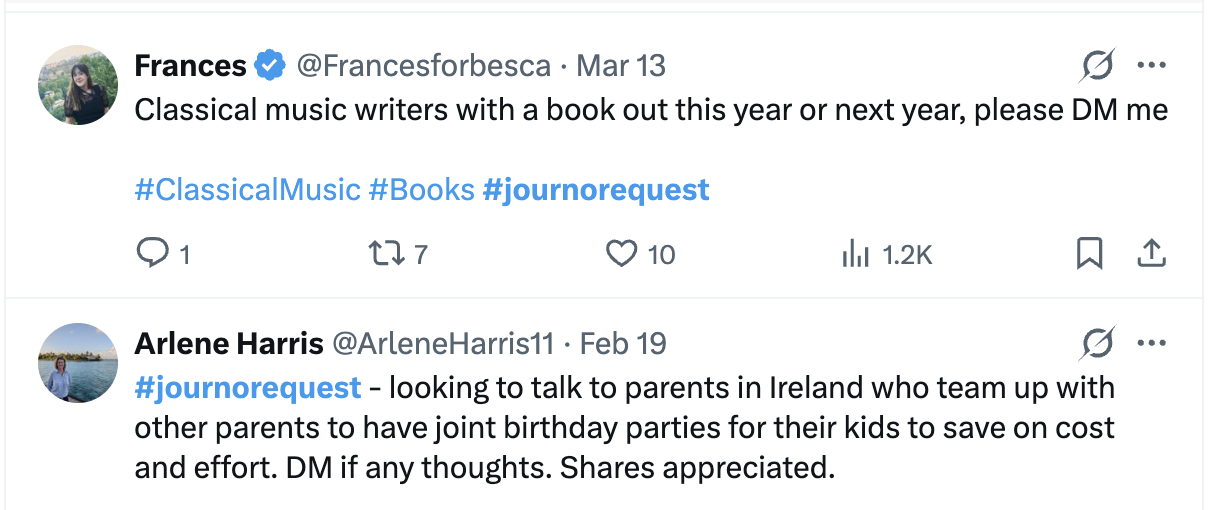
Arlene is a journalist with placements in the Irish Times and other editorial publications:

By the way, the Irish Times is a DR 89 website with nearly 800k monthly visitors. Hell, I might reach out to her and pretend to be a mommy blogger to get a link.
All you have to do is put in #journorequest and add your niche to get even more targeted results. Here’s what I found when I added “marketing”:
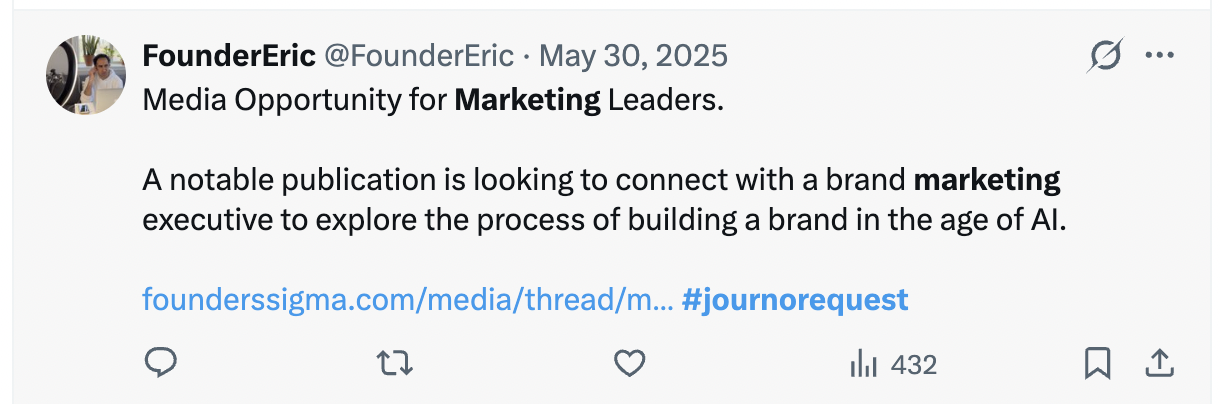
Pro Tip: Journalists are on tight deadlines AND inundated with pitches. Keep your eyes on important hashtags 24/7 and jump at any opportunity. I suggest setting up a hashtag monitoring tool like Sprout Social or Keyhole to get notifications whenever someone uses those hashtags.
Who is Social Media Outreach Best for?
Using social media is an excellent way to build links for everyone, in my opinion. However, it works best for the following cases:
- You’re an Influencer: Journalists are more likely to accept quotes from real experts with a following rather than some random Joe who claims to be an expert.
- You’re on a Budget: Social media only costs time and elbow grease. I mean, other platforms are like $10 per month, so it’s not that bad either. But if you want free HARO type links, social platforms are great.
Pros and Cons
Pros
- Completely free
- You’re in total control
- Works especially well if you already have a social following or industry clout
- Opportunities across multiple platforms, including X, Bluesky, LinkedIn, and Facebook
Cons
- Requires constant monitoring of hashtags and journalist activity to catch opportunities in time
- Journalists are on tight deadlines and inundated with pitches, so competition is fierce
- Hard to scale without investing in a hashtag monitoring tool like Sprout Social or Keyhole
- No structured dashboard or tracking, so you’re managing everything manually
Pricing
Free, but different platforms have paid upgrades.
5. Source Bottle

Source Bottle is a matchmaking service that connects expert sources to journalists, bloggers, and other media. As a source, you’ll receive daily emails with opportunities for pitching your expertise to be featured in a news story.
Journalists post “callouts” looking for experts to interview or sources of information, and if you get chosen, you’ll get a link. If you’ve ever used HARO before, you know the drill. I don’t have to explain how that part works.
Why is Source Bottle a Great HARO Alternative?
Source Bottle is a solid alternative to HARO, mainly because it’s more curated and easier to connect with journalists.
You can “subscribe” to different keywords (up to 10 on the free plan), so you aren’t inundated with random “we need a French wolf grooming expert” pitches that literally nobody on Earth is qualified for. There are also pretty sick giveaways where you get sample products and vouchers…I’m assuming that’s for you to test them and say something nice.
Also, for a fee, you can be higher up in the expert listings or featured on the home page so journalists see your profile first.
How to Use Source Bottle
To be 100% honest, I don’t use Source Bottle to get HARO links, but I did a ton of research and asked a few people who do use it, and they all said roughly the same thing: Most of the sites are small, and the free plan isn’t really worth it.
So, I recommend powering up to one of the paid plans, setting up your expert profile, and subscribing to keywords related to your niche. On higher tier plans, the platform will recommend you to journalists when they place “callouts” for expert sources.
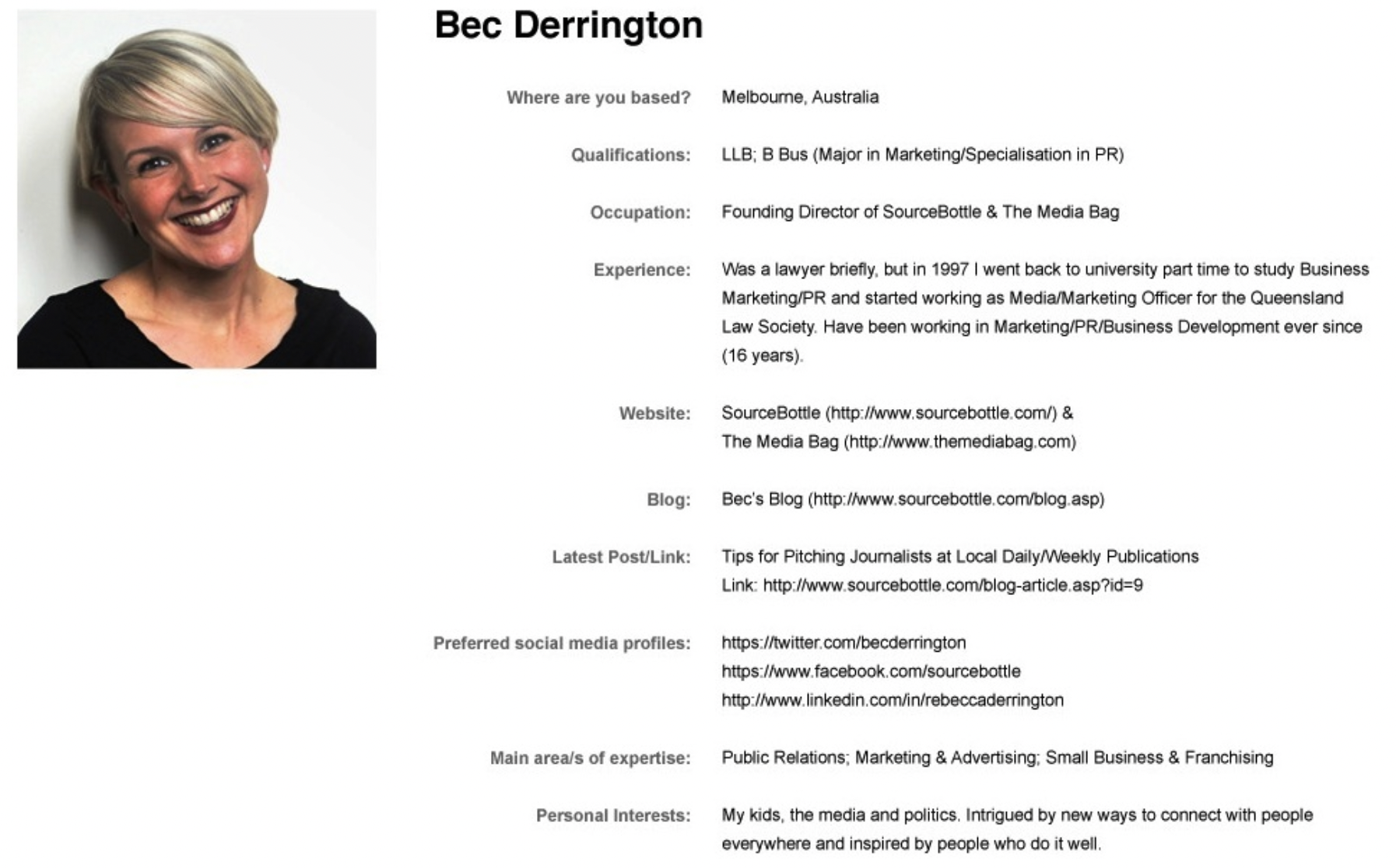
Here’s what an expert profile looks like (this is the founder’s profile):
Who is Source Bottle for?
Source Bottle is a good HARO alternative for low level link building or as a supplement to your current link building efforts. For the price ($65 for the best results), it’s a bit expensive. You can get a Featured.com Pro subscription for less, and a Business subscription for only about $30 more, so I just don’t think the value is there. Still, it doesn’t hurt to set up a free plan and try to build some extra free links.
Pros and Cons
Pros
- You can subscribe to up to 10 keywords on the free plan
- Paid plans let you get featured higher
- Daily emails with journalist “callouts”
- Includes perks like product samples and vouchers for giveaways
Cons
- Mostly low authority sites
- The free plan isn’t really worth it
- It’s overpriced compared to Featured.com’s Pro plan
- Limited value when you could spend a bit more and get a much better platform like Featured
Pricing
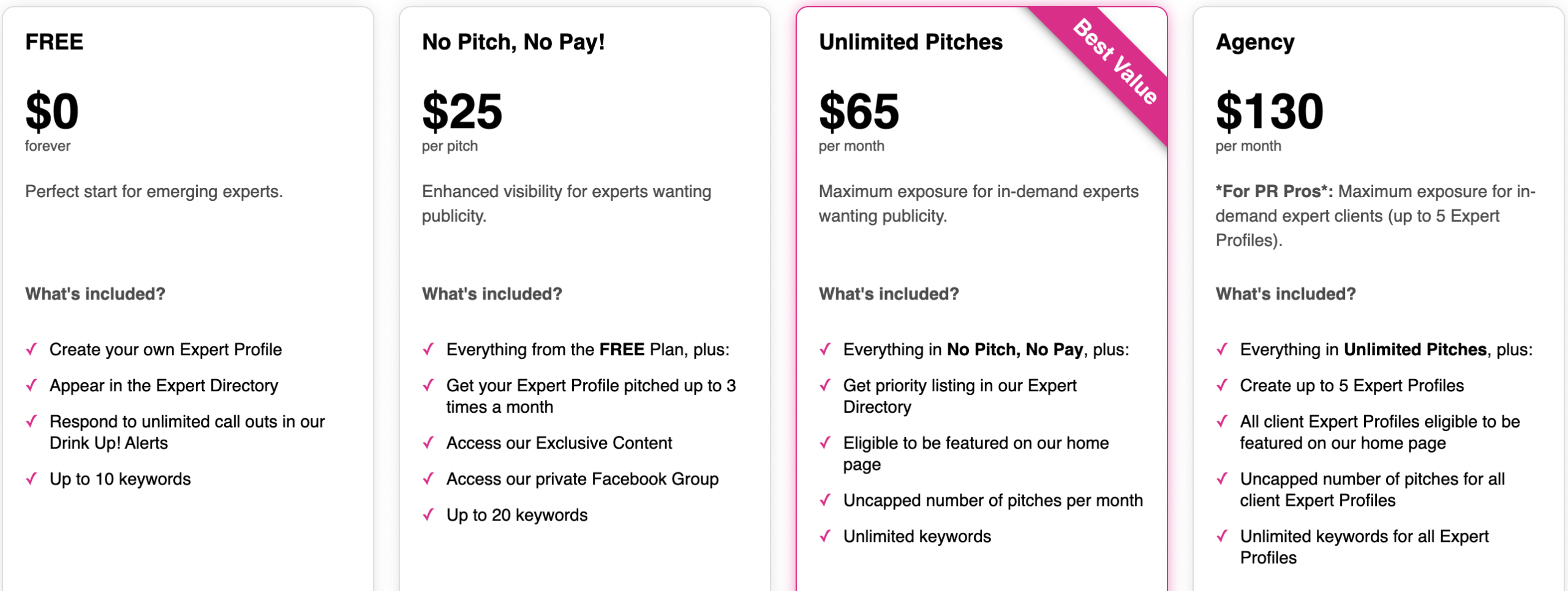
Like I said before, Source Bottle is a bit overpriced considering the value. You’ll need the $65 plan to do anything meaningful. Try it for free and see if you like it, then evaluate from there.
6. MentionMatch (Help a B2B Writer)

What is MentionMatch?
MentionMatch is a platform for connecting B2B writers with expert sources. It’s basically HARO but strictly for B2B niches like AI, manufacturing, entrepreneurship, sales, marketing, and similar niches. You sign up as a source, see relevant requests, and, if you get chosen, you get cited on a high authority website in your niche.
If you’re in industries like tech, SaaS, or marketing, MentionMatch is a cheat code for getting DR 70+ links.
Why is MentionMatch a Great HARO Alternative?
If you’ve ever used HARO, you know how much of a grind it is. It’s absolutely mind melting at times. AI spam is rampant, and it covers every niche imaginable, so it’s difficult to find a high quality, relevant opportunity.
Help a B2B Writer (now MentionMatch) is a smaller, more niche platform specifically for B2B with less spam and higher average quality opportunities.
The platform is absolutely ruthless about weeding out AI spam replies (thankfully). Not to mention the platform is totally free.
How to Use MentionMatch
MentionMatch is pretty straightforward. You sign up as an expert source and add your credentials. It’s a bit odd, because you have to do it through an email they send to your inbox:
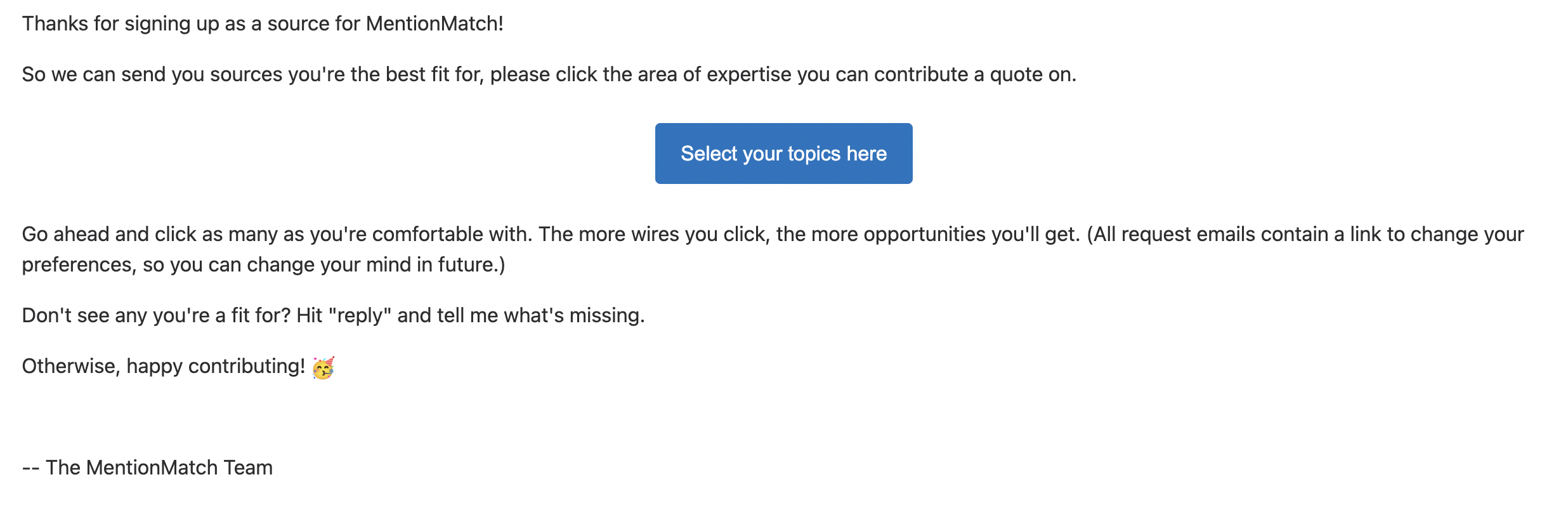
Then, you select which “wires” you want to subscribe to, which is essentially which skills/experience you have:

That’s it! You’ll now receive emails related to that niche and can pitch away.
Please keep in mind that MentionMatch is VERY strict on AI spam, and if you’re caught sending garbage, you’ll be removed.
Here are some tips for a good pitch:
- Write it yourself
- Don’t follow a template
- Purposely vary sentence and paragraph lengths
- Include unique data
- Include a contrarian opinion
- Include a personal anecdote or experience
Here’s what a good pitch looks like, according to the company:

Who is MentionMatch for?
I think it’s pretty obvious, but you’ll get the most out of MentionMatch if you’re in B2B niches like SaaS, manufacturing, or marketing. I know people who’ve gotten featured in HubSpot and Semrush through MentionMatch. I also highly recommend it for solopreneur consultants trying to grow their brand.
Pros and Cons
Pros
- Completely free
- Strictly B2B focused, so opportunities are highly relevant if you’re in tech, SaaS, or marketing
- Platform is ruthless about weeding out AI spam
- Can land features on high authority sites like HubSpot and Semrush
Cons
- Only useful if you’re in B2B niches
- Very strict on AI generated responses
- A smaller platform means fewer opportunities compared to bigger alternatives
- Onboarding is a bit clunky with the email signup process for selecting your wires
Pricing
Free!
7. JournoFinder
What is JournoFinder?
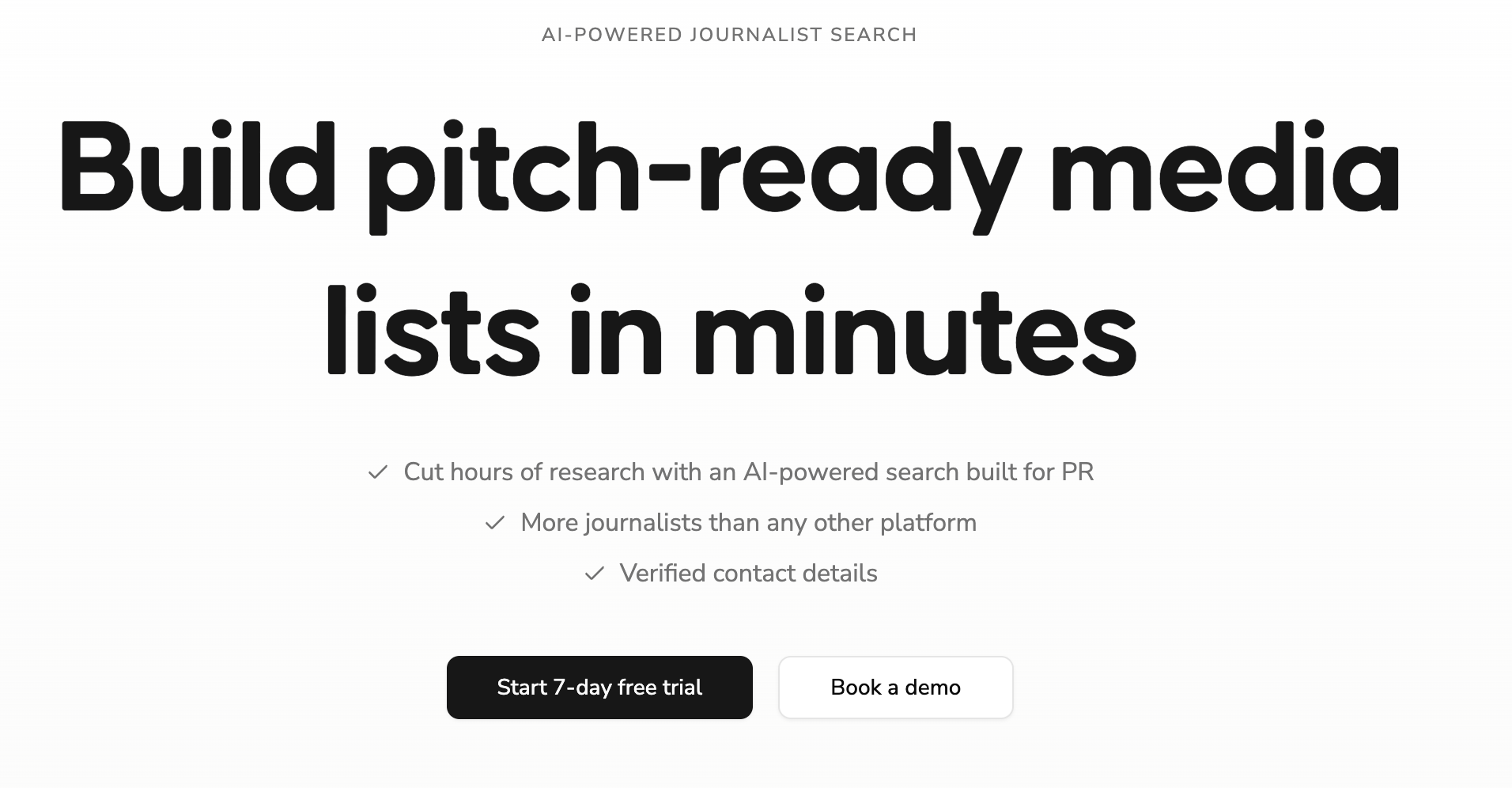
JournoFinder is an AI powered media database built to connect SEOs, marketers, link builders, and PR professionals with media opportunities based on journalists’ most recent articles. For example, if you want to write a PR piece about a lawyer in Los Angeles, you could search the database to find a journalist in the legal niche. Or, if you want to write a sponsored post in a media publication like Forbes, you can find a Forbes contributor and contact them directly.
It is by far the largest journalist database in existence (reportedly 1 million + contacts), and it lets you use granular search filters to find the perfect journalist for your industry. I love that you can search by country, keyword, domain authority, and publication date.
It’s way better than doing things manually and far more targeted than the Help a Reporter Out method.
Why JournoFinder is a Great Alternative to HARO
HARO is a volume game for journalists to find experts for quotes (and you are competing with thousands of other SEOs like me). JournoFinder is more for high end “legit” digital PR, where you find journalists to cover a story idea that you have.
The biggest advantage JournoFinder has over HARO is the sheer size and scope of the database.
You gain direct access to over a million potential link opportunities just by signing up, and you don’t have to wait for them to come to you. No checking your inbox or sitting around waiting for a good link opportunity. You want a guest post on a high authority site? Reach out. Need to contact them via social media to build a broken link? Done.
And, remember what I said about monitoring social media? They’ve got that feature built in too:
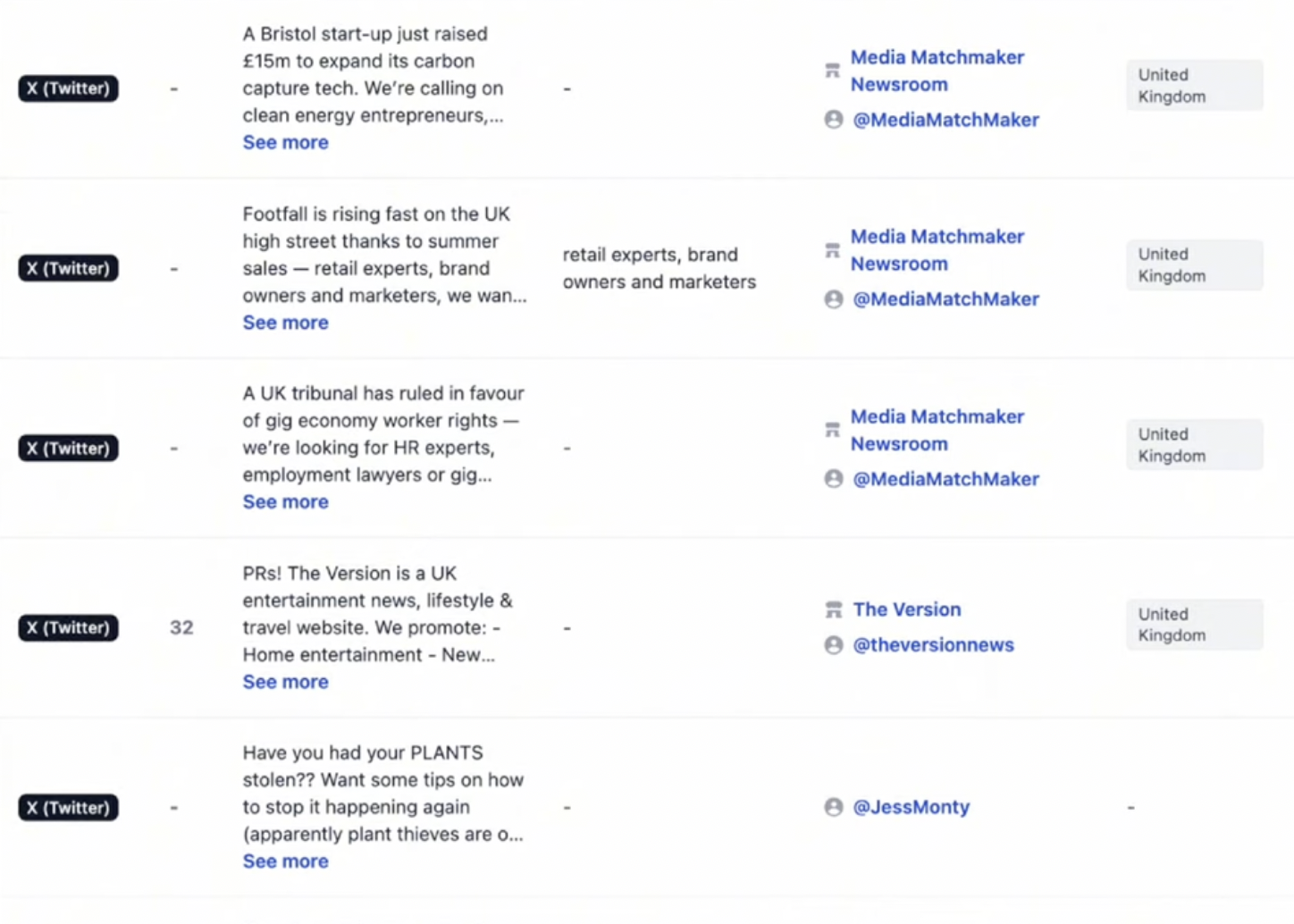
No more endless scrolling or waiting around. Just actionable leads, fast.
How to Use JournoFinder
My best tip for finding highly relevant journalists open to writing pieces for you is to do a deep search of their database using a keyword related to your niche. Here’s an example of a search I ran using tech as the niche:
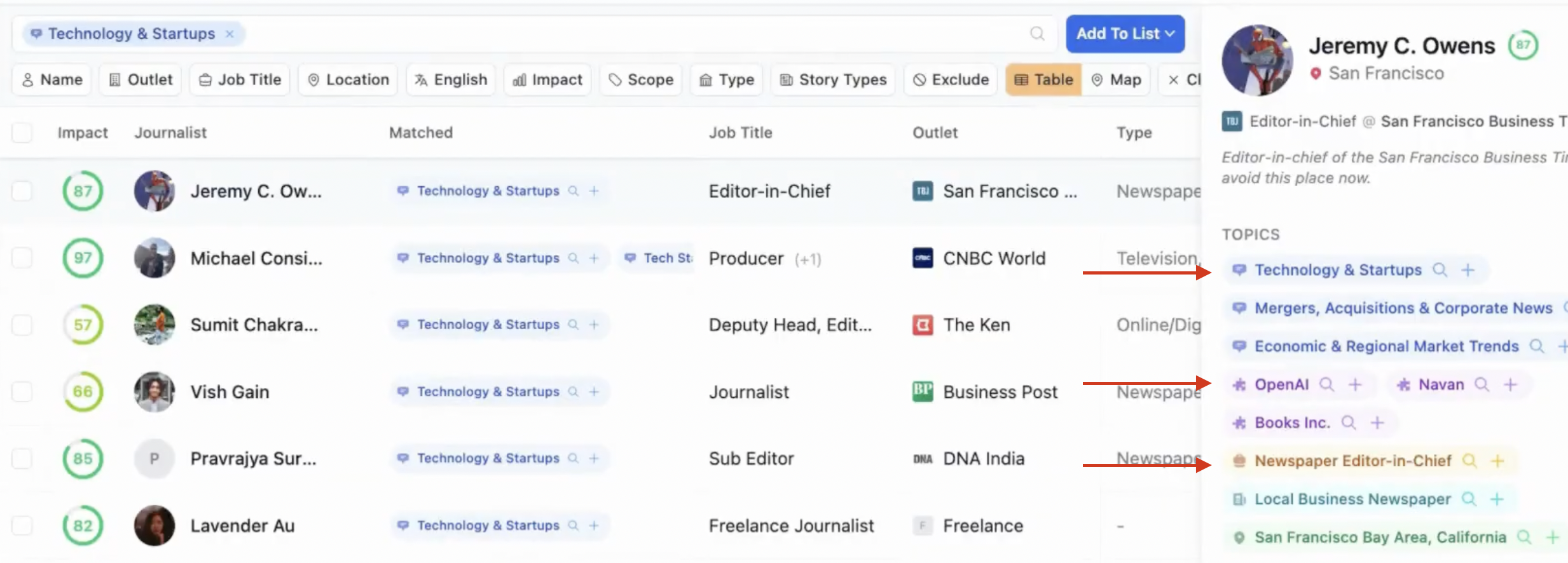
On the right, you can see different colored “pills” (their name, not mine. Hate it). These denote what they write about, which entities they’ve used, and what their role is, among other information.
I’d get as granular as possible with your search to find the ideal journalist to cover your story. You can even throw the URL of their publication into Ahrefs Site Explorer to get the domain rating and traffic.
Here’s a cool hack for local coverage. As you can see in the following screenshot, you can even filter down to the type of journalism work they do, like television:
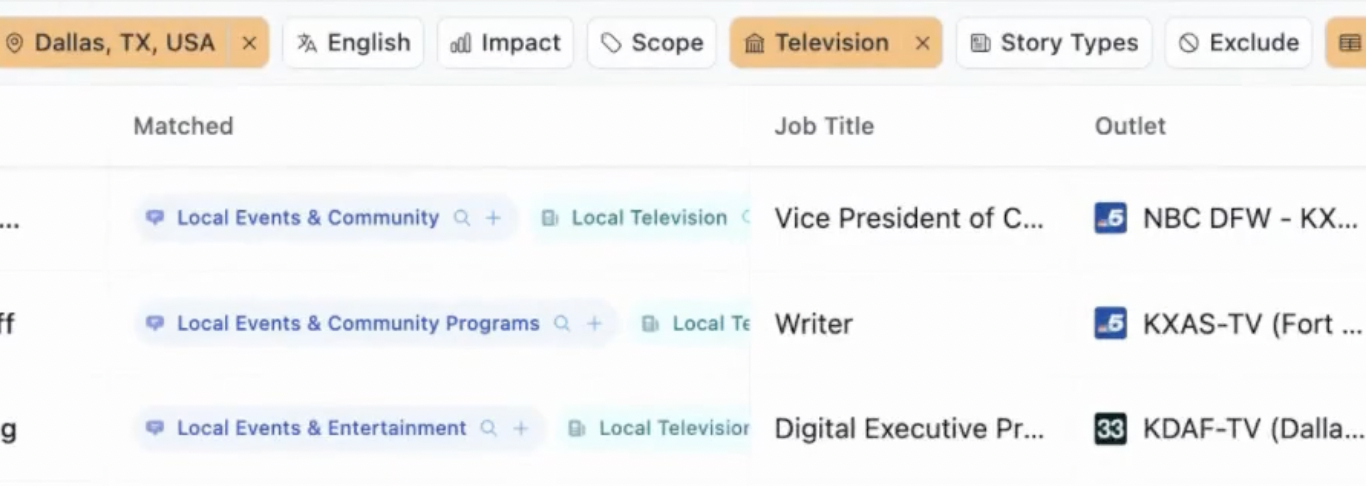
Imagine you’re doing local SEO for an event or service provider. You could easily find high authority link opportunities with local media networks.
Who is JournoFinder For?
I recommend JournoFinder for high end link building and digital PR firms doing editorial link building at scale.
Pros and Cons
Pros
- Massive database of over 1 million journalist contacts
- Granular search filters by country, keyword, domain authority, and publication date
- Built in social media monitoring
- You don’t have to wait for journalists to come to you, just search and reach out directly
Cons
- Geared toward high end digital PR, so it’s overkill for casual or small scale link building
- Requires you to have a compelling story idea or pitch, not just expertise to offer
- You still need to manually check domain rating or domain authority and traffic in tools like Ahrefs
Pricing
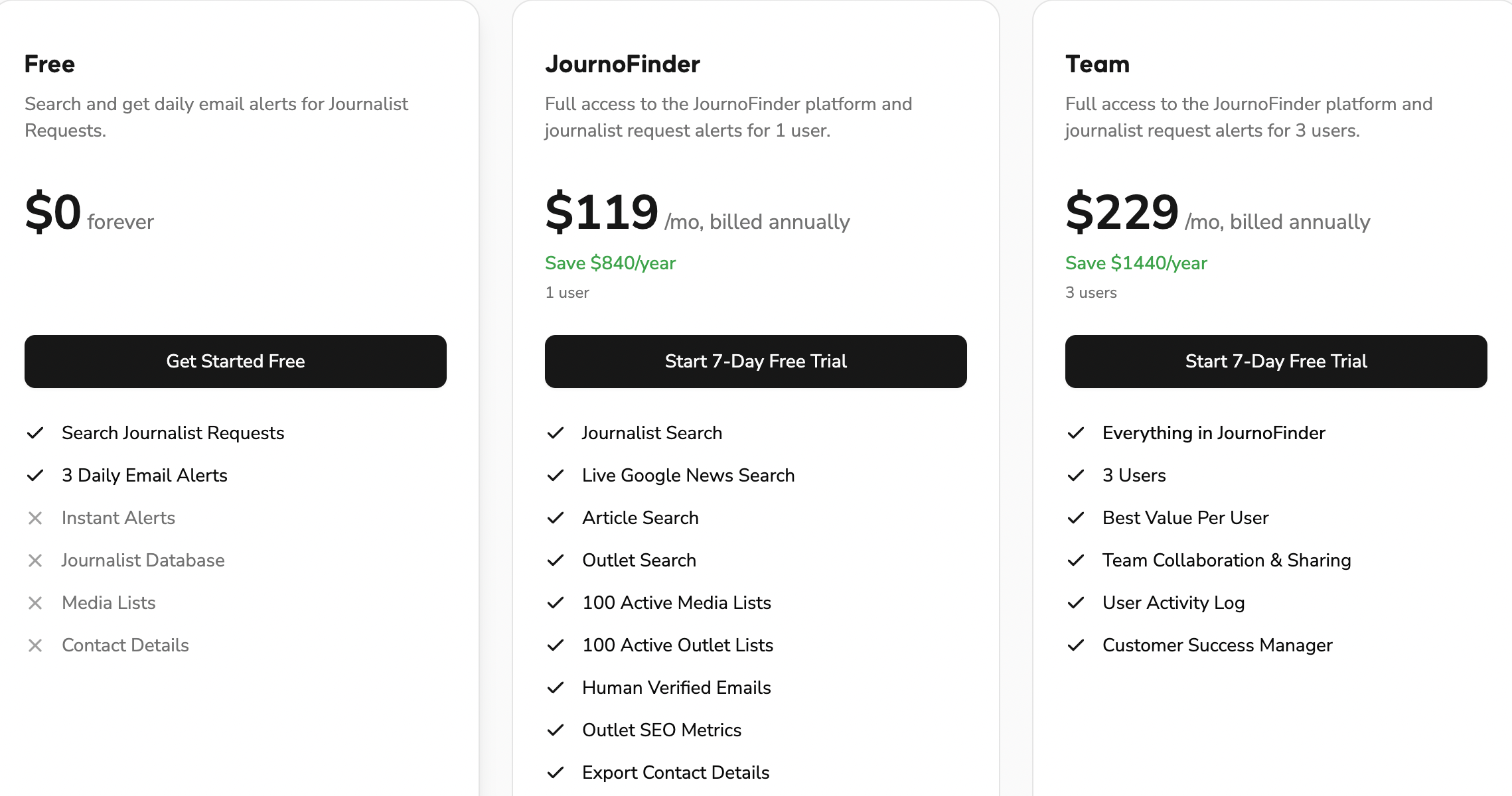
JournoFinder is a premium, enterprise level PR service, so don’t let the price scare you. The level of value you get is mental. If you’re a PR firm, this price is pennies. Again, think of the value of just one editorial link on a high authority site. It’s most likely hundreds or even $1,000+ dollars. You need to spend money to make money.
Bonus – HARO (Do You Even Need an Alternative?)
As you may know, HARO is back, so you might not even need an alternative anymore. If you’re familiar with the old HARO and want to use it again for nostalgia purposes, I don’t blame you. It’s not that good, though. I feel like competitors have completely overtaken it.
We’ve tried the new version, and it’s basically the same platform SEOs fell in love with years ago, just with better spam filters and a cleaner experience. If you used the original HARO back in the day, you already know how powerful it was for earning high authority backlinks from real publications.
Here’s the quick backstory.
Cision rebranded HARO to “Connectively” in 2024, added paywalls and clunky login dashboards, and stripped out the simple email based pitching that made the platform work in the first place (hence why we all left and trashed it).
Thankfully, in 2024, they shut it down.
Then, in April 2025, Featured.com swooped in, acquired the platform from Cision, and relaunched it as the original email based model I used to love back in the day. It’s free again for both sources and journalists, which is how it should have stayed.
The biggest upgrade is the spam filter. Anyone who used the old HARO knows it was drowning in garbage pitches and AI generated slop that made it dang near unusable.
The new version uses AI content detection, LinkedIn profile verification, and image analysis to catch fake headshots. Anyone caught breaking the rules is banned for life (their words…not mine).
Everything else is pretty much the same. You sign up, get three emails per day packed with journalist queries across different categories, and pitch the ones that match your expertise. If a journalist likes your response, you get quoted in their article and usually pick up a backlink from the publication.
How to Choose the Right HARO Alternative?
I’ll just leave you with a few tips for choosing the best HARO alternative for you. I understand that it can be hard to choose when there are dozens of platforms all claiming to be the best.
My advice is to first decide on your budget and then on your specific link building needs. Those are the two most important factors. Everything else doesn’t really matter.
Let me break them both down here:
- Budget: If you’re tight on money, stick with a free option like SoS or MentionMatch. If you’re going to do link building the right way, you should have around $100 a month to spend on a platform.
- Link Needs: Are you a digital PR firm trying to get Forbes links, or will any DR 40 link do? Are you in a specialized niche like B2B sales, or just need mommy blogger links? If you need specialized links, then you need MentionMatch, Featured, or QWOTED. Do you need guest posts or press releases? If you’re more flexible, socials, SoS, or the OG HARO will do just fine. Read my complete guide on the topic if you aren’t sure how many links you need. And, by the way, if you’re building backlinks at volume, I highly suggest you read my guide on backlink management.
Final Thoughts
As someone who personally used HARO (and loved it) for more than a decade, I’m sad to see its current state of affairs.
Gone are the glory days of 2015 when anyone could land a DR 70+ Forbes mention with 5 minutes of work and then share it on social media so everyone thought they were the absolute boss.
There’s really nothing to be sad about, though. Forget the sentimentality and crying over your favorite website no longer being viable. That’s life.
HARO is overrun by AI spam, and it’s nearly impossible to compete with massive PR firms who game the system. You’re much better off with a smaller, more curated alternative. You could easily build high DR, relevant backlinks on real media publications just using social media or free alternatives like SoS.
My advice? Stop crying, and start beating other SEOs by using better alternatives to Help a Reporter Out. If you’re on a budget, go with SoS. If you’re a high end SEO working with niche clients, QWOTED or MentionMatch are your best choice. And for PR firms doing enterprise link building, JournoFinder is my recommendation.
Whatever you choose, I wish you luck. As always, happy link building.